
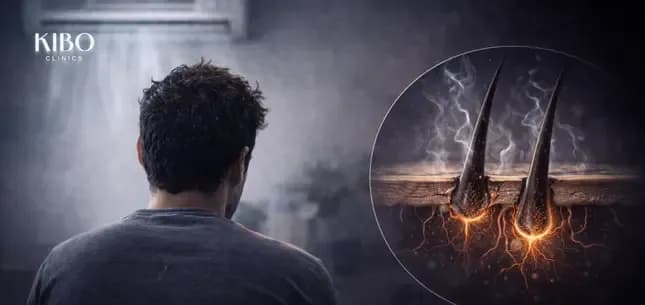
Air conditioning is not proven to cause follicular hair loss or permanent baldness. However, air-conditioned rooms can lower indoor humidity, and human hair fibres change their water content and mechanical behaviour as humidity changes. In susceptible hair, especially bleached, heat-damaged or naturally fragile hair, a dry environment may worsen roughness, static and breakage. If hair is shedding from the root, the cause should not automatically be blamed on AC.
That difference matters because hair breakage and true hair loss need different solutions. Conditioner, gentler styling and less friction can help protect a dry hair shaft. They will not treat a receding hairline, widening part, alopecia areata, telogen effluvium or a nutritional or hormonal cause of shedding.
If you notice more hair after a full day in office AC, first ask what you are actually seeing: short snapped strands, full-length shed hairs, or a gradual reduction in density. That is a better starting point than assuming the temperature setting itself is damaging the follicles.
Does AC Actually Cause Hair Fall?
The strongest evidence supports an indirect effect on the hair fibre, not a direct effect on the follicle. Hair is a keratin fibre whose tensile behaviour depends partly on water content and environmental humidity. When relative humidity changes, stiffness, extensibility and other mechanical properties change too. This makes it reasonable to say that persistently dry indoor air can affect how hair feels and behaves, but it does not prove that AC triggers biological hair shedding.
The more accurate question is therefore: can dry indoor air make vulnerable hair more likely to break? Yes, that is biologically plausible and consistent with hair-fibre research. The effect is likely to be larger when hair is already compromised by bleaching, repeated straightening, high heat, tight styling or rough grooming.
How Does Dry Indoor Air Affect Hair Elasticity?
Hair continuously exchanges water with the surrounding air. Water acts as a plasticising molecule within keratin, so humidity changes the fibre's mechanical behaviour. Research on human hair shows that tensile strength and elasticity-related properties are humidity dependent. In lower-moisture conditions, hair can become stiffer and less forgiving under bending, brushing or tension.
This does not mean that a few hours in AC will suddenly weaken healthy hair. The practical risk is cumulative mechanical stress on hair that is already dry or damaged. If you want a deeper explanation of how flexibility protects the strand, see hair elasticity and stress resistance.
| Factor | What may happen | What the evidence does not prove |
|---|---|---|
| Low indoor humidity | Changes hair-fibre water content and mechanical behaviour | That AC directly causes follicular hair loss |
| Already damaged hair | May feel rougher, more static or more prone to snapping | A universal recovery timeline for every hair type |
| Dry or sensitive scalp | May feel tighter, itchier or flakier in some people | That all dandruff is caused by dry air |
| Direct cool airflow | May worsen the sensation of dryness for some people | That scalp blood flow is reduced enough to cause baldness |
Hair Breakage vs Hair Shedding: How Can You Tell the Difference?
A common reason AC gets blamed for hair loss is that broken strands and shed hairs both end up on clothing, pillows or the floor. The pattern around them is more useful than inspecting one strand.
| What you notice | More consistent with breakage | More consistent with root-level hair loss |
|---|---|---|
| Length of fallen hair | Short and uneven pieces | Often full-length strands |
| Hair appearance | Split ends, roughness, frizz, snapping | Density loss may occur even when shafts look normal |
| Where change is visible | Uneven lengths through the hair | Widening part, receding hairline, circular patches or diffuse density loss |
| Main next step | Reduce friction and improve conditioning | Identify the follicular or medical cause |
For a fuller diagnostic comparison, see the guide to hair breakage causes and treatments. If density is changing, the broader guide to hair loss types and symptoms explains when thinning is more likely to be follicular.
Who Is More Likely to Notice Dryness or Breakage in AC?
Not everyone working in the same office will notice the same change. Hair that already has structural damage has less reserve when it is repeatedly bent, brushed or heated.
- Bleached, highlighted, relaxed or chemically straightened hair
- Hair exposed to frequent blow-drying, straighteners or curling irons
- Long hair that undergoes more brushing, tying and surface friction
- Curly or coily hair that is naturally more prone to dryness and mechanical breakage
- Hair already showing split ends, roughness or poor elasticity
- People with an irritated or sensitive scalp who feel worse in very dry rooms
High heat adds a separate source of hair-shaft stress. If AC dryness and styling happen together every day, the heat exposure may be the more important modifiable factor. See hair-dryer heat and hair safety for the distinction between shaft damage and follicle loss.
Seeing short broken strands is different from watching your part line widen. A scalp and follicle assessment can separate the two.
How Can You Protect Hair in Air Conditioning?
You do not need an elaborate AC-specific routine. The best-supported approach is to reduce avoidable hair-shaft damage and keep the scalp comfortable.
- Use a gentle shampoo suited to your scalp. Clean the scalp without repeatedly stripping already dry lengths.
- Condition after shampooing. Conditioner coats the strand, improves manageability and helps reduce friction, breakage and split ends.
- Add a leave-in conditioner or detangler when needed. This can reduce friction in hair that tangles easily.
- Reduce high-heat styling. Use the lowest effective heat and avoid repeated passes on the same section.
- Handle wet hair gently. Avoid rough towel rubbing and forceful detangling, especially if hair is bleached or already brittle.
- Avoid tight styles on dry hair. Repeated tension adds mechanical stress at weak points.
- Adjust direct airflow if it makes you uncomfortable. Moving a vent or seat is a reasonable comfort measure, even though direct airflow has not been shown to damage follicles.
- Consider room humidity only if the air is genuinely very dry. A clean, well-maintained humidifier may improve comfort, but it is not a hair-loss treatment.
If you are washing more often because of sweat, oil or commuting, frequency should be based on scalp needs rather than a fixed rule. The guide to frequent washing and hair loss explains why washing itself is often blamed for strands that were already shedding.
What Hair Loss Cannot Be Explained by AC Alone?
Do not let a dry office environment become the default explanation for every change in density. AC is unlikely to explain:
- A steadily receding hairline or enlarging crown
- A widening central part over months or years
- Round or oval smooth patches
- Sudden heavy shedding after fever, surgery, major stress, childbirth or rapid weight change
- Hair loss with scalp pain, burning, pustules or shiny scar-like skin
- Loss of eyebrows or other body hair
These patterns can have genetic, inflammatory, autoimmune, nutritional, endocrine or medication-related causes. Treating the shaft without identifying the cause of follicular loss can waste months.
Can AC Dry the Scalp or Cause Dandruff?
Very dry indoor air may worsen the feeling of scalp tightness or flaking in susceptible people, but dandruff is not simply a lack of moisture. Seborrhoeic dermatitis involves inflammation and yeast-related factors, while psoriasis and contact dermatitis have different mechanisms again.
If flakes are greasy, yellowish, very itchy or accompanied by redness, changing humidity alone is unlikely to solve the problem. The guide to seborrhoeic dermatitis and scalp flaking explains why the diagnosis changes the shampoo and treatment approach.
When Should You See a Dermatologist for Hair Fall in AC?
Consider a medical assessment when the problem looks bigger than simple dryness or breakage. A dermatologist or hair specialist may examine the scalp, hair shafts and density pattern, review recent illnesses and medicines, and decide whether tests are needed.
- Hair density is visibly decreasing
- The hairline is receding or the part is widening
- Shedding is sudden, heavy or continues for several weeks
- There are smooth patches, scalp pain, burning, crusting or pustules
- Breakage continues despite gentler hair care
- You also have fatigue, menstrual changes, recent illness, major weight change or another possible medical trigger
Kibo Clinics' Perspective on AC and Hair Fall
AC-related dryness should be treated as an environmental hair-care factor, not a diagnosis. If the problem is roughness and snapping, protecting the shaft may be enough. If density is reducing, the priority is to identify whether the follicles are miniaturising, shedding prematurely or affected by a scalp disorder.
At Kibo Clinics, the useful first question is not “How many hours are you in AC?” but “Is this breakage, shedding or progressive follicular thinning?” That distinction prevents cosmetic dryness from being overtreated and medical hair loss from being missed.
If your hair looks thinner rather than simply drier, get the cause checked before changing products again.
Frequently Asked Questions
Does sleeping in AC cause hair fall?
Sleeping in an air-conditioned room is not proven to cause follicular hair loss. If the room is very dry, it can make the hair shaft feel rougher and may increase breakage in vulnerable hair. Receding, patchy or persistent root-level shedding needs another explanation.
Can air conditioning cause permanent hair loss?
There is no good evidence that normal air-conditioning exposure permanently destroys hair follicles. AC-related dryness is more relevant to hair-shaft condition and scalp comfort. Permanent or progressive thinning should be assessed for causes such as androgenetic alopecia, scarring alopecia or other medical conditions.
Does AC make hair dry and brittle?
It can contribute when air conditioning lowers indoor humidity. Hair fibres exchange water with the environment, and their mechanical properties change with humidity. The effect is usually more noticeable in bleached, chemically treated, heat-damaged, curly or otherwise fragile hair.
Can a dry scalp from AC cause dandruff?
Dry indoor air may worsen scalp tightness or flaking in some people, but dandruff and seborrhoeic dermatitis are not simply caused by dryness. Persistent greasy scale, redness or itch may need an anti-dandruff treatment or a dermatologist assessment.
Does a humidifier help hair in an AC room?
A humidifier may improve comfort when indoor air is unusually dry, but there is no clinical proof that it prevents hair loss. Keep the device clean and avoid excessive humidity, because poorly maintained humidifiers can spread microorganisms and very humid rooms can create other problems.
How can I protect my hair in air conditioning?
Use a gentle shampoo, condition after washing, add a leave-in conditioner or detangler if needed, reduce high-heat styling, avoid rough towel drying and limit tight hairstyles on brittle hair. If direct AC airflow makes your scalp or hair feel dry, changing the vent direction may also help.
How can I tell hair breakage from hair shedding?
Breakage usually creates shorter strands of different lengths, split ends and snapping during grooming. Shedding usually involves full-length hairs released from the follicle. A widening part, receding hairline, smooth patches or sudden heavy shedding should not be diagnosed from a single strand and is better assessed clinically.
Should I stop using AC if my hair feels dry?
Usually no. The practical goal is to reduce unnecessary dryness and mechanical damage rather than avoid air conditioning completely. Adjust your hair-care routine, avoid direct airflow if it worsens symptoms and seek assessment if true shedding or progressive thinning continues.
Continue Reading
Hair Transplant: Hair Transplant Guide | FUE Hair Transplant Guide | Hair Transplant Results Timeline
Hair Regrowth: PRP Therapy | GFC Therapy | Microneedling for Hair Regrowth
Must Read: Hair Density vs Strength | Can Brushes and Combs Cause Hair Loss? | Sulfate-Free vs Regular Shampoo
Relevant Blogs: Does Humidity Cause Hair Loss? | Straighteners and Curling Irons Hair Stress | Seasonal Weather and Hair Shedding
Medical Disclaimer : Information from Kibo Hair Clinics is for educational purposes only. It does not replace diagnosis, trichoscopy, blood test interpretation, prescription treatment, procedure advice, or side-effect counselling from a qualified dermatologist or hair restoration doctor.