
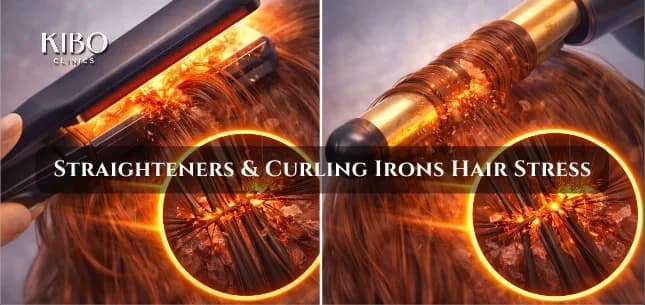
Hair straighteners and curling irons can damage hair, but they usually cause shaft breakage rather than common forms of hair loss from the root. Direct-contact heat can roughen the cuticle, alter keratin structure and make strands easier to snap. That breakage can reduce visible length and fullness, so hair may look thinner even when the follicles are still functioning normally.
The risk rises with higher heat, longer contact, repeated passes, frequent styling and using a conventional hot tool on damp hair. Fine, bleached, chemically treated, weathered or already brittle hair has less tolerance for repeated thermal stress.
The key distinction is whether you are seeing short broken strands or full-length hairs shedding from the follicle. Heat tools can explain the first much more often than the second.
Do Straighteners Cause Hair Loss or Hair Breakage?
Most damage from a flat iron or curling iron happens to the exposed hair fibre. Heat can weaken the strand until it breaks, while the follicle beneath the scalp may remain unaffected. This is why styling damage can make the hair look less dense without causing classic pattern baldness.
| What You Notice | More Suggestive Of | What to Do |
|---|---|---|
| Short pieces, split ends, white dots, uneven lengths | Hair-shaft breakage | Reduce heat, improve conditioning and minimise friction |
| Hair snaps during styling or detangling | Structural weakness from heat or chemical damage | Pause direct-contact heat and simplify the routine |
| Full-length hairs with bulbs shedding diffusely | Follicular shedding | Look for triggers such as illness, stress, deficiencies or medications |
| Widening part, receding hairline or crown thinning | Possible pattern hair loss | Get a scalp and follicle assessment |
| Smooth circular patches or painful inflamed areas | Possible medical scalp or hair-loss condition | See a dermatologist rather than treating it as heat damage |
If you are unsure, compare your pattern with this guide to hair breakage causes and treatment. Breakage is managed differently from follicular hair loss.
How Do Flat Irons and Curling Irons Damage the Hair Shaft?
Human hair is built from overlapping cuticle cells surrounding a protein-rich cortex. Direct heat changes both the surface and internal structure of the fibre. Laboratory studies using flat irons and curling irons have documented cuticle cracking, surface wear and heat-related changes within the cortex. Damage becomes more likely as temperature, contact time and the number of heat cycles increase.
| Hair Structure | Heat Effect | Visible Result |
|---|---|---|
| Cuticle | Scale lifting, cracking and surface wear | Roughness, tangling and reduced shine |
| Cortex | Keratin and structural changes | Reduced strength and easier snapping |
| Internal water | Rapid vapour formation if the fibre is damp | Bubbling, buckling and severe local damage |
| Weathered ends | Repeated exposure on the oldest part of the fibre | Split ends, white break points and thinning-looking ends |
Heat also interacts with the hair's existing condition. A strand that has already been bleached, coloured, relaxed or repeatedly blow-dried has less structural reserve than untreated hair. That is why the same tool setting can produce very different outcomes in two people.
Why Is Using a Straightener on Wet or Damp Hair Riskier?
Conventional flat irons and curling irons should be used on fully dry hair. When water remains inside the fibre, direct heat can rapidly turn that water into vapour. Experimental curling-iron research has shown far more severe structural damage in wet fibres, including bubbling and buckling around the cuticle.
Dense or curly sections can remain damp even when the surface feels dry. Finish drying first, then use the hot tool. If the product or device is specifically designed for wet-to-dry styling, follow the manufacturer instructions rather than applying a conventional iron to wet hair.
What Temperature Is Safe for Straightening or Curling Hair?
There is no single medically established temperature that is damage-free for every person. Research shows that high-temperature flat ironing can produce significant structural damage, but the real-world risk depends on more than the number shown on the tool. Contact time, pressure, passes per section and baseline hair condition all matter.
The safest practical rule is to use the lowest effective setting that achieves the style with the fewest passes. Fine, bleached, relaxed, colour-treated or already damaged hair should be treated more conservatively than healthy, coarse hair.
| Hair Condition | Practical Heat Approach |
|---|---|
| Fine, bleached, fragile or heavily processed | Use the lowest effective setting and consider avoiding direct-contact heat when damage is active |
| Colour-treated or moderately weathered | Use lower heat, good conditioning, heat protectant and minimal passes |
| Healthy, coarse or resistant | Increase gradually only if needed; do not default to the maximum setting |
| Damp or wet | Do not use a conventional flat iron or curling iron |
A tool's display may not perfectly reflect the temperature of every part of the plate or barrel. Avoid assuming that a digital number alone makes a technique safe.
If your hair is snapping even at lower heat, a clinical check can help rule out an underlying cause of fragility or thinning.
Does Heat Protectant Prevent Straightener Damage?
Heat protectants can reduce risk, but they do not make heat styling damage-free. Cosmetic-science research has shown that selected pretreatments can reduce breakage or surface damage during hot flat ironing. Their benefit depends on the formulation, how evenly the product is applied and how the tool is used.
Think of a heat protectant as one layer of risk reduction. It cannot compensate for maximum heat, long clamping times or repeated passes over the same section. If the product is applied to damp hair, let the hair dry fully before using a conventional flat iron or curling iron unless the instructions specifically state otherwise.
Straightener vs Curling Iron: Which Damages Hair More?
Neither tool is automatically safer. A straightener clamps the fibre between two heated plates and may be passed over the same section repeatedly. A curling iron wraps hair around a heated barrel and may keep one section in contact with heat for longer. The more useful comparison is total heat exposure, not the name of the tool.
If you also get regular salon blowouts, cumulative exposure matters. Read about frequent blow-drying and salon heat damage rather than evaluating each styling habit in isolation.
Who Is More Vulnerable to Heat Damage?
Any hair can be damaged by excessive heat, but some fibres have less tolerance for repeated styling. Risk is higher when several forms of damage occur together.
- Bleached, highlighted, relaxed or chemically straightened hair
- Fine hair or hair that is already showing split ends and breakage
- Curly or coily hair that is naturally more prone to dryness and mechanical damage
- Long hair, because the ends are older and have accumulated more weathering
- Hair exposed to frequent blow-drying, sunlight, swimming or repeated friction
- Anyone using a hot tool on damp hair or making several passes over each section
The idea of structural reserve is closely related to hair elasticity and stress resistance. Hair that has already lost flexibility is easier to snap during styling.
How Can You Reduce Damage From Straighteners and Curling Irons?
- Start with fully dry hair: Do not use a conventional direct-contact iron on damp sections.
- Use the lowest effective heat: Start low and increase only if the style cannot be achieved with one controlled pass.
- Apply a suitable heat protectant: Use it evenly through the lengths and follow the product instructions.
- Work in manageable sections: Oversized sections often lead to repeated passes and uneven heating.
- Keep contact brief: Do not hold the tool in one place and do not repeatedly clamp the same point.
- Reduce frequency: Use heatless styles between sessions and give damaged hair more time away from direct heat.
- Condition consistently: Rinse-out and suitable leave-in conditioners improve slip and reduce additional friction during grooming.
- Avoid combining heat with traction: Do not follow a high-heat session with very tight ponytails, buns or extensions on already fragile hair.
Gentle detangling matters too. Repeated pulling on heat-weakened hair can turn invisible structural damage into visible breakage. See how brushes and combs add mechanical stress.
Can Heat-Damaged Hair Recover?
The visible hair shaft is non-living keratin, so it cannot heal in the same way as skin. Conditioners, leave-in products and bond-support products may improve smoothness, reduce friction and make damaged hair easier to manage, but they do not rebuild a severely damaged fibre back to its original biological state.
If the ends are splitting or snapping despite gentler care, trimming the most damaged section and allowing healthier hair to grow out is often more realistic than repeatedly trying to coat the same fibre.
When Is Hair Thinning More Than Heat Damage?
Do not blame every change in density on a flat iron. Heat breakage tends to create uneven lengths and short fragments. A receding hairline, widening part, crown thinning, sudden diffuse shedding or smooth patches point toward a follicular process that needs a different evaluation.
If the pattern is unclear, review the main types of hair loss and their symptoms. Persistent thinning is better assessed by a dermatologist or hair restoration doctor than by changing styling products repeatedly.
Kibo Clinics' Perspective on Heat Styling and Hair Loss
Heat styling is a common source of hair-shaft damage, but it should not become a convenient explanation for every form of hair fall. At Kibo Clinics, the first step is to determine whether the visible problem is breakage, follicular shedding, patterned miniaturisation, scalp disease or a combination of factors.
If styling changes are enough, the plan can stay simple. If the pattern suggests medical hair loss, scalp examination and trichoscopy can help identify the cause before treatment is discussed.
Persistent breakage or thinning despite gentler styling deserves a diagnosis-led plan, not another higher-priced styling product.
Frequently Asked Questions
Do hair straighteners cause hair loss?
Straighteners mainly damage the hair shaft and can cause breakage, which may make hair look thinner. They do not usually cause androgenetic or pattern hair loss. Progressive thinning, a widening part, a receding hairline or patchy loss should be assessed separately.
Do curling irons damage hair?
Yes. Curling irons expose the hair shaft to direct heat. Repeated use, high temperatures, long contact times and styling the same section more than once can increase cuticle and cortex damage and make breakage more likely.
Can I use a flat iron on damp hair?
Conventional flat irons and curling irons should be used on fully dry hair. Research on heated hair fibres shows that moisture inside the shaft can rapidly turn to vapour and contribute to bubbling, cracking and severe local damage.
What temperature is safe for a hair straightener?
There is no single damage-free temperature for every hair type. Use the lowest effective setting and minimise contact time and repeated passes. Fine, bleached, chemically treated or already damaged hair generally needs more conservative heat than healthy, coarse hair.
Does heat protectant completely prevent heat damage?
No. Heat protectants can reduce friction and some thermal damage, but they do not make high heat, prolonged clamping or repeated passes harmless. Technique and total heat exposure still matter.
How often can I straighten or curl my hair without damage?
There is no universal safe frequency because hair condition, temperature and technique vary. Less frequent use lowers cumulative exposure. If you are already seeing split ends, roughness or short broken strands, reduce heat use substantially while the damaged hair grows out.
Can heat-damaged hair be repaired?
The visible hair shaft is non-living keratin, so severe structural damage cannot be biologically healed. Conditioners and leave-in products can improve smoothness, reduce friction and limit further breakage, while badly damaged sections need to grow out and may need trimming.
Is ceramic safer than titanium for hair?
Plate material alone does not guarantee safety. Even heating, adjustable temperature, smooth plates and good technique can help, but temperature, contact time, number of passes and hair condition are usually more important than the material label alone.
How can I tell heat breakage from hair shedding?
Heat breakage often creates shorter hairs of different lengths, split ends and white break points. Shedding usually involves full-length hairs released from the follicle. A widening part, receding hairline, circular patches or sudden heavy shedding should not be blamed on styling without assessment.
When should I see a dermatologist for hair damage from heat tools?
Seek assessment if breakage continues despite reducing heat, if the scalp is burned, painful or inflamed, or if you notice progressive thinning, patchy loss, a widening part or other signs that the problem is not limited to the hair shaft.
Key evidence reviewed:
- American Academy of Dermatology: How to stop damaging your hair
- American Academy of Dermatology: Hair styling without damage
- The effect of various cosmetic pretreatments on protecting hair from thermal damage by hot flat ironing
- Effects of thermal treatments with a curling iron on hair fiber
- Heat-damaged evaluation of virgin hair
If you have scalp burns, pain, sudden shedding, patchy loss or progressive thinning, seek assessment from a qualified dermatologist or hair restoration doctor.
Continue Reading
Hair Transplant: Hair Transplant Guide | FUE Hair Transplant Guide | Hair Transplant Results Timeline
Hair Regrowth: PRP Therapy | GFC Therapy | Microneedling for Hair Regrowth
Must Read: Sulfate-Free vs Regular Shampoo | Tight Styling and Hair Damage | Humidity and Hair Breakage
Relevant Blogs: Round Brush vs Flat Brush | Hair Touching and Breakage | AC Dryness and Hair Elasticity
Medical Disclaimer : Information from Kibo Hair Clinics is for educational purposes only. It does not replace diagnosis, trichoscopy, blood test interpretation, prescription treatment, procedure advice, or side-effect counselling from a qualified dermatologist or hair restoration doctor.