
Who This Is For: Anyone noticing short pieces, split ends, or frizz who wants to know whether it's breakage or hair fall, whether it can actually be fixed, and what's genuinely worth doing about it.
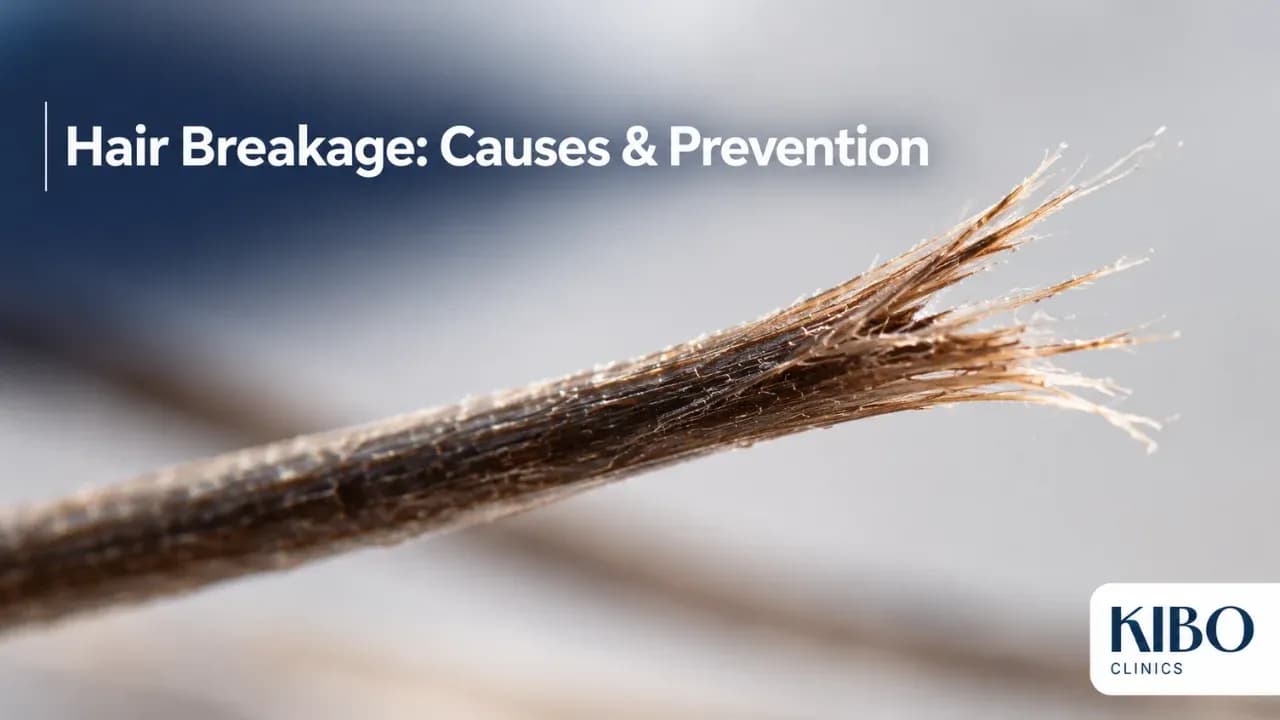
Hair breakage occurs when the visible hair shaft snaps or splits, creating short uneven pieces, split ends, frizz, and reduced length. It is different from shedding, in which a complete hair fibre leaves the follicle. Heat, chemical processing, friction, rough detangling, and tight styles can weaken the shaft. Damaged lengths cannot biologically repair, but stopping the cause, protecting the hair, trimming severely split ends, and allowing healthy follicles to grow new hair can improve the result.
Breakage vs Shedding vs Thinning
The visible hair shaft above your skin is keratinised and nonliving. Once it's substantially fractured or split, it genuinely can't biologically heal, whatever a product label might imply. That's the key distinction worth holding onto: breakage is a shaft problem, while shedding is a follicle-cycle event, and thinning is about the follicle's own production changing over time. All three can genuinely coexist, which is part of why this gets confusing.
| Finding | More Consistent With | Important Qualification |
|---|---|---|
| Full-length hair with club-shaped end | Shedding | Root appearance alone does not diagnose the cause |
| Short uneven hairs at many lengths | Breakage | Can also occur with alopecia areata, tinea, traction, or a pulling disorder |
| Split ends and frizz | Shaft damage | Existing split ends do not fuse back together |
| Pain, stinging, casts, tight style | Traction/inflammation | Stop the tension and seek assessment if it persists |
| Diffuse loss after illness or weight loss | Telogen effluvium | Often delayed; can coexist with breakage |
| Patchy scale and broken hairs | Infection or inflammatory disease | Needs clinical evaluation |
| Smooth shiny bald areas | Possible scarring alopecia | Prompt specialist review is important |
Signs of Breakage
Short pieces mixed in with your normal length, noticeably different lengths across your head, split ends, frizz, a rough texture you can feel, tangling that seems worse than it used to be, loss of shine, and hair that just doesn't seem to hold its length no matter how long you go between cuts. None of these on their own diagnose anything specific, but together they paint a picture that's genuinely different from diffuse thinning or patchy loss.
Common Causes
Heat styling, chemical processing (bleaching, relaxing, perming, dyeing), wet-hair friction, rough towel drying, repeated aggressive brushing, tight styles, extensions worn too long, environmental exposure like sun and chlorine, and, less commonly, a genuine hair-shaft disorder can all weaken the shaft enough to cause visible breakage. Most of what people experience day to day sits in the first few categories rather than anything rare or inherited.
Can Damaged Hair Be Repaired?
Not biologically, no. Conditioners, leave-ins, oils, silicones, and bond-forming products may temporarily improve feel, reduce friction, or make hair look smoother, but none of them restore the original fibre once it's genuinely fractured. What actually works is stopping further damage, protecting the lengths you already have, trimming the parts that are visibly split, and letting healthy follicles do what they already do, which is grow new hair. That last part just takes time you can't really shortcut with a product.
An Evidence-Based Routine
The AAD's actual recommendations are refreshingly unglamorous: massage shampoo into the scalp rather than rubbing it through the lengths, and use conditioner after each shampoo. This is a low-risk practice worth adopting, not a prescription for any particular brand or ingredient. If your current shampoo seems to be making things worse rather than better, it's worth considering whether a gentler formulation suits your hair and scalp better, though formulation, concentration, and your own individual tolerance all matter more than the ingredient name alone.
For drying: blot or wrap hair rather than rubbing vigorously, and let it air dry when you can. If you do use a dryer, keep it on the lowest effective heat, keep it moving, and don't hold it close to the same spot. A 2011 study that tested standardised hair tresses under repeated drying found more surface damage as temperature increased. It used hair samples rather than living people, so it supports the underlying mechanism rather than giving you a precise consumer temperature rule to follow.
On wet-hair detangling: the advice genuinely isn't "never brush wet hair" for everyone. Straight hair often does better left to dry a bit before gentle wide-tooth combing, while textured or tight-curly hair may actually be easier to comb while still damp, using a wide-tooth comb. The common thread is low tension and gentle handling, not a single universal rule.
On heat and chemicals: less frequent hot-tool use and more spacing between chemical touch-ups both genuinely help. Hair dryers, straighteners and curling irons, and frequent salon blowouts all add up over time even when any single session feels harmless. Don't expect a bond-repair product to reverse damage that's already happened; at best it can improve feel or temporarily reduce friction.
On tension: loose styles genuinely reduce both breakage and traction risk at the same time. Light extensions, professional application, good scalp hygiene, limited wear time, and actually changing up your style all help. Pain, stinging, crusting, or broken hairs specifically at the hairline are warning signs worth taking seriously, not just normal beauty discomfort to push through.
On trims: cutting off visibly split or frayed ends can stop the damage from travelling further up the strand, but it doesn't speed up follicle growth or repair the cuticle on the hair you keep. Trim according to your own goals and how much damage you're actually seeing, not a rigid schedule someone else set for a different hair type. And while it's a smaller factor, something like a silk pillowcase can genuinely reduce overnight friction for some people. It's a friction-reduction option worth trying, not a proven treatment for breakage on its own.
Hair-Shaft Disorders and the Clinical Differential
Beyond everyday cosmetic damage, there are genuine inherited and acquired shaft defects, including monilethrix, trichorrhexis nodosa, pili torti, trichorrhexis invaginata, trichothiodystrophy, and acquired bubble hair. These can produce fragile, abnormal, or unusually shaped fibres that break far more easily than normal hair. Broken hairs can also show up in alopecia areata, fungal infection, traction alopecia, trichotillomania, and scarring disease. Persistent or severe breakage genuinely shouldn't just get written off as "dry hair" without considering these.
Trichotillomania in particular is a recognised hair-pulling disorder, not simply a bad habit someone needs to break through willpower. If irregular broken hairs and repeated pulling are both present, supportive mental-health care alongside dermatology input may genuinely be needed, not styling advice alone.
Nutrition and Supplement Safety
Hair production does need adequate overall nutrition, but everyday shaft breakage is usually more directly tied to external damage than to diet. Iron deficiency, thyroid disease, restrictive eating, rapid weight loss, or other medical conditions can genuinely cause shedding or altered growth, but targeted testing should be guided by your actual symptoms and history, not applied as a blanket panel for anyone with frizzy ends. Don't reach for high-dose biotin routinely either. Biotin deficiency is genuinely uncommon, and high doses can interfere with thyroid and cardiac laboratory tests, which is a real practical downside worth knowing about before you start supplementing.
When to See a Dermatologist
Get assessed for patchy loss, scalp pain, scaling, pustules, inflammation, sudden widespread breakage, eyebrow involvement, ongoing thinning, or breakage that just doesn't improve after you've genuinely removed the obvious damage sources. If what you're actually dealing with turns out to be a follicle-level pattern rather than shaft damage, that's a different conversation entirely, and it's worth having a dermatologist or trichologist tell you which one you're actually looking at rather than guessing from a mirror.
Not sure if it's breakage or something follicle-level? A proper look settles it faster than another product will.
Kibo Clinics' Perspective on Hair Breakage
Breakage and hair loss get treated as the same problem constantly, and they genuinely aren't. We'd rather help you figure out which one you're actually dealing with than sell you a routine for the wrong problem.
At Kibo Clinics, we believe a fractured strand deserves an honest answer about what it is, not a product promising to "repair" something that genuinely can't be repaired.
If your hair isn't holding length no matter what you try, or something about the pattern feels off, a Kibo Clinics hair specialist can take a proper look and tell you whether you're dealing with breakage, something follicle-level, or both at once.
Frequently Asked Questions
Why is my hair breaking after washing?
Water, detangling, friction, towel rubbing, and handling can expose existing damage, particularly when the hair is wet. Shampoo should be massaged mainly into the scalp, lengths conditioned, and hair blotted rather than rubbed.
Does heat cause hair breakage?
Repeated or intense heat can damage the cuticle and increase fragility. Use lower heat, continuous motion, distance from the shaft, and less frequent hot tools.
Is brushing wet hair always harmful?
Not always. Straight hair may be easier to detangle after partial drying, while textured or tight-curly hair may be best combed damp with a wide-tooth comb. The key is low tension and gentle handling.
Do oils stop hair breakage?
Some oils can reduce friction or improve feel, but they do not repair a fractured fibre or treat follicle-level disease. Heavy oiling can also irritate or complicate scalp care for some people.
When is breakage a medical problem?
Seek dermatology advice for sudden widespread breakage, patchy loss, scalp pain, redness, pustules, thick scale, eyebrow loss, shiny areas without follicle openings, or continued thinning despite removing obvious damage.
Related Articles & Services
Hair Transplant
FUE Hair Transplant | Sapphire FUE Hair Transplant | Real-Time FUE Hair Transplant | Bio FUE Hair Transplant | Unshaven Hair Transplant | Direct Hair Transplant (DHT) | Body Hair Transplant | Corrective Hair Transplant | Hairline Correction
Hair Regrowth
PRP Therapy | GFC Therapy | Exosomes Therapy | IV Hair Boosters | Low-Level Laser Therapy | Mesotherapy for Hair Regrowth | Microneedling for Hair Regrowth | PDO Threads for Hair Regrowth
Must Read
Hair Fall in Monsoon | Telogen Effluvium Explained | Night-Time Hair Care to Reduce Breakage
Relevant Blogs
Scalp Oil and Hair Friction | Scalp Massagers and Hair Growth | Dermatologist-Recommended Shampoo
Medical Disclaimer : Information from Kibo Hair Clinics is for educational purposes only. It does not replace diagnosis, trichoscopy, blood test interpretation, prescription treatment, procedure advice, or side-effect counselling from a qualified dermatologist or hair restoration doctor.