
How Is The Exosome Hair Treatment Procedure Done?
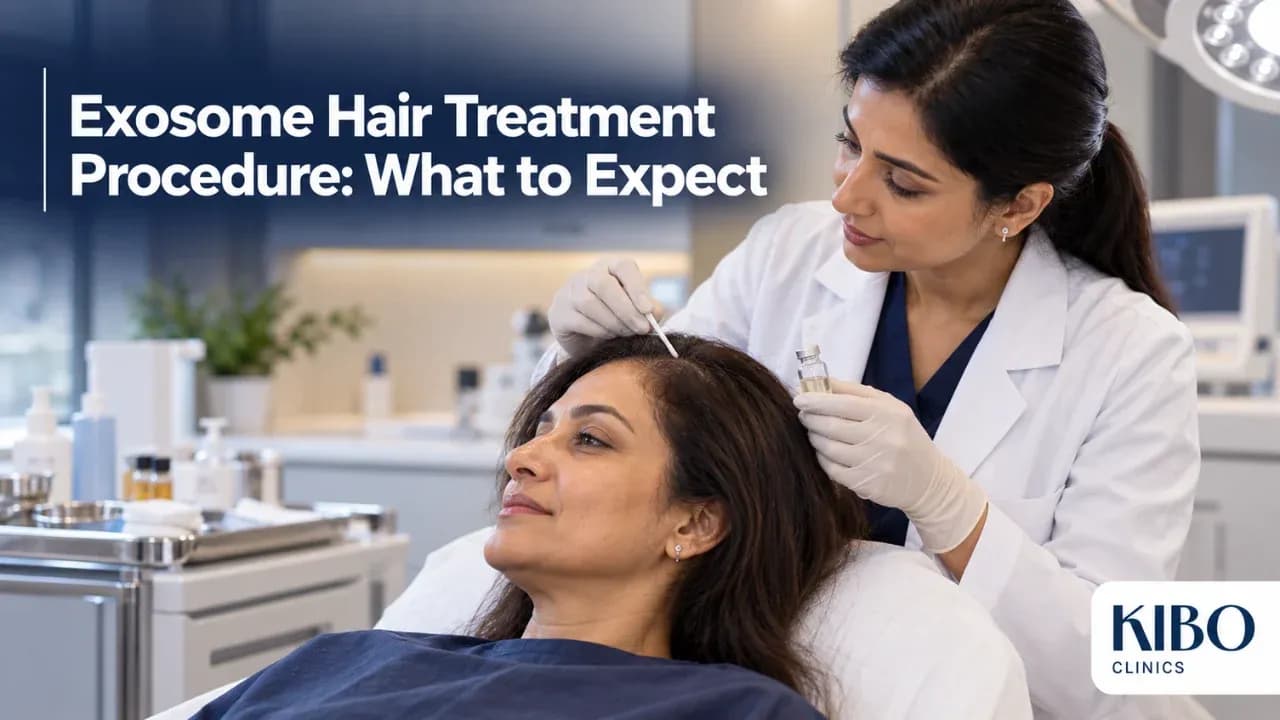
While there is no single exosome hair treatment process, a clinical pathway may include several stages. The exact steps can differ depending on the patient's diagnosis, the preparation being used, and the delivery technique.
A clear overview of the procedure can help you understand what to expect at each stage and what to discuss with your clinician.
-
Consultation and Diagnosis
Your treatment should begin with an assessment of your hair loss. Your clinician may examine your scalp and hair density and look for signs that can help identify the cause of your hair loss.
This helps determine whether exosome therapy is appropriate to consider at all. This step matters because hair loss can have different causes, and a treatment studied for one type of alopecia may not work for another.
-
Treatment Planning
Once your hair loss has been assessed, your clinician can discuss whether an exosome-based treatment is appropriate for you.
This is also where you need to discuss key aspects of the procedure with your clinician, including:
- What exosome or extracellular vesicle preparation will be used
- Where the exosome will be sourced from
- How it will be processed and prepared
- How it will be delivered
- What evidence supports its use
- Why has this particular treatment plan been suggested
Confirming these details is essential because exosome preparations used in research are not necessarily identical. Studies have used products from different biological sources and have varied in preparation, dosing and delivery.
-
Exosome Hair Treatment Preparation
Exosome hair treatment preparation generally involves the clinician reviewing the patient's medical history, current medicines, allergies, and relevant scalp conditions.
Before the procedure, give your clinician the following details about yourself:
- Medicines or supplements you take
- Allergies you may have
- Existing medical conditions
- Scalp problems or infections
- Previous hair-loss treatments that you may have taken
Do not stop a medicine or supplement on your own to prepare for exosome treatment. If anything needs to be stopped or changed, your clinician should give you those instructions.
Before the exosome hair treatment procedure, it is also useful to clarify whether the planned treatment involves injections, microneedling followed by topical application, or another approach.
-
Scalp Preparation
The scalp is prepared according to the selected technique. This may involve cleansing or disinfecting the treatment area before the delivery of exosomes.
Whether a numbing agent or local anaesthesia is used depends on the procedure. Injection-based delivery may involve discomfort from the injections themselves, while microneedling can temporarily cause sensitivity.
Therefore, anaesthesia should not be presented as a mandatory part of every exosome treatment.
-
Delivery of the Exosome Preparation
This is the part of the exosome hair treatment process that can vary the most. The procedure you may be suggested can either be delivery of exosomes through intradermal injections or microneedling and topical application.
A brief breakdown of the two types may help you understand them better:
- Intradermal injections
Some published studies have used intradermal delivery, where the preparation is injected into the scalp. The exact injection technique, depth, amount, and treatment area depend on the protocol. - Microneedling and topical application
Other research has used microneedling followed by topical application of an exosome preparation. Microneedling creates tiny channels in the skin, after which the topical preparation is applied to the scalp.
A 2025 study, for example, looked at microneedling radiofrequency followed by topical exosome application in people with pattern hair loss. However, this was one specific research protocol, not a standard procedure for everyone.
Some treatments may also combine approaches.
There is currently not enough evidence to say that one delivery method is better than all others. Your clinician should explain why a particular method has been selected for you.
- Intradermal injections
-
Short-Term Observation
Following treatment, the clinician may assess the scalp and provide instructions for the immediate recovery period.
Some local effects can occur after injections or microneedling, including temporary redness, sensitivity, swelling or tenderness. These effects can be related to the procedure itself and do not necessarily indicate a reaction to the exosome preparation.
The treating clinician should explain what is expected and what symptoms require further assessment.
-
Follow-up
Follow-up may include checking your scalp and hair growth over time. Your clinician may use photographs, trichoscopy (a close examination of the scalp and hair), or other measurements to assess changes.
What Does Exosome Hair Treatment Aftercare Involve?
There is no universal aftercare routine for the exosome hair treatment procedure. The instructions should reflect the technique performed and the preparation used.
In general, the treating clinician may advise patients to take the following steps:
- Avoid unnecessary rubbing or scratching the scalp immediately after treatment.
- Use only products that the clinician has approved for the immediate recovery period.
- Follow specific instructions regarding exercise and heat exposure.
- Protect the scalp from sun exposure as directed.
- Follow the clinician's instructions about when to wash the hair.
- Attend follow-up appointments and complete any recommended photographs or scalp assessments.
These instructions should not be generalised from one study to every patient. A study may use a specific needle depth, product, or aftercare routine, but these may differ from one treatment to another.
What Is The Downtime for Exosome Hair Treatment?
The recovery period, or the downtime, for exosome hair treatment may depend on the delivery method, needle depth where applicable, and the preparation used. It may also differ from person to person.
During this period, you may have short-term redness, swelling, tenderness, or scalp sensitivity.
When Should You Seek Medical Advice?
Some temporary redness or tenderness may occur after the exosome hair treatment procedure. But certain symptoms need medical attention.
Contact your treating clinician promptly if you develop the following symptoms:
- Persistent or worsening pain
- Significant or increasing swelling
- Redness that spreads
- Pus or other unusual discharge
- Fever
Do not try to manage these symptoms yourself if they are severe or getting worse.
Kibo Clinics' Perspective on Exosome Hair Treatment Procedure
Exosome hair treatment is still an investigational approach, with limited human evidence and no standardised product or treatment protocol. The procedure, including the preparation, delivery method, aftercare, and number of sessions, may vary based on the cause and stage of your hair loss, the condition of your hair follicles, and the treatment being considered.
At Kibo Clinics, we believe that understanding the cause of your hair loss is the first step before considering any treatment.
If you are experiencing hair loss, a Kibo Clinics hair specialist can assess your hair and scalp, identify the likely cause, and discuss suitable evidence-based treatment options based on your individual needs.
Frequently Asked Questions
Is the exosome hair treatment procedure safe?
Early clinical studies have reported mostly mild local effects, but the evidence base is small and heterogeneous. Long-term safety and standardised protocols have not been established.
How many exosome hair treatment sessions do you need?
There is no universally established session schedule for the number of exosome hair treatment sessions. Your clinician should explain why a particular number and spacing of sessions have been recommended for you.
Can I wash my hair after exosome treatment?
Hair-washing instructions depend on the specific procedure. Follow the timing recommended by the treating clinician.
Is exosome treatment painful?
The extent of discomfort depends on the delivery technique. Injection-based procedures may cause temporary discomfort, while microneedling can cause temporary sensitivity. Numbing may be used in some procedures.
Is microneedling used with exosomes?
Yes. Published research has explored microneedling followed by topical exosome application. However, this is only one of the delivery methods studied in hair-loss research.
Bottom Line
Exosome hair treatment is a multi-step process that includes assessment, planning, preparation, delivery and follow-up, but there is no single standardised protocol. Talk to a qualified clinician about which approach, aftercare routine and downtime apply to your specific treatment plan.
Hair Transplant
Bio FUE hair transplant | body hair transplant | corrective hair transplant | direct hair implantation (DHI) | FUE hair transplant | real-time FUE hair transplant | sapphire FUE hair transplant | unshaven hair transplant | hairline correction
Hair Regrowth
GFC therapy for hair | IV hair boosters | low-level laser therapy (LLLT) | mesotherapy for hair regrowth | microneedling for hair regrowth | PDO threads for hair regrowth | PRP therapy for hair
Must Read
exosome hair treatment cost in India | exosome vs PRP for hair loss | exosome vs GFC for hair loss | exosome vs stem cell hair treatment | exosome therapy after hair transplant
Relevant Blogs
GFC hair transplant guide | GFC before hair transplant | GFC after hair transplant | GFC therapy vs PRP | GFC vs PRP after hair transplant | does GFC improve hair transplant results | PRP vs PRF for hair growth
Medical Disclaimer : Information from Kibo Hair Clinics is for educational purposes only. It does not replace diagnosis, trichoscopy, blood test interpretation, prescription treatment, procedure advice, or side-effect counselling from a qualified dermatologist or hair restoration doctor.