
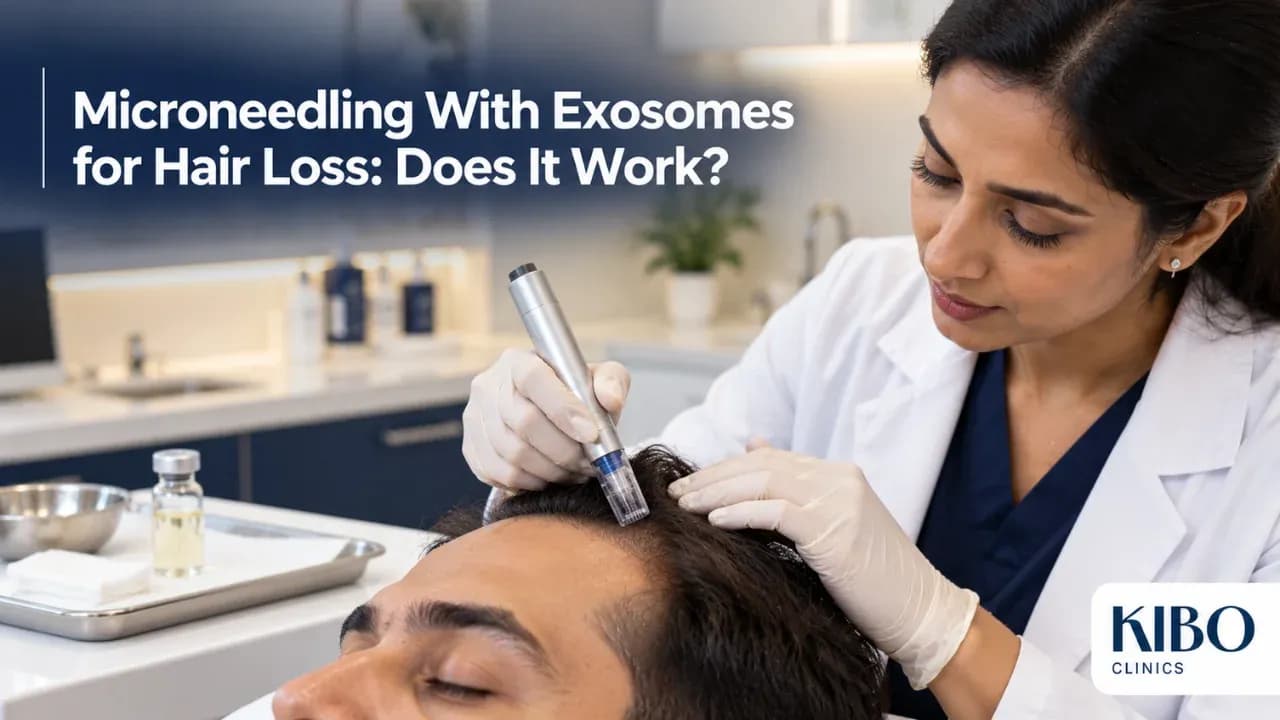
What Is Microneedling With Exosomes for Hair Loss?
Microneedling with exosomes for hair loss combines controlled microneedling with the application of an exosome-containing preparation to the scalp. Microneedling creates tiny punctures that trigger the skin's natural healing response, while exosomes are being studied for their potential role in signalling processes involved in hair follicle activity.
The combination is intended to support the hair-growth environment and may improve the delivery of the topical preparation into the treated scalp. However, exosome microneedling for hair is still an emerging treatment, and current evidence is not yet strong enough to establish its effectiveness or ideal treatment protocol.
How Does Exosome Microneedling for Hair Work?
Exosome microneedling for hair combines controlled scalp micro-injury with a topical exosome preparation. The approach aims to stimulate healing signals while exposing the scalp to exosome-derived cellular signals overall.
How Does Microneedling Affect the Scalp?
Microneedling creates controlled micro-injuries in the scalp, triggering wound-healing signals that may influence the local environment around hair follicles locally.
How Might Exosomes Support Hair Growth?
Microneedling with exosomes for hair growth is being studied because exosomes carry signalling molecules that may influence follicular cells and pathways involved in hair growth over time.
Why Combine Microneedling With Exosomes?
The proposed rationale is to apply an exosome preparation after microneedling, when the skin has been disrupted. This may help bring the preparation into contact with the treated scalp, but it has not been established that microneedling improves exosome absorption or effectiveness. The FDA has not cleared microneedling devices for use with other products, including cosmetics, drugs or platelet-rich plasma.
What Are the Potential Benefits of Exosome Scalp Microneedling?
Exosome scalp microneedling may offer several potential benefits, although research is still developing and results can vary:
- May support hair density: Early studies have reported improvements in hair density.
- May improve hair thickness: Some research suggests potential increases in hair shaft diameter.
- May support the hair-growth environment: The treatment may influence signalling around hair follicles.
- May complement other treatments: It may be considered alongside established hair-loss treatments when clinically appropriate.
- Minimally invasive: It does not involve the incisions required for surgical hair restoration.
What Does the Evidence Say About Exosome Microneedling Hair Treatment?
Exosome microneedling hair treatment shows promising early results, but the evidence remains limited. Studies vary in exosome sources, formulations, treatment protocols and follow-up, making it difficult to establish its effectiveness or ideal use.
What Do Studies Show About Exosomes for Hair Loss?
Early clinical studies report improvements in hair density and thickness with exosome-based treatments. However, small sample sizes, different exosome sources and formulations, and varied follow-up periods limit how confidently these findings can be applied more broadly.
What Do Studies Show About Microneedling for Hair Loss?
Microneedling has a broader evidence base, particularly as an adjunct for androgenetic alopecia. Reviews report improvements in hair parameters, although studies use different devices, depths and treatment schedules, and overall evidence quality remains limited.
Is Microneedling With Exosomes Effective for Hair Loss?
Current evidence is promising but still limited. Two recent publications are particularly relevant:
- 2025 prospective study: Clinics in Dermatology published a prospective study of 20 people with pattern hair loss who received radiofrequency microneedling followed by topical exosome application. The study reported significant increases in hair density and diameter, but the authors called for randomised controlled trials to confirm the findings.
- 2026 systematic review: A systematic review in the Journal of Cosmetic Dermatology evaluated microneedling combined with exosomes across dermatological conditions. It concluded that larger studies and longer follow-up are needed to establish the treatment's effectiveness and long-term safety.
The early findings are encouraging, but there is not yet enough high-quality evidence to consider exosome microneedling an established treatment for hair loss.
Is Exosome Treatment With Microneedling Safe?
Exosome treatment with microneedling may cause temporary redness, swelling, sensitivity or mild discomfort after treatment. The risk of infection can also increase if sterile technique is not followed.
For safer treatment, the procedure should be performed by a trained professional using appropriate sterile equipment and a clearly identified product. Because exosome formulations can vary, their safety profile may also depend on the source, formulation and method of application.
Are Exosome Treatments FDA-Approved?
No. The FDA currently states that there are no FDA-approved exosome products. It regulates exosome products intended to treat diseases or medical conditions as biological products requiring appropriate regulatory review and approval.
This refers specifically to US FDA approval and does not determine whether an exosome treatment is permitted or regulated in India. In India, regulatory requirements for investigational drugs and biological products fall under the Central Drugs Standard Control Organisation (CDSCO) and the applicable New Drugs and Clinical Trials Rules.
For patients, the important point is to ask about the product's source, formulation, clinical evidence, regulatory status and safety information, rather than assuming that an "exosome" label means the treatment has been clinically approved.
Who May Consider Microneedling With Exosomes for Hair Loss?
Microneedling with exosomes for hair loss may be considered for some people with hair thinning, but suitability depends on the underlying cause, scalp condition, medical history and previous treatments. A confirmed diagnosis should come before choosing an exosome-based treatment.
Why Does the Cause of Hair Loss Matter?
Different types of hair loss require different approaches. Pattern hair loss, telogen effluvium, alopecia areata and scarring alopecia have different underlying mechanisms, so a regenerative treatment should not replace proper diagnosis and condition-specific care.
What Can You Expect From an Exosome Microneedling Session?
Exosome microneedling for hair typically begins with a scalp assessment to identify the type and extent of hair loss. The scalp is then cleansed and prepared before microneedling, followed by application of the exosome preparation when included in the clinical protocol. The session generally involves:
- Scalp assessment: Evaluate hair loss and scalp health.
- Preparation: Cleanse and prepare the treatment area.
- Microneedling: Create controlled micro-injuries across the scalp.
- Exosome application: Apply the preparation according to the treatment protocol.
- Post-treatment care: Follow instructions to protect the treated scalp.
- Follow-up: Assess progress and determine the next steps.
There is no universal needle depth, number of sessions or hair-growth timeline. Protocols vary according to the device, product and clinical approach, and current research remains heterogeneous.
How Does Microneedling With Exosomes Compare With Other Hair Loss Treatments?
Different hair-loss treatments serve different purposes. The right option depends on the diagnosis, treatment goals and clinical assessment.
| Treatment | Main Role |
|---|---|
| Microneedling | Adjunctive scalp treatment that may support hair-growth responses |
| Exosome therapy | Emerging regenerative approach still under investigation |
| Minoxidil | Established medical treatment for certain types of hair loss |
| PRP | Autologous treatment with evidence that varies by condition and protocol |
| Hair transplant | Surgical hair restoration for suitable candidates |
Kibo Clinic's Perspective on Microneedling With Exosomes for Hair Loss
Microneedling with exosomes is an emerging approach being studied for hair loss, but treatment should begin with identifying the underlying cause of hair thinning and assessing the scalp.
At Kibo Clinics, we focus on personalised hair-loss treatment based on your diagnosis, scalp condition, treatment history and long-term hair restoration goals. Emerging treatments such as exosome therapy may be considered where clinically appropriate.
If you are experiencing persistent or progressive hair loss, a Kibo Clinics board certified hair transplant surgeon can assess your condition and recommend a treatment plan suited to your individual needs.
Frequently Asked Questions
Does microneedling with exosomes help hair growth?
It may support hair growth, but evidence remains limited. Early studies report improvements in hair density and thickness, but larger controlled trials are needed.
How many sessions of exosome microneedling are needed for hair loss?
There is no established number of sessions. Treatment frequency depends on the protocol, product, device and individual clinical assessment.
Is exosome microneedling safe for hair loss?
It may cause temporary redness, swelling, sensitivity or discomfort. Safety also depends on sterile technique and the specific exosome product used.
Can microneedling with exosomes treat baldness?
It has not been established as a treatment that can reverse baldness. Evidence is still emerging, particularly for different types and stages of hair loss.
Is exosome therapy better than PRP for hair loss?
There is not enough high-quality evidence to determine that exosome therapy is better than PRP. Both have different evidence bases and treatment protocols.
Bottom Line
Microneedling combined with exosomes is an emerging approach for hair loss, with early evidence but no standardised protocol. It is not an established replacement for proven treatments. Get your hair loss properly diagnosed first, and discuss whether this combination fits your treatment plan with a qualified specialist.
Hair Transplant
Bio FUE hair transplant | body hair transplant | corrective hair transplant | direct hair implantation (DHI) | real-time FUE hair transplant | sapphire FUE hair transplant | unshaven hair transplant | hairline correction
Hair Regrowth
GFC therapy for hair | IV hair boosters | low-level laser therapy (LLLT) | mesotherapy for hair regrowth | microneedling for hair regrowth | PDO threads for hair regrowth
Must Read
what is exosome hair treatment | exosome hair treatment procedure | exosome hair treatment cost in India | exosome vs GFC for hair loss | exosome vs stem cell hair treatment | exosome therapy after hair transplant
Relevant Blogs
GFC hair transplant guide | GFC before hair transplant | GFC after hair transplant | GFC therapy vs PRP | GFC vs PRP after hair transplant | does GFC improve hair transplant results | PRP vs PRF for hair growth
Medical Disclaimer : Information from Kibo Hair Clinics is for educational purposes only. It does not replace diagnosis, trichoscopy, blood test interpretation, prescription treatment, procedure advice, or side-effect counselling from a qualified dermatologist or hair restoration doctor.