
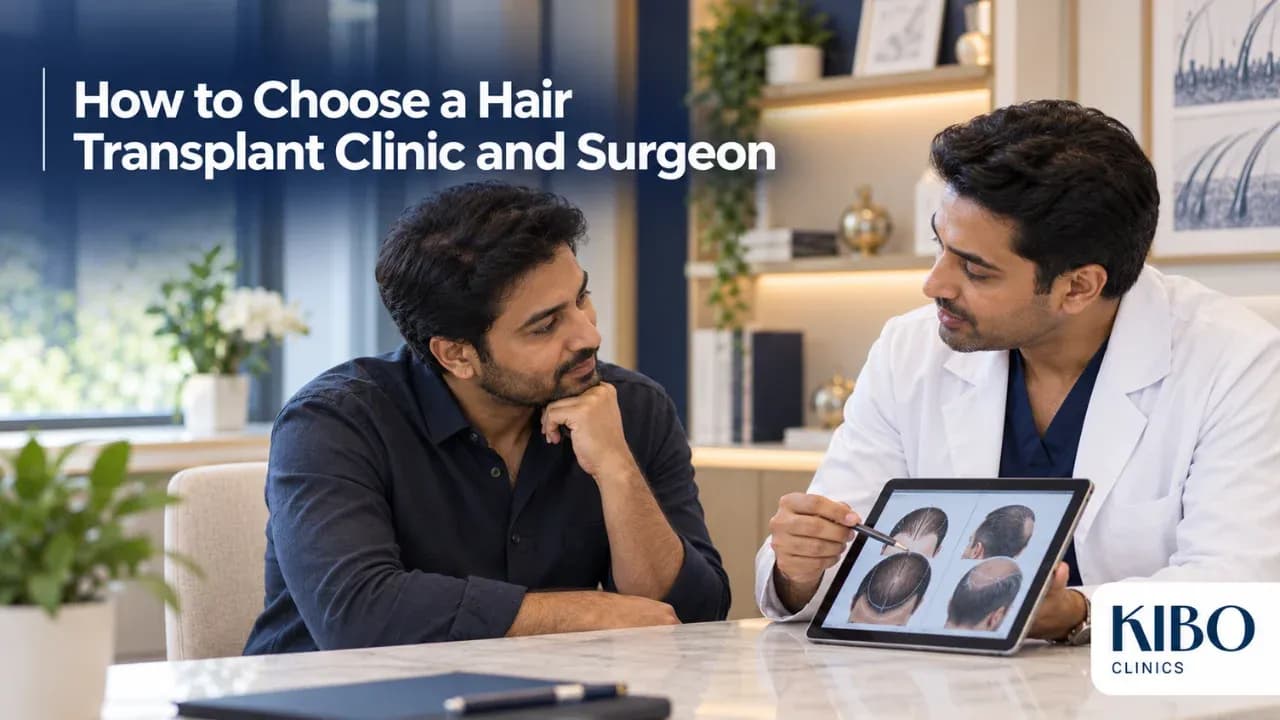
Why Does Choosing the Right Hair Transplant Clinic Matter?
Choosing the right hair transplant clinic matters because the quality and safety of your treatment depend on factors such as the surgeon's qualifications and extent of involvement in the procedure, the clinic's surgical practices, the way your grafts are planned, and the follow-up care available.
The clinic should also be able to explain why a particular treatment approach is suitable for you, who will perform each surgical step, and how your result will be monitored after surgery.
How Do You Choose a Hair Transplant Clinic and Surgeon?
When choosing a hair transplant clinic, verify the surgeon's qualifications, registration, experience, and the extent of their involvement in the procedure before comparing techniques or prices.
You should also check who performs each part of the procedure, how the clinic handles safety and infection control, whether results are documented, and whether the graft plan, quote, and follow-up care are clearly explained.
A hair transplant is a surgical procedure, so the person performing it and the clinical environment matter as much as the technique being offered.
A structured checklist of all the factors to check can help you compare clinics based on accountability and evidence rather than marketing claims alone.
Check the Hair Transplant Surgeon's Qualifications
Start by finding out exactly who will be responsible for your procedure. Ask the clinic to give you the following details:
- Full name of the surgeon performing the transplant
- Their medical qualification
- Their current medical registration
- Relevant postgraduate or surgical training
- Experience performing hair-transplant surgery
In India, the National Medical Commission's Indian Medical Register allows searches using details such as a doctor's name, qualification, registration number, registration year, and registered council.
Professional-society membership can provide additional information about a doctor's involvement in the field, but it should not replace verification of registration, training, and individual surgical experience.
Similarly, a marketing title such as "hair transplant specialist" should not be treated as proof of qualification.
A clinic may also advertise the number of procedures performed by its entire team. That does not necessarily tell you how much experience your surgeon has.
Ask how long the surgeon has personally performed hair-transplant procedures and whether they regularly manage cases similar to yours.
Ask Who Will Perform Each Part of Your Hair Transplant
This is one of the most important details to clarify before booking a hair transplant surgery. Ask the clinic who will perform each part of your procedure and which steps will be performed by the surgeon personally.
The clinic's answer should be clear rather than simply referring to "our team."
The following table lists all the questions you should ask the hair transplant clinic about each stage of the procedure:
| Stage of Procedure | Question to Ask |
|---|---|
| Diagnosis and consultation | Who evaluates my hair loss and decides whether surgery is appropriate? |
| Surgical planning | Who decides the graft number, donor strategy, and hairline design? |
| Donor harvesting | Who performs FUE (follicular unit extraction) or strip harvesting? |
| Recipient-site creation | Who creates the recipient incisions or sites? |
| Implantation | Who places the grafts and who supervises the process? |
| Medical management | Who handles anaesthesia, medical issues, and possible adverse reactions? |
| Post-operative care | Who reviews healing and manages complications or poor growth? |
The International Society of Hair Restoration Surgery (ISHRS) states that core activities such as preoperative evaluation, surgical planning, donor harvesting, hairline design, recipient-site creation, and postoperative care should be performed by a properly trained and licensed physician, while recognising that local laws determine the scope of practice for different professionals.
That distinction matters in India. Do not assume that every technician role is illegal or permitted simply based on a general online claim. Instead, ask the clinic exactly who does what and verify that the arrangement complies with applicable local requirements.
Check the Clinic's Safety Processes
A good clinic should be able to explain how it maintains a safe clinical environment.
Before you book a transplant procedure with them, ask about the following safety factors:
- Hand hygiene and personal protective equipment
- Instrument sterilisation or disinfection
- Safe injection practices
- Biomedical waste management
- Medical supervision during the procedure
- Emergency arrangements
The National Accreditation Board for Hospitals & Healthcare Providers (NABH) includes infection control, patient care, facility management, and safety among its Allopathic Clinic Accreditation standards.
Accreditation can be a useful quality signal, but NABH accreditation should not be treated as a guarantee of hair-transplant results.
You also do not need to judge a clinic by its décor or the number of machines it displays. Ask practical questions about the procedure area, clinical responsibility, and safety processes instead.
Evaluate Hair Transplant Before-and-After Photos Carefully
Before-and-after photographs can help you understand a surgeon's work, but a few impressive images do not tell the whole story.
Look for cases that allow you to compare. The following table gives a simple breakdown of what you can check in the before-and-after pictures and how you can spot positive results:
| What to Check in Pictures | What Good Evidence Looks Like |
|---|---|
| The patient's identity | The same patient is visible in before-and-after pictures |
| Timeline | The time after surgery is stated |
| Angles | Front, temples, top, or crown views are shown where relevant |
| Lighting | Photos use consistent lighting and hair condition |
| Case similarity | The case has a similar hair-loss pattern and donor situation as yours |
| Case details | Graft count, timeline, and treatment plan can be explained |
Be cautious if every photograph shows an unusually perfect result, the lighting or hairstyle changes significantly, or the clinic cannot provide basic details about the case.
Understand Your Graft Estimate
A graft is a small group of hair follicles taken from the donor area and transplanted to areas affected by hair loss. The graft count refers to how many of these follicular units are planned for transplantation.
Each graft can contain a different number of hairs. So, graft count and hair count are not the same. This is why a larger graft number does not automatically mean a better transplant.
The number recommended for you should take into account your donor supply, the area requiring coverage, your density goals, hair characteristics, and the potential for future hair loss.
Once the clinic gives you a graft estimate, ask them how it was calculated. You can also ask how many hairs are expected per graft, which areas will be prioritised, and what happens if your native hair loss progresses.
Compare Hair Transplant Quotes Carefully
The headline price that a clinic gives you does not always tell you the actual cost of treatment. Before comparing quotes, ask what is included and what is charged separately.
The following table breaks down the key items to check in a hair transplant quote and what you should clarify before comparing one quote with another:
| Quote Item | What to Clarify |
|---|---|
| Surgery | The technique that will be used and the graft estimate |
| Consultation | Are they included or billed separately? |
| Pre-operative tests | Which tests are required, and are they included? |
| Anaesthesia and medicines | Are they included or billed separately? |
| Follow-up | Number of consultations/clinical reviews included |
| Taxes and fees | Are they included? |
| Revision support | Is clinical support included if the expected growth is not achieved? |
Ask About Follow-Up and Revision Support
Your relationship with a clinic should not end when the procedure is over. You will require follow-up consultations to check if you are getting desired results and if you need other medical assistance.
To make sure that you have good post-surgery support, make sure you ask the following questions to the clinic:
- When will the surgeon review you after surgery?
- Who will be your clinical point of contact?
- How are healing concerns handled?
- What happens if hair growth is poorer than expected?
- What support is available if a revision is eventually needed?
A clear post-operative pathway gives you a better idea of who remains responsible for your care after the procedure.
What Questions Should You Ask at a Hair Transplant Consultation?
During your hair transplant consultation, consider asking questions that help you understand the surgeon's qualifications, your diagnosis and graft plan, who will perform each part of the procedure, the expected results, the risks, the cost, and the follow-up care.
Getting clarity about these factors can also help you compare clinics based on the quality and transparency of the care they offer.
Here is a checklist of questions that you can ask the surgeon at the hair transplant clinic during your consultation:
- What is causing my hair loss?
- Am I a suitable candidate for a transplant?
- What are your medical qualifications and registration details?
- How many hair-transplant procedures have you personally performed?
- Which parts of my procedure will you personally perform?
- What is my donor density and long-term donor capacity?
- How many grafts do I need, and how was that number calculated?
- Why is this technique appropriate for my case?
- Who will design my hairline, and how will future hair loss be considered?
- Can I see documented cases similar to mine with treatment timelines?
- What are the relevant risks for my case?
- What is included and excluded from the written quote?
- Who will review me after surgery?
- What happens if the growth is poorer than expected?
- What support is available if I eventually need a revision?
What Are the Red Flags When Choosing a Hair Transplant Clinic?
When choosing a hair transplant clinic, watch for red flags such as pressure to book or pay immediately, guaranteeing results without a complete assessment, and unclear pricing or follow-up arrangements.
Paying attention to these signs can help you avoid making a decision based mainly on sales claims and instead focus on the clinic's transparency, accountability, and approach to patient care.
Here are some red flags to look out for when evaluating a hair transplant clinic:
- Pressure to pay or book immediately
- Guarantees of a specific density or result without individual assessment
- Unusually high graft recommendations without an assessment of donor supply
- Unclear information about who performs extraction, recipient-site creation, or implantation
- Little or no access to the surgeon
- Unverifiable or inconsistent before-and-after photographs
- Low headline prices with unclear exclusions
- Reluctance to discuss risks or what happens if the expected result is not achieved
- No clear post-operative clinical contact
- Use of terms such as "scarless surgery" as a guarantee
The ISHRS specifically cautions against exaggerated claims such as "scarless surgery." Both the clinic's promises and its willingness to discuss limitations deserve attention.
How to Choose a Hair Transplant Clinic: A Quick Checklist
Before making your decision, make sure you can answer these questions:
- Have I verified the surgeon's medical registration and qualifications?
- Do I know how much hair-transplant experience the surgeon personally has?
- Do I know who will perform each major step?
- Have I asked about infection control, sterilisation, and medical supervision?
- Have I seen documented, comparable before-and-after cases?
- Do I understand how my graft estimate was calculated?
- Has the clinic considered my future hair-loss pattern and donor reserves?
- Do I have written inclusions and exclusions?
- Do I know who will review me after surgery?
- Do I know what support is available if the result is poor?
- Have I noticed any pressure, guarantees, unclear staffing, or excessive graft promises?
If the answers are clear, you are in a much better position to compare clinics based on clinical accountability and evidence rather than price or marketing alone.
Kibo Clinics' Perspective on Choosing a Hair Transplant Clinic and Surgeon
Choosing a hair transplant clinic involves more than comparing prices or before-and-after photographs.
At Kibo Clinics, we believe you should have a clear understanding of your diagnosis, treatment plan, expected outcomes, and the role of the surgeon before deciding on a hair transplant.
Your hair loss has its own cause, pattern, and progression, so the treatment plan should begin with an appropriate assessment rather than a pre-set graft package or procedure.
If you are experiencing hair loss, a Kibo Clinics hair specialist can assess your hair and scalp, identify the likely cause, and discuss suitable evidence-based treatment options based on your individual needs.
Frequently Asked Questions
How do you choose a hair transplant clinic?
Start by verifying the surgeon's medical registration, qualifications, and individual experience, and check who performs each surgical step, the clinic's safety processes, documented results, graft planning, quote inclusions, and follow-up support.
How do you choose a hair transplant surgeon?
Check the surgeon's current medical registration, relevant training, and personal experience in hair-transplant surgery, and ask which parts of your procedure they will personally perform and whether they can explain your diagnosis, graft plan, and long-term treatment strategy.
Who should perform a hair transplant?
The ISHRS states that core surgical and planning activities should be performed by a properly trained and licensed physician, while local laws determine the scope of practice for different professionals.
How can you tell whether hair transplant before-and-after photos are reliable?
Look for the same patient, a clearly stated timeline, comparable angles and lighting, and cases with a similar hair-loss pattern and donor situation. Ask whether the clinic can explain the graft count and treatment plan behind the result.
Is a higher number of grafts better?
Not necessarily. The appropriate graft number depends on your donor supply, recipient area, hair characteristics, density goals, and expected future hair loss. Excessive extraction can compromise the donor area and future treatment options.
What should a hair transplant quote include?
Ask for the procedure and graft estimate, surgeon involvement, consultation, pre-operative tests, medicines and anaesthesia, procedure-day supplies, aftercare, follow-up, taxes or fees, additional treatments, and revision terms. The clinic should clearly state which items are included and which are charged separately.
Bottom Line
Choosing a hair transplant clinic comes down to accountability, not marketing. Verify the surgeon's registration and personal involvement, check the clinic's safety processes, scrutinise before-and-after evidence, and get a clear, itemised quote before you commit.
Hair Transplant
Bio FUE hair transplant | body hair transplant | corrective hair transplant | direct hair implantation (DHI) | hairline correction | real-time FUE hair transplant | sapphire FUE hair transplant | unshaven hair transplant
Hair Regrowth
GFC therapy for hair | IV hair boosters | low-level laser therapy (LLLT) | mesotherapy for hair regrowth | microneedling for hair regrowth | PDO threads for hair regrowth | PRP therapy for hair
Must Read
touring a hair transplant clinic | what makes a hair transplant consultation clear | hair transplant red flags to avoid | common hair transplant mistakes | hair transplant quote structures | what's included in a transparent quote
Relevant Blogs
hair transplant safety checklist | graft survival factors | same graft count, different look | single vs multiple grafts | FUE revision surgery | second hair transplant after a failed first | your first hair transplant consultation
Medical Disclaimer : Information from Kibo Hair Clinics is for educational purposes only. It does not replace diagnosis, trichoscopy, blood test interpretation, prescription treatment, procedure advice, or side-effect counselling from a qualified dermatologist or hair restoration doctor.