
֎ Show Quick Answer
AI Quick answer summary
- A soft fabric scrunchie is usually the gentlest everyday option: its wider surface spreads pressure and reduces direct friction compared with a thin, tight elastic.
- A claw clip can also be low tension: it avoids wrapping elastic around the ponytail, but sharp seams, heavy clips or repeated placement can create local breakage and scalp pressure.
- Thin rubber bands and metal-joined ties carry the highest practical breakage risk: they concentrate force, snag strands and are often pulled off rather than unwound.
- No accessory is completely damage free: tightness, duration, wet hair, hairstyle position and repeated daily use matter more than the product label.
- Pain, bumps or thinning at the hairline are warning signs: early traction alopecia may improve when pulling stops, but long-standing scarring can become permanent.
Which Is Better: Hair Ties, Scrunchies or Clips?
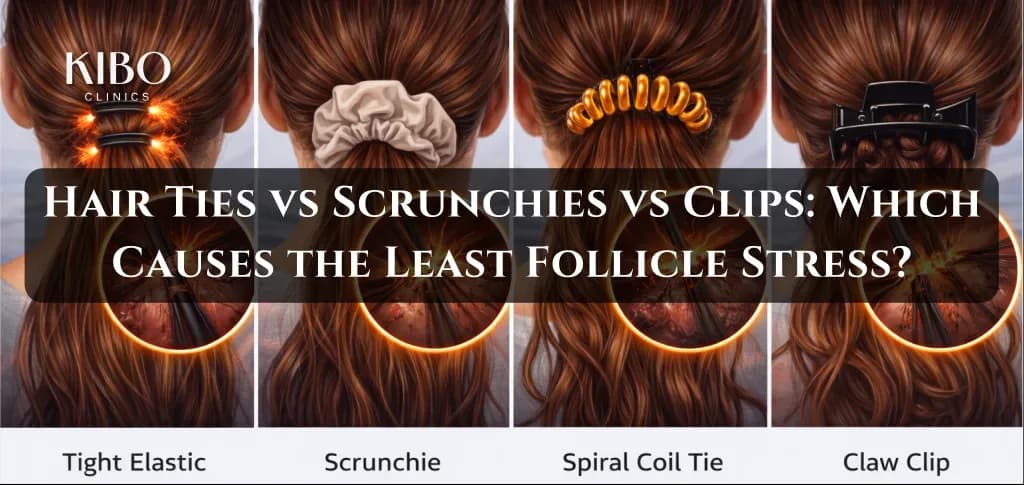
For most people, a soft, wide scrunchie worn loosely is the safest everyday choice. A smooth claw clip can also be gentle when it fits the amount of hair and does not press into the scalp. Thin elastics are more likely to concentrate tension and snag strands, especially when they are tight, worn in the same position or removed roughly.
The accessory name does not decide the risk by itself. A tight silk scrunchie can still pull follicles. A smooth elastic worn loosely may be safer than a heavy claw clip. The key variables are tension, surface roughness, weight, placement, duration and the condition of the hair.
Hair Accessory Comparison at a Glance
| Accessory | Main advantage | Main risk | Best use |
|---|---|---|---|
| Fabric scrunchie | Spreads force over a wider area | Can still pull when wrapped tightly | Loose daily ponytails and sleep styles |
| Claw clip | Avoids circular elastic compression | Pressure points, sharp seams or local breakage | Low-tension updos with a correctly sized clip |
| Spiral coil tie | Distributes contact over a longer spiral | Can tangle or overstretch fine and curly hair | Shorter wear and active days |
| Thin elastic | Strong hold and compact size | Concentrated pressure, snagging and breakage | Occasional loose use, not repeated tight styling |
Why Tight Accessories Can Damage Hair
Hair damage can occur at two levels. Mechanical friction can fracture the shaft, producing short broken hairs and split ends. Repeated pulling can also stress the follicle and cause traction alopecia. Dermatology guidance consistently identifies tight ponytails, buns, braids and extensions as preventable causes of traction-related hair loss.
Early traction alopecia may improve when the pulling stops. Continued tension can lead to inflammation and eventually scarring, at which point full regrowth becomes less likely. Pain is not a sign that a hairstyle is secure. It is a reason to loosen it.
Are Scrunchies Better for Hair?
Scrunchies are usually gentler because fabric covers the elastic and increases the contact area. This reduces direct rubbing and lowers the chance that individual strands become trapped in exposed rubber or metal joints.
Material still matters. Smooth silk or satin creates less surface friction than rough fabric, but there is no strong clinical evidence supporting exact percentage reductions in follicle stress. The practical benefit comes from wider pressure distribution and easier removal, not from a guaranteed damage-free material.
Are Claw Clips Safer Than Hair Ties?
Claw clips can reduce circular tension because they hold a folded section of hair rather than compressing a ponytail with elastic. They may be helpful for thick hair that requires several tight elastic wraps.
A clip can still cause damage when it is too small, too heavy, cracked or worn in the same place every day. Teeth and hinges can pinch strands. A hard clip pressed against the scalp can also cause discomfort, and wearing a large rigid clip while driving may create an avoidable injury risk during impact.
Are Spiral Hair Ties Good for Hair?
Spiral ties spread contact across a coiled surface and may leave less of a crease than a narrow elastic. They can work well for exercise or shorter wear. They are not automatically ideal for every texture.
Fine, porous, curly or tangled strands may catch between coils during removal. Stretch the coil gently, unwind it and avoid pulling it straight through the ponytail. Replace ties that become rough, cracked or permanently distorted.
Why Thin Elastics Cause More Breakage
A narrow elastic places the holding force over a small band of hair. When wrapped several times, it can create a sharp bend point that is repeatedly stressed during movement and sleep. Exposed rubber and metal joins can also snag the cuticle.
The greatest risk comes from tightness and removal technique. Pulling the elastic off in one motion drags against the fibre. Unwind it one loop at a time and discard accessories with broken coating or rough edges.
Can Hair Ties Cause Permanent Hair Loss?
Yes, but usually only when repeated tension causes traction alopecia over time. The highest-risk patterns include daily tight ponytails, buns, braids or extensions, especially when pain, bumps and broken hairs are ignored.
Early signs include tenderness, itching, redness, small bumps and short broken hairs around the hairline. Later, the part or edge may look smooth and shiny as follicles scar. Read about tension-based hair damage and traction alopecia from tight hairstyles.
How Tight Is Too Tight?
- The style causes pain, headache or scalp tenderness
- The skin around the hairline looks pulled or raised
- You see bumps, redness or crusting
- Short hairs repeatedly snap near the tie point
- The accessory leaves a deep mark for hours
- You need several forceful wraps to keep the style in place
- The hairstyle pulls when you turn your head
A style that hurts is too tight. Do not wait for visible thinning before changing it.
Is It Safe to Tie Wet Hair?
Wet hair is more extensible and can stretch farther before breaking. Tying it tightly while swollen can create a fixed bend point and increase tangling as it dries. Bleached, chemically straightened or heat-damaged hair is particularly vulnerable.
Blot gently, allow the hair to dry partially and use a loose accessory. Read wet-hair styling and root vulnerability and humidity and mechanical hair stress.
Which Accessory Is Best for Sleeping?
A loose silk or satin scrunchie is usually the most practical option for a low braid or loose top knot. Avoid thin elastics, tight high ponytails and hard claw clips during sleep. A rigid clip can press into the scalp and concentrate force when the head rests against a pillow.
The hairstyle should remain loose enough that you can move your head without feeling pull. See night-time hair care to reduce breakage and silk pillowcases and hair health.
Best Choice for Fine, Thick, Curly and Damaged Hair
| Hair type | Lower-risk choice | What to avoid |
|---|---|---|
| Fine hair | Small soft scrunchie or light smooth clip | Heavy clips and tight coils |
| Thick hair | Large scrunchie or correctly sized claw clip | Small elastics requiring many wraps |
| Curly or coily hair | Smooth wide scrunchie and low-tension sectioning | Rough seams and accessories that snag coils |
| Bleached or damaged hair | Soft fabric accessory with minimal wraps | Thin elastic on wet hair |
How to Tie Hair With Less Damage
- Choose the correct size: the accessory should hold without several forceful wraps.
- Keep the style loose: no pain, pulling or scalp distortion.
- Rotate the position: alternate low, mid and loose styles rather than stressing one zone daily.
- Dry hair partially first: avoid a tight style on fully wet hair.
- Smooth tangles before tying: do not force an accessory through knots.
- Remove it slowly: unwind ties and open clips before sliding them out.
- Inspect the accessory: discard cracked clips, exposed rubber and rough seams.
- Give the scalp breaks: wear hair down or in a low-tension style when practical.
Should You Change the Position Every Day?
Yes. Repeating the same high ponytail or clip position concentrates stress on the same shafts and follicles. Rotating the location changes the load pattern and gives previously stressed areas time to recover.
Position change is helpful but does not make a very tight style safe. Lower tension remains the most important factor.
What to Do If You Notice Breakage
Stop using the accessory that repeatedly catches or pulls. Reduce heat and chemical processing, trim split ends when needed and use conditioner to reduce detangling force. A broken shaft cannot be permanently fused back together by oil or serum.
See the guides to hair brushes and combs, sleeping positions and friction and how to thicken thin hair naturally.
When to See a Dermatologist
Book an assessment for persistent tenderness, bumps, redness, broken hairs at the hairline, progressive edge thinning, a widening part or smooth shiny areas. Sudden round patches or diffuse shedding may have another cause and should not be blamed on accessories without examination.
Useful comparisons include dermatologist versus trichologist, hair loss in women and alopecia areata regrowth.
What This Means for You
A scrunchie is usually the gentlest default, a smooth claw clip can be a useful low-tension alternative, and thin elastics deserve the most caution. Yet the safest accessory can still cause damage when it is tight, heavy or worn in the same position for many hours.
Choose low tension, smooth surfaces and slow removal. Pain, bumps and progressive thinning are not normal styling effects and should be addressed early.
Need help assessing hairline breakage or possible traction alopecia?
Frequently Asked Questions
Are scrunchies better than hair ties?
Usually, because their wider fabric surface spreads pressure and reduces snagging. They can still damage hair when wrapped too tightly.
Are claw clips healthier for hair?
They can reduce circular elastic tension, but heavy, sharp or poorly fitting clips can create pressure points and local breakage.
Do thin elastics cause hair loss?
They can contribute to shaft breakage and, when used in tight repeated styles, traction alopecia.
Can scrunchies cause traction alopecia?
Yes. Any accessory can contribute if it holds a tight hairstyle that repeatedly pulls the same follicles.
Are spiral hair ties safe?
They may distribute pressure more widely, but coils can catch fine, curly or damaged hair during removal.
Is it bad to tie wet hair?
Wet hair stretches more easily and may break when tied tightly. Allow partial drying and use a loose, soft accessory.
What is the best hair accessory for sleeping?
A loose silk or satin scrunchie used for a low braid or loose top knot is usually more suitable than a thin elastic or hard clip.
How do I know if my ponytail is too tight?
Pain, headache, scalp tenderness, bumps, pulled skin or short broken hairs are warning signs.
Can traction alopecia grow back?
Early traction alopecia may improve after tension stops. Long-standing disease can scar follicles and become permanent.
Should I change ponytail position daily?
Yes. Rotating position reduces repeated stress on the same shafts and follicles, although lower tension is still essential.
Which hair accessory is best for fine hair?
A small, lightweight fabric scrunchie or smooth light clip is usually preferable to a heavy clip or tight thin elastic.
When should I see a dermatologist?
Seek assessment for persistent pain, bumps, progressive hairline thinning, smooth shiny areas, sudden patches or unexplained shedding.
Want a diagnosis-led plan for breakage or traction-related thinning?
Why Kibo Clinics
Kibo Clinics separates shaft breakage from follicular traction and other forms of hair loss. The assessment considers accessory use, hairstyle position, scalp findings, chemical exposure and the pattern of thinning.
The doctor who conducts your consultation is the same doctor who handles your treatment through every stage.
Explore Kibo Clinic Services
Hair Transplant: FUE Hair Transplant | Sapphire FUE | Direct Hair Transplant | Bio FUE | Real Time FUE | Corrective Hair Transplant | Hairline Correction | Unshaven Hair Transplant | Body Hair Transplant
Non-Surgical: PRP Therapy | GFC Therapy | Mesotherapy | Microneedling | Low-Level Laser Therapy | IV Hair Boosters |
Medical Disclaimer : Information from Kibo Hair Clinics is for educational purposes only. It does not replace diagnosis, trichoscopy, blood test interpretation, prescription treatment, procedure advice, or side-effect counselling from a qualified dermatologist or hair restoration doctor.