
Reviewed By:
Shritej Mali
Independent Research Reviewer
Reviewing peer-reviewed studies and medical literature for evidence-based accuracy.
Written By: Kibo Clinics Content Team
Sources Referenced: American Academy of Dermatology, International Journal of Trichology, textile-friction research, ClinicalTrials.gov and peer-reviewed hair-fibre reviews
Last Updated: July 17, 2026
Reading Time: 10 minutes
֎ Show Quick Answer
AI Quick answer summary
- Silk pillowcases can reduce overnight friction: the smoother surface may reduce tangles, frizz and mechanical breakage, particularly in curly, long, bleached or fragile hair.
- They do not treat hair loss: a pillowcase cannot reverse androgenetic alopecia, hormonal shedding, iron deficiency, alopecia areata or scalp disease.
- Silk is not automatically superior to every satin product: silk is a fibre, while satin is a weave. A smooth synthetic satin pillowcase may provide similar friction reduction at a lower price.
- Evidence is supportive but limited: dermatology guidance supports silk or satin to reduce friction, but direct clinical trials measuring hair growth or density are lacking.
- Buy for smoothness and practicality: check genuine fibre content, construction, care instructions and comfort rather than relying on exaggerated momme or “hair-growth” claims.
Do Silk Pillowcases Really Help Hair?
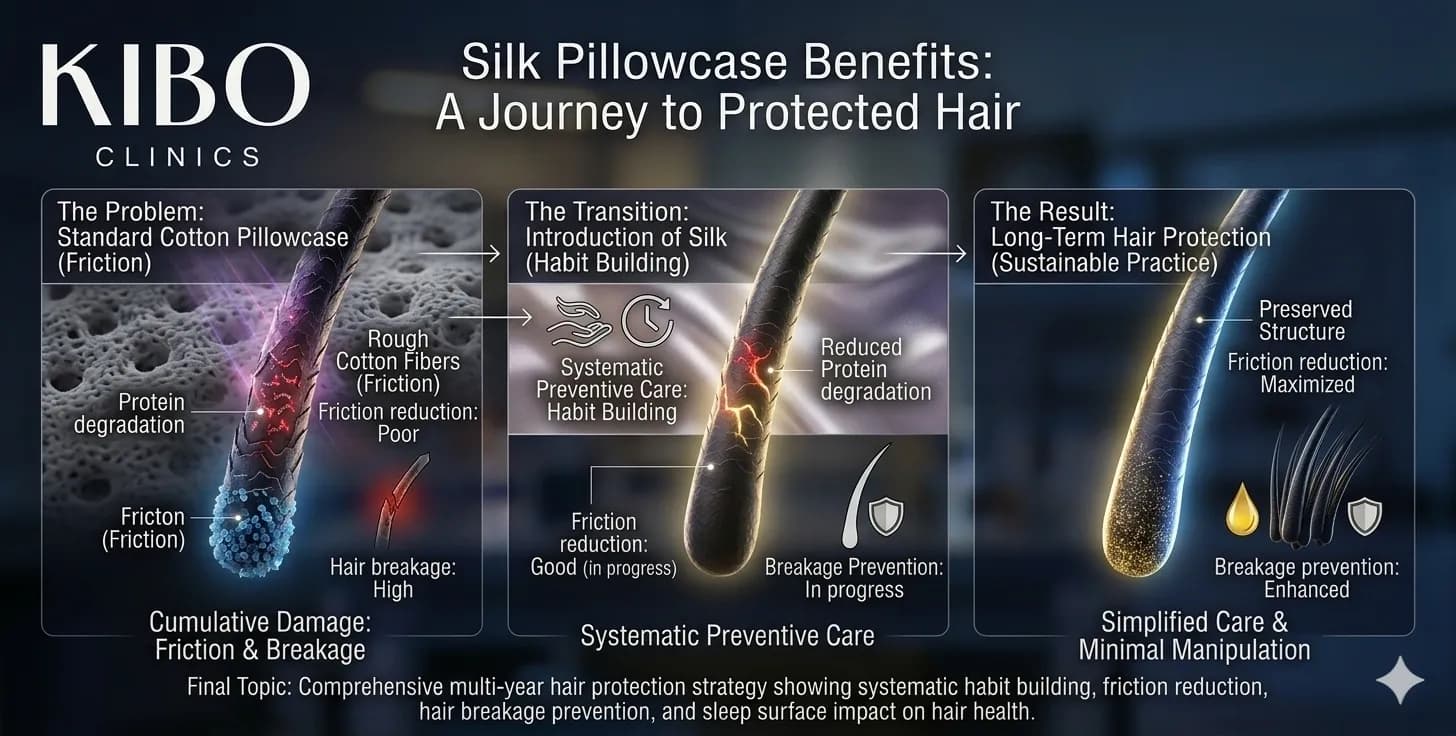
Silk pillowcases can help reduce friction-related hair damage, but they are not a treatment for hair loss. A smoother sleep surface lets strands move with less snagging as you turn during the night. That can mean fewer morning tangles, less frizz and less repeated abrasion of the cuticle.
The American Academy of Dermatology advises people with curly hair that silk or satin bonnets and pillowcases may reduce friction and help preserve the hairstyle. That guidance supports a practical benefit, but it does not prove that silk increases follicle growth, hair density or the duration of the anagen phase.
The key distinction is between hair breakage and hair shedding from the root. A smoother pillowcase may reduce breakage along the shaft. It cannot correct DHT-related hair loss, thyroid disease, iron deficiency or an inflammatory scalp condition.
How a Silk Pillowcase May Protect the Hair Shaft
| Mechanism | Possible Benefit | Important Limit |
|---|---|---|
| Lower surface friction | Less snagging and tangling | Does not stop follicular shedding |
| Less repeated abrasion | May reduce cuticle wear and frizz | Cannot repair existing split ends |
| Smoother movement during sleep | May preserve curls and blowouts | Results vary with weave and hair type |
| Different moisture absorption | May help some hair feel less dry | Direct hair-hydration trials are limited |
Hair-fibre reviews describe friction, combing and repeated grooming as contributors to cuticle weathering. A smooth pillowcase is therefore best understood as one friction-reduction step within a wider routine. It works alongside conditioning, gentle detangling and lower-tension styling rather than replacing them.
The same principle applies to sleeping positions that reduce hair friction and night-time hair care. If the hair is tightly tied, soaking wet or heavily tangled, changing only the pillowcase may have a limited effect.
What the Research Actually Shows
Direct clinical research on silk pillowcases and hair outcomes is sparse. There is no strong peer-reviewed trial showing that silk pillowcases increase hair count, reverse miniaturisation or reduce androgenetic alopecia. Claims that they improve hair growth by a fixed percentage should therefore be treated cautiously.
The stronger support is indirect and mechanical. AAD guidance recognises that silk or satin sleep surfaces may reduce friction for curly hair. Hair-science literature also establishes that repeated friction and grooming can roughen the cuticle and contribute to breakage. ClinicalTrials.gov has recorded pillowcase studies for skin conditions, but that is not the same as proof of hair regrowth.
This is why the article avoids unsupported universal figures such as “43% less breakage” or “34% lower friction” unless the exact test method, fabric, hair type and independent source are available. A laboratory textile comparison cannot automatically predict clinical results for every person.
Silk vs Satin vs Cotton for Hair
| Material | What It Means | Hair-Care Advantage | Trade-Off |
|---|---|---|---|
| Silk | Natural protein fibre | Smooth, breathable and low-friction when well made | More expensive and needs careful washing |
| Satin | A weave, often polyester | Smooth and usually more affordable | Breathability and heat retention vary |
| Cotton | Natural cellulose fibre | Durable, easy to wash and breathable | Some weaves create more friction |
| Bamboo-derived rayon | Regenerated cellulose textile | Can feel smooth and cool | Performance depends on weave and finish |
Silk and satin are not interchangeable terms. Silk describes the fibre. Satin describes how fibres are woven. A genuine silk pillowcase may be satin-woven, while a polyester pillowcase can also use a satin weave.
For hair, the practical variables are surface smoothness, seam placement, breathability, cleaning and whether the case remains smooth after washing. A well-made synthetic satin case may be a sensible lower-cost alternative. Cotton is also acceptable when the weave is smooth and the rest of the routine is gentle.
Who Is Most Likely to Benefit?
The benefit is most noticeable when hair is already prone to friction damage. Long hair has older, more weathered ends. Curly and tightly textured hair can tangle more easily because neighbouring fibres interact at multiple angles. Bleached, coloured, chemically straightened and heat-styled hair also has less tolerance for repeated abrasion.
- Curly, coily or highly textured hair
- Long hair that tangles during sleep
- Fine, dry, bleached or chemically treated hair
- Hairline breakage from repeated friction or styling
- People preserving a blowout, curls or protective style overnight
A silk pillowcase is less likely to change a problem caused by active scalp disease or follicular miniaturisation. If the concern is a widening part, temple recession or crown thinning, compare hair loss in women and receding hairline causes.
Does Momme Weight Matter?
Momme is a textile-weight measurement commonly used for silk. A higher number usually indicates a denser, heavier fabric, but it does not directly measure hair benefit. No clinical study establishes that 22 momme prevents more breakage than 19 or 25 momme.
For daily use, choose a pillowcase that feels smooth, is opaque enough for durability and can be washed according to your routine. Fibre authenticity matters if you are paying for silk. Look for clear composition labelling rather than relying only on words such as “silky,” “silk feel” or “premium satin.”
Construction also matters. Rough zips, exposed seams or pilling can reduce the advantage of the fabric. A hidden closure and smooth internal stitching are practical features, but none should be marketed as a medical treatment.
How to Choose and Use a Silk Pillowcase
- Check the fibre label: confirm whether it is genuine silk or synthetic satin.
- Feel the surface: choose a smooth fabric without rough embroidery or exposed seams.
- Prioritise washability: follow the care label and avoid buying a fabric you cannot maintain.
- Wash before use: remove finishing residues and keep the case clean.
- Dry hair before bed: wet hair stretches and tangles more easily, as explained in wet-hair styling damage.
- Use a loose night style: avoid tight ponytails or buns that add traction.
- Track the right outcome: assess tangles, frizz and broken pieces rather than expecting new follicle growth.
Common Claims That Go Beyond the Evidence
“Silk pillowcases regrow hair”
They do not stimulate follicles or block DHT. Less breakage can make hair appear fuller because more length is retained, but that is different from new growth.
“Silk repairs split ends”
A smoother surface may reduce additional wear. Existing split ends cannot fuse permanently and usually need trimming.
“Silk is naturally antibacterial and never needs frequent washing”
A pillowcase collects oil, sweat, skin cells and hair products. Wash it regularly according to the care label, particularly when scalp oiliness or dandruff is present.
When a Pillowcase Is Not the Answer
A pillowcase will not correct progressive pattern loss, alopecia areata, fungal infection, scarring alopecia or telogen effluvium. Seek assessment when loss is sudden, patchy, painful, associated with scaling or accompanied by a widening part or receding hairline.
A clinician can separate broken shafts from full-length shedding and follicular miniaturisation. The guide to trichologist versus dermatologist explains who should evaluate medical warning signs. Blood tests may be considered when history suggests iron, thyroid or nutritional causes, as covered in blood tests for hair fall.
What This Means for You
A silk pillowcase is a reasonable friction-reduction tool, especially for curly, long, bleached or fragile hair. It may improve morning manageability and reduce tangling, but the expected benefit is cosmetic and mechanical.
Choose based on smoothness, comfort, care and budget. Do not pay a premium for unsupported hair-growth claims. If thinning continues despite gentler care, investigate the cause instead of changing fabrics repeatedly.
Need help distinguishing breakage from progressive thinning?
Frequently Asked Questions
Do silk pillowcases really help hair?
They can reduce overnight friction, tangling and frizz, especially in curly, long, dry, bleached or fragile hair. They do not treat genetic, hormonal, nutritional or inflammatory hair loss.
Can a silk pillowcase stop hair fall?
It may reduce shaft breakage that looks like hair fall, but it cannot stop hairs shedding from the follicle. Persistent shedding or progressive thinning needs diagnosis.
Is silk better than satin for hair?
Both can provide a smooth, lower-friction surface. Silk is a natural fibre, while satin is a weave that is often made from polyester. The better choice depends on smoothness, comfort, care requirements and budget.
Is cotton bad for hair?
Cotton is not inherently harmful. Rougher cotton weaves may create more friction and tangling in vulnerable hair, but gentle styling and good conditioning matter more than fabric alone.
What momme weight is best for a silk pillowcase?
A mid-range silk weight is usually practical for durability and softness, but no clinical study proves that one momme number improves hair outcomes. Fibre authenticity and surface smoothness matter more than marketing claims.
How long does it take to notice a difference?
Frizz and morning tangles may improve within days or weeks. Reduced breakage takes longer to judge because it depends on your full routine, hair condition and how consistently the pillowcase is used.
Should curly hair use silk or satin at night?
Either can reduce friction. A silk or satin pillowcase, bonnet or scarf may help preserve curls, and the American Academy of Dermatology specifically notes these options for reducing friction.
Can silk pillowcases repair split ends?
No. They may reduce further friction, but split ends cannot be biologically repaired. Damaged ends need conditioning, protection and eventual trimming.
How often should I wash a silk pillowcase?
Wash it regularly according to the care label, especially if you use leave-in products or have an oily scalp. A pillowcase is not self-cleaning or antibacterial by default.
When should hair loss be assessed instead of changing bedding?
Seek assessment for a widening part, receding hairline, crown thinning, patches, scalp pain, scaling or continued full-length shedding. These signs are not explained by pillowcase friction alone.
Want a diagnosis-led plan for hair loss or breakage?
Why Kibo Clinics
Kibo Clinics separates shaft breakage from shedding and progressive follicular hair loss before discussing treatment. Examination considers the pattern, scalp findings, timeline, styling routine and whether trichoscopy or targeted testing is needed.
The doctor who conducts your consultation is the same doctor who handles your treatment through every stage.
Explore Kibo Clinic Services
Hair Transplant: FUE Hair Transplant | Sapphire FUE | Direct Hair Transplant | Bio FUE | Real Time FUE | Corrective Hair Transplant | Hairline Correction | Unshaven Hair Transplant | Body Hair Transplant
Non-Surgical: PRP Therapy | GFC Therapy | Mesotherapy | Microneedling | Low-Level Laser Therapy | IV Hair Boosters | PDO Threads | Exosome Therapy
Explore More
Night-Time Hair Care: Low-Stress Hair Care | Minimalist Hair Care | Hair Ties vs Scrunchies vs Clips | Hair Accessories and Hidden Pulling
Breakage and Styling:
Medical Disclaimer : Information from Kibo Hair Clinics is for educational purposes only. It does not replace diagnosis, trichoscopy, blood test interpretation, prescription treatment, procedure advice, or side-effect counselling from a qualified dermatologist or hair restoration doctor.