
Who This Is For: Anyone who wakes up to hair on the pillow and wants to know whether their bedtime habits are to blame, what is worth changing, and when it is more than breakage.
A night routine may reduce breakage by avoiding sleep with soaking-wet hair, minimising rough towel friction, detangling gently, and avoiding tight styles. It does not treat androgenetic alopecia, telogen effluvium, alopecia areata, or scarring hair loss. Persistent thinning, patchy loss, scalp inflammation, or increased shedding needs dermatological assessment.
What Hair on Your Pillow Can Mean
Some hair on the pillow is normal. Everyone sheds hair every day, and a pillow is where a night's worth of loose hairs collects. What matters is what kind of hair it is. Shedding releases full-length hairs from the follicle, while breakage snaps hairs along the shaft and leaves short fragments, split ends, a rough texture, uneven lengths, and more tangling. Many people have both at once, and telling them apart by eye is harder than it sounds: the clinical literature itself notes that the difference is not always clear from the patient's point of view, a point we confirmed in a 2015 review of hair cosmetics in the International Journal of Trichology.
| What You See | What It Usually Points To | What to Do |
|---|---|---|
| Short pieces, split ends, rough or snapping hair, uneven lengths | Breakage along the shaft | Reduce friction, heat, and tension, and handle hair gently |
| Full-length hairs, often with a small bulb at the root | Shedding from the follicle | If it is new, heavy, or persistent, have it assessed |
| A widening part, a receding hairline, patchy bald areas, scalp redness, scale, or pain | A pattern or scalp condition, not a bedtime habit | See a dermatologist for a diagnosis |
Hair on a pillow therefore proves very little about the cause. A bedtime habit may be adding to breakage, but pattern recession, a widening part, diffuse shedding, sudden patches, pain, scale, and scalp redness all need diagnosis, and a pillowcase will not explain them. Our guides to hair breakage causes and treatments and shedding versus mechanical breakage cover the difference in more detail, and the types of hair loss is the place to start if the pattern worries you.
Why Night-Time Handling Matters
Hair spends hours rubbing against bedding every night, and how you handle it before bed decides how much of that rubbing it has to absorb. Laboratory work summarised in the 2015 review found that wet virgin hair can stretch by about 30% of its length without damage, but that stretching beyond that point causes irreversible changes. Combing matters too. The same review reports that combing dry hair is more linked to short breaks and split ends, while wet combing is linked to longer breaks. In plain terms, hair can be damaged whether it is wet or dry, so the answer is gentleness at both stages and not one perfect rule. Our guide to wet-hair styling and root vulnerability covers the wet side in more depth.
A Gentle Bedtime Routine
This routine follows the American Academy of Dermatology (AAD) guidance on how to stop damaging your hair, and we say plainly where that guidance runs out.
- If your hair is wet, blot it or wrap it in a towel to absorb the water instead of rubbing it, and let it air dry as far as is practical before you sleep.
- Detangle gently with a wide-tooth comb. If your hair is straight, let it dry a little first. If it is textured or tightly curled, comb it while damp, with care.
- Keep heat low. Let hair air dry when you can, use the lowest heat setting if you use a dryer, and limit hot combs and curling irons, which AAD advises using once a week or less.
- Wear your hair loose, or in a low-tension style, with no tight band at the hairline. If you use bands, choose covered ones made for styling hair, and change the style if the same spot is pulled every night.
- Wash gently and condition. Massage shampoo into the scalp, let the rinse water flow through the lengths without rubbing them, and use conditioner after every shampoo.
How often to wash depends on your scalp oiliness, sweat, pollution, any medical treatment, and your hair texture, so there is no universal number, and our page on frequent washing explains why. Our guides to brushes and combs, hair ties, scrunchies and clips, and hair dryer heat go through the tools.
Pillowcases, Oils and Leave-On Products
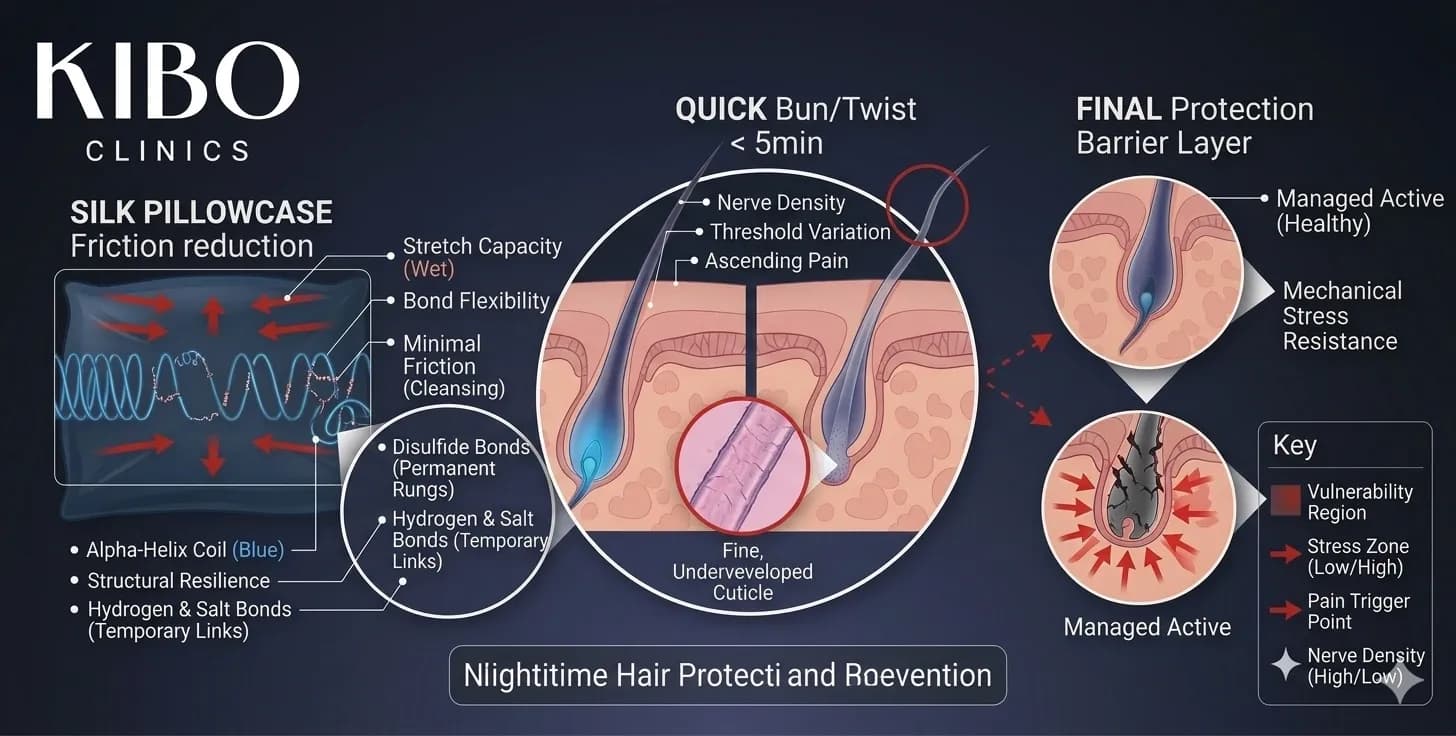
A smooth, clean pillow surface may reduce tangling for some hair types, and it is a reasonable, low-risk change. What it cannot do is change how a follicle behaves. We looked for independent clinical trials showing that satin or silk pillowcases reduce breakage or regrow hair and did not find any. The friction figures that circulate online come largely from tests commissioned by pillowcase brands. So we treat satin and silk as a friction-reduction option and not as a treatment. Our pages on silk pillowcases and hair health and sleeping positions and hair friction go further.
Overnight oiling is a similar story. Laboratory studies on hair tresses, summarised in the same 2015 review, found that some oils reduced combing force and the formation of split ends, while butters increased combing force. That is evidence about the shaft under test conditions, not about the follicle or regrowth, and it does not make oiling a treatment for hair loss. Oils and leave-on products can also irritate a sensitive scalp or add to buildup, so use only what suits your scalp and stop if you get itching, rash, or burning. See miracle hair-growth oils, DIY hair masks, and scalp buildup for more.
What to Avoid
- Rubbing wet hair with a towel
- Brushing wet hair hard, or brushing 100 strokes a day, which AAD calls a myth
- High heat and frequent hot tools
- Tight ponytails, buns, braids, or bands that pull on the same follicles night after night, and heavy extensions or weaves worn for long periods
- Stacking chemical treatments, such as colouring, perming, and relaxing, close together
Tension deserves its own warning, because it is the habit on this list that can lead to permanent loss. Tight hairstyles are the commonest cause of traction alopecia, and when the pulling continues for long enough it can destroy the follicle, so the hair loss becomes permanent. Stopping tight styles is the most important step, according to the British Association of Dermatologists, and early traction can recover once the tension stops. Our guides to traction from tight buns, moving away from tight styles, and tension-based hair damage cover it.
Sleep, Stress and Nutrition: A Short Note
Sleep, stress, nutrition, and some medicines can influence shedding, but we cannot promise that fixing any one of them will regrow hair, and a night-time routine does not address them. A significant illness, surgery, childbirth, or period of severe stress a few months earlier can trigger a temporary diffuse shedding called telogen effluvium, and a low iron level may be involved in some people. If shedding has been heavy or has lasted, it needs assessment and not guesswork. See stress-induced hair loss and telogen effluvium and iron deficiency and hair thinning.
When the Routine Is Not Enough
If gentler handling does not help, your hair care may not be the cause, as AAD guidance itself says. See a dermatologist for any of the following:
- Progressive thinning, or a widening part
- Patchy hair loss
- Full-length shedding that persists
- Scalp pain, redness, scale, or pustules
- Signs of scarring
- No improvement after a period of gentle care
Most causes can be stopped or treated, and the sooner the problem is addressed, the better the results, according to AAD guidance. Our guides to androgenetic alopecia, telogen effluvium, alopecia areata, and dermatologist versus trichologist explain what an assessment looks for.
Hair on the pillow that keeps increasing, or thinning that is not improving? A scalp assessment can tell breakage from loss.
Kibo Clinics' Perspective on Night-Time Hair Care
Night-time care is worth doing and easy to oversell. A gentler routine can cut down on avoidable breakage, but it is not a treatment, and much of the advice online promises more than a pillowcase or an oil can deliver.
At Kibo Clinics, our doctors believe the most useful thing a hair-care guide can do is help you tell breakage from loss, because the two need different answers.
If your hair is thinning, shedding more than usual, or not improving with gentle care, a dermatologist-led Kibo Clinics team can examine your scalp and tell you which one you are dealing with.
Frequently Asked Questions
Is sleeping with wet hair a cause of baldness?
No. Wet hair stretches and tangles easily, so it is worth avoiding friction while it is damp, but sleeping with wet hair does not by itself cause or prove follicle-level baldness.
Does a satin pillowcase stop hair loss?
It may reduce friction and tangling for some people, which could reduce breakage. It does not treat genetic, autoimmune, inflammatory, nutritional, or stress-related hair loss, and we found no independent clinical trials showing that it regrows hair.
Should I tie my hair at night?
If tying is comfortable, use a loose, low-tension style that does not pull on the hairline or the same follicles every night. Tight styles can contribute to traction alopecia, which can become permanent if follicles are damaged.
Does overnight oiling regrow hair?
No. There is no basis to present ordinary overnight oiling as a proven treatment for hair loss. Some oils reduced combing force and split ends in laboratory studies on hair tresses, but that concerns the shaft and not regrowth, and persistent thinning needs diagnosis.
Why is there hair on my pillow?
Everyone sheds hair daily, so some is normal. Hair on a pillow can be normal shedding, breakage, or both, and the amount alone does not tell you which. Increased shedding, a widening part, or patches need assessment.
How do I tell breakage from shedding?
Breakage leaves short fragments, split ends, uneven lengths, and a rough texture. Shedding releases full-length hairs, often with a small bulb at the root. You can have both, and if you are unsure, a dermatologist can tell.
When should I see a dermatologist?
See one for progressive thinning, patchy loss, full-length shedding that persists, scalp pain, redness, scale, or pustules, signs of scarring, or no improvement after gentle care.
References
We referred to the following guidelines, patient-information pages, and peer-reviewed studies when preparing this guide, and we have named them in full so that you can check them yourself.
- American Academy of Dermatology. Stop damaging your hair. Patient guidance.
- British Association of Dermatologists. Traction alopecia: patient information leaflet.
- Gavazzoni Dias MF. Hair cosmetics: an overview. Int J Trichology. 2015;7(1):2-15.
Related Articles & Services
Hair Transplant
FUE Hair Transplant | Sapphire FUE Hair Transplant | Real-Time FUE Hair Transplant | Bio FUE Hair Transplant | Unshaven Hair Transplant | Direct Hair Transplant (DHT) | Body Hair Transplant | Corrective Hair Transplant | Hairline Correction
Hair Regrowth
Exosomes Therapy | GFC Therapy | IV Hair Boosters | Low-Level Laser Therapy | Mesotherapy for Hair Regrowth | Microneedling for Hair Regrowth | PDO Threads for Hair Regrowth | PRP Therapy
Must Read
A Long-Term Plan to Prevent Hair Stress | Minimalist Hair Care for Follicle Protection | Hair Myths Busted | Why Scalp Hygiene Matters
Relevant Blogs
Low-Stress Hair Care for Busy Professionals | Hair Accessories and Hidden Pulling | Hair Extensions and Traction Alopecia Risk | Humidity, Hair Texture, and Breakage | Hair Elasticity and Stress Resistance | Sulfate-Free vs Regular Shampoo
Medical Disclaimer : Information from Kibo Hair Clinics is for educational purposes only. It does not replace diagnosis, trichoscopy, blood test interpretation, prescription treatment, procedure advice, or side-effect counselling from a qualified dermatologist or hair restoration doctor.