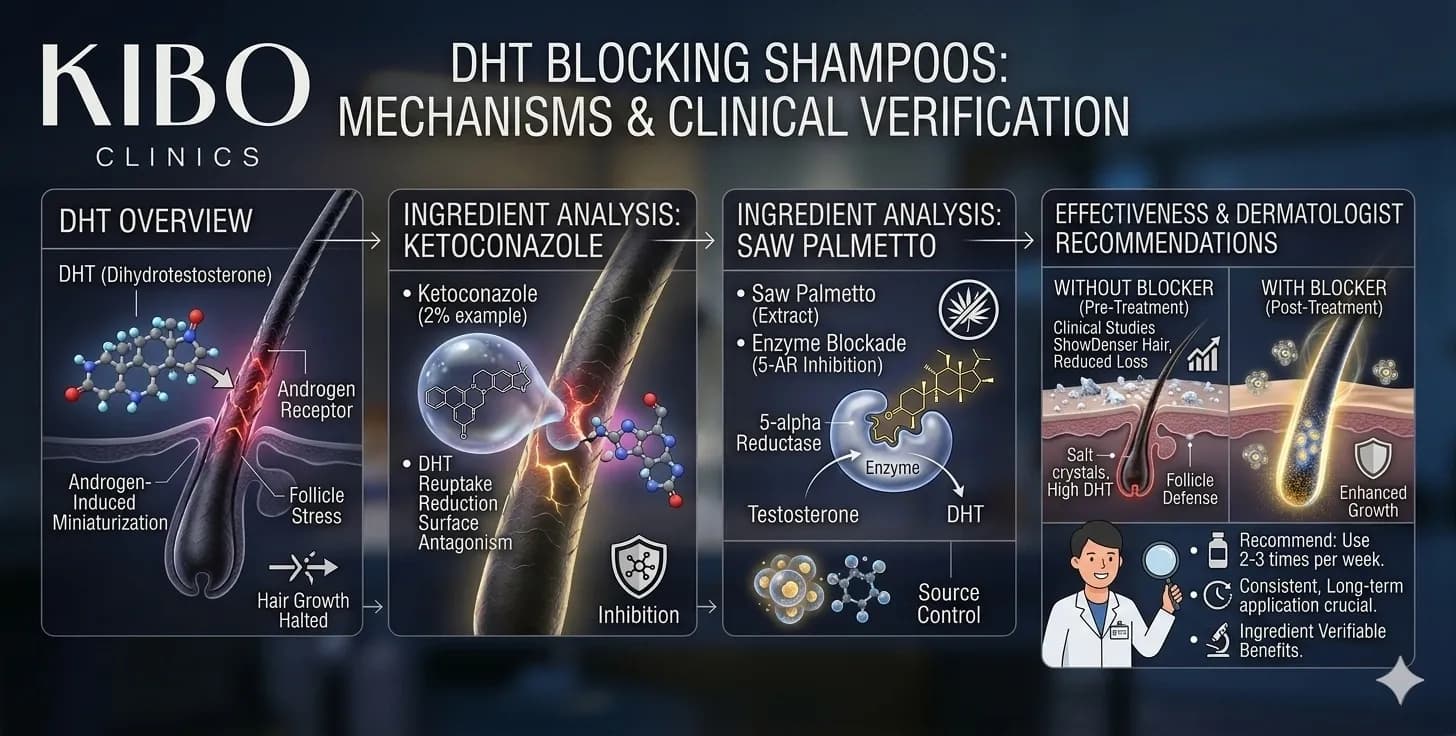
DHT-blocking shampoos can be useful as supportive scalp care, but they are not proven substitutes for established androgenetic alopecia treatment. Among commonly marketed ingredients, ketoconazole has the strongest adjunctive evidence, particularly when dandruff or seborrhoeic dermatitis is also present. Caffeine has some shampoo-specific clinical data. Saw palmetto, pumpkin seed oil and green-tea or multi-botanical formulas have weaker or more indirect evidence.
The phrase “DHT-blocking shampoo” is largely a marketing category rather than a single medically standardised treatment class. A bottle may contain an antifungal medicine, caffeine, botanical extracts or a mixture of cosmetic ingredients, but the label alone does not prove that enough active ingredient reaches the follicle or lowers scalp DHT to a clinically meaningful degree.
That distinction matters because DHT-related hair loss happens inside genetically sensitive follicles. Shampoo is in contact with the scalp for minutes. If your hairline is receding or your crown is progressively thinning, the correct diagnosis matters more than repeatedly changing bottles.
Do DHT-Blocking Shampoos Actually Work?
They may help, but “works” needs a precise definition. A shampoo can treat dandruff, reduce scalp inflammation, clean excess oil and improve the hair shaft. Some ingredients also have early or supportive research for androgenetic alopecia. What has not been established is that a rinse-off shampoo can consistently suppress the DHT pathway enough to match a prescription DHT-lowering medicine or reliably reverse advanced miniaturisation.
For someone with greasy scaling plus early pattern thinning, an antifungal shampoo may improve the scalp environment and complement the main hair-loss plan. For someone with a smooth bald temple or steadily widening part, relying on shampoo alone can delay more appropriate treatment.
Top 5 DHT-Shampoo Ingredients Ranked by Evidence
The ranking below compares the evidence behind ingredient categories, not commercial brands. Product formulas, concentrations and contact times vary, so a study on one preparation cannot automatically validate every shampoo carrying the same ingredient name.
| Rank | Ingredient Type | Evidence for Hair Loss | Most Realistic Role |
|---|---|---|---|
| 1 | Ketoconazole | Best supportive evidence among shampoo ingredients | Dandruff or seborrhoeic dermatitis with pattern thinning; possible adjunctive AGA benefit |
| 2 | Caffeine | Promising shampoo-specific human evidence, still limited | Supportive use for early thinning while medical treatment is considered |
| 3 | Saw palmetto | Plausible mechanism, weak shampoo-specific evidence | Optional botanical adjunct, not a natural substitute for prescription treatment |
| 4 | Pumpkin seed oil | Some topical or oral evidence, little rinse-off evidence | Conditioning and supportive use rather than proven scalp DHT suppression |
| 5 | Green tea or multi-botanical formulas | Mostly laboratory, indirect or mixed-formulation evidence | Cosmetic scalp support with low certainty for DHT-related regrowth |
1. Ketoconazole Shampoo: Strongest Supportive Evidence
Ketoconazole is an antifungal medicine used for dandruff and seborrhoeic dermatitis. That is its clearest evidence-based role. By reducing yeast activity and scalp inflammation, it can improve an unhealthy scalp environment that may otherwise worsen itching, scratching and shedding.
Published reviews have also found a possible adjunctive benefit in androgenetic alopecia, including changes in hair-shaft diameter and photographic appearance. The evidence is encouraging but small compared with established hair-loss treatments, and stronger controlled trials are still needed. If recurrent greasy scale is part of your problem, read more about seborrhoeic dermatitis and scalp flaking.
Best fit: pattern thinning with dandruff, greasy scale or scalp inflammation. Main limitation: it is not a proven standalone treatment for genetic miniaturisation and can dry or irritate some scalps.
2. Caffeine Shampoo: Promising, but Not Equivalent to Medical Therapy
Caffeine has biological activity in laboratory hair-follicle models, and some controlled shampoo studies have reported improvements in hair-pull or shedding-related measures. More recent research also suggests that caffeine-containing topical preparations may be useful for hair loss.
The limitation is that study designs, formulas and outcome measures vary. Reduced shedding is not the same as proven reversal of follicle miniaturisation. Caffeine shampoo is therefore better viewed as a supportive option rather than a replacement for diagnosis or an established leave-on or prescription treatment.
3. Saw Palmetto Shampoo: Plausible DHT Mechanism, Weak Rinse-Off Evidence
Saw palmetto is frequently marketed as a natural 5-alpha-reductase inhibitor. Research on oral supplements and some leave-on topical preparations suggests possible benefit in androgenetic alopecia. The problem is that these results cannot be transferred directly to a shampoo that is rinsed off after a short exposure.
If you are considering it, treat it as an optional adjunct and review the broader evidence on saw palmetto for DHT-related hair loss. Claims such as “natural finasteride shampoo” go beyond what shampoo-specific research currently proves.
4. Pumpkin Seed Oil Shampoo: Ingredient Evidence Is Not Shampoo Evidence
Pumpkin seed oil contains phytosterols and has been studied in oral and topical forms. A randomised trial in women with pattern hair loss reported improvement with topical pumpkin seed oil, but that study did not test a rinse-off shampoo.
In shampoo, pumpkin seed oil may help conditioning and scalp comfort. It is reasonable to regard it as a cosmetic supportive ingredient, but not as proof that the product suppresses enough scalp DHT to stop genetic hair loss.
5. Green Tea and Multi-Botanical Shampoos: Lowest Certainty
Green tea polyphenols and other botanical extracts have laboratory or early research suggesting antioxidant, anti-inflammatory or 5-alpha-reductase activity. Multi-ingredient shampoos are harder to judge because the dose of each ingredient may be unclear and the formula may not match the preparation used in research.
Biotin, amino acids, peptides and oils may improve hair feel or reduce breakage, but that is different from blocking DHT. If a product is being chosen mainly because it contains biotin, remember that shampoo choice should match the cause of hair fall, not the longest ingredient list.
If your hairline or crown is changing despite switching shampoos, a follicle-level assessment may be more useful than another product trial.
Can a Shampoo Really Lower Scalp DHT?
For most products, that claim has not been demonstrated with strong clinical evidence. Some ingredients have plausible anti-androgenic mechanisms, but showing activity in a laboratory or in a leave-on formula is not the same as proving clinically meaningful DHT reduction from a rinse-off shampoo.
This is also why ketoconazole sits at the top of the list for supportive evidence even though its clearest medical purpose is antifungal treatment. Its value is better supported than most botanical “DHT-blocker” labels, but it still does not have evidence comparable with established treatments designed to act on the follicle or DHT pathway.
How to Choose a DHT-Blocking Shampoo Without Falling for the Label
- Start with the scalp problem: If you have flakes, greasy scale or inflammation, choose an ingredient that treats that condition rather than a generic “hair fall” claim.
- Check the active ingredient: Look for a clearly named active and follow its labelled concentration and directions. A long botanical list does not prove effectiveness.
- Use the recommended contact time: Leaving shampoo on longer than directed can increase irritation without proving stronger DHT inhibition.
- Judge tolerance before hype: Burning, marked dryness, rash or worsening scale is a reason to stop and reassess the product.
- Track the right outcome: Use standardised monthly photographs and note scalp symptoms rather than judging progress by one shower or one wash day.
- Escalate progressive thinning: A widening part, temple recession or crown loss should trigger diagnosis rather than months of shampoo rotation.
DHT Shampoo vs Minoxidil and Finasteride: What Is the Difference?
A shampoo mainly cleans the scalp and provides short-contact ingredient exposure. Minoxidil is a leave-on hair-growth medicine used for suitable types of pattern hair loss. Finasteride is a prescription medicine that reduces conversion of testosterone to DHT and is used for selected men with androgenetic alopecia under medical supervision.
| Option | Main Role | Evidence Position | Key Limitation |
|---|---|---|---|
| DHT-blocking shampoo | Scalp care plus ingredient-specific support | Supportive evidence varies widely by ingredient | Brief rinse-off exposure and weak evidence for major follicle regrowth |
| Minoxidil | Supports hair growth and maintenance in suitable pattern loss | Established human evidence | Requires continued use and can irritate some scalps |
| Finasteride | Reduces DHT pathway activity in selected men | Established evidence for male pattern hair loss | Prescription treatment with contraindications and side-effect discussion |
They are not interchangeable. If you are comparing strengths or treatment routes, see the guide to 5% versus 10% minoxidil. If DHT-lowering medicine is being considered, review DHT-blocker side effects and monitoring with a clinician rather than self-prescribing.
When a DHT-Blocking Shampoo Is Not Enough
Do not keep changing shampoo when the pattern suggests a follicle disorder. A receding hairline, widening part, progressive crown thinning, clearly miniaturised hair or a strong family pattern needs proper assessment. Sudden diffuse shedding, patchy loss, scalp pain, pustules or scarring may point to a different diagnosis altogether.
A clinician may use history, scalp examination and trichoscopy to separate androgenetic alopecia from telogen effluvium, alopecia areata, inflammatory scalp disease or shaft breakage. When the history suggests a systemic trigger, targeted blood tests for hair fall may also be considered.
What This Means for You
If you want a DHT-blocking shampoo, choose it for a realistic reason. Ketoconazole is the strongest evidence-based adjunct when dandruff or seborrhoeic dermatitis overlaps with pattern thinning. Caffeine has some shampoo-specific human evidence. Saw palmetto, pumpkin seed oil and multi-botanical formulas are less certain and should not be treated as proven substitutes for medical therapy.
The most important question is not “Which shampoo blocks the most DHT?” It is “What is causing my thinning, and is a rinse-off product enough for that cause?” If the answer is progressive follicle miniaturisation, early diagnosis and a treatment plan usually matter more than moving from one anti-hair-fall bottle to another.
Want to know whether shampoo is enough for your current hair-loss pattern?
Frequently Asked Questions
Do DHT-blocking shampoos actually work?
They can support scalp health and may reduce shedding in selected situations, but a rinse-off shampoo has limited evidence for meaningfully reversing genetic follicle miniaturisation. The result depends on the ingredient, formulation, contact time and the actual cause of your hair loss.
What is the best DHT-blocking shampoo ingredient?
Ketoconazole has the strongest supportive evidence, especially when dandruff or seborrhoeic dermatitis coexists with pattern thinning. Its role is still adjunctive. It should not be treated as a replacement for established medical treatment of androgenetic alopecia.
Does ketoconazole shampoo block DHT?
Ketoconazole has possible local anti-androgenic and anti-inflammatory effects, and published reviews describe it as promising for androgenetic alopecia. However, direct evidence that shampoo use produces clinically meaningful scalp DHT suppression is limited.
Does caffeine shampoo work for hair loss?
Caffeine shampoos have some controlled clinical evidence showing improvements in shedding-related measures, but the studies do not prove that caffeine shampoo reverses follicular miniaturisation as reliably as established hair-loss medicines.
Does saw palmetto shampoo work?
Saw palmetto has a plausible 5-alpha-reductase mechanism and some positive research in oral and leave-on preparations. Shampoo-specific evidence is much weaker because the product is rinsed away after brief contact.
Can DHT-blocking shampoo regrow lost hair?
A shampoo may improve scalp condition, reduce inflammation or help hair feel fuller, but substantial regrowth from miniaturised follicles should not be expected from shampoo alone. Long-standing smooth bald areas are especially unlikely to respond to a rinse-off product.
Can a DHT-blocking shampoo cause more shedding?
Temporary changes in shedding are more often related to the underlying hair-loss cycle than to DHT shampoo itself. However, irritation, dryness or aggressive cleansing can increase breakage or scalp discomfort, so stop the product and seek advice if symptoms worsen.
How often should you use a DHT-blocking shampoo?
Use the frequency stated on the product label or recommended by a dermatologist. Medicated shampoos and cosmetic shampoos are not used on the same schedule, and using them more often does not automatically improve hair-loss results.
Can women use DHT-blocking shampoo?
Women can use suitable shampoos when the ingredients are appropriate for their scalp, but progressive female pattern thinning should be assessed medically. Treatment choices differ by diagnosis, age, medical history and pregnancy potential.
Can you use DHT-blocking shampoo with minoxidil?
They may be used within the same treatment plan when appropriate. Shampoo should be rinsed out and the scalp allowed to dry before a leave-on medicine is applied. If either product causes irritation, ask your clinician how to adjust the routine.
Related Kibo Services
Surgical Hair Restoration: FUE Hair Transplant | Direct Hair Transplant
Non-Surgical Hair Regrowth: PRP Therapy | GFC Therapy | Low-Level Laser Therapy
Continue Reading
Medical Disclaimer : Information from Kibo Hair Clinics is for educational purposes only. It does not replace diagnosis, trichoscopy, blood test interpretation, prescription treatment, procedure advice, or side-effect counselling from a qualified dermatologist or hair restoration doctor.