
Reviewed By:
Shritej Mali
Independent Research Reviewer
Reviewing peer-reviewed studies and medical literature for evidence-based accuracy.
Last Updated: June 12, 2026, 1:38 PM IST
Reading Time: 9 minutes
֎ Show Quick Answer AI Quick answer summary
- Basic hair fall blood test: CBC, serum ferritin with iron profile, thyroid test, vitamin D, and vitamin B12 are the usual starting tests.
- Men: add HbA1c if weight gain, sugar risk, insulin resistance, or family history of diabetes is present. DHT or testosterone is not routine for every man.
- Women: add hormone tests when periods are irregular, acne is active, facial hair is increasing, PCOS is suspected, or the centre part is widening.
- Patchy hair loss: do not depend only on blood tests. A scalp exam and trichoscopy are often more important.
- Normal reports: hair fall can still be real. Pattern hair loss, scalp inflammation, traction, breakage, and alopecia areata can have normal blood reports.
Which Blood Test Is Required for Hair Fall?
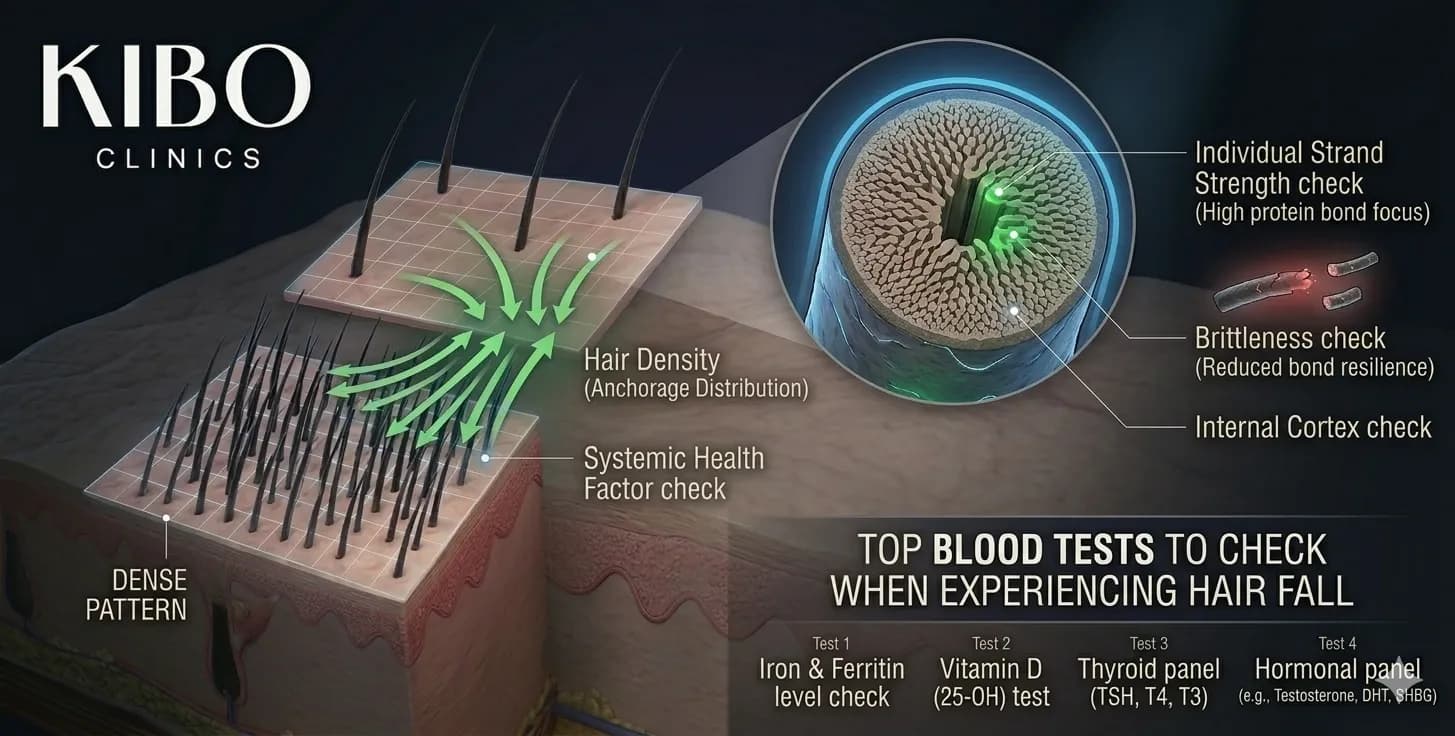
The useful starting point is a focused hair fall blood test panel, not a random full-body package. Most people need tests that check anemia, iron stores, thyroid function, vitamin levels, and sugar or hormone clues only when symptoms point that way. A practical first list is CBC, serum ferritin with iron profile, TSH or thyroid profile, vitamin D, and vitamin B12. These tests cover the most common correctable internal triggers that can disturb the hair growth cycle.
A blood test can help find hidden triggers, but it does not diagnose every type of hair loss by itself. Slow crown thinning, temple recession, patchy bald spots, itchy scalp, flaky scalp, and broken hair all need a scalp examination too. If shedding started suddenly after fever, stress, crash dieting, surgery, childbirth, or a major illness, the doctor may also check whether it looks like telogen effluvium. If the pattern is gradual, family-linked, and concentrated around the hairline or crown, blood reports can be normal even when hair loss is progressing.
| Test Name | Men | Women | Why It Is Done |
|---|---|---|---|
| CBC | Yes | Yes | Checks anemia, hemoglobin, infection clues, and general blood health. |
| Serum ferritin + iron profile | Yes, especially diffuse shedding | Yes, especially heavy periods or postpartum shedding | Checks iron storage and iron availability. |
| Thyroid test | TSH first | TSH, often with T3 and T4 | Checks thyroid imbalance linked with shedding. |
| Vitamin D and vitamin B12 | Yes when deficiency risk exists | Yes when diffuse shedding or deficiency risk exists | Checks vitamin deficiency that can worsen hair quality or shedding. |
| Hormone panel | Not routine | Add when PCOS or androgen symptoms exist | Checks androgen, prolactin, and reproductive hormone clues. |
| HbA1c | If sugar risk exists | If PCOS, sugar risk, or weight gain exists | Checks long-term blood sugar pattern. |
Evidence basis: American Academy of Dermatology, “Hair loss: Diagnosis and treatment”; Mounsey & Reed, American Family Physician, 2009; StatPearls, “Telogen Effluvium,” 2024.
Hair Fall Blood Test List for Men
For men, the first question is whether the hair fall is diffuse shedding or pattern thinning. Diffuse shedding means hair is coming out from all over the scalp. Pattern thinning usually shows as temple recession, a receding hairline, crown thinning, or visible scalp at the top. If the pattern looks like male pattern baldness, blood tests may be normal because the main issue is follicle sensitivity, not always a deficiency.
Men should still test when shedding is sudden, heavy, unexplained, or linked with fatigue, poor diet, rapid weight loss, recent fever, stress, digestive problems, or medication changes. The basic male hair fall blood test list is CBC, serum ferritin with iron profile, TSH, vitamin D, vitamin B12, and HbA1c if sugar or insulin resistance risk is present. A dermatologist may also look for androgenetic alopecia and DHT-related hair loss during scalp examination.
Do men need DHT or testosterone tests for hair loss?
Not every man needs a DHT or testosterone blood test. Typical male pattern hair loss is usually diagnosed from the pattern, family history, age of onset, scalp miniaturization, and progression. Hormone tests are more useful when hair loss is very early and aggressive, when sexual health symptoms exist, when acne or body-hair changes are unusual, or when a medicine or endocrine condition is suspected. Testing DHT without symptoms may not change the treatment plan.
Evidence basis: American Academy of Dermatology, “Hair loss: Diagnosis and treatment”; Mounsey & Reed, American Family Physician, 2009.
Hair Fall Blood Test List for Women
Women usually need a wider first check because hair shedding can overlap with iron deficiency, heavy periods, thyroid imbalance, PCOS, childbirth, perimenopause, menopause, crash dieting, stress, and vitamin deficiency. The starting list is CBC, serum ferritin with iron profile, thyroid profile, vitamin D, and vitamin B12. This is especially important when the ponytail feels thinner, the centre part looks wider, or shedding has continued for several weeks without a clear cause.
A hormone panel is not mandatory for every woman, but it becomes important when the story fits. Add hormone tests when there are irregular periods, acne, facial hair growth, oily skin, weight gain, infertility concerns, PCOS history, or widening parting. Common add-on tests include total testosterone, free testosterone, DHEAS, SHBG, prolactin, LH, FSH, and sometimes fasting insulin or HbA1c. These are especially relevant when hair loss may be linked with PCOS hair thinning or broader hair loss in women.
Women should add hormone tests when these signs are present
- Periods are irregular, delayed, absent, or unusually heavy.
- Acne, facial hair, oily skin, or weight gain has increased with hair fall.
- The centre part is widening while the front hairline is mostly preserved.
- Hair fall started after childbirth, stopping hormonal pills, or perimenopause.
- There is a known PCOS history or family history of hormonal hair thinning.
Postpartum shedding and menopause-related thinning need context, not panic. After delivery, shedding may rise because many hairs shift phases together, while iron status and sleep loss can make it worse. During perimenopause or menopause, hormone shifts may reduce density and expose female pattern thinning. For more focused reading, see Kibo guides on postpartum hair loss recovery and menopause and hair density changes.
Evidence basis: American Academy of Dermatology, “Hair loss: Diagnosis and treatment”; Lin et al., Tzu Chi Medical Journal, 2023; Park et al., Journal of Korean Medical Science, 2013.
Not sure whether your hair fall is nutritional, hormonal, or pattern hair loss?
Ferritin, Iron and CBC Test for Hair Fall
If someone asks for one practical blood test group for hair fall, CBC plus ferritin with iron profile is usually near the top. CBC checks hemoglobin and blood-cell patterns. Ferritin checks iron storage. Iron profile checks how much iron is available and how it is being carried in the body. This combination is more useful than checking hemoglobin alone because a person can have low iron stores before severe anemia appears.
Ferritin matters most when shedding is diffuse, when periods are heavy, when diet is low in iron, when there has been recent blood loss, when fatigue is present, or when hair fall follows childbirth or crash dieting. Low ferritin does not automatically prove it is the only cause of hair fall, but it can be a correctable contributor. Kibo has a detailed guide on iron deficiency and hair thinning if ferritin is low or borderline.
Do not start iron only because hair is falling. Excess iron supplementation without confirmed deficiency can be harmful, and ferritin can also rise with inflammation, infection, liver issues, or other medical conditions. The safer approach is to test, review symptoms, interpret the full iron profile, and correct only when the report and history match. If hair fall is severe but CBC and ferritin are normal, the next step is not more iron. It is scalp diagnosis and pattern review.
Evidence basis: StatPearls, “Telogen Effluvium,” 2024; Mounsey & Reed, American Family Physician, 2009; Park et al., Journal of Korean Medical Science, 2013. Ferritin interpretation note based on standard laboratory medicine.
Thyroid Test for Hair Fall
Thyroid imbalance can push hair into shedding because thyroid hormones influence metabolism and the hair cycle. The usual first thyroid test is TSH. If symptoms are present or TSH is abnormal, the doctor may add T3 and T4. Women are often checked with a full thyroid profile when hair fall is linked with menstrual changes, fatigue, weight change, cold intolerance, constipation, anxiety, palpitations, or heat intolerance.
A thyroid test is especially useful when hair fall is diffuse rather than patchy. It is also useful when the scalp looks normal but shedding is persistent. If thyroid values are abnormal, hair improvement usually depends on correcting the thyroid condition and giving the hair cycle time to reset. If thyroid reports are normal, do not keep repeating thyroid tests without a new symptom change. Look at iron, vitamin status, scalp findings, stress triggers, medication history, and pattern hair loss instead.
Evidence basis: StatPearls, “Telogen Effluvium,” 2024; American Academy of Dermatology, “Hair loss: Diagnosis and treatment.”
Vitamin Test for Hair Loss: Vitamin D, B12, Biotin and Zinc
The most common vitamin tests asked for hair loss are vitamin D and vitamin B12. Vitamin D is often checked when there is low sunlight exposure, fatigue, body aches, autoimmune concerns, or long-term shedding. Vitamin B12 is useful when the person is vegetarian, has fatigue, mouth ulcers, tingling, numbness, digestive problems, or a history of poor absorption. A vitamin test is most useful when the result will change treatment, not when it is added blindly to make a panel look bigger.
Biotin is different. Biotin deficiency is uncommon compared with the way biotin supplements are marketed. Taking high-dose biotin without deficiency does not guarantee hair growth and can interfere with several important lab tests, including thyroid panels, hormone tests, and cardiac markers like troponin. Tell the doctor and lab if you take hair, skin, nail supplements, multivitamins, or high-dose biotin before testing. If you are already taking supplements, read Kibo guides on vitamin D and hair follicles and biotin supplements for hair growth.
Zinc, folate, copper, and other micronutrient tests are not routine for everyone. They become useful when diet is restrictive, gut symptoms exist, long-term medication use is present, or previous surgery may affect absorption. The goal is not to test every nutrient. The goal is to match the test to the person in front of the doctor.
Evidence basis: FDA, “UPDATE: The FDA Warns that Biotin May Interfere with Lab Tests,” FDA Safety Communication, 2019; Mounsey & Reed, American Family Physician, 2009.
Hormone Test for Hair Loss: When Is It Needed?
Hormone tests are useful when the symptoms suggest hormone-related hair loss. For women, that usually means irregular periods, acne, facial hair, weight gain, infertility concerns, PCOS signs, oily skin, or widening parting. For men, hormone testing is not routine for common pattern baldness, but it may be considered when symptoms are unusual or when medication, endocrine disease, or sexual health symptoms are part of the history.
Common hormone tests may include total testosterone, free testosterone, DHEAS, SHBG, prolactin, LH, FSH, and sometimes estradiol, fasting insulin, or HbA1c depending on the situation. These tests should not be ordered as a bundle for every person with hair fall. They should answer a specific clinical question: is there androgen excess, PCOS, prolactin imbalance, reproductive hormone change, or insulin resistance contributing to the shedding?
| Situation | Tests That May Be Added | Why |
|---|---|---|
| Irregular periods with acne or facial hair | Testosterone, DHEAS, SHBG, LH, FSH, prolactin | Checks androgen excess or PCOS pattern. |
| Widening part with oily skin | Androgen panel plus ferritin and thyroid profile | Separates deficiency overlap from hormone-related thinning. |
| Weight gain, cravings, PCOS history | HbA1c, fasting insulin if advised, lipid profile if clinically relevant | Checks metabolic risk that can overlap with PCOS. |
| Male crown thinning only | Usually clinical exam first, not routine DHT testing | Classic pattern hair loss is often diagnosed by scalp pattern. |
| Low libido, breast tenderness, sudden endocrine symptoms | Doctor-selected sex hormone and endocrine tests | Looks beyond ordinary pattern hair loss. |
If DHT-related thinning is suspected, the treatment conversation may include medical therapy, scalp treatments, or long-term density planning. Kibo has separate guides on DHT blockers for hair loss and saw palmetto and DHT if the next step is treatment discussion rather than diagnosis alone.
Evidence basis: Lin et al., Tzu Chi Medical Journal, 2023; Mounsey & Reed, American Family Physician, 2009; American Academy of Dermatology, “Hair loss: Diagnosis and treatment.”
Alopecia, Patchy Hair Loss or Scalp Problem: Are Blood Tests Enough?
No. Blood tests are not enough when hair loss is patchy, painful, scaly, itchy, inflamed, or rapidly worsening. Round bald patches may suggest alopecia areata, but the diagnosis is made from scalp appearance, trichoscopy, and medical history. Thyroid or autoimmune tests may be added only when symptoms or examination point that way. Ordering a vitamin package alone can miss the main diagnosis.
If there is redness, scale, dandruff, pain, burning, pus, or broken hair, the first test may not be a blood test at all. A dermatologist may check for dandruff, fungal infection, psoriasis, seborrheic dermatitis, traction, hair shaft breakage, or scarring alopecia. Read more about seborrheic dermatitis and scalp flaking and scalp psoriasis versus dandruff if the scalp is visibly irritated.
This is where scalp examination, pull test, trichoscopy, and sometimes biopsy become more useful than extra blood panels. If you are not sure which specialist to see, this comparison of dermatologist versus trichologist can help you choose the right appointment.
Evidence basis: American Academy of Dermatology, “Hair loss: Diagnosis and treatment”; Mounsey & Reed, American Family Physician, 2009.
Hair Fall Blood Test Cost in India: What to Expect
The cost of hair fall blood tests in India depends on how many tests are included, the city, the lab, home collection, report speed, and whether hormones are added. A basic panel is usually cheaper than a full hair fall screening package. A hormone panel can increase the cost because testosterone, DHEAS, prolactin, LH, FSH, insulin, and other markers may be billed separately or as part of a broader package.
Do not choose the biggest package only because it looks complete. Choose the smallest accurate panel that matches your symptoms. For sudden diffuse shedding, CBC, ferritin with iron profile, thyroid, vitamin D, and B12 may be enough to start. For women with PCOS signs, a hormone panel may be worth adding. For patchy bald spots or inflamed scalp, paying first for a dermatology examination may be more useful than paying for a very large blood panel.
Ask the lab whether fasting is needed, whether home collection is available, how quickly reports arrive, and whether the package includes serum ferritin or only hemoglobin. Many people assume a CBC covers iron fully, but it does not. If the goal is to understand iron storage, ferritin and iron profile should be checked separately.
Note: Note: Test costs vary by city, lab, and panel composition. The guidance above reflects clinical test-selection principles from the sources referenced in this article.
How to Choose the Right Hair Fall Blood Test Panel
Use symptoms to decide the test panel. This keeps the article practical and avoids the common mistake of testing everything. A person with sudden shedding after fever needs a different plan from a woman with acne and irregular periods or a man with slow crown thinning.
- Start with the pattern: diffuse shedding, receding hairline, widening part, patchy bald spot, or scalp irritation.
- Add the basic panel: CBC, ferritin with iron profile, thyroid test, vitamin D, and vitamin B12 when shedding is unexplained or persistent.
- Add gender-specific tests: HbA1c for metabolic risk in men or women; hormone panel for women with PCOS or androgen signs.
- Do scalp diagnosis when needed: patchy hair loss, itching, scaling, pain, and redness need examination first.
- Review reports with the hair pattern: numbers alone do not tell the full story.
If your shedding seems linked with stress, illness, sleep loss, or lifestyle ...
Medical Disclaimer : Information from Kibo Hair Clinics is for educational purposes only. It does not replace diagnosis, trichoscopy, blood test interpretation, prescription treatment, procedure advice, or side-effect counselling from a qualified dermatologist or hair restoration doctor.