
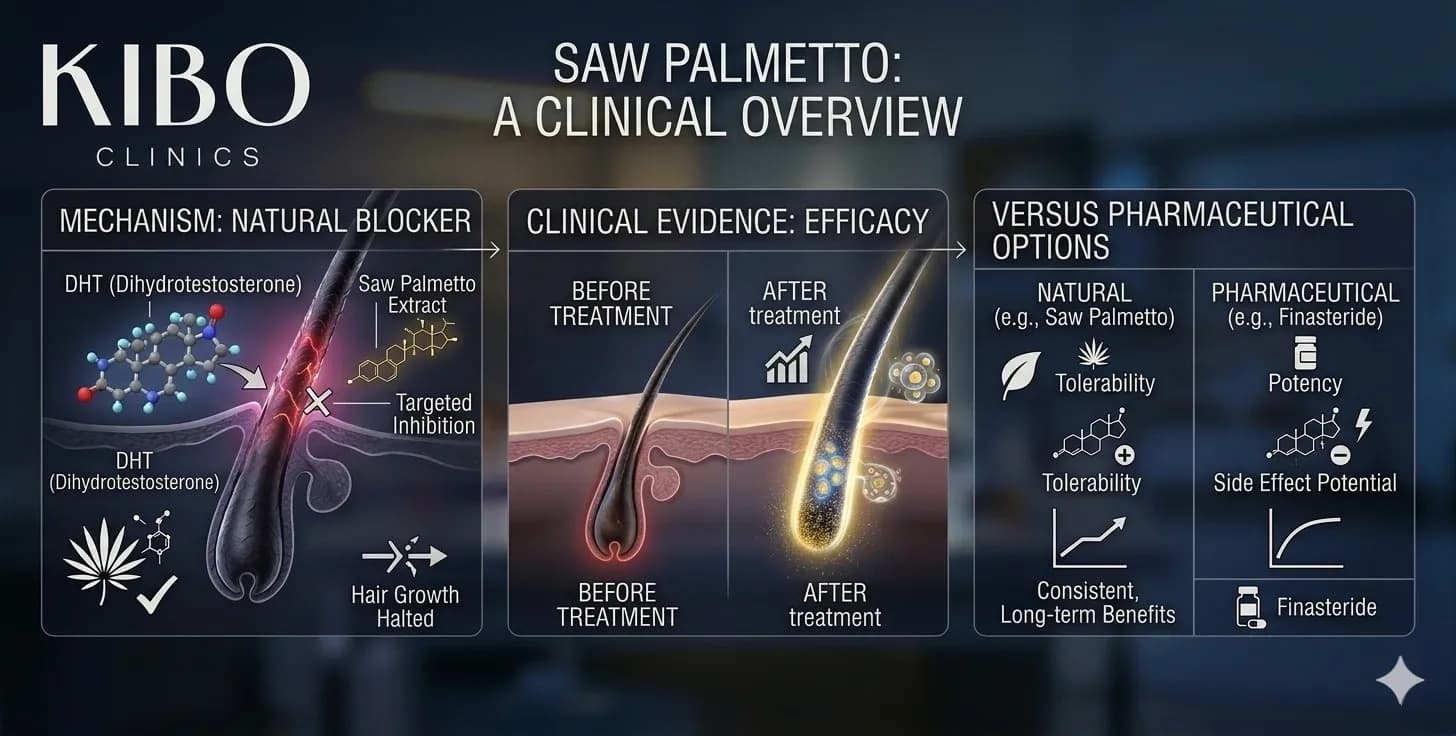
Who This Is For: Anyone considering saw palmetto as a plant-based alternative to prescription DHT blockers, and wanting an honest read of what the actual evidence says before spending money on it.
Saw palmetto is a plant extract studied as a possible support for androgenetic alopecia, but current evidence is limited and inconsistent. Small studies of specific oral or topical formulations have reported reduced shedding or modest density changes, while the US National Center for Complementary and Integrative Health (NCCIH) says there is not enough evidence to draw firm conclusions for hair loss. It should not be treated as a proven or equivalent substitute for finasteride, and it may be unsafe during pregnancy or breastfeeding.
What Is Saw Palmetto?
Saw palmetto is the extract of Serenoa repens berries, a small palm native to the southeastern United States. Here's where it genuinely gets confusing for anyone trying to buy the right thing: products sold under this one name can contain meaningfully different extracts, fatty-acid profiles, doses, and delivery routes. An oral capsule, a topical oil, and a shampoo aren't interchangeable just because the label says "saw palmetto," and that distinction matters more than most marketing copy lets on.
Why Is It Called a DHT Blocker?
The proposed mechanism involves 5-alpha-reductase, the enzyme that converts testosterone into DHT, the hormone genuinely implicated in androgenetic alopecia. Laboratory and mechanistic research suggests saw-palmetto constituents may interfere with this pathway. But a plausible mechanism in a lab dish is genuinely not the same thing as proof that a retail capsule or shampoo lowers DHT on your actual scalp. Keep those two claims separate in your head, because a lot of marketing deliberately doesn't.
Does Saw Palmetto Actually Work?
Here's the honest verdict before any marketing language: small studies of specific formulations have reported reduced shedding or modest density improvements, but the evidence base is genuinely limited, heterogeneous, and tied to particular products rather than "saw palmetto" as a general category. NCCIH's position is direct on this: the few small hair-loss studies that exist are too limited to allow firm conclusions either way. That's not the same as saying it definitely doesn't work. It's saying nobody can currently promise you that it does.
What the Studies Actually Tested
A 2020 systematic review identified five randomised trials and two prospective cohorts reporting positive findings for products containing 100 to 320 mg of saw palmetto, but the same review concluded that robust, high-quality data are genuinely lacking and that larger trials isolating saw palmetto's specific contribution are still needed. A 2023 double-blind, placebo-controlled study in 80 Indian adults with mild-to-moderate androgenetic alopecia tested a proprietary standardised oil formulation (VISPO), both orally and topically, over 16 weeks. It reported reduced hair fall, modest density increases, and a reduction in serum DHT in the oral group specifically, with no serious adverse events.
| Evidence | What It Shows | What It Does Not Show |
|---|---|---|
| Mechanistic/laboratory rationale | Saw-palmetto constituents may affect 5-alpha-reductase or androgen pathways | That a retail product reliably lowers scalp DHT or regrows hair |
| 2020 systematic review | 5 RCTs and 2 cohorts reported positive effects in products containing 100-320 mg | Strong proof of saw palmetto alone; studies were heterogeneous and high-quality data were lacking |
| 2023 VISPO RCT | In 80 Indian adults, a proprietary oral/topical oil was tested for 16 weeks with reported hair-fall and density changes | That every saw-palmetto product or shampoo produces the same result; long-term efficacy |
| NCCIH assessment | A few small hair-loss studies exist, but evidence is too limited for firm conclusions | That saw palmetto is useless or proven; it means genuine uncertainty remains |
Worth being direct about the VISPO trial specifically: it was one proprietary formulation, tested at a single centre, in a small sample, over a short follow-up, in a selected mild-to-moderate population that excluded smokers and various health conditions. The manufacturer is also represented among the study's affiliations, which is a real conflict of interest worth knowing rather than a reason to dismiss the result outright. None of this makes the finding worthless, but it does mean it can't be generalised into "saw palmetto works," full stop.
DHT and Why Sex Matters Here
DHT genuinely participates in male pattern hair loss biology, but a receding hairline or thinning crown still needs an actual diagnosis rather than an assumption. Female pattern hair loss has more complex biology, and many women with it have no overt androgen excess at all. Saw palmetto's antiandrogenic marketing shouldn't be read as implying every woman with hair loss has elevated DHT, or that PCOS-related thinning can be self-managed with a supplement bought online. It also matters to separate a blood-level change from a scalp-level result: even the 2023 trial's serum-DHT reduction doesn't automatically mean improved follicle density, and it certainly can't be generalised to other products.
Saw Palmetto vs Finasteride
| Factor | Saw Palmetto | Finasteride |
|---|---|---|
| Category | Dietary supplement/botanical extract | Prescription 5-alpha-reductase inhibitor in many jurisdictions |
| Evidence for AGA | Limited, heterogeneous, formulation-specific | More established clinical evidence for selected male pattern hair loss; suitability is individual |
| Dose | No globally agreed hair-loss dose | Approved/prescribed doses depend on indication and clinician judgment |
| Product consistency | Extract and content vary between brands | Defined active ingredient and dose, subject to local regulation |
| Pregnancy considerations | NCCIH says may be unsafe in pregnancy/breastfeeding | Contraindicated/strictly restricted in pregnancy-related contexts |
| Main takeaway | Saw palmetto is a possible adjunct or option only after informed discussion. Finasteride isn't automatically appropriate either; both need a real conversation about risks and benefits, not a self-prescribing decision. | |
Safety, Pregnancy, Breastfeeding and Interactions
NCCIH reports that saw palmetto is generally well tolerated in research, with mild and infrequent side effects such as digestive symptoms, dizziness, and headache, but it explicitly flags that it may be unsafe during pregnancy or breastfeeding. Tell your clinician about every supplement and medicine you're taking, since herbal products genuinely can interact with medicines in ways that aren't always well studied, and supplement marketing isn't a substitute for that conversation. Unregulated multi-ingredient products add another layer of uncertainty worth being aware of, since "natural" doesn't automatically mean predictable or contamination-free.
Who Should Not Self-Treat With It
Rapid or patchy loss, scalp inflammation, postpartum shedding, suspected PCOS, children, pregnancy or breastfeeding, current medication use, liver concerns, or an upcoming surgery are all situations where reaching for a supplement without a proper diagnosis first is genuinely the wrong move. If your shedding is diffuse and delayed rather than a stable pattern, it's also worth understanding the hair growth cycle and whether you're actually looking at telogen effluvium, which saw palmetto's proposed mechanism has nothing to do with.
A Diagnosis-First Hair-Loss Plan
Confirm whether the pattern actually suggests androgenetic alopecia rather than telogen effluvium, traction, scarring, infection, or a systemic condition, ideally with the help of someone who can properly examine a receding hairline rather than guess from a photo. Record baseline photographs, correct any proven contributing factor such as iron deficiency, and if you do choose a supplement after that conversation, write down the exact brand, extract, dose, route, and batch rather than just "saw palmetto." Don't start multiple hair supplements at once, since you'll never be able to tell which one actually did anything. Reassess at a clinically meaningful interval, four to six months is often reasonable for observing a genuine hair-cycle change, but that's an observation window, not proof the product worked. Stop and seek advice for adverse effects or worsening loss, and don't delay established treatment indefinitely while waiting for a supplement to show results it may never show.
Considering saw palmetto or wondering what's actually causing your thinning? Start with a real diagnosis.
Kibo Clinics' Perspective on Saw Palmetto
Saw palmetto isn't a scam, and it isn't a natural finasteride either. It sits somewhere honest and unglamorous in between: biologically plausible, backed by a handful of small, product-specific studies, and genuinely not proven at the level marketing often implies.
At Kibo Clinics, we'd rather tell you what the evidence actually supports than sell you certainty that doesn't exist yet, for this or any other option.
If you're trying to work out whether your hair loss is even the kind saw palmetto's mechanism could plausibly help with, a Kibo Clinics hair specialist can give you an actual diagnosis before you spend months on a supplement that might be solving the wrong problem entirely.
Frequently Asked Questions
How long does saw palmetto take to work?
Hair-cycle changes take months, and a 16-week study tested one proprietary formulation. There is no reliable universal timeline. If there is no objective improvement or if loss is progressing, reassess the diagnosis and treatment rather than continue indefinitely.
Does saw palmetto lower DHT?
Some studies of specific formulations report DHT changes, but effects are not established for every product and serum DHT does not automatically predict scalp response.
Is topical saw palmetto better than oral saw palmetto?
There is no definitive answer. They differ in absorption, formulation, dose, and evidence. A topical product is not automatically safer or more effective.
Can I take saw palmetto with finasteride?
Do not combine them without clinician guidance. Evidence for added benefit is not established, and combining products can complicate adverse-effect attribution and safety monitoring.
Is saw palmetto safe during pregnancy or breastfeeding?
NCCIH states that it may be unsafe during pregnancy or breastfeeding. Avoid self-use and ask a qualified clinician.
Can saw palmetto treat telogen effluvium?
Saw palmetto targets a proposed androgen pathway, while telogen effluvium usually reflects a delayed hair-cycle response to an internal trigger. It should not be used as a substitute for finding and correcting the trigger.
Related Articles & Services
Hair Transplant
FUE Hair Transplant | Sapphire FUE Hair Transplant | Real-Time FUE Hair Transplant | Bio FUE Hair Transplant | Unshaven Hair Transplant | Direct Hair Transplant (DHT) | Body Hair Transplant | Corrective Hair Transplant | Hairline Correction
Hair Regrowth
PRP Therapy | GFC Therapy | Exosomes Therapy | IV Hair Boosters | Low-Level Laser Therapy | Mesotherapy for Hair Regrowth | Microneedling for Hair Regrowth | PDO Threads for Hair Regrowth
Must Read
DHT Blockers for Hair Loss | DHT-Related Hair Loss | DHT Blocker Side Effects: What Research Shows | Hair Transplant Side Effects
Relevant Blogs
Minoxidil vs Redensyl | Hair Transplant Procedure Steps | Dermatologist vs Trichologist
Medical Disclaimer : Information from Kibo Hair Clinics is for educational purposes only. It does not replace diagnosis, trichoscopy, blood test interpretation, prescription treatment, procedure advice, or side-effect counselling from a qualified dermatologist or hair restoration doctor.