
Why NRIs Choose Mumbai for Hair Transplant: A Planning Guide for Patients from the US, UK, Canada, UAE and Australia
Published on Wed Jun 17 2026
Article Information
Reviewed By: Shritej Mali
Written By: Kibo Clinics Content Team
Sources Referenced: ISHRS Practice Census 2022 and 2025 (global procedure pricing and surgeon distribution data), market pricing aggregated from publicly listed clinic quotes in US, UK, UAE, and India (Q1 2026)
Last Updated: May 2026
Reading Time: 16 minutes
Who This Is For: NRIs in the US, UK, Canada, Australia, UAE, Singapore, or Gulf countries researching whether to get their hair transplant during a trip to Mumbai
Prices and exchange rates are indicative as of Q1 2026. Always confirm current pricing directly with the clinic.
Planning from abroad? A virtual consultation with a Board Certified Doctor can be done before you book flights.
The Real Cost Comparison: Mumbai vs Your Home Country
This is the table most NRIs are looking for. Below is a realistic comparison of what a 2,500-graft FUE procedure costs across different countries in 2026. These figures are based on publicly listed clinic pricing and ISHRS market data, not promotional rates.
| Country | FUE Cost (2,500 Grafts) | Approx. INR Equivalent | Savings vs Mumbai |
|---|---|---|---|
| United States | $8,000-$20,000 | Rs 6,70,000-16,70,000 | Mumbai saves 70-85% |
| United Kingdom | £6,000-£12,000 | Rs 6,30,000-12,60,000 | Mumbai saves 65-80% |
| Canada | CAD 10,000-20,000 | Rs 6,10,000-12,20,000 | Mumbai saves 65-80% |
| Australia | AUD 10,000-20,000 | Rs 5,50,000-11,00,000 | Mumbai saves 65-80% |
| UAE (Dubai) | AED 20,000-45,000 | Rs 4,55,000-10,25,000 | Mumbai saves 55-75% |
| Singapore | SGD 8,000-18,000 | Rs 5,00,000-11,20,000 | Mumbai saves 65-80% |
| Mumbai (India) | Rs 1,25,000-3,00,000 | Rs 1,25,000-3,00,000 | Baseline |
Even after adding return flights (Rs 30,000-80,000 for most routes), 7 to 10 nights of accommodation near the clinic (Rs 15,000-50,000 total), and local transport, the all-in cost of getting a hair transplant in Mumbai during a trip home is typically 50 to 70% less than having it done locally in any of these countries. For a 2,500-graft procedure, that difference can be $5,000 to $15,000, which is not a trivial amount. Our detailed Mumbai vs international cost-benefit analysis breaks down the full comparison.
Why Mumbai and Not Turkey, Thailand, or Another Indian City?
Why not Turkey? Turkey markets aggressively to NRIs with package deals that include flights, hotels, and procedures for $2,000-$4,000. The pricing is attractive, but the ISHRS has repeatedly flagged concerns about high-volume clinics where technicians, not surgeons, perform critical surgical steps, and where after a 3 to 4 day "hair transplant holiday," the patient has no local follow-up infrastructure if complications arise months later. As an NRI, if something goes wrong with a procedure done in Istanbul, your recourse from New Jersey or London is limited. With Mumbai, you have a surgeon who speaks your language, family nearby, and the ability to return for in-person review during your next trip home. The Mumbai vs Turkey comparison covers this in detail.
Why Mumbai over Delhi or Bangalore? All three cities have qualified transplant surgeons. Mumbai's advantage for NRIs specifically is connectivity. Mumbai airport (BOM) has the most direct international flights of any Indian city, including non-stop routes from New York (JFK), London (LHR), Dubai (DXB), Singapore (SIN), Toronto (YYZ), and Sydney (SYD). For NRIs combining a procedure with a family visit, Mumbai is also India's most visited city by the diaspora. The practical benefit: shorter layovers, easier logistics, and family support during recovery.
Why Mumbai over a smaller Indian city? Mumbai has one of the highest concentrations of ISHRS-member and IADVL-certified hair transplant surgeons in India. According to the ISHRS Practice Census data, India is one of the top 5 countries globally for hair restoration procedures performed annually, and Mumbai accounts for a significant share. The depth of the surgeon pool means you have more options to compare, which matters when you are travelling specifically for this procedure.
What to Look for in a Mumbai Clinic as an International Patient
The quality bar for an NRI patient should be higher than for a local patient, because you cannot easily return if something goes wrong. Here is what to verify:
- The surgeon who consults you must be the same surgeon who operates. This is the single most important verification. In many high-volume clinics globally, the surgeon meets you, designs the hairline, and then hands the procedure to a trained team. For a patient who is flying 8,000 miles for this, that is not acceptable. Ask the question directly and get it confirmed in writing.
- Virtual consultation before you book flights. A clinic serving NRI patients should offer a structured video consultation where the surgeon reviews your photographs, discusses your Norwood stage, estimates graft count, and provides a preliminary treatment plan and cost estimate. You should not need to fly to Mumbai just to find out if you are a candidate.
- Written, itemised quote in advance. Understanding what a transparent quote includes is critical. The quote should specify graft count, technique, per-graft rate or total fee, what is included (pre-op tests, medications, follow-ups), and what is excluded. Compare this across at least two clinics before committing.
- Remote aftercare protocol. After you fly home, how does follow-up work? A clinic experienced with NRI patients should have a structured photo submission schedule (weekly for month 1, monthly thereafter), a responsive communication channel (WhatsApp, email, or dedicated portal), and clear guidance on when to seek local care vs when to contact the Mumbai team.
- Verifiable before-and-after cases at 12 months for your specific Norwood stage. Not just day-of photos that show the hairline design but no growth.
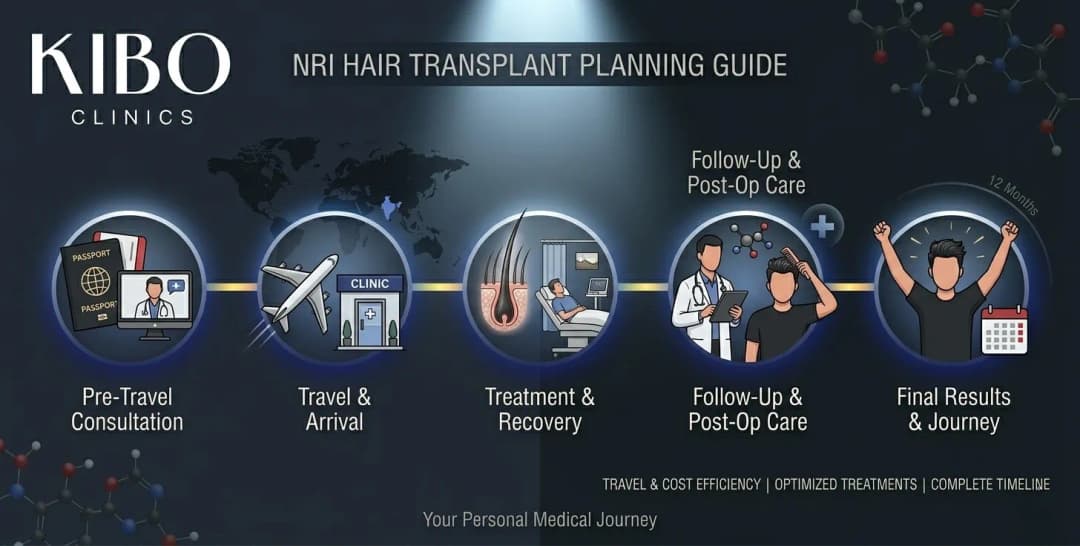
Planning Your Trip: NRI Patient Timeline
4 to 6 Weeks Before: Virtual Consultation and Planning
Schedule a video consultation with the clinic. Submit high-quality photographs (front, sides, crown, donor area) in natural lighting. The surgeon assesses candidacy, estimates graft count, recommends a technique, and provides a written quote. If blood tests are needed, your home country GP can order them in advance. This consultation also covers any medications to pause before surgery (blood thinners, certain supplements). Reading our guide on what to prepare for your first consultation helps you maximise this session.
Travel Logistics by Country
| From | Flight to Mumbai | Visa | Time Zone vs IST |
|---|---|---|---|
| New York / NJ | Non-stop 15-16 hrs | OCI card (no visa needed) or e-Tourist visa | IST is +9.5 to +10.5 hrs ahead |
| London | Non-stop 9-10 hrs | OCI card or e-Tourist visa | IST is +4.5 to +5.5 hrs ahead |
| Toronto | Non-stop 14-15 hrs | OCI card or e-Tourist visa | IST is +9.5 to +10.5 hrs ahead |
| Dubai | Non-stop 3-3.5 hrs | OCI card or e-Tourist visa | IST is +1.5 hrs ahead |
| Sydney / Melbourne | 1 stop, 14-18 hrs total | OCI card or e-Tourist visa | IST is 4.5 to 5.5 hrs behind |
| Singapore | Non-stop 5.5 hrs | OCI card or e-Tourist visa | IST is 2.5 hrs behind |
Most NRIs hold OCI (Overseas Citizen of India) cards, which eliminate the need for a separate visa. If you do not have OCI, an e-Tourist visa is processed online in 3 to 5 business days for citizens of the US, UK, Canada, Australia, UAE, and Singapore. An e-Medical visa is also available if you prefer to document the trip as a medical visit.
Day 1: Arrival and In-Person Consultation
Arrive at least one day before the procedure to rest after the flight. The in-person consultation refines the virtual plan: the surgeon examines your scalp under magnification, finalises the hairline design, confirms graft count, and answers any remaining questions. This is your opportunity to verify that the surgeon you consulted virtually is the same person who will operate.
Day 2: Procedure Day
Plan for 6 to 9 hours at the clinic. The day includes pre-procedure photographs, hairline marking, local anaesthesia, donor extraction, recipient site creation, graft placement, and post-procedure instructions with a washing demonstration. Most patients experience minimal discomfort and can walk, eat, and use their phone normally throughout. Our guide on what to bring on procedure day covers the practical details.
Days 3 to 7: Recovery in Mumbai
Swelling peaks around day 3 and resolves by day 5 to 7. Sleep elevated. Gentle washing begins on day 2 or 3. Scabs form and start shedding. Most NRI patients use this recovery week to spend time with family, work remotely (desk work is fine from day 3 to 5), and attend their follow-up review before flying home. This is also when many patients combine the trip with visiting parents, attending a family event, or handling other commitments in India.
Day 7 to 10: Pre-Flight Review
Schedule an in-person review before your return flight. The surgeon checks healing, confirms washing technique, and clears you for air travel. Most patients are comfortable flying by day 5 to 7 once visible swelling has resolved. Cabin air is dry, so keeping a saline spray handy during the flight helps. If you are flying 15+ hours (US, Canada), day 7 to 10 is the ideal window. For shorter flights (Dubai at 3 hours, Singapore at 5.5 hours), day 5 to 7 is usually sufficient.
Remote Aftercare: How Follow-Up Works Across Time Zones
This is where many NRIs get nervous, and where the quality of the clinic you choose matters most. After you fly home, your transplanted grafts are entering their most important growth phase. You need a structured way to stay connected with your surgical team without needing to fly back to Mumbai every month.
What a good remote aftercare protocol looks like:
- Week 1 to 4 (critical healing): Weekly photo submissions via WhatsApp or email. The surgical team reviews and responds within 24 hours with specific washing, care, or medication guidance.
- Month 2 to 6 (shedding and early growth): Monthly photo submissions. Shock loss at weeks 2 to 6 is normal and expected. The team reassures and tracks progress. Photo tracking guidance ensures consistency.
- Month 6 to 12 (visible growth): Quarterly updates. By month 6, most patients see noticeable density improvement. Near-final results at month 10 to 12.
- Month 12 to 18 (final assessment): If you visit India during this period, an in-person review is ideal. If not, a detailed photo review with the surgeon determines whether results meet expectations or if any refinement is worth discussing.
Time zone consideration: If you are in the US (9.5 to 10.5 hours behind IST), a photo submission sent in your evening reaches the Mumbai team during their morning. Responses typically come during your night or next morning. For Dubai and Singapore patients, the time difference is small enough that near-real-time communication is practical. For the complete results timeline, our guide covers each milestone.
What If Something Goes Wrong After I Fly Home?
This is the question every NRI patient has but does not always ask. Here is the honest answer: serious complications after a well-performed FUE procedure are rare. The most common post-operative concerns, itching, mild redness, temporary numbness, or a folliculitis bump, are manageable remotely with photo-guided instructions. True surgical complications like infection or significant scarring are uncommon when performed by an experienced surgeon in a sterile environment.
However: if a concern arises that cannot be resolved remotely, you need a plan. Before the procedure, ask the clinic what happens if you need in-person follow-up that was not planned. Some clinics have referral networks with dermatologists in major NRI cities (New York, London, Dubai). Others offer virtual consultations with the operating surgeon at any point during the 12-month growth period. Understand the protocol before you commit, not after.
Kibo Clinics for NRI Patients
Kibo Clinics in Khar West, Mumbai, serves a growing number of NRI patients from the US, UK, Canada, UAE, Australia, and Singapore. The clinic is 40 minutes from Mumbai airport and centrally located in the Bandra-Khar corridor, making it accessible for NRI patients staying with family in most parts of Mumbai.
Every procedure is performed by board certified dermatologists and hair restoration surgeons. The doctor who conducts your virtual consultation is the same doctor who performs your surgery. All surgical steps, graft extraction, site creation, and implantation, are performed exclusively by the surgeon. Technicians do not perform any part of the procedure.
What Kibo offers that is relevant to NRI patients specifically:
- Virtual pre-operative consultation with the operating surgeon before you book flights
- Full surgical planning documentation provided digitally before travel
- Written, itemised quote with no hidden costs
- Structured remote aftercare protocol with photo-based progress tracking
- Responsive communication across time zones (WhatsApp and email)
- Coordination support for accommodation recommendations near the clinic
For NRI patients evaluating FUE, Sapphire FUE, or DHI, the virtual consultation determines which technique is appropriate for your case. The decision is clinical, not a marketing preference. Mumbai hair transplant pricing is discussed transparently during the consultation.
What This Means for You
If you are sitting in New Jersey, London, Toronto, Dubai, or Sydney and researching hair transplant options, here is the decision framework that matters: the cost saving of doing it in Mumbai is real and significant. But the saving is only worth it if the surgeon you choose meets the same standard you would demand at home. A $2,000 transplant in Istanbul or a Rs 50,000 package in a budget Mumbai clinic is not a saving if you need a corrective procedure 18 months later.
- Start with a virtual consultation. It costs nothing at most reputable clinics and tells you whether Mumbai is the right choice for your specific case.
- Get written quotes from 2 to 3 Mumbai clinics and compare them using our comparison checklist
- Confirm the operating surgeon. Ask directly.
- Plan 7 to 10 days in Mumbai. Combine it with a family visit.
- Understand the remote aftercare protocol before committing.
Planning from abroad? Start with a virtual consultation.
Frequently Asked Questions
How much can I save by getting a hair transplant in Mumbai instead of the US or UK?
For a 2,500-graft FUE procedure, Mumbai costs Rs 1,25,000 to Rs 3,00,000 compared to $8,000 to $20,000 in the US or £6,000 to £12,000 in the UK. Even including flights and accommodation, the total saving is typically 50 to 70%.
How many days do I need in Mumbai?
Plan for 7 to 10 days. Day 1 for arrival and consultation. Day 2 for the procedure. Days 3 to 7 for recovery. Day 7 to 10 for pre-flight review. For Dubai and Singapore patients (shorter flights), 7 days is usually sufficient. For US, UK, Canada, and Australia (longer flights), 10 days is more comfortable.
When can I fly back after a hair transplant?
Most patients are cleared for air travel by day 5 to 7. For short flights (3 to 6 hours), day 5 is usually fine. For long-haul flights (14+ hours), day 7 to 10 is recommended to allow swelling to fully resolve and scabs to start shedding. Keep a saline spray handy during the flight to combat cabin air dryness. Our post-transplant travel guide linked above covers the details.
How does follow-up work after I return to the US, UK, or UAE?
A structured remote protocol involves weekly photo submissions for the first month, monthly for months 2 to 6, and quarterly for months 6 to 12. The surgical team reviews each submission and responds with specific guidance. Communication is typically via WhatsApp or email, working across time zones.
Do I need a visa for a medical trip to India?
Most NRIs hold OCI (Overseas Citizen of India) cards, which allow unlimited entry with no separate visa needed. If you do not have OCI, an e-Tourist visa is available online (processed in 3 to 5 business days) for US, UK, Canadian, Australian, UAE, and Singaporean passport holders. An e-Medical visa is also available if you prefer to document the trip specifically as a medical visit.
Is Mumbai better than Turkey for a hair transplant?
Turkey offers lower prices but the ISHRS has flagged concerns about technician-led procedures at high-volume clinics. For NRIs, Mumbai has specific advantages: the surgeon speaks your language, your family is nearby for recovery support, you can return for in-person follow-up during future India trips, and if complications arise, your recourse is practical. The Mumbai vs Turkey comparison linked earlier in this guide covers the full analysis.
Can I work remotely during recovery in Mumbai?
Yes. Most NRI patients with desk-based or remote-friendly roles return to work from day 3 to 5. You will need a laptop, a stable internet connection (widely available in Mumbai hotels and family homes), and reasonable expectations about video calls during the first week (mild redness and swelling may be visible). Recovery expectations are manageable for most professional roles.
What if I am not satisfied with the result?
Results take 12 to 18 months to fully mature. Many perceived concerns at month 3 to 6 (slow growth, uneven sprouting, uneven early growth) resolve with time. If at month 12 density does not meet the surgical plan's targets, discuss with the surgeon. Reputable clinics will be transparent about whether a touch-up session is warranted and how it is priced. Ask about the revision policy during your initial consultation, not after the procedure.
Medical Disclaimer
This article is published by Kibo Clinics for education only. International pricing is based on publicly listed clinic quotes and market data as of Q1 2026. Exchange rates fluctuate. Always confirm current pricing directly with the clinic. Individual outcomes depend on donor density, technique, surgeon skill, and aftercare adherence.
Sources Referenced: ISHRS Practice Census 2022 and 2025 (global procedure volume, surgeon distribution, pricing data); market pricing aggregated from publicly listed clinic quotes in the US, UK, UAE, Singapore, Canada, and Australia (Q1 2026).
For a personal assessment, consult a Board Certified Doctor at Kibo Clinics. The doctor you meet in your consultation is the same doctor who handles your treatment through every stage.
Explore Kibo Clinic Services
Hair Transplant:
Direct Hair Transplant (DHI) | Bio FUE | Real Time FUE | Corrective Transplant | Hairline Correction | Body Hair Transplant
Non-Surgical:
PRP Therapy | GFC Therapy | Mesotherapy | Microneedling | LLLT
Related Articles
NRI and Travel:
Trip Planning Guide | Stay Duration in Mumbai | Recovery Tips for Outstation Patients | What to Wear on Procedure Day
Transplant Guides:
Complete Guide | FUE Guide | Cost India | Best Technique | Side Effects
Results and Recovery:
Role of Patience | Grooming While Waiting | Returning to Gym | First Week Self-Care