
Why Kibo Clinics? The Science Behind Our Natural Hairline Design
Published on Fri Apr 10 2026
Why Kibo Clinics? The Science Behind Our Natural Hairline Design
A hairline is the first thing people notice when they look at your face. If it looks artificial or too straight, it can make even a dense transplant look unnatural. At Kibo Clinics, our natural hairline design is based on facial proportions, age, and long-term hair loss planning, not trends or fixed templates.
Hair restoration is not just about filling bald areas. The real challenge is creating a hairline that matches your face today and still looks natural 10–20 years later. Many people regret transplants done elsewhere because the hairline was placed too low or drawn like a ruler line. Science-based planning prevents that mistake.
The Story Behind a Natural Hairline
Rohan, 32, from Hyderabad, came for a correction consultation. He had undergone a transplant at another clinic at 27. Initially, he was happy because his forehead looked smaller. But within four years, his natural hair behind the transplanted line started thinning.
His first clinic had designed a very low, straight hairline without considering future pattern baldness. As his native hair receded, the transplanted hairline looked disconnected and unnatural. He had to use fibers daily to blend the gap.
After detailed scalp and follicle assessment, his correction plan focused on redesigning the hairline with micro-irregularities, adjusting density distribution, and planning for progressive loss. The goal was not just density, but harmony with his face and future hair stability.
What Makes a Hairline Look Natural?
A natural hairline is never straight, flat, or overly dense in the front row. It follows facial anatomy and subtle asymmetry.
Step one is scalp health. If the scalp has inflammation, poor blood supply, or scarring, graft survival and direction control can be affected.
Step two is follicle selection. Single-hair grafts are placed at the front to mimic nature. Multi-hair grafts are placed behind to create density. Mixing them incorrectly creates a pluggy appearance.
Step three involves hormones and progression. In men with androgenetic alopecia, DHT-sensitive follicles continue to miniaturize over time. A low hairline without medical planning can look isolated later.
Step four considers lifestyle and environment. Stress, poor sleep, smoking, and nutritional deficiencies can reduce native hair stability, affecting long-term design planning.
Why Straight Lines Fail Over Time
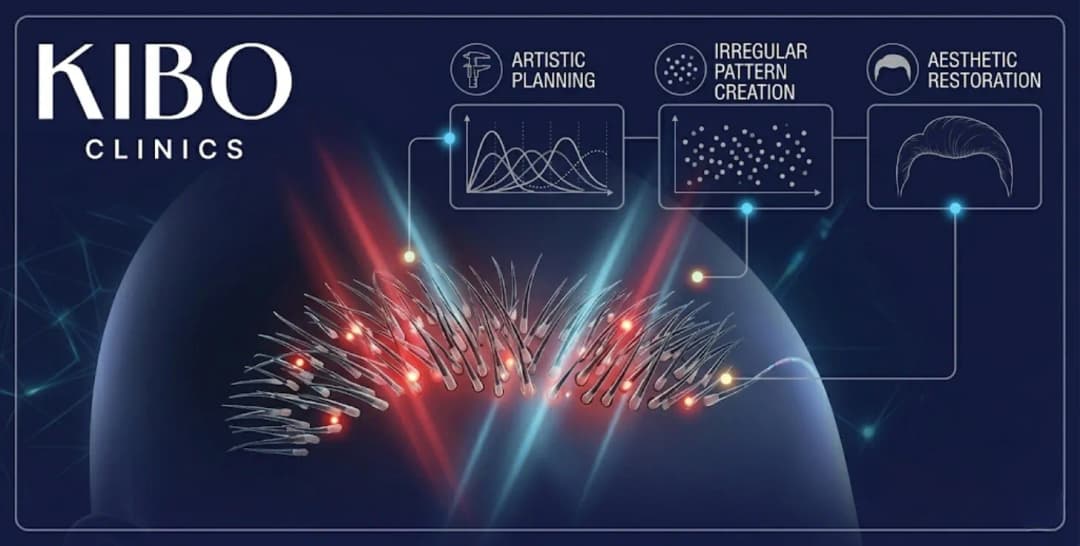
Nature never creates perfectly straight hairlines. There are soft zig-zag patterns, micro and macro irregularities, and slight asymmetry.
A straight line may look “sharp” immediately after surgery, but as surrounding hair thins, the artificial pattern becomes obvious. Scientific design builds controlled irregularity into the first 1–2 cm.
How Is a Scientific Hairline Designed?
Scientific hairline design begins with facial measurements.
We assess forehead height, facial thirds, temple angles, and jaw structure. A narrow face needs a different framing than a broad face.
We evaluate age. A 22-year-old should not receive the same hairline position as a 38-year-old. Aggressive lowering at a young age may not age well.
We assess donor capacity. The donor area has a limited number of grafts. Using too many grafts in the hairline may compromise crown coverage later.
We map future loss. Based on family history and miniaturization patterns, we estimate progression. This helps in creating a sustainable plan.
| Design Factor | Scientific Approach | Risk If Ignored |
|---|---|---|
| Age | Age-appropriate positioning | Unnatural look over time |
| Facial Proportion | Measured facial thirds | Imbalanced appearance |
| Graft Selection | Singles in front, multiples behind | Pluggy hairline |
| Future Hair Loss | Long-term planning | Isolated hair island effect |
How Does Hairline Design Show in Men and Women?
In men, recession often starts at the temples, forming an M-shape. A natural male hairline usually has mild temporal recession and soft corners.
In women, hairlines are typically lower and rounder. Female hair loss often presents as diffuse thinning rather than deep temple recession. Designing a male-type hairline for a woman can look unnatural.
Men usually require stronger temple angle definition.
Women require preservation of frontal density and softer framing around the face.
Both require careful density gradients, but the aesthetic goals differ.
What Daily Habits Make Hairline Results Better or Worse?
Smoking reduces blood flow to follicles. Poor circulation can affect graft survival and long-term scalp health.
Chronic stress increases cortisol levels, which may accelerate shedding in genetically prone individuals.
Skipping post-procedure care instructions can increase infection risk or disturb graft placement.
Using harsh chemical styling products early after transplant can irritate the scalp.
On the positive side, balanced nutrition supports follicle strength.
Consistent medical therapy, when advised, helps stabilize surrounding native hair.
Gentle scalp hygiene prevents buildup and inflammation.
Avoiding aggressive hairstyles that pull on the hairline reduces traction stress.
What Helps First? (Relief Steps)
If you are unhappy with your current hairline design, the first step is assessment.
A detailed scalp examination identifies whether the issue is density, angle, direction, or placement.
In early thinning cases, non-surgical treatments such as PRP therapy, GFC therapy, or medical management may help stabilize surrounding hair.
In correction cases, redistribution of grafts or adding density with refined FUE techniques may be planned.
Initial visible growth after transplant usually starts around 3–4 months.
Noticeable cosmetic improvement appears around 6–8 months.
Final maturity may take 12 months.
When to Meet a Hair Specialist
Your hairline keeps receding rapidly over a short period.
You notice thinning behind an existing transplant.
Your transplanted hairline looks straight or pluggy.
You experience persistent scalp redness, itching, or scaling.
You are under 25 and considering aggressive lowering.
You want a second opinion before your first transplant.
Early consultation prevents long-term design mistakes.
Common Myths About Natural Hairline Design
Myth 1: Lower hairline means better results.
A very low hairline may look dense initially but may not match aging patterns.
Myth 2: More grafts always means more natural.
Natural appearance depends on placement and angle, not just number.
Myth 3: All hairlines should be symmetrical.
Mild asymmetry mimics nature and improves realism.
Myth 4: One transplant lasts forever without planning.
Progressive hair loss can continue in untreated areas.
Why Kibo Clinics for Natural Hairline Design
Many patients choose Kibo Clinics for hairline restoration because our approach addresses both aesthetic framing and long-term hair loss planning. We begin with comprehensive scalp assessment, hair and follicle analysis, and thorough lifestyle and environmental review.
Our No Ghost Surgery pledge ensures the consulting surgeon personally performs your entire procedure, maintaining consistent quality throughout the session. We don't delegate critical steps to technicians.
The Kibo Hair Analysis (scalp and follicle assessment) is the first step in understanding your specific condition. We provide education, guidance, and support without guarantees, exaggerated claims, or miracle cure promises.
Our 12-month structured follow-up monitors growth progression, scalp health, and native hair stability. Adjustments in medical therapy, nutrition guidance, or supportive treatments are suggested based on individual response.
---
Ready to design a hairline that still looks natural years from now? Speak to a specialist and understand your long-term plan before making a decision.
---
Frequently Asked Questions
How do doctors decide where to place a hairline?
Doctors measure facial proportions, assess age, study hair loss pattern, and evaluate donor capacity. The position is chosen to balance natural appearance and long-term planning. Too low can look artificial later. Too high may not frame the face well.
Can a bad hairline transplant be corrected?
Yes, but correction can be complex. Options include graft redistribution, adding density, or softening the front row. Results depend on donor availability and previous scarring. Complete reversal is not always possible.
Is natural hairline design different for women?
Yes. Women usually need a softer, rounded hairline with preserved frontal density. Male-style recession patterns are avoided unless medically necessary. Design depends on individual thinning pattern.
How many grafts are needed for a natural hairline?
It varies based on forehead size, density goals, and hair characteristics. Some patients need 800–1200 grafts for hairline framing. Larger areas require more. Excess graft use may limit future coverage.
Does hairline transplant look natural immediately?
No. Initially, there is redness and scabbing. Hair sheds in the first few weeks. Visible growth starts after 3–4 months. Final natural blending may take up to a year.
Can hairline continue to recede after transplant?
Yes, native hair behind the transplanted zone can thin if not medically managed. That is why long-term planning and follow-up are important.
Is Sapphire FUE better for hairline precision?
Sapphire FUE allows precise incisions and controlled angles. It may help in dense packing and refined placement. However, surgeon skill remains more important than instrument type.
At what age should someone consider hairline transplant?
Generally after pattern stability is clearer, often mid-to-late twenties. Very young patients need careful evaluation to avoid aggressive lowering that may not age well.
Disclaimer
This content is for informational purposes only and does not substitute personalized medical advice. Hairline design outcomes vary based on age, genetics, scalp health, and donor capacity. Treatment responses differ between individuals. Surgical and non-surgical results cannot be guaranteed. A qualified hair restoration specialist must evaluate your condition before any procedure.
Hair Transplant
Direct Hair Transplant | Bio FUE | Corrective Transplant
Hair Regrowth
GFC Therapy | Mesotherapy | Microneedling | IV Hair Boosters
Must Read
Hair Transplant Guide | FUE Complete Guide | Procedure Steps | Results Timeline | Norwood Scale
Relevant Blogs
Kibo Clinics Home | Hair Myths Busted | Hair Breakage Guide | DHT Blockers | Kibo Experience
---