

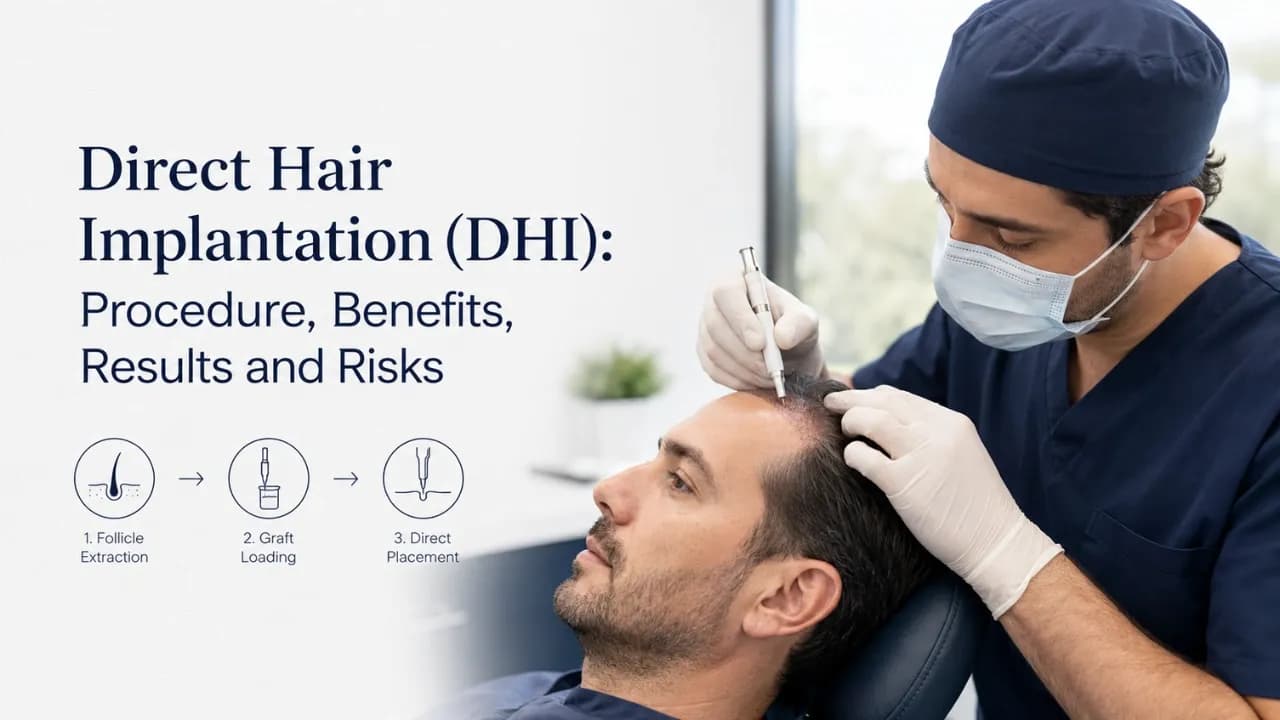
Direct Hair Implantation, commonly called DHI, is an implantation technique in which follicular grafts are placed into the scalp using a sharp implanter pen. In most modern DHI-labelled procedures, grafts are still harvested one by one using Follicular Unit Excision. The main difference is therefore the placement stage, not the extraction stage.
The implanter pen can create the recipient opening and place the graft in one controlled motion. This may help the surgeon manage angle, direction and depth, especially around a hairline or between existing hairs. It does not automatically make the transplant denser, scar-free, permanent or more successful than every other placement method.
A good DHI result still depends on diagnosis, donor planning, graft handling, surgical skill, realistic density targets and long-term protection of native hair. The technique label should support a sound surgical plan, not replace one.
What Is Direct Hair Implantation?
Direct Hair Implantation describes graft placement with an implanter device, often called a Choi-style or sharp implanter pen. The International Society of Hair Restoration Surgery explains that DHI is not a separate method of hair transplantation. It is a way of implanting grafts after they have been harvested.
This distinction matters because patients are often asked to choose between DHI and FUE as though they are completely separate surgeries. In practice, many DHI procedures use FUE for extraction and an implanter pen for placement. The detailed DHI and FUE comparison explains this difference in more depth.
The term is also used differently across clinics. One provider may use it for sharp implanter placement without pre-made slits, while another may use it for a broader workflow involving small-batch extraction and rapid implantation. Ask the clinic to explain exactly how grafts are harvested, stored, loaded and placed.
How Does the DHI Procedure Work?
A DHI-labelled transplant usually follows the same overall surgical pathway as other modern hair transplants. The key variation appears during graft placement.
- Diagnosis and planning: The doctor confirms the type of hair loss, checks whether it is stable, assesses the donor area and estimates a safe graft range.
- Hairline and zone design: The recipient area is mapped according to facial proportions, future hair loss and the available donor supply.
- Local anaesthesia: The donor and recipient areas are numbed while the patient remains awake.
- Follicle extraction: Individual follicular units are commonly removed using the same micropunch principles described in the FUE hair transplant guide.
- Graft inspection and loading: Suitable grafts are sorted, kept hydrated and carefully loaded into implanter pens of an appropriate diameter.
- Direct placement: The sharp implanter enters the recipient area and releases the graft while the surgeon controls its depth, direction and angle.
- Aftercare: The clinic provides instructions for washing, sleeping, activity, medication and follow-up.
Some teams extract and implant in small batches to reduce the time grafts remain outside the body. This can be a sensible workflow, but graft survival depends on the full chain of handling, hydration, temperature, storage and placement, not on speed alone.
What Does the Implanter Pen Actually Change?
The implanter pen combines recipient-site creation and graft insertion in a single action. A trained surgeon can use it to control how each follicular unit enters the scalp and how it sits relative to nearby hairs.
This can be useful when working in a high-visibility frontal zone, placing single-hair grafts at the edge of a hairline, or implanting between existing hairs. The principles of natural hairline design still determine whether the result looks soft and age-appropriate.
The device does not remove the need for skill. Grafts can still be compressed, bent, dehydrated, placed too deep or positioned at an unnatural angle if the loading and implantation technique is poor. Implanter use requires correct tip selection, depth control, team coordination and repeated training.
What Are the Potential Benefits of DHI?
| Potential benefit | What it may mean | Important limitation |
|---|---|---|
| Controlled placement | The surgeon can adjust angle, direction and depth during implantation. | Control depends on operator skill, graft loading and tip selection. |
| Work between existing hair | The pen may help place grafts in selected thinning areas without creating all channels in advance. | Dense native hair can also make implantation technically difficult and increases the need for careful planning. |
| Small-batch workflow | Extraction and placement may be alternated to limit out-of-body time. | Shorter out-of-body time alone does not guarantee higher survival. |
| No linear donor scar | When DHI is combined with FUE extraction, the donor area heals with small dot scars rather than a strip scar. | This is an advantage of FUE harvesting, not of the implanter pen itself. |
| Partial-shave options | Some selected patients may avoid a full recipient-area shave. | Not every graft count or hair-loss pattern is suitable for an unshaven approach. |
These advantages are practical possibilities, not universal guarantees. Current literature explains how implanters can be used effectively, but it does not prove that DHI produces better final outcomes than every well-performed pre-made-site technique.
How Does DHI Compare With FUE and FUT?
| Feature | DHI-labelled procedure | Conventional FUE placement | FUT |
|---|---|---|---|
| Follicle harvesting | Usually individual FUE extraction | Individual FUE extraction | Strip removal followed by graft dissection |
| Implantation | Sharp implanter creates the opening and places the graft | Recipient sites are usually created first, then grafts are placed | Recipient sites are usually created first, then grafts are placed |
| Donor scar | Small dot scars when FUE extraction is used | Small dot scars | Linear scar |
| Main planning advantage | Controlled placement and ability to work in selected zones | Efficient large-area site creation and flexible placement methods | Potentially high graft yield in suitable donors |
| Evidence of universal superiority | Not established | Not established over every other method | Not established over every other method |
The most useful comparison is not whether one label is modern and another is old. It is whether the chosen harvesting and implantation plan suits the donor area, target zones, graft requirement and surgeon's strongest technique.
Who May Be a Suitable Candidate for DHI?
DHI may be considered for adults with a confirmed, transplant-suitable form of hair loss and enough stable donor hair. It is often discussed for frontal hairline work, temples, selected density enhancement, beard or eyebrow restoration, and cases where partial shaving may be useful.
A suitable candidate generally has:
- A stable diagnosis, most commonly androgenetic alopecia
- Adequate donor density and hair calibre
- Realistic expectations about density and coverage
- A hairline plan that remains appropriate if hair loss progresses
- No uncontrolled scalp inflammation or infection
- General health that allows elective surgery and normal healing
The Norwood scale can describe the visible pattern in men, but it cannot confirm donor safety or predict how quickly native hair will thin. A scalp examination remains necessary.
When May DHI Not Be the Right Choice?
DHI is not a solution for every form of hair loss. Surgery may be delayed, modified or avoided when the diagnosis is unstable, the donor area is weak, the recipient scalp has active disease or the requested coverage exceeds the available donor supply.
- Active alopecia areata or active scarring alopecia
- Diffuse unpatterned thinning involving the donor area
- Rapidly progressing loss without a long-term preservation plan
- Very limited donor density for the requested coverage
- Uncontrolled diabetes, bleeding risk or other conditions affecting healing
- Expectations of teenage density, zero shedding or guaranteed graft survival
People mainly seeking discretion may ask about an unshaven hair transplant. This is a separate planning decision and is not automatically suitable just because an implanter pen is used.
How Many Grafts Can Be Implanted With DHI?
There is no universal maximum graft count for DHI. Session size depends on donor supply, treatment area, graft quality, the number of trained staff loading implanters, procedure duration and the surgeon's ability to maintain consistent placement quality.
Small frontal or temple cases may involve roughly 800 to 1,500 grafts. Moderate frontal and mid-scalp work may require 1,500 to 3,000 or more. Large multi-zone restoration may need a different workflow, staged surgery or another placement method. A higher graft number is not automatically better if it overharvests the donor area or spreads limited grafts too thinly.
What Is the Recovery Timeline After DHI?
| Time | What you may notice | Main care focus |
|---|---|---|
| Days 0 to 3 | Redness, tenderness, swelling and small crusts | Protect grafts, sleep as advised and use prescribed medicines |
| Days 4 to 10 | Crusts soften and visible healing progresses | Follow the clinic's washing method and avoid scratching |
| Weeks 2 to 8 | Many transplanted shafts shed temporarily | Do not judge the result during the shedding phase |
| Months 3 to 4 | Fine early growth may begin | Continue follow-up and any prescribed native-hair treatment |
| Months 6 to 9 | Coverage becomes easier to assess | Track progress with consistent photographs |
| Months 12 to 18 | Density, calibre and crown growth continue to mature | Review the final outcome and future-loss plan |
Visible surface recovery is much faster than biological hair growth. The full hair transplant recovery guide explains why shedding and delayed regrowth are expected after any implantation method.
Want a realistic graft plan based on your donor area and future hair-loss pattern?
When Will You See DHI Results, and Are They Permanent?
DHI does not shorten the biological hair-growth cycle. Early regrowth often starts around months 3 to 4, visible improvement develops through months 6 to 9, and the result is usually assessed around 12 months. Crown areas may continue maturing for up to 18 months.
The month-by-month results timeline is broadly similar whether grafts were placed with implanters or into pre-made recipient sites.
Transplanted follicles selected from a stable donor area are generally long lasting. Native hair around them can continue to thin because DHI does not stop androgenetic alopecia. Medical treatment may be discussed when appropriate to preserve the overall appearance and reduce a future gap behind the transplanted zone.
What Are the Risks and Side Effects?
DHI is still hair-transplant surgery. Common temporary effects include pain during anaesthetic injections, scalp tenderness, redness, swelling, itching, crusting, pinpoint bleeding, temporary numbness and shock loss.
Less common complications can include infection, folliculitis, visible donor thinning, poor graft growth, cobblestoning, an unnatural hairline, wrong growth direction, scarring and the need for corrective surgery. Recipient-site necrosis is rare but serious. Review the detailed hair transplant side-effects guide before consenting.
The implanter pen does not eliminate these risks. Patient selection, sterile technique, surgical planning, graft handling and aftercare remain central to safety.
How Much Does DHI Cost in India?
Published Indian clinic prices vary widely. A useful working range for hair transplantation is about Rs. 50 to Rs. 150 per graft, while DHI-labelled procedures are often positioned toward the upper end because implanter placement can be more time-intensive and may require additional devices and staffing.
The final cost depends on graft count, surgeon involvement, donor complexity, whether the procedure is partially shaven, the number of implanter pens used, medicines, tests and follow-up. The hair transplant cost guide for India helps compare written quotes without relying only on a per-graft headline.
Ask whether the bill is based on grafts planned, extracted or implanted, and whether GST, tests, medicines and aftercare are included.
How Should You Choose a Clinic for DHI?
- Confirm the diagnosis before discussing technique or graft count.
- Ask who performs extraction, hairline design, site creation and implantation.
- Request a donor-area assessment and a long-term plan for future hair loss.
- Ask the clinic to define what it means by DHI and which implanter system it uses.
- Review consistent before-and-after photographs in similar lighting and angles.
- Avoid guarantees of zero scarring, zero shedding, fixed survival percentages or instant density.
- Compare the total written package, follow-up and complication support.
Technique should come after diagnosis and planning. A surgeon who is skilled with a well-chosen conventional placement method may produce a better result than an inexperienced team using an implanter pen.
What This Means for You
DHI is best understood as an implantation technique, usually combined with FUE extraction. The implanter pen can offer controlled placement and may be useful for selected hairline, density or partial-shave cases. It does not guarantee higher graft survival, faster final growth or a better result for every patient.
Choose the procedure only after confirming the diagnosis, donor supply, target graft count, future-loss plan and the surgeon's direct role. The quality of the overall surgery matters more than the marketing name attached to the implantation tool.
Compare the technique only after a doctor confirms whether surgery is suitable for you.
Kibo Clinics' Perspective on Direct Hair Implantation
At Kibo Clinics, the implanter-pen approach is considered within a diagnosis-led treatment plan rather than sold as a universal upgrade. The team evaluates the cause and stability of hair loss, donor density, hair calibre, recipient-zone requirements and long-term progression before recommending a surgical workflow.
Kibo's Direct Hair Transplant service uses small-batch extraction and implanter placement where clinically appropriate. The objective is controlled graft handling and natural direction, while keeping expectations realistic about donor limits, recovery and native-hair thinning.
Frequently Asked Questions
Is DHI a separate hair transplant method?
DHI is more accurately described as an implantation technique. In most cases, follicles are extracted using FUE and then placed with a sharp implanter pen.
Is DHI better than FUE?
Not automatically. DHI usually uses FUE extraction and changes the implantation stage. The better option depends on the case, target zones and the surgeon's skill with the selected workflow.
Is DHI hair transplant permanent?
Transplanted follicles from a stable donor area are generally long lasting. DHI does not stop untreated native hair from continuing to thin.
Does DHI leave scars?
When DHI is combined with FUE extraction, it avoids a linear strip scar but still leaves small dot scars in the donor area and tiny healing sites in the recipient area.
Is DHI painful?
The procedure is performed under local anaesthesia. The anaesthetic injections can sting, and temporary soreness, tightness or tenderness may occur during recovery.
Can DHI be done without shaving?
A partial-shave or unshaven approach may be possible in selected cases. Suitability depends on graft count, hair length, donor access and the surgeon's workflow.
How long does DHI recovery take?
Visible healing commonly progresses over 7 to 10 days. Temporary shedding may occur over the following weeks, and the final result takes about 12 to 18 months to mature.
How many grafts can DHI implant in one session?
There is no fixed maximum. The safe number depends on donor supply, treatment area, procedure duration, team efficiency and the surgeon's ability to maintain placement quality.
Does DHI guarantee higher graft survival?
No. Implanter placement may support controlled handling, but survival also depends on extraction quality, hydration, storage, out-of-body time, recipient-site conditions and aftercare.
How much does DHI cost in India?
Sources used for medical and technical review include the International Society of Hair Restoration Surgery guidance on DHI terminology and surgical treatments, published research on sharp implanter methods and graft placement, the American Academy of Dermatology's hair-transplant patient guidance, NHS hair-transplant safety information, and peer-reviewed reviews of hair-transplant complications.
- ISHRS: Why FUE Is So Confusing
- ISHRS: Surgical Treatments for Hair Loss
- Published guide to sharp implanter graft placement
- Published review of implanters and recipient sites
- American Academy of Dermatology: Hair Transplant Guidance
- NHS: Hair Transplant Risks and Recovery
- Published review of hair-transplant complications
Related Articles & Services
Hair Transplant
FUE Hair Transplant | Sapphire FUE | Bio FUE | Corrective Hair Transplant | Hairline Correction
Hair Regrowth
PRP Therapy | GFC Therapy | Mesotherapy | Microneedling | Low-Level Laser Therapy
Must Read
Hair Transplant Procedure Steps | Complete Hair Transplant Guide | Real-Time FUE | Hair Thickness and Results | Document Your Hair Journey
Relevant Blogs
Corrective Hair Transplant Guide | Hair Mill Red Flags | Receding Hairline Treatment | Hairline Design Over Graft Count | How to Evaluate a Hair Transplant Clinic
Medical Disclaimer : Information from Kibo Hair Clinics is for educational purposes only. It does not replace diagnosis, trichoscopy, blood test interpretation, prescription treatment, procedure advice, or side-effect counselling from a qualified dermatologist or hair restoration doctor.