
Who This Is For: People comparing hair transplant graft counts or clinic plans who want to understand how single-hair and multi-hair follicular units affect hairline softness, visual density, donor use and long-term naturalness.
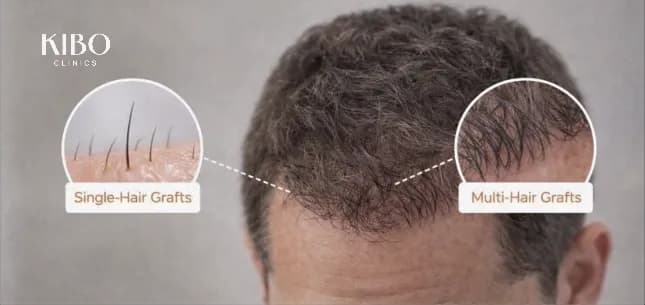
Single-hair and multi-hair grafts do different jobs in a natural-looking hair transplant. Single-hair follicular units are commonly used at the front edge and temples to keep the transition soft, while double-hair and triple-hair units are usually placed farther behind to build coverage. The best plan is not the one with the most multi-hair grafts. It is the one that matches graft type to scalp zone, hair calibre, angle, direction, donor supply and future hair loss.
A graft is also not the same as one hair. Modern hair transplantation works with naturally occurring follicular units. These units commonly contain one to four hairs, so a 2,000-graft procedure does not automatically mean 2,000 hairs. This difference is one reason two patients with the same graft count can end up with very different visual density.
What Is a Hair Graft, and How Many Hairs Can It Contain?
A follicular unit is a natural grouping of hairs in the scalp. The International Society of Hair Restoration Surgery describes follicular units as small natural bundles, often containing one to four hairs. During modern transplantation, these units are harvested from a donor area and moved to a recipient area where coverage is needed.
| Graft Type | What It Contains | Typical Visual Role | Main Planning Point |
|---|---|---|---|
| Single-hair graft | 1 hair | Front hairline and delicate temple work | Creates softness but contributes less hair count per placement |
| Double-hair graft | 2 hairs | Transition behind the front edge and general coverage | Builds body while preserving a soft leading edge |
| Triple-hair graft | 3 hairs | Mid-scalp and selected crown areas | Adds more hairs per placement where coverage is the priority |
| Four-hair graft | 4 hairs in a naturally occurring unit | Selected density-building areas | A valuable donor unit that should be used where it improves coverage most |
When you compare clinic quotes, ask whether the number refers to intact follicular units and how many hairs those grafts are expected to contain. Kibo has a separate explanation of why the same graft count can create different visual results. The total number is useful, but it does not describe the complete transplant plan.
Why Are Single-Hair Grafts Used at the Hairline?
A believable hairline should not begin as a dense, straight wall. Natural frontal hairs vary in spacing, calibre and direction, and the transition from forehead skin to thicker hair is gradual. Fine single-hair grafts help recreate that softer front edge. Published hair-transplant guidance specifically describes single-hair units at the frontal hairline, with larger two- and three-hair units used farther behind for density.
The graft type is only one part of the design. The surgeon also has to control the angle, direction, irregularity and age-appropriate position of the hairline. Kibo's guide to natural hairline design principles explains why a technically dense line can still look artificial.
A second useful comparison is hairline design over graft count. It shows why adding more grafts is not automatically better if the front edge becomes too harsh or the donor reserve is being spent inefficiently.
Comparing two graft plans? Ask how many single-hair units are being reserved for the front edge and how density will increase behind them.
Where Are Single, Double and Triple Hair Grafts Usually Placed?
There is no universal map for every patient, but the general principle is a gradual transition. The leading edge is usually finer, the mid-scalp needs efficient coverage, and the crown has to respect the natural whorl. A surgeon may change the mix based on donor composition, hair calibre, curl and the size of each treatment zone.
| Scalp Zone | Grafts Commonly Preferred | Why | What Can Look Wrong |
|---|---|---|---|
| Leading frontal edge | Fine single-hair units | Creates a softer transition from forehead to hair | Coarse multi-hair units too far forward can look heavy or pluggy |
| Temples and temple points | Fine singles where suitable | These areas need delicate calibre, angle and direction matching | Thick units or upright placement can be obvious |
| Behind the hairline | Doubles and selected triples | Builds body behind the soft front edge | Using only singles can waste donor efficiency and reduce coverage |
| Mid-scalp | Mix based on donor composition | Balances coverage, flow and donor conservation | Uniform placement without regard to calibre can leave visible gaps |
| Crown | Often multi-hair units where direction allows | Helps build coverage across the whorl | Ignoring the spiral pattern can reduce visual density |
Zone priorities matter when donor supply is limited. The comparison of mid-scalp versus hairline density explains why some patients should not chase maximum density in every area at once. The crown is even more demanding because the same number of hairs is distributed around a whorl, which is covered separately in the guide to crown grafts and visual density.
Are Single and Multi-Hair Grafts Different From FUE, FUT or DHI?
No. These terms describe different parts of the transplant. FUE and FUT describe how donor follicular units are harvested. Single-hair, double-hair and triple-hair describe the natural composition of the graft being placed. A modern FUE case can contain a mixture of singles, doubles, triples and four-hair units, and so can a FUT case.
DHI is commonly used as an implantation label, but it also does not change the number of hairs inside each follicular unit. If you are comparing techniques rather than graft composition, use the FUE, FUT and DHI technique comparison. Keeping these concepts separate prevents misleading clinic claims such as presenting a graft-size mix as a completely different surgical method.
What Actually Makes the Graft Mix Look Natural?
Graft composition matters, but it does not work in isolation. A poorly angled single-hair graft can still look unnatural, while a well-positioned multi-hair graft can add useful coverage without being visible. The surgeon has to combine graft type with hair characteristics, recipient-zone size and long-term donor planning.
| Factor | Why It Matters | What It Changes Visually |
|---|---|---|
| Hair calibre | Thicker shafts cover more scalp per hair | A lower hair count can sometimes look fuller than a larger number of very fine hairs |
| Curl or wave | Curved hairs overlap and create more visual bulk | Texture changes density perception even with the same graft count |
| Hair-to-skin contrast | High contrast makes scalp gaps easier to see | Visual density is not determined by grafts per square centimetre alone |
| Angle and direction | Controls how hair exits and overlaps | Correct flow can increase the impression of coverage |
| Recipient area size | The same graft count spread over a larger area looks thinner | Hairline, mid-scalp and crown need different allocation priorities |
| Graft survival | Only growing grafts contribute to the final result | A blanket clinic percentage cannot describe every case |
| Progressive native hair loss | Surrounding hair can continue thinning | A good plan should remain natural if native density changes later |
This is also why donor planning comes before a final graft promise. The guide to the donor area in a successful hair transplant explains why the supply is finite and why aggressive harvesting can compromise future options.
Want a graft plan that explains hair count, zone allocation and donor reserve instead of giving you only one headline number?
Does a Higher Graft Count Always Mean a Better Result?
No. A larger graft count can be useful when a larger area needs restoration, but the number has to be interpreted alongside hairs per graft, donor safety and recipient-area size. If a clinic splits naturally occurring multi-hair units into smaller grafts, the reported graft count can increase even though the total number of hairs has not increased.
A more useful comparison is the complete plan: donor density, expected mix of one-hair and multi-hair units, recipient area, hairline position, calibre, angle, direction, and how much donor supply is being reserved for future loss. This makes it harder for a high graft number to be used as a sales shortcut.
Should Multi-Hair Grafts Be Split Into Single-Hair Grafts?
A naturally occurring follicular unit should not be split simply to create a larger headline graft number. Dividing a unit does not create additional donor hair. In some cases, selective refinement may be used when a surgeon needs finer grafts for a delicate front edge, but unnecessary splitting increases handling and can remove some protective tissue around follicles.
This is one reason patients should ask how the clinic counts grafts and whether multi-hair follicular units are being preserved intact where appropriate. The important outcome is how many healthy hairs are moved and how well they are used, not how large the quoted graft number looks.
Do Single-Hair and Multi-Hair Grafts Survive Differently?
There is no universal percentage that can be assigned to every graft type, clinic or transplant technique. Published reviews describe multiple factors that influence whether grafts grow, including dehydration, mechanical trauma, storage conditions, time outside the body, recipient-site trauma and implantation technique.
The previous live version of this page used broad 85% to 97% and 90% to 95% survival statements. Those ranges are too general to present as a dependable expectation for every patient. A better patient question is how the clinic handles, hydrates, sorts and implants the grafts. Kibo's guide to factors that influence graft survival covers this topic in more detail.
What Should You Ask Before Accepting a Graft Plan?
- How many grafts are planned for the hairline, mid-scalp and crown separately?
- How will single-hair units be reserved for the leading hairline and temples?
- Will naturally occurring multi-hair follicular units be kept intact where appropriate?
- How do my hair calibre, curl and hair-to-skin contrast change the plan?
- What donor density is available now, and how much is being preserved for future hair loss?
- How are angle, direction and spacing planned in each zone?
- How does the clinic count grafts when a follicular unit contains multiple hairs?
- What graft-handling, hydration and implantation steps are used to reduce avoidable injury?
These questions are more useful than comparing two clinics only by the total graft figure. A diagnosis-led transplant plan should explain how a limited donor supply is being converted into a believable hairline and enough visual coverage for the areas that matter most.
How the Graft Mix Looks Over Time
Single and multi-hair grafts are not visually final immediately after surgery. Transplanted hairs may shed before regrowth begins. New growth then develops gradually, and the overall appearance continues to change as hairs gain length, calibre and styling behaviour. The hairline may look sparse before fine single hairs gain length, while density behind it can look uneven before enough multi-hair units have grown to overlap.
Judge progress with consistent photographs and the timeline given by your surgeon rather than daily mirror checks. The hair transplant growth tracking guide explains how to document changes more consistently.
Need a personalised hairline and density plan based on your donor composition rather than a generic graft target?
Frequently Asked Questions
What is a single-hair graft in a hair transplant?
A single-hair graft is a follicular unit containing one hair. Fine single-hair units are commonly reserved for the frontal transition zone and temples because they help create a softer edge than coarse multi-hair units.
What is a multi-hair graft?
A multi-hair graft is a naturally occurring follicular unit containing two, three, and sometimes four hairs. These units are commonly used behind the leading hairline, where the goal shifts from softness to coverage and visual density.
Is one graft equal to one hair?
No. A graft and a hair are not the same thing. A follicular unit can contain one to four hairs, so two procedures with the same graft count can move different total numbers of hairs.
Are single and multiple grafts different from FUE and FUT?
Yes. FUE and FUT describe donor harvesting methods. Single-hair, double-hair and triple-hair describe the composition of the graft being placed. Either harvesting method can produce a mix of follicular unit sizes.
Why are single-hair grafts used at the front hairline?
A natural hairline usually transitions gradually from skin to denser hair. Fine single-hair follicular units help create this softer transition. Angle, direction, spacing, hair calibre and irregular design also matter, so graft type alone does not make a hairline natural.
Can multi-hair grafts be placed in the hairline?
Multi-hair units can be useful behind the leading edge, but placing coarse double or triple units too far forward can make the transition look heavy or abrupt. The first rows are usually planned more delicately.
Do more multi-hair grafts always mean a denser result?
Not automatically. Multi-hair units can add more hairs per placement, but visible density also depends on the area being covered, hair diameter, curl, hair-to-skin contrast, angle, direction, spacing, graft survival and donor supply.
Should multi-hair grafts be split into single-hair grafts?
Not routinely. Dividing a naturally occurring follicular unit does not create more donor hair. Selective refinement may sometimes be used when a surgeon needs finer units for a hairline, but unnecessary splitting can increase handling and should not be treated as a way to inflate graft numbers.
Do single-hair and multi-hair grafts have different survival rates?
There is no universal survival percentage for every single-hair or multi-hair graft. Growth depends on factors such as extraction quality, hydration, storage, mechanical trauma, out-of-body time, recipient-site creation, implantation technique, scalp condition and aftercare.
How long does it take to see the final look from the graft mix?
The terms single-hair graft, double-hair graft and multi-hair graft describe the hair composition of transplanted tissue. FUE and FUT describe donor harvesting methods. DHI is commonly used as an implantation label. These terms should not be treated as interchangeable.
A higher graft count does not guarantee a denser or more natural result. Final appearance varies with donor composition, hair diameter, curl, hair-to-skin contrast, recipient-area size, hairline design, angle, direction, spacing, graft handling, graft survival, healing and future native-hair loss.
There is no universal graft-survival percentage that applies to every clinic, technique or patient. The earlier live version of this page used broad survival-rate ranges. This reoptimized version removes those blanket claims because published evidence shows that survival depends on several procedural and biological factors.
After a transplant, contact your treating clinic or seek medical care if you develop increasing pain, spreading redness, fever, pus or unusual discharge, bleeding that does not settle, or another symptom your surgeon has advised you to treat urgently.
Authoritative sources reviewed:
ISHRS: FUE and naturally occurring follicular units
ISHRS: Hair graft placement and aesthetic planning
ISHRS: Surgical hair restoration overview
Hair Transplantation Surgery, Journal of Cutaneous and Aesthetic Surgery
Related Articles & Services
Hair Transplant
FUE Hair Transplant | Sapphire FUE Hair Transplant | Direct Hair Transplant DHT | Bio FUE Hair Transplant | Hairline Correction
Hair Regrowth
PRP Therapy | GFC Therapy | Low Level Laser Therapy | Microneedling for Hair Regrowth | Mesotherapy for Hair Regrowth
Must Read
Hair Transplant Guide | Hair Transplant Procedure Steps | Hair Transplant Safety | Hair Transplant Recovery
Relevant Blogs
Uneven Early Hair Growth | Transplants and Native Hair Thinning | Hair Transplant Long-Term Maintenance | How to Read Hair Transplant Before and After Photos
Medical Disclaimer : Information from Kibo Hair Clinics is for educational purposes only. It does not replace diagnosis, trichoscopy, blood test interpretation, prescription treatment, procedure advice, or side-effect counselling from a qualified dermatologist or hair restoration doctor.