
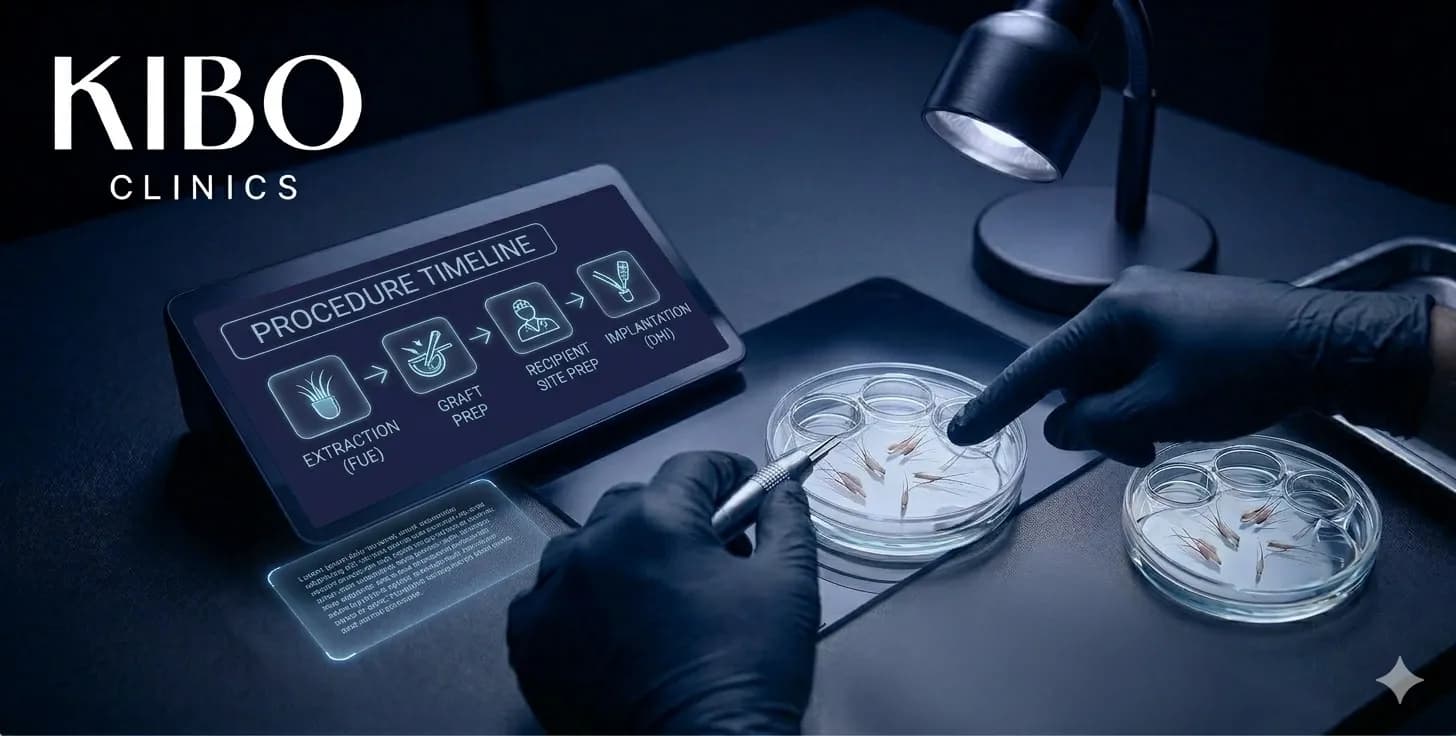
Who This Is For: Anyone considering a hair transplant who wants to understand the actual surgical sequence, what happens on the day, realistic recovery timing, and whether they are likely to be a suitable candidate before booking anything.
A hair transplant typically involves consultation and diagnosis, donor and recipient planning, local anaesthesia, graft harvesting by FUE or FUT, microscopic graft preparation, recipient-site creation, graft placement, dressing, and structured aftercare. The surgery commonly takes several hours. Transplanted hairs may shed temporarily before new growth becomes visible. Many patients see results at 6 to 9 months, while full evaluation may take about 12 months.
What Is a Hair Transplant?
A hair transplant is a surgical procedure that redistributes a person's own hair follicles from a donor region, usually the back or sides of the scalp, to a thinning or bald recipient area. It treats selected, stable forms of permanent hair loss. It is not a universal fix for every cause of shedding, and understanding your own type of hair loss matters before considering surgery at all.
A transplant can also be relevant to a receding hairline once the underlying pattern has been properly diagnosed as stable, rather than assumed from appearance alone.
Step 1: Consultation, Diagnosis and Candidacy
The process starts with a history and scalp examination, not a straight jump to graft numbers. This covers your pattern of loss, family history, medical and medication history, scalp condition, donor density, hair calibre, and often trichoscopy or dermoscopy to examine the follicles more closely. Most surgical candidates have androgenetic alopecia, commonly referred to as male-pattern baldness in men, often described using a staging system such as the Norwood scale.
Assessing the donor area properly is just as important as assessing the bald area. The donor region should never be assumed to be permanently stable without examination, and the surgeon needs to know how much can safely be used now while preserving reserve for the future.
Part of this step is ruling out or identifying treatable contributing factors, such as iron deficiency, thyroid imbalance, or localized tension from styling that points to traction alopecia rather than a pattern condition. Temporary shedding patterns, such as ongoing postpartum hair loss, generally should not go straight to surgery. The pattern needs to stabilize and a permanent cause needs to be confirmed first.
You should also know who is actually doing the diagnosis. A dermatologist or trichologist may be involved at different stages, and it is reasonable to ask which professional is assessing your scalp and confirming your diagnosis before a surgical plan is built.
Step 2: Design and Surgical Plan
Once candidacy is established, the surgeon works out hairline design, recipient priorities, a graft estimate, donor-zone boundaries, anticipated future loss, and technique choice. You should review the proposed design before surgery, not see it for the first time on the day. A common trap here is assuming that a higher graft count automatically means a better hairline. Design and placement matter as much as the raw number.
Step 3: Preparation and Local Anaesthesia
On the day, this covers photographs, marking, trimming or shaving where needed, positioning, antisepsis, and local anaesthesia, with sedation only when clinically appropriate. This is also when you should disclose allergies, current medicines, blood-pressure issues, bleeding disorders, smoking, diabetes, and any previous reactions to surgery or anaesthesia. None of this is optional paperwork. It directly affects how safely the rest of the procedure goes.
Step 4: Donor Harvesting, FUE or FUT
This is where FUE and FUT actually differ. In FUE, now commonly expanded as follicular unit excision (the older term "follicular unit extraction" is still widely used), the surgeon removes individual follicular units one at a time using a small punch. In FUT, a strip of hair-bearing scalp is removed from the donor area and later divided into grafts under a microscope, and the donor wound is closed with sutures or staples.
| Feature | FUE (Follicular Unit Excision) | FUT (Follicular Unit Transplantation) |
|---|---|---|
| Harvest method | Individual follicular units removed with punches | A strip of hair-bearing scalp removed and dissected |
| Donor scar | Multiple small punctate scars. Not scarless. | A single linear scar closed with sutures or staples |
| Donor wound | Multiple small wounds | One linear wound |
| Graft preparation | Individual grafts extracted and inspected | Strip is microscopically dissected into grafts |
| Main trade-offs | Longer extraction time; transection and overharvesting risk | Linear scar, wound tension, sutures or staples, possible numbness |
| Which is better | Depends on diagnosis, donor characteristics, hairstyle goals, and surgeon expertise. Neither is universally better. | |
You may also come across "no-shave" terminology, referring to unshaven FUE, or technique variants such as bio-FUE and real-time FUE. These describe differences in handling or workflow rather than a different biological outcome, and a technique or brand name on its own does not guarantee better growth.
Whichever method is used, scar visibility and healing depend on technique, healing response, and how closely you crop your hair afterward, not just which method you picked. If donor supply on the scalp is genuinely limited, some patients and surgeons also discuss body hair transplantation as an additional donor source, though it comes with its own considerations around hair texture and growth behaviour. Whatever the source, avoiding overharvesting matters, since taking too much from the donor area can thin it permanently.
Step 5: Graft Inspection, Dissection and Preservation
Grafts are counted, inspected, and kept moist in a holding solution chosen by the surgical team while they wait to be implanted. Handling time, temperature, dehydration, crushing, and transection all affect graft quality, which is why graft survival depends as much on careful handling as on the extraction method itself. Be wary of any clinic that promises a specific graft-survival percentage without a transparent, independently audited method behind that number.
Step 6: Recipient-Site Creation
The surgeon creates tiny recipient sites according to the planned hairline, direction, angle, density, hair calibre, curl, and any existing hair in the area, sometimes using fine instruments such as sapphire-tipped blades. This is a major aesthetic and technical stage in its own right, not just "making tiny holes." Natural appearance depends on more than graft count. It depends on how single-hair grafts are placed at the frontal edge before transitioning to greater density behind it.
The crown typically consumes a large number of grafts on its own and may be prioritized after the frontal region depending on diagnosis and goals, since covering more area can reduce density while maximizing density in one zone can leave less donor reserve for later. This is also where the trade-off between mid-scalp versus hairline density gets decided, and why the same graft count can look very different depending on how it is distributed.
Step 7: Graft Placement
Grafts are placed into the prepared sites using forceps or an implanter device, matched to their intended orientation. You may hear this implanter-based approach referred to as direct implantation, sometimes marketed under names like DHI. This describes part of the implantation workflow, not a separate biological procedure, and it still depends on diagnosis, donor harvesting, site design, and aftercare like any other approach. The number of hairs in each follicular unit, and how single versus multiple-hair grafts are placed, meaningfully shapes how natural the final result looks.
Step 8: Closure, Dressing and Discharge
FUT requires closing the donor wound. FUE does not need a linear closure but still leaves multiple small puncture sites. The scalp may be dressed or left open depending on the surgeon's protocol. Before you leave, you should receive written aftercare instructions, emergency contact details, any prescribed medication, and a follow-up plan.
Step 9: Early Recovery
Expect some swelling, crusting, itching, tenderness, and numbness in the days that follow, along with activity restrictions and specific instructions on washing and sleep position to protect the grafts. Aftercare protocols genuinely vary between clinics, so your operating surgeon's specific instructions always take priority over anything general you read online, including this guide.
Step 10: Shedding, Regrowth and Final Assessment
Transplanted hair shafts commonly shed within the first several weeks while the follicles themselves stay in place beneath the skin, a normal part of the hair growth cycle resetting after the trauma of surgery. This is sometimes called shock loss, and it can also affect some of the existing hair nearby, not just the transplanted grafts. The scalp may look thin or uneven around month 3. Many patients see visible cosmetic improvement around 6 to 9 months, with density and texture continuing to mature for some patients out to 12 months or longer.
What Happens on Surgery Day?
A typical session runs roughly 4 to 8 hours, though this varies with graft number, technique, team size, and whether treatment is staged across more than one day. Some larger cases are deliberately planned as multiple sessions rather than one long day. You are usually awake throughout, with a numbed scalp and a mild sedative if appropriate. Even with sharp pain controlled, you may still feel pressure, pulling, positioning discomfort, and repeated anaesthetic injections. The exact sequence of steps is not identical at every clinic. Some teams harvest before creating recipient sites, others do it the other way around. What matters is that the core components are all covered properly, not that they follow one rigid script.
Recovery Timeline
| Period | Common Experience | Safety Note |
|---|---|---|
| Surgery day | Numb scalp, pressure, donor and recipient wounds, dressing or spray depending on protocol | You should leave with written instructions and emergency contact details. |
| Days 1-3 | Tenderness, mild swelling, crusting, sensitivity | Sudden severe pain, breathing difficulty, rapidly worsening swelling, fever, or heavy bleeding needs urgent contact. |
| Days 4-14 | Scabs gradually loosen; itching or altered sensation may occur | Do not pick or rub the grafts. Washing instructions vary by surgeon. |
| Weeks 2-8 | Transplanted shafts may shed; nearby existing hair may also experience shock loss | Shedding at this stage does not automatically mean graft failure. |
| Around month 3 | The scalp may look thin or uneven; early growth may be limited | Avoid judging the final outcome at this stage. |
| Months 4-6 | New growth becomes more noticeable | Growth rate varies by patient and by individual follicle cycle. |
| Months 6-9 | Many patients see visible cosmetic improvement | Commonly cited as the typical result window. |
| Months 9-12+ | Density and texture continue to mature | Some results take 12 months or longer. Assess with your surgeon, not a mirror alone. |
Who Is, and Isn't, a Good Candidate?
Pattern hair loss is a common reason people consider surgery, but not everyone with thinning hair is automatically a candidate. Categories that generally need more caution or a different approach first include diffuse unpatterned alopecia, active scarring alopecia, unstable or still-progressing hair loss, insufficient donor supply, very young patients whose pattern hasn't stabilized, unrealistic expectations, certain psychological conditions such as body dysmorphic disorder, and general medical unfitness for surgery.
Surgery should be deferred, not pushed forward, when the diagnosis is uncertain, when inflammation or scarring is still active, when hair loss hasn't stabilized, when donor density genuinely can't support the goal, or when expectations can't realistically be met. In some of these situations medical treatment or a period of observation is the more appropriate next step, not the operating table.
Curious whether you're actually a candidate? Start with a proper assessment, not a graft estimate.
Will the Results Be Permanent?
A transplant redistributes your own hair. It does not stop the underlying tendency for nontransplanted hair to keep thinning. Donor-dominant follicles tend to keep their relative resistance to pattern loss, but "permanent" needs qualifying: individual outcomes vary, and the hair surrounding your transplant can continue to change over time. A very low or aggressively designed hairline can also become a long-term problem if the hair around it keeps thinning.
Because of this, many patients discuss additional non-surgical options with their surgeon to help manage the surrounding, nontransplanted hair, such as PRP therapy, GFC therapy, or low-level laser therapy. Others consider mesotherapy, microneedling, PDO threads, IV hair boosters, or exosome therapy, depending on diagnosis and goals. None of these are required, and the right combination, if any, depends entirely on your individual situation.
Risks and When to Contact Your Clinic
Hair transplantation is generally considered low-risk when performed appropriately, but no surgery is risk-free. Reported issues include pain, itching, dissatisfaction, infection, wound separation, allergic reactions, swelling, folliculitis, graft dislodgement, numbness, and postoperative shedding. For a fuller picture, our side-effects guide covers these in more depth, and it's worth separating genuine risk from some of the common myths that circulate around transplant safety.
Tenderness, crusting, itching, swelling, temporary numbness, and temporary shedding are common and expected. Contact your clinic promptly for increasing redness, warmth, pus, worsening pain, fever, heavy bleeding, persistent or severe swelling, wound separation, rapidly darkening skin, or signs of an allergic reaction such as hives, breathing difficulty, facial swelling, or faintness. Any of the more serious symptoms need urgent medical attention, not a wait-and-see approach.
Questions to Ask Before You Book
Worth asking any clinic directly: who diagnoses your hair loss and performs each surgical step, and whether surgeon experience genuinely differs from technician involvement at that clinic. Ask how your donor density was actually measured, what design accounts for future loss, and what the estimated graft range is, along with what happens if fewer grafts turn out to be safely harvestable than planned.
It's also worth learning the general red flags in clinic selection, asking to see long-term, dated, consented cases similar to your own hair type, and understanding how to actually read before-and-after photos rather than taking them at face value. On cost, be cautious of any quote given without an individualized assessment. Our guide on transparent pricing structures explains what a fair quote should actually include. If a previous procedure didn't go the way you hoped, it's also worth understanding common reasons people need a corrective transplant before repeating the same process elsewhere.
Kibo Clinics' Perspective on the Hair Transplant Procedure
A hair transplant is a real surgical procedure with a real recovery, not a quick cosmetic fix. Our approach puts diagnosis and candidacy first, walks you through what actually happens at each stage, and is upfront about what varies by technique, by surgeon, and by your own healing.
At Kibo Clinics, we believe you should understand the full sequence, the realistic timeline, and the honest trade-offs before you commit to a graft number or a technique name.
If you're weighing whether surgery is the right next step, a Kibo Clinics hair specialist can assess your scalp, confirm your diagnosis, and walk you through which approach, surgical or otherwise, actually fits your situation.
Frequently Asked Questions
How many steps are there in a hair transplant?
There is no single universal number, since clinics divide the workflow differently. The shared components are consultation and design, anaesthesia, donor harvesting, graft preparation, recipient-site creation, placement, dressing, aftercare, and follow-up. Presenting this as roughly 8 to 10 educational steps is useful, but the operating sequence itself varies by surgeon.
Are hair transplants permanent?
Transplanted donor-dominant follicles may provide long-lasting coverage, but "permanent" does not mean all surrounding hair stays unchanged. Existing nontransplanted hair can continue to thin, so a long-term plan should address future loss too.
Do hair transplants leave scars?
Yes, though the pattern differs. FUT leaves a linear donor scar. FUE avoids a linear scar but leaves multiple small punctate scars that can be visible with close shaving or depending on healing.
Is DHI a separate transplant technique?
DHI commonly refers to placing grafts with a direct implanter device. It describes part of the implantation workflow rather than eliminating the need for diagnosis, donor harvesting, site design, graft handling, and aftercare. A device name on its own does not guarantee a superior result.
Can women have hair transplants?
Some women are candidates, but diffuse female-pattern loss, unstable shedding, low donor density, traction, scarring disease, and unrecognized systemic causes all need evaluation first. Candidate selection should be led by diagnosis, not by visible thinning alone.
Can I have a transplant for postpartum hair loss?
Usually not during temporary postpartum shedding. The cause should be established and the pattern should stabilize before surgery is even considered. A dermatologist can assess whether a separate, permanent pattern is also present.
When can I return to work?
Some patients return to desk work within several days, but swelling, scabs, donor-area shaving, discomfort, and your clinic's specific instructions all affect timing. Your operating surgeon should give you individualized advice, not a fixed number.
When can I wash my hair and exercise?
Protocols vary between surgeons, covering washing, exercise, water exposure, bandages, and sprays differently. Always follow your own surgeon's specific instructions over anything general you read online.
What is shock loss?
Shock loss is temporary shedding of existing hair after the trauma of surgery, swelling, or recipient-site work. It can occur around the recipient or donor areas, should be explained to you before surgery, and persistent or severe loss needs assessment.
What happens if transplanted hair does not grow?
Your surgeon should assess timing, graft survival, diagnosis, aftercare, ongoing hair loss, and any possible complications. Don't assume failure before the expected maturation window has passed, but do document concerns with photographs and attend your follow-up appointments.
Related Articles & Services
Hair Transplant
Must Read
Can Hair Recover From Androgenetic Alopecia? | Androgenetic Alopecia and Hair Density | Hair Transplant Safety Checklist
Relevant Blogs
When Your First Transplant Didn't Work | How Long Hair Transplant Results Last | Is a Hair Transplant Good or Bad for You?
Medical Disclaimer : Information from Kibo Hair Clinics is for educational purposes only. It does not replace diagnosis, trichoscopy, blood test interpretation, prescription treatment, procedure advice, or side-effect counselling from a qualified dermatologist or hair restoration doctor.