
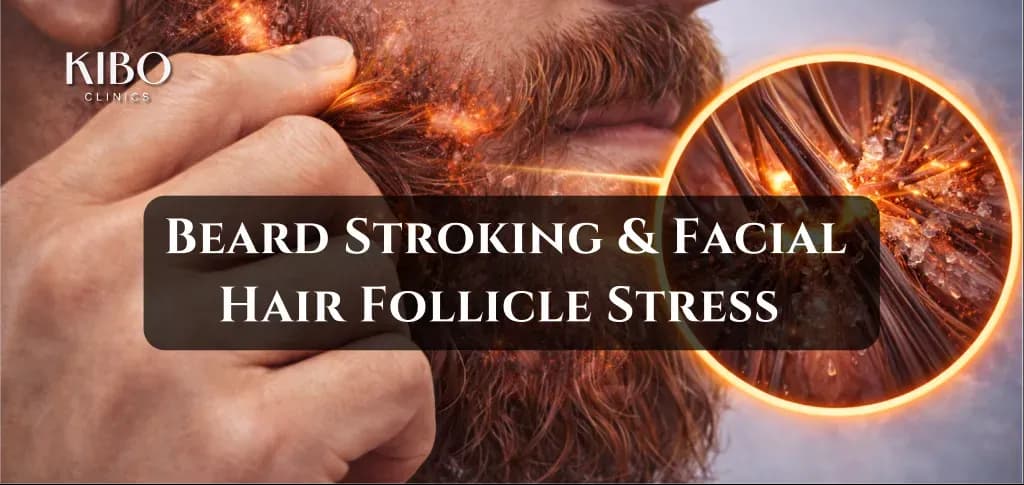
Who This Is For: People who frequently stroke, twist, tug or pluck their beard or moustache; anyone noticing short broken hairs, uneven beard density or a bald patch in an area they repeatedly handle; and readers who want to distinguish a grooming habit from alopecia barbae, traction, folliculitis, fungal infection or trichotillomania before trying treatment.
Gentle, occasional beard stroking is unlikely to cause meaningful beard hair loss by itself. The evidence is stronger for a different set of behaviours: repeated twisting can stress and break the hair shaft, sustained tugging can create traction, and recurrent plucking can remove hairs from the follicle. If pulling becomes repetitive, causes visible hair loss and is difficult to control, beard hair can also be a site of trichotillomania. Separately, touching the beard can transfer dirt and germs from the hands to the skin beneath it, which may worsen skin problems but does not prove that the follicle has been mechanically weakened.
A patchy beard should therefore not be diagnosed from the habit alone. A smooth round patch can be alopecia barbae, inflamed or scaly loss can suggest infection or folliculitis, and irregular areas with hairs at many different lengths can raise suspicion for repeated pulling. The most useful question is not “How many times did I touch my beard today?” but “Was I lightly stroking the surface, repeatedly twisting the same hairs, tugging them under tension, or actually pulling them out?”
| Behaviour | Main Risk | What You May Notice | Does It Prove Follicle Damage? |
|---|---|---|---|
| Occasional light stroking | Hand-to-skin transfer of dirt/germs; minimal mechanical stress | Usually no visible hair change | No |
| Repeated rubbing / running fingers through beard | Friction, tangling and shaft wear if forceful or frequent | Roughness, tangles or broken hairs | No |
| Tight twisting or tugging | Shaft breakage plus traction on the follicle | Uneven lengths, short broken hairs, localized thinning | Not by appearance alone |
| Repeated plucking / compulsive pulling | Hair removed from follicle; possible skin trauma or scarring with chronic injury | Irregular bald patches, hairs at different lengths, hemorrhagic or traumatic signs on dermoscopy | Requires clinical context |
Does Stroking Your Beard Actually Cause Hair Loss?
There is no good evidence that ordinary, gentle beard stroking by itself causes follicles to stop growing hair. The American Academy of Dermatology advises people to stop touching and stroking the beard mainly because hands transfer dirt and germs to the face, which can contribute to skin problems beneath facial hair. That is a skin-hygiene concern, not proof that every stroke weakens the follicle anchor.
Mechanical hair damage becomes more plausible when touching includes bending, twisting, tugging or plucking. Beard-specific traction alopecia is uncommon but has been described in the medical literature when grooming or pulling applies persistent force. The critical distinction is traction: a light downward stroke is not mechanically equivalent to wrapping hairs around a finger and pulling repeatedly.
Beard Breakage vs Beard Hair Loss: What Is the Difference?
Beard breakage happens along the hair shaft; beard hair loss happens when density falls because hairs are removed from or stop being produced by follicles. This distinction matters because a beard can look thinner even when the follicles are still healthy if the same hairs keep snapping before they reach full length.
- Breakage: short pieces, uneven length, frayed or split ends, rougher texture, intact follicular openings.
- Normal shedding: whole hairs release as part of the hair cycle. A pale or white club-shaped end can occur on normally shed telogen hairs and does not prove that traction forced the follicle to release the hair.
- Traction/pulling loss: hairs may be forcibly removed and the area may show broken hairs, empty follicles or traumatic changes depending on severity.
- Inflammatory or autoimmune loss: the beard may thin or develop bald patches even when there is no touching habit.
If short broken hairs are the main problem, Kibo's guide to hair breakage causes and treatments explains why damaged shafts behave differently from follicular hair loss.
Can Touching Your Beard Cause Skin Problems Even If It Does Not Cause Hair Loss?
Yes. This is one of the best-supported reasons to reduce unnecessary touching. Dermatologists note that hands can transfer dirt and germs to the beard and face. The skin under facial hair can also be affected by acne, folliculitis, pseudofolliculitis barbae, dryness and irritation, especially around shaving.
However, it is important not to convert that skin-care advice into a stronger claim than the evidence supports. Touching with unclean hands may aggravate skin problems; it does not mean that every beard touch introduces an infection, and it does not prove that hand sanitiser or lotion is chemically damaging the follicle. If there are pustules, painful bumps, crusting or spreading redness, the skin problem needs its own diagnosis.
Does Stroking or Rubbing Your Beard Make It Grow Faster?
No convincing clinical evidence shows that stroking or rubbing the beard makes it grow faster or thicker. Beard density and pattern are influenced mainly by genetics, age, androgen responsiveness and the number and distribution of facial follicles. Briefly increasing local blood flow through rubbing is not the same thing as increasing follicle number or extending beard growth in a clinically meaningful way.
The practical goal is therefore not to stimulate a beard by rubbing it. It is to keep the skin clean, moisturize if dryness or itch makes you manipulate the beard more, detangle gently, and avoid repeated pulling on the same hairs.
Are Beard Follicles More Vulnerable Than Scalp Follicles?
Beard hair and scalp hair are biologically and physically different, but the current evidence does not justify a simple rule that beard follicles are easier to loosen because they all sit at a specific 30-45 degree angle. Facial hair fibres can be coarser, more irregular in shape, and their direction changes across the cheeks, jaw, chin and moustache. Beard hair also has a different growth-cycle profile from scalp hair.
Those differences matter for grooming and transplantation, but they should not be used to claim that ordinary stroking applies dangerous leverage to the follicle. The clinically established mechanical risk is repeated tension or forced pulling, not a particular angle measured from the skin surface.
What Happens When Beard Stroking Turns Into Twisting or Pulling?
Twisting and pulling change the mechanical load. Repeated bending and friction can weaken a hair shaft, especially when the hair is already dry, chemically treated, heat-damaged or tangled. Repeated tugging applies traction to the follicle. Medical reviews of beard alopecia recognize traction alopecia as a possible consequence of traumatic grooming or excessive pulling, with early non-scarring loss potentially reversible and chronic damage capable of becoming permanent.
This is also where the scalp-hair parallel becomes useful. Kibo's guide to hair touching and twirling breakage explains the same core principle: manipulation matters when it becomes repetitive friction, twisting, tension or actual pulling rather than simple contact.
Patchy Beard After Touching: Is the Habit Really the Cause?
Maybe, but a patch that happens to sit where you touch your beard is not enough to diagnose mechanical hair loss. Beard bald spots have several important differentials, and the treatment can be completely different for each.
| Possible Cause | Typical Clues | Why It Matters |
|---|---|---|
| Mechanical breakage | Short hairs, uneven length, rough shafts, intact skin | Hair-care and habit change may be enough if follicles are unaffected |
| Traction alopecia | History of repeated tight pulling or grooming force; broken hairs/local thinning | Early removal of traction can allow recovery; chronic cases can scar |
| Trichotillomania | Recurrent self-pulling, hairs at different lengths, failed attempts to stop, possible ritual around coarse hairs | Behavioural treatment is central; cosmetic treatment alone misses the cause |
| Alopecia barbae | Sudden smooth round/oval patch; possible exclamation-mark hairs; normal-looking skin | Autoimmune process; needs dermatologist-led diagnosis and treatment |
| Tinea barbae / infection | Scaling, redness, crusting, pustules, broken hairs or tenderness | Antifungal or antimicrobial treatment may be required |
| Folliculitis / pseudofolliculitis | Red bumps, pustules, ingrown hairs, shaving-related irritation | Primarily a skin/follicle inflammation problem, not a stroking diagnosis |
If a patch is smooth, sudden, enlarging or unrelated to where you manipulate the beard, review alopecia areata explained and get the beard assessed rather than trying to prove the habit is responsible.
Does One-Sided Beard Patchiness Prove a Stroking Habit?
No. Asymmetry is a clue, not a diagnosis. A right-handed person can repeatedly manipulate one side and create more breakage there, but autoimmune, infectious, scarring and developmental beard patterns can also be asymmetric. Genetic beard density does not have to be perfectly symmetrical either.
A more useful assessment combines the shape of the patch, speed of onset, whether the skin is smooth or inflamed, the lengths of hairs inside it, grooming/pulling history and dermoscopy when the diagnosis is uncertain.
Does a White Bulb on a Beard Hair Prove It Was Pulled Out Prematurely?
No. A white or pale club-shaped end can be seen on telogen hairs that are shed as part of a normal hair cycle. The follicle itself remains in the skin. A white bulb therefore cannot be used as a home test proving that mechanical traction forced a beard follicle to release its hair.
If you are physically plucking hairs, you already know a pulling force is present. If hairs are simply appearing on your desk or hand, the root appearance alone does not distinguish normal shedding from a broader hair-cycle problem.
When Does Beard Pulling Become Trichotillomania?
Beard trichotillomania is uncommon but documented. Trichotillomania is a body-focused repetitive behaviour disorder involving recurrent hair pulling that leads to hair loss and difficulty reducing or stopping the behaviour. Pulling can be focused - for example, searching for one coarse or “wrong” beard hair - or automatic while reading, working, driving or watching a screen.
- You intentionally pluck beard or moustache hairs rather than simply stroke them.
- You search for hairs with a particular texture, colour or sensation.
- You repeatedly return to the same patch despite wanting to stop.
- You see visible loss, skin injury or bald spots.
- The behaviour causes distress, shame, distraction or affects social/work life.
- You pull from other sites such as scalp, eyebrows or eyelashes.
- You bite, chew or swallow pulled hairs. Swallowing hair needs medical attention because hairballs can cause gastrointestinal complications.
What Can Dermoscopy Show in Beard Trichotillomania?
Dermoscopy can help when beard pulling is suspected but the diagnosis is not obvious. Trichotillomania often shows hairs broken at different lengths, black dots, hook or coiled hairs, tulip hairs, hair powder and other traumatic signs. A beard-specific feature called the pluck-out sign has been described as small hemorrhages around hair follicles after forced plucking.
These signs are useful because alopecia barbae, tinea barbae and traction can produce different patterns. They are not a reason to self-diagnose from a phone zoom image; a clinician interprets dermoscopic findings together with the history and skin examination.
A beard patch can be breakage, traction, autoimmune loss, infection or pulling. Get the pattern diagnosed before spending on a regrowth treatment.
How Do You Stop Touching, Twisting or Pulling Your Beard?
If the behaviour is a mild fidget, the first goal is awareness rather than an arbitrary “safe” number of touches. If it is recurrent pulling that feels difficult to control, habit reversal training is one of the main evidence-based behavioural approaches.
- Define the behaviour precisely. Are you stroking the surface, twisting the ends, tugging the roots or plucking individual hairs?
- Track triggers, not just counts. Note calls, screen time, reading, driving, anxiety, boredom and the sensation of a coarse beard hair.
- Catch the earliest movement. HRT begins with awareness of the hand moving toward the pull site.
- Use a competing response. Gently clench your fists, fold your hands, hold a neutral object or use another movement that physically prevents pulling for a short period.
- Reduce easy access without creating traction. A shorter beard can help some people, but do not replace pulling with tight tying or harsh grooming.
- Make grooming gentler. Use a comb for detangling, condition dry beard hair, and avoid aggressive brushing or picking at ingrown hairs.
- Ask for supportive feedback if useful. A trusted person can help you notice automatic pulling without shaming or policing you.
- Get professional behavioural-health support if you cannot reliably stop. Habit reversal training, often within CBT-based treatment, targets the pulling pattern itself.
Does Beard Oil Prevent Damage From Stroking?
Beard oil or conditioner can soften dry facial hair and reduce itch, which may make the beard feel easier to groom. The AAD recommends moisturizing beard hair and the skin beneath it as part of routine beard care. But there is no clinical evidence that beard oil creates a protective layer that makes repeated pulling safe or prevents traction alopecia.
Use moisturizing as skin and shaft care, not as permission to continue a damaging habit. If twisting or plucking is the problem, reducing the behaviour matters more than trying to lubricate each pulling event.
Will Beard Hair Grow Back After You Stop Pulling It?
Often it can, if the follicle has not been permanently scarred. Early traction-related loss can recover after the pulling force stops. Repeated or longstanding trauma can eventually cause scarring and permanent loss in some areas. Trichotillomania can also lead to permanent hair loss when chronic damage scars the follicle.
There is no reliable universal promise that a patch will refill in exactly three or four months. Recovery depends on whether the problem was shaft breakage, normal shedding, hairs repeatedly pulled from intact follicles, active autoimmune disease, infection or permanent scarring. A broken shaft needs time to grow out; a scarred follicle may not produce another hair.
Do PRP, GFC or Hair-Growth Procedures Fix Beard Pulling Damage?
No procedure treats the urge to pull or twist beard hair. The first step is to stop the mechanical behaviour and identify whether there is true follicular loss. Treatments used for scalp hair loss should not be automatically transferred to beard pulling because beard-specific evidence is limited and the cause may be behavioural, autoimmune, infectious or scarring.
A service such as PRP therapy for hair loss may be discussed only if a clinician identifies a separate appropriate non-scarring hair-loss indication. It is not first-line therapy for trichotillomania, and it should not be marketed as a way to “reactivate” a beard follicle that is still being repeatedly pulled.
When Is a Beard Transplant Considered for Permanent Patchy Loss?
Surgical beard restoration is a late option, not the first response to a touching habit. It only makes sense after the diagnosis is clear, active pulling or inflammation is controlled, and the affected area is stable. A transplant should not be placed into active alopecia areata or while trichotillomania is uncontrolled because the underlying process can continue.
Where permanent stable scarring has destroyed follicles and reconstruction is appropriate, donor hairs can be harvested using an FUE hair transplant extraction approach and then placed to match natural beard direction. Beard restoration requires particularly careful angle and direction planning, so candidacy should be assessed separately from general scalp FUE.
When Should a Patchy Beard Be Checked by a Dermatologist?
| What You Notice | Best Next Step |
|---|---|
| Light stroking, no thinning or breakage | Routine beard hygiene and grooming; no need to medicalize the habit |
| Short broken hairs in a repeatedly twisted area | Reduce manipulation and other shaft stress; monitor with consistent photos |
| Smooth sudden round bald patch | Dermatology assessment for alopecia barbae / alopecia areata |
| Redness, scale, crust, pustules or painful bumps | Assess for fungal infection, folliculitis or pseudofolliculitis |
| Repeated plucking, failed attempts to stop, distress | Dermatology plus mental-health support / HRT for possible trichotillomania |
| Stable smooth patch that does not recover after the cause is controlled | Evaluate for scarring/permanent follicular loss before considering restoration |
Persistent beard patchiness deserves a diagnosis before oils, injections or transplant planning.
Frequently Asked Questions
Does stroking your beard cause hair loss?
Gentle occasional stroking is unlikely to cause meaningful beard hair loss by itself. Risk increases when touching includes repeated twisting, tight tugging or actual plucking that creates shaft breakage or traction on the follicle.
Does touching your beard damage it?
Light touching usually causes little mechanical damage. Frequent forceful rubbing, twisting or bending can contribute to shaft wear and breakage, and touching can transfer dirt and germs to the skin beneath the beard.
Does rubbing or stroking your beard make it grow faster?
No convincing clinical evidence shows that rubbing or stroking increases beard growth rate or density. Beard growth is driven mainly by genetics, age, hormones and follicle distribution.
Can pulling beard hair cause a bald spot?
Yes. Repeated pulling can cause localized traction or self-induced hair loss. Chronic pulling can sometimes scar follicles, but a bald beard patch can also be alopecia barbae, infection or another condition, so the pattern should be assessed.
Is beard pulling a form of trichotillomania?
It can be. Beard trichotillomania is uncommon but documented. It involves recurrent hair pulling that causes hair loss and is difficult to reduce or stop, often with focused or automatic pulling patterns.
How do I stop pulling or twisting my beard?
Identify the exact behaviour and its triggers, notice the earliest hand-to-beard movement, and use a competing response that prevents pulling. If the behaviour is recurrent, causes loss or is difficult to control, habit reversal training with a qualified professional is an evidence-based option.
Does a white bulb on a beard hair mean I pulled out the follicle?
No. A white or pale club-shaped end can occur on telogen hairs shed during the normal hair cycle. The follicle remains in the skin, so the bulb is not proof of permanent damage or premature traction shedding.
How can I tell beard pulling from alopecia barbae?
Pulling-related loss may show irregular patches and hairs at different lengths with a history of manipulation. Alopecia barbae typically causes sudden smooth round or oval patches and may show exclamation-mark hairs. Dermoscopy can help when the distinction is unclear.
What is the pluck-out sign in beard trichotillomania?
The pluck-out sign is a dermoscopic finding described in beard trichotillomania, consisting of small hemorrhages around hair follicles after forced plucking. It is a clinical clue, not a home diagnostic test.
Will beard hair grow back after I stop pulling it?
Often it can if the follicles are still intact and non-scarring. Longstanding repetitive pulling can scar some follicles and make loss permanent, so a persistent smooth patch should be examined rather than given a fixed regrowth deadline.
Can beard oil stop traction or trichotillomania damage?
No. Beard oil can soften facial hair and moisturize skin, but it does not make repeated pulling safe and does not treat trichotillomania. The damaging behaviour or underlying condition must be addressed directly.
When should I see a dermatologist for a beard bald spot?
See a dermatologist if a patch is sudden, smooth, enlarging, recurrent, painful, red, scaly, crusted, pustular, does not match your grooming habit, or persists after pulling has stopped. Those features can indicate autoimmune, infectious, inflammatory or scarring causes.
Bottom Line
Beard stroking is not automatically a hair-loss habit. Casual touching is mainly a hygiene and skin-contact issue. Repetitive twisting can contribute to shaft breakage, repeated tension can create traction, and actual plucking can cause patchy loss or form part of trichotillomania. There is no evidence-based threshold such as ten, forty or one hundred touches a day that diagnoses beard damage.
If a patch appears, do not use asymmetry, a white bulb or the fact that your hand often goes there as proof of cause. Look at the skin, onset, hair lengths, pulling behaviour and dermoscopic pattern. Diagnosis matters because alopecia barbae, fungal infection, folliculitis, traction and trichotillomania require very different treatment pathways.
Related Articles & Services
Hair Transplant
Sapphire FUE Hair Transplant | Direct Hair Transplant (DHT) | Body Hair Transplant | Corrective Hair Transplant | Hairline Correction
Hair Regrowth
GFC Therapy | Low-Level Laser Therapy | Microneedling for Hair Regrowth | Mesotherapy for Hair Regrowth
Must Read
Beard Transplant Cost in Mumbai | Beard to Scalp Hair Transplant | Traction Alopecia from Tight Hairstyles | Daily Hair Protection | Hair Loss Types and Causes
Relevant Blogs
Scalp Oil and Hair Friction | Low-Stress Hair Care | Hair Ties vs Scrunchies vs Clips | Repeated Hair Parting Damage | Hair Transplant Long-Term Maintenance
Medical Disclaimer : Information from Kibo Hair Clinics is for educational purposes only. It does not replace diagnosis, trichoscopy, blood test interpretation, prescription treatment, procedure advice, or side-effect counselling from a qualified dermatologist or hair restoration doctor.