
֎ Show Quick Answer
AI Quick answer summary
- Curly and tightly coiled hair is more prone to dryness and breakage: bends, twists and uneven strand shape create points where stress concentrates during combing and styling.
- Curl type does not automatically cause hair loss: breakage affects the shaft, while repeated pulling at the root can cause traction alopecia.
- Tighter curl patterns often need lower-force handling: sectioned detangling, conditioner, wide-tooth tools and low-tension styles reduce avoidable damage.
- Protective styles are only protective when they are comfortable: pain, bumps, headache or pulled edges mean the style is too tight.
- Persistent thinning needs diagnosis: a widening part, smooth patches, scalp pain or shiny areas cannot be explained by curl pattern alone.
Why Does Curly Hair Break So Easily?
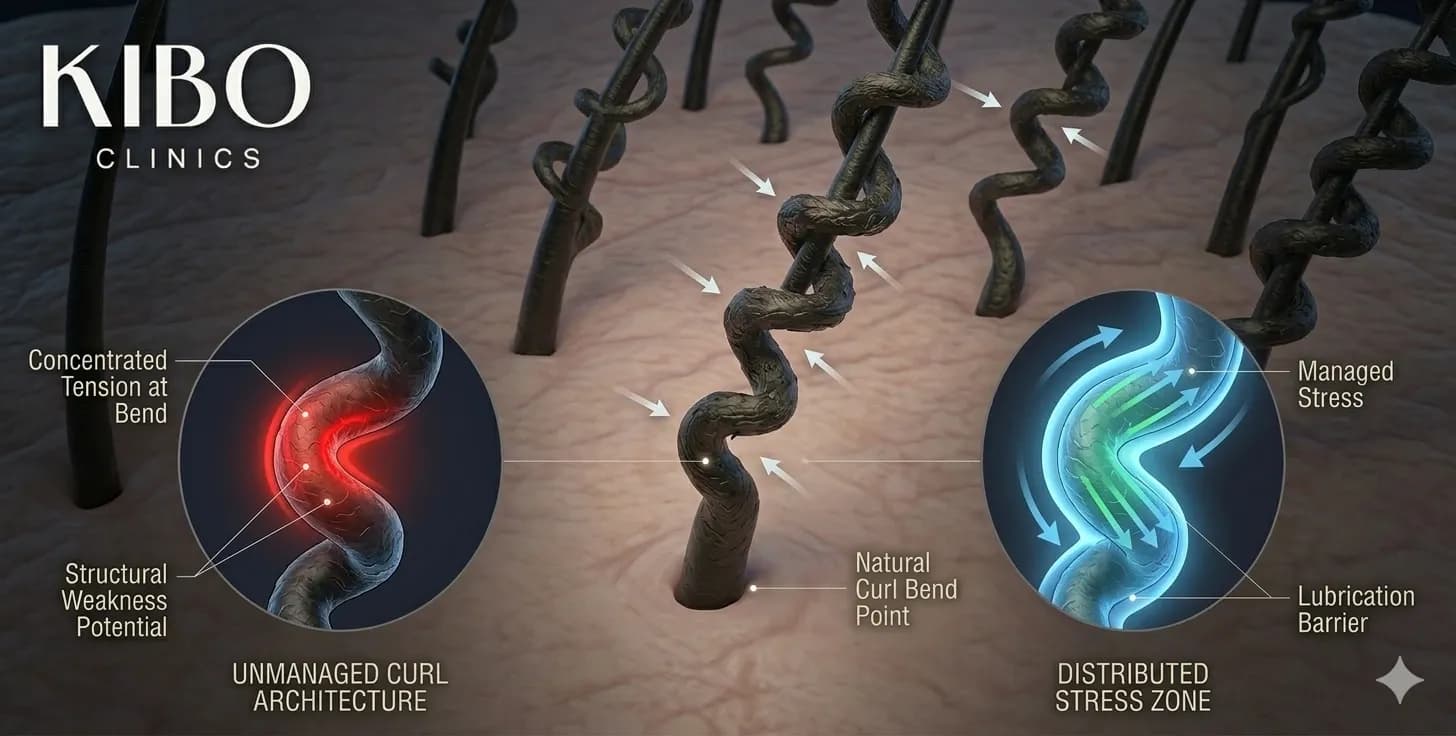
Curly and coily hair can break more easily because its bends, twists and variable cross-sectional shape create points where mechanical stress concentrates. Dermatology references also note that natural scalp oil travels less evenly along a curved strand, so the lengths may be drier and more vulnerable to friction.
This is a structural tendency, not a defect. Curl pattern alone does not cause baldness. Most curl-related damage occurs along the shaft, while true hair loss from tension develops when repeated pulling affects the follicle.
How Curl Pattern Changes Mechanical Stress
Straight hair tends to distribute pulling force along a more uniform fibre. In curly hair, force changes direction at each bend. Microscopic and mechanical studies describe twisting, variable diameter and weak points where cracks can form during repeated grooming.
Tighter patterns generally contain more bends per centimetre, but breakage risk is not decided by curl category alone. Strand diameter, porosity, chemical treatment, moisture, tool choice and styling force can matter just as much.
Curl Pattern and Breakage Risk at a Glance
| Pattern | Typical mechanical concern | Lower-risk approach |
|---|---|---|
| Wavy hair | Tangling, heat damage and brushing-related frizz | Gentle detangling and moderate heat |
| Loose curls | Friction at bends and loss of definition | Conditioner, sectioning and low manipulation |
| Tight curls | More tangles and stress concentration | High-slip detangling and wider sections |
| Coily hair | Shrinkage, knotting, dryness and traction risk | Low-tension styles, careful sectioning and minimal force |
Breakage vs Traction Alopecia
Breakage occurs when the visible strand snaps. You may see short pieces, split ends, uneven lengths and frizz. Traction alopecia occurs when a hairstyle repeatedly pulls the follicle. Early signs can include tenderness, bumps and broken hairs around the hairline.
Early traction alopecia may improve when tension stops. Long-standing inflammation can scar follicles and make loss permanent. Read the detailed guide to tension-based hair damage.
Does Tighter Curl Pattern Mean More Hair Loss?
No. Tighter curls may be more vulnerable to shaft breakage, but curl pattern does not directly cause androgenetic alopecia, alopecia areata or scarring alopecia. Hair-loss risk depends on genetics, inflammation, hormones, illness, nutrition and styling history.
Curly hair can also hide reduced density because volume and shrinkage mask the scalp. A progressively wider part or shrinking ponytail should be assessed even when curls still look full.
Why Curly Hair Becomes Dry
Sebum spreads more easily along a straight strand than around repeated curves. Washing, weather, friction, colouring and heat can further reduce lubrication. Dry fibres have more surface friction and are harder to detangle without force.
Dryness should be managed with gentle cleansing, conditioner and suitable leave-in products. It does not mean the scalp must be coated with heavy oil or that every sulfate is harmful.
Is Wet Curly Hair More Fragile?
Wet hair is more extensible, meaning it stretches further under force. Curly hair is often easier to detangle when wet and conditioned, but rough brushing can still overstretch weak points. The answer is not simply “never brush wet hair”.
Use conditioner for slip, divide hair into sections and start at the ends. Hold the section above a knot so the pulling force does not travel directly to the root. See wet-hair styling and root vulnerability.
Best Detangling Method for Curly Hair
- Work in sections: smaller controlled sections reduce repeated passes.
- Add slip: use water and conditioner suited to the hair.
- Start at the ends: remove lower tangles before moving upward.
- Use fingers or a wide-tooth tool: avoid dragging a dense brush through knots.
- Hold above the tangle: this limits force reaching the scalp.
- Stop when it hurts: pain means tension is too high.
- Remove shed hairs gently: trapped shed hairs can form knots if left in place.
Are Protective Styles Safe for Curly Hair?
A protective style reduces daily manipulation only when it is installed without excessive tension and removed carefully. Tight braids, extensions, ponytails, buns and wigs can cause traction alopecia when they pull for long periods.
A style should not cause headache, stinging, bumps or a raised hairline. Added hair increases weight, so longer and heavier styles may create more traction even when the braid itself looks neat.
Low-Tension Hairstyles for Curly and Coily Hair
- Loose pineapple using a wide fabric scrunchie
- Low loose braid or two loose braids
- Loose twists without added weight
- Low bun with minimal wrapping
- Correctly sized smooth claw clip
- Styles that rotate position rather than pulling the same edge daily
Compare hair ties, scrunchies and clips and hairstyles that minimise follicle stress.
Can Sleeping Damage Curly Hair?
Repeated rubbing against bedding can increase tangling and breakage. Tight night-time wrapping can also create prolonged traction. A loose pineapple, loose braid, smooth bonnet or satin pillowcase may reduce friction, but no method should pull the hairline.
Research has described night-time hairstyle maintenance as a possible overlooked source of traction in some patients. Read night-time hair care and silk pillowcases and hair health.
Heat, Bleach and Chemical Straightening
Heat and chemical processing weaken the cuticle and cortex. Curved fibres already experience uneven stress, so bleached or relaxed curls may break at lower handling force. Damage can accumulate even when one styling session appears harmless.
Reduce temperature, limit repeated passes and space chemical services apart. A damaged shaft cannot biologically repair itself, although conditioning products can temporarily improve smoothness and reduce friction.
Does Humidity Increase Curly Hair Breakage?
Humidity makes hair absorb water, swell and change shape. This increases frizz and may make porous hair easier to stretch and tangle. Humidity alone does not destroy follicles, but rough handling of swollen hair can increase mechanical breakage.
Read humidity and mechanical hair stress for a full explanation.
How to Reduce Curly Hair Breakage
- Use a gentle shampoo matched to scalp oil and buildup.
- Condition every wash when the lengths are dry or tangled.
- Detangle in sections with low force.
- Avoid repeated tight styles and heavy extensions.
- Dry gently without aggressive towel rubbing.
- Limit bleach, relaxers and high-temperature tools.
- Trim split ends before fractures travel upward.
- Rotate hairstyle position and give the scalp rest periods.
- Use smooth accessories without exposed rubber or sharp seams.
- Seek diagnosis when density is reducing, not only when strands snap.
Protein vs Moisture for Curly Hair
Protein-containing conditioners can temporarily reinforce damaged areas in some fibres, while moisturising products improve flexibility and slip. Neither category permanently repairs a fractured shaft. Too much of any product can create buildup or stiffness.
Choose by how the hair responds rather than following a fixed internet schedule. Sudden shedding from the root will not be corrected by a protein mask.
How to Tell If Hair Is Breaking or Shedding
| Sign | Breakage | Root shedding |
|---|---|---|
| Length | Short and uneven pieces | Usually full-length strands |
| End | Frayed or blunt broken end | May have a small club-shaped bulb |
| Pattern | Uneven length and rough ends | Overall reduction in density |
When Curl Pattern Is Not the Real Cause
A widening part, receding hairline, smooth patch, eyebrow loss, pain, pus or shiny scarring needs medical assessment. These signs can indicate pattern hair loss, alopecia areata, infection or inflammatory scarring disease.
Useful guides include hair loss in women, male pattern baldness, alopecia areata regrowth and dermatologist versus trichologist.
What This Means for You
Curly and coily hair needs lower-force handling because bends, dryness and tangling concentrate mechanical stress. The goal is not to change the curl pattern. It is to reduce friction, avoid prolonged root tension and preserve the strand.
Breakage can usually improve with gentler care. Progressive density loss, pain or scalp changes need diagnosis because curl pattern alone does not explain follicular hair loss.
Need help separating breakage, traction and medical hair loss?
Frequently Asked Questions
Is curly hair more prone to breakage?
Yes. Curved fibres have more bends, variable shape and tangling, which can concentrate stress during grooming.
Which curl type breaks the most?
Tighter curls often face more tangling and stress points, but porosity, strand diameter, chemical damage and handling can matter as much as curl category.
Does curly hair cause traction alopecia?
Curl pattern does not cause traction alopecia. Repeated pulling from tight or heavy hairstyles causes it.
Should curly hair be detangled wet or dry?
Many people find wet, conditioned detangling safer because it adds slip. The key is low force, sectioning and starting at the ends.
Are protective styles good for curly hair?
They can reduce manipulation, but only when loose, lightweight and comfortable. Pain or bumps mean the style is too tight.
Does sleeping with a pineapple damage hair?
A loose pineapple can reduce friction. A tight one can pull the hairline and create prolonged tension.
Can curly hair break from dryness?
Dryness increases friction and makes detangling harder, which raises the risk of mechanical breakage.
Does humidity cause curly hair loss?
Humidity mainly changes the shaft and increases frizz or tangling. It does not usually cause permanent follicular loss.
Can protein treatments stop breakage?
They may temporarily improve some damaged fibres, but they cannot permanently repair a fractured shaft.
How do I know if I have breakage or shedding?
Broken hairs are shorter and lack a root bulb. Shed hairs are usually full length and may have a small club-shaped bulb.
Can traction alopecia grow back?
Early traction loss may improve after tension stops. Long-standing scarring may be permanent.
When should I see a dermatologist?
Seek assessment for pain, bumps, progressive edge thinning, widening part, smooth patches, pus or shiny scarring.
Want a diagnosis-led plan for breakage or traction-related thinning?
Why Kibo Clinics
Kibo Clinics separates shaft breakage, traction-related loss and other causes of thinning before recommending hair care, medicine or procedures. The assessment considers curl pattern, grooming, scalp findings, chemical exposure and the distribution of hair loss.
The doctor who conducts your consultation is the same doctor who handles your treatment through every stage.
Explore Kibo Clinic Services
Hair Transplant: FUE Hair Transplant | Sapphire FUE | Direct Hair Transplant | Bio FUE | Real Time FUE | Corrective Hair Transplant | Hairline Correction | Unshaven Hair Transplant | Body Hair Transplant
Non-Surgical: PRP Therapy | GFC Therapy | Mesotherapy | Microneedling | Low-Level Laser Therapy | IV Hair Boosters | PDO Threads | Exosome Therapy
Explore More
Hair Strength and Friction: Fine Hair and Traction Risk |
Medical Disclaimer : Information from Kibo Hair Clinics is for educational purposes only. It does not replace diagnosis, trichoscopy, blood test interpretation, prescription treatment, procedure advice, or side-effect counselling from a qualified dermatologist or hair restoration doctor.