
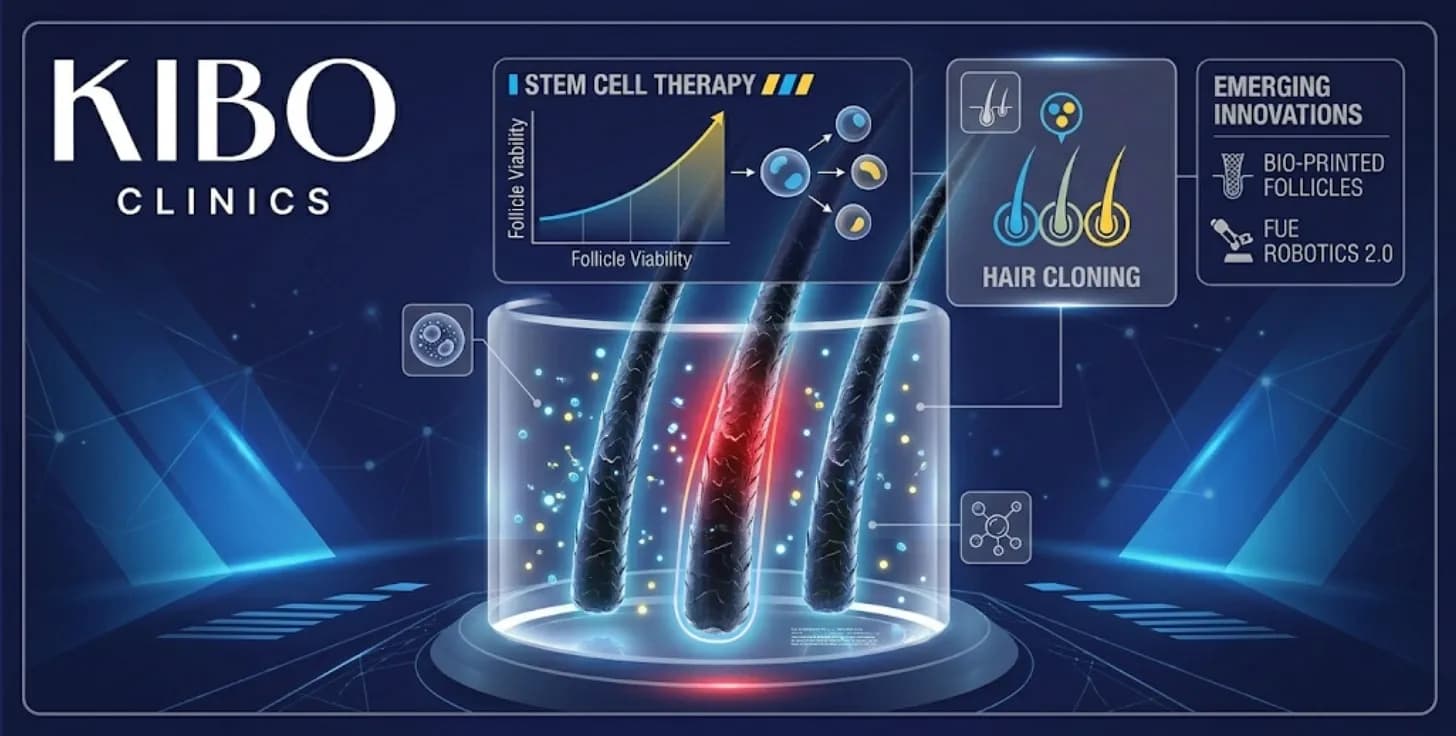
Who This Is For: People seeing ads or news about stem cell hair treatment, exosomes, hair cloning, follicle banking or regenerative hair restoration and wanting to know what is proven, what is experimental, what changed in 2026, and what questions to ask before paying for an emerging treatment.
Stem cell-based hair restoration and hair cloning are scientifically active areas in 2026, but they are not yet standardized replacements for established hair-loss treatment or hair transplantation. Human studies of autologous cell-based micrografts, adipose-derived products, conditioned media and other regenerative approaches have reported improvements in some patients, but the studies use different protocols and are generally too heterogeneous to support one universal "stem cell hair treatment." Hair cloning goes a step further by trying to multiply or engineer hair-forming cells so donor supply could eventually be expanded, and that remains investigational.
The field is moving. HairClone announced in March 2026 that clinical testing of autologous follicle-cell injections had begun in Guatemala, and ClinicalTrials.gov lists ongoing studies of mesenchymal stem cells, hair-follicle-derived products and exosome-based approaches for androgenetic alopecia. That is meaningful research progress, but a registered or early clinical study is not the same as a broadly approved, predictable treatment.
Stem Cell Therapy, Exosomes and Hair Cloning Are Not the Same Thing
One of the biggest problems in this topic is terminology. "Regenerative hair treatment" can describe very different products and procedures. A patient should never assume that two clinics using the words stem cells are offering biologically equivalent treatments.
| Term | What It Usually Means | Creates New Follicles? | 2026 Reality |
|---|---|---|---|
| Cell-based hair therapy | Autologous or donor-derived cells, cell fractions or follicular micrografts used to influence existing follicles | Not reliably | Small human studies exist, but methods and evidence vary |
| Conditioned media / secretome | Cell-free mixture of factors released by cultured cells | No proven new-follicle creation | Investigational, with limited standardization |
| Exosomes | Extracellular vesicles carrying biological signals | Not proven to create full new follicles | Promising early research, but clinical evidence remains limited |
| PRP / GFC | Blood-derived platelet and growth-factor preparations | No | Different category entirely, not stem cell treatment |
| Hair cloning / hair multiplication | Expansion or engineering of hair-forming cells to regenerate or multiply follicular structures | That is the goal | Still experimental and not routine clinical care |
| Follicle banking | Cryopreservation of follicles or follicular tissue for possible future use | No | A storage service, not a treatment by itself |
This distinction is important when comparing currently available care. PRP, GFC, microneedling and low-level laser approaches belong to a different evidence and mechanism category from cultured cell therapy or follicle multiplication. Kibo's 2026 comparison of non-surgical hair-loss treatments is a better place to compare options that are actually offered today.
Why Hair Follicle Stem Cells Matter in Pattern Hair Loss
Hair follicles repeatedly cycle through growth, regression and rest. Stem cells in the follicular bulge help replenish cell populations needed for new growth, while dermal papilla cells at the base of the follicle provide important signalling. Androgenetic alopecia changes this system over time and produces progressive miniaturisation.
A landmark human study found that bald scalp in men with androgenetic alopecia still contained hair-follicle stem cells but had fewer progenitor cells. That observation helped strengthen the idea that future treatments might focus on restoring the transition from stem cell to active progenitor state rather than assuming every miniaturised follicle has disappeared. It is biologically interesting, but it is not proof that injecting generic stem cells into the scalp reverses pattern hair loss.
For the disease context itself, see Kibo's guide to androgenetic alopecia and follicle miniaturisation.
Seeing a clinic advertise stem cells, exosomes or regenerative hair therapy? Ask exactly what is being injected, where it comes from, how it is processed and what human evidence supports that exact protocol.
What Do Human Studies of Stem Cell-Based Hair Treatments Show?
Human research is more substantial than it was a decade ago, but it is still difficult to compare across studies. Reviews include autologous follicular-cell preparations, adipose-derived stromal or stem-cell approaches, stromal vascular fraction, conditioned media and cell-derived products. Some studies report improved hair count, density or thickness, but they do not all use the same material, dose, injection method, comparison group or follow-up period.
That is why the phrase "stem cell therapy works" is too broad. A result from one autologous micrograft protocol cannot automatically validate an adipose-derived product, an umbilical-cord product, an exosome product or a clinic-specific cocktail. Reviews published through 2025 continue to describe promising signals while highlighting the need for larger controlled studies and standardized protocols.
| Research Area | What Has Been Seen | Main Limitation | What Patients Should Conclude |
|---|---|---|---|
| Autologous cell / micrograft approaches | Some small human studies report higher density or thickness | Different cell sources and preparation methods | Promising, but not one standardized therapy |
| Adipose-derived approaches | Clinical and pilot studies report potential hair-growth signals | Variable products, processing and study quality | Evidence for one protocol should not be generalized to all |
| Exosomes / extracellular vesicles | Early clinical reports and reviews describe density improvements | Small samples, short follow-up and product heterogeneity | Investigational rather than a proven universal treatment |
| Follicular cell expansion | Human cell-therapy programs have reached clinical development | Durability, optimal dose and reproducibility remain open questions | Development is real, but routine availability is not |
| iPSC / tissue-engineered follicles | Strong laboratory and preclinical interest | Complex follicle architecture and safety must be solved | A future platform, not a clinic-ready baldness cure |
What Is Hair Cloning or Hair Multiplication?
Hair cloning is a convenient public term for a set of research strategies that try to overcome the donor limitation of transplantation. The basic idea is to take a small number of hair-forming cells or follicular tissue, expand or manipulate them in a laboratory, and then use them to rejuvenate miniaturised follicles or eventually generate additional functional follicles.
If true follicle multiplication becomes reliable, it could change one of the biggest constraints in surgical restoration: the donor area is finite. Today, surgeons must redistribute existing donor follicles. This is why safe donor planning and avoiding donor overharvesting remain important even while regenerative research continues.
Why Is Hair Cloning Still Difficult?
A working hair follicle is a mini-organ. It needs more than a population of cells. It needs the right cell types to organize in the right three-dimensional structure, integrate into skin, receive vascular and neural support, produce a hair shaft at an acceptable angle, maintain pigment and repeat normal hair cycles.
- Loss of inductive ability in culture: human dermal papilla cells can lose the signals that let them initiate follicle formation when expanded under ordinary laboratory conditions.
- Three-dimensional organization: expanding cells is easier than reconstructing a complete follicular unit that behaves like a natural follicle.
- Direction and cosmetic quality: a follicle must produce hair with useful angle, calibre, curl and orientation, not merely any hair shaft.
- Long-term cycling: a cosmetic treatment needs follicles that continue through repeated growth cycles, not a short-lived experimental response.
- Manufacturing: cell processing must be reproducible, sterile, traceable and scalable.
- Safety: abnormal cell behaviour, contamination, immune effects and unexpected tissue responses have to be evaluated over meaningful follow-up.
- Regulation: a laboratory cell product or biologic may require a very different regulatory pathway from a conventional hair-transplant procedure.
What Changed in 2026?
The most useful update is that regenerative hair research is moving from theory toward more formal human testing, but at different stages of development.
- HairClone announced clinical testing in Guatemala: the company said its GMP facility was operational and that volunteers were being selected for autologous follicle-cell injections, with efficacy and mechanism monitoring planned.
- ClinicalTrials.gov continues to register AGA studies: examples include mesenchymal stem-cell approaches, hair-follicle-derived secretome research and new exosome trials.
- Exosome research has expanded: systematic and scoping reviews published in 2025 and 2026 describe promising early signals but still note translational and standardization challenges.
- iPSC and tissue-engineering research remains active: researchers continue to work on generating hair-forming precursor cells and skin organoids that contain follicular structures.
None of these developments establishes a universal commercial hair-cloning treatment. Early clinical testing should be interpreted as a development milestone, not a guarantee of later approval, affordability or predictable cosmetic results.
If you are considering an emerging regenerative treatment now, compare the exact protocol with established alternatives instead of buying the label 'stem cell' by itself.
Where Do Exosomes Fit?
Exosomes are cell-derived extracellular vesicles, not stem cells. They are being studied because they can carry signalling molecules that influence dermal papilla cells, inflammation and hair-cycle pathways. Several recent reviews have found encouraging early clinical findings, but the evidence base is still small compared with established hair-loss treatments.
Regulation is also important. In the United States, the FDA states that exosome products intended to treat disease generally require approval and that there are currently no FDA-approved exosome products. That US regulatory position should not be confused with the rules of every other country, but it is a useful reminder that a product being marketed by a clinic does not automatically mean it has undergone the type of approval patients may assume.
What Should You Ask Before Paying for a "Stem Cell" Hair Treatment?
- What exactly is the material? Ask whether it contains living cells, a tissue fraction, conditioned media, secretome, exosomes or a blood-derived product.
- Where does it come from? Autologous scalp, fat, donor tissue, umbilical tissue and commercial biologic products are not interchangeable.
- Is the product expanded or cultured? Laboratory expansion can change the regulatory and safety profile.
- What human trial supports this exact product and protocol? Evidence for a different product should not be used as proof.
- What is the regulatory status where I am being treated? Ask for documentation rather than relying on the phrase 'approved technology'.
- What outcomes are actually measured? Hair count, shaft diameter, standardized photography and long-term follow-up are more useful than testimonials alone.
- What are the risks and alternatives? Experimental consent should make uncertainty clear.
- What happens if there is no response? A responsible plan should not guarantee regrowth or require indefinite packages without evidence.
What Hair Restoration Options Are Realistically Available Today?
The right option depends on diagnosis. Androgenetic alopecia, telogen effluvium, alopecia areata, scarring alopecia and hair-shaft breakage do not share one treatment pathway. Start by identifying the condition rather than choosing a technology name. Kibo's guide to hair-loss types, symptoms and causes explains the main patterns.
For suitable patients with stable patterned bald areas and adequate donor hair, transplantation remains an established surgical way to redistribute permanent-zone follicles. It does not create new donor hair, which is precisely the limitation hair-cloning research is trying to solve. The FUE, FUT and DHI comparison explains current surgical terminology.
Non-surgical options have different evidence levels and goals. PRP, GFC, microneedling and low-level laser therapy are not hair cloning. They may be considered in selected patients after diagnosis, but none should be described as creating an unlimited new donor supply.
When Will Hair Cloning Be Available?
No reliable date can be promised. Competitor articles often quote late-2020s or 2030s timelines, but these are forecasts. A technology can succeed in laboratory models and still face years of clinical optimization, manufacturing validation and regulatory review. It can also fail during development.
The more useful milestones to watch are published controlled human data, reproducible long-term hair cycling, standardized manufacturing, regulator decisions and independent replication. Until those arrive, "available soon" should be treated as marketing unless it is tied to a clearly documented trial or approval.
Kibo Clinics' Perspective on Future Hair Restoration
Future regenerative medicine may eventually change donor limitations and expand treatment choices. The responsible position today is to separate early research from established clinical care. Kibo does not need to dismiss promising science, but it should not present early studies as a guaranteed cure.
If someone is losing hair now, the practical sequence is diagnosis, evidence-based management of the underlying condition, preservation of existing hair where appropriate, and transplant planning only when the pattern and donor area support it. Experimental regenerative options should be evaluated with the same standard: exact product, exact evidence, exact risks and clear uncertainty.
Want to know what is evidence-based for your current stage of hair loss, without waiting for a future cloning breakthrough? Start with a diagnosis-led consultation.
Frequently Asked Questions
Is stem cell therapy for hair loss proven in 2026?
Not as a single standardized treatment. Human studies of several cell-based and cell-derived approaches report encouraging signals, but protocols, cell sources, processing methods, sample sizes and follow-up differ. Current reviews still call for larger controlled trials and standardization before these approaches can be treated as routine first-line care.
Is hair cloning available now?
True hair cloning or follicle multiplication is not a routine, widely approved hair-restoration treatment. Research groups and companies are testing cell-based approaches, and HairClone announced clinical testing in Guatemala in 2026, but that is development activity rather than proof that a standardized commercial cure is available.
What is the difference between stem cell therapy and hair cloning?
Stem cell therapy is a broad label that can refer to different cell-based or cell-derived procedures intended to influence existing follicles. Hair cloning or hair multiplication aims to expand hair-forming cells or engineer new follicle-producing units so donor supply could eventually be increased. The two ideas should not be used interchangeably.
Are exosomes the same as stem cells?
No. Exosomes are small extracellular vesicles released by cells. They can carry proteins, lipids and nucleic-acid signals, but they are not living stem cells. Early hair-loss studies are promising, yet clinical evidence is still limited and products and protocols are not standardized.
Are PRP and GFC stem cell treatments?
No. PRP and GFC are blood-derived treatments based on platelets and growth-factor-rich fractions. They do not clone follicles and they should not be marketed as stem cell therapy.
Can stem cells create new hair follicles in a completely bald scalp?
That remains a research goal rather than a dependable clinical outcome. Some experimental approaches aim to reactivate miniaturized follicles, while hair-cloning and tissue-engineering research aims to create or multiply follicular structures. Reliable de novo follicle generation with predictable human cosmetic results has not become routine care.
Why is hair cloning so difficult?
A hair follicle is a mini-organ, not a single cell. Dermal papilla cells, epithelial cells, stem and progenitor cells, pigment cells and surrounding tissue must organize correctly, connect with the scalp and keep cycling. Human dermal papilla cells also tend to lose hair-inducing properties during ordinary laboratory expansion.
Is follicle banking the same as hair cloning?
No. Follicle banking means collecting and cryopreserving follicles or follicular tissue for possible future use. It does not itself multiply hair or guarantee that a future cell therapy will work. It is best viewed as a storage service linked to an experimental future-treatment pathway.
When will hair cloning become widely available?
There is no reliable date. Commercial timelines quoted online are forecasts, not medical evidence. Availability depends on reproducible human efficacy, long-term safety, manufacturing standards, regulatory approval and whether newly generated or rejuvenated follicles behave normally over repeated hair cycles.
What should I do now if I am losing hair?
"Stem cell hair therapy" is not one standardized intervention. Published human studies include different cell sources, micrografts, stromal vascular fractions, conditioned media, secretomes and cell-derived products. Results from one protocol should not be generalized to another product simply because both are marketed as regenerative medicine.
Hair cloning, follicle multiplication, iPSC-derived follicle engineering and related cell-expansion approaches remain investigational. HairClone's 2026 announcement of clinical testing in Guatemala is a development update from the company itself. It should not be interpreted as independent proof of efficacy, regulatory approval in India, or routine worldwide availability.
Exosomes are not stem cells. Recent systematic and scoping reviews describe promising early signals for hair restoration, but small samples, short follow-up, variable sources and non-standardized preparation remain important limitations. In the United States, the FDA states that there are currently no FDA-approved exosome products. Regulatory requirements differ by country, so patients in India should verify the exact product and local regulatory status with the treating doctor and relevant authority.
No regenerative treatment should be presented as guaranteed permanent regrowth, unlimited donor hair, or a proven replacement for all current treatments. Seek medical assessment for rapid shedding, scarring, scalp pain, inflammation, smooth bald patches or progressive pattern thinning before choosing any experimental procedure.
Authoritative and primary sources reviewed:
Human Stem Cell Use in Androgenetic Alopecia, 2023 review
Bald scalp in androgenetic alopecia retains hair follicle stem cells but lacks progenitor cells
Induced pluripotent stem cell approaches for hair follicle regeneration, 2024 review
Regenerative therapies for hair loss, 2025 review
Exosomes and Hair Regeneration, 2025 systematic review
US FDA consumer alert on stem cell and exosome products
HairClone 2026 company update on clinical testing in Guatemala
ClinicalTrials.gov: mesenchymal stem-cell study in androgenetic alopecia
Related Articles & Services
Hair Transplant
FUE Hair Transplant | Sapphire FUE Hair Transplant | Direct Hair Transplant DHT | Body Hair Transplant | Corrective Hair Transplant
Hair Regrowth
PRP Therapy | GFC Therapy | Low-Level Laser Therapy | Microneedling for Hair Regrowth | Exosomes Therapy
Must Read
Hair Transplant Guide | FUE Hair Transplant Guide | Hair Transplant Safety Myths and Facts | Hair Transplant Procedure Steps | Graft Survival Factors
Relevant Blogs
GFC Therapy vs PRP | LLLT Hair Helmet Therapy | PDO Threads for Hair Restoration | Dermarolling vs Professional Microneedling | Hair Transplant Longevity
Medical Disclaimer : Information from Kibo Hair Clinics is for educational purposes only. It does not replace diagnosis, trichoscopy, blood test interpretation, prescription treatment, procedure advice, or side-effect counselling from a qualified dermatologist or hair restoration doctor.