
Who This Is For: Anyone noticing recession, crown thinning, a widening part, or a family pattern of hair loss, and wanting a straight explanation of what it is, how it's diagnosed, and which treatments actually have evidence behind them.
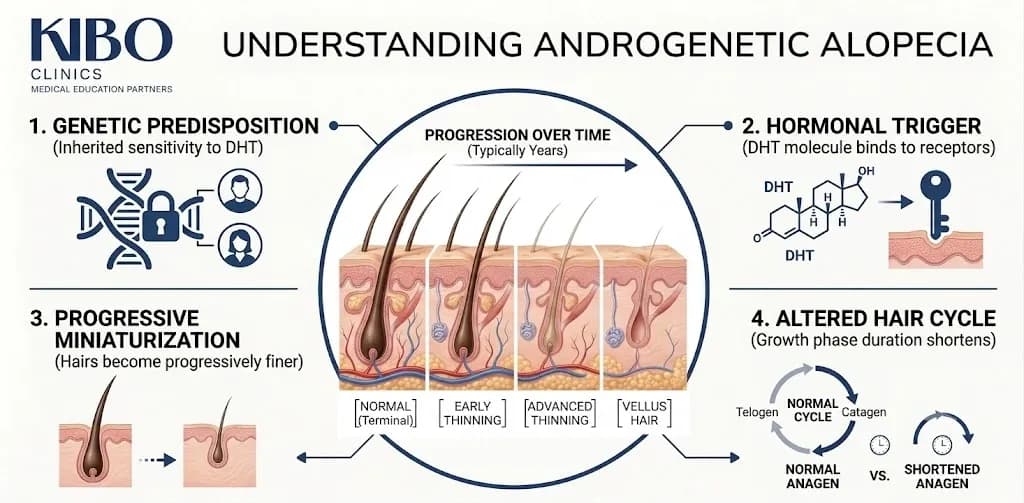
Androgenetic alopecia is chronic pattern hair loss caused by inherited susceptibility of certain follicles to androgen signalling. Sensitive follicles gradually miniaturise: thick terminal hairs become shorter and finer over repeated cycles, making the scalp more visible. Men commonly develop temple or frontal recession and crown thinning; women more often develop central or midfrontal thinning with a widening part. Diagnosis is usually clinical, and sudden shedding, patches, pain, scale, or inflammation suggests another or additional condition.
What Is Androgenetic Alopecia?
Androgenetic alopecia, or AGA, is the medical name for what most people call male pattern baldness in men and female pattern hair loss in women. It's a nonscarring condition, meaning the follicles aren't destroyed, and it's chronic and progressive, meaning it tends to continue changing over time rather than resolving on its own. Worth being clear about one thing early: this is a miniaturisation disorder, not necessarily a high-daily-shedding one. Many people with AGA never notice handfuls of hair coming out. They notice the scalp becoming more visible instead.
How Genetics and Androgen Signalling Contribute
DHT is formed from testosterone by an enzyme called 5-alpha-reductase, and it can activate androgen receptors in genetically susceptible scalp follicles. But the clinically important feature isn't necessarily a high DHT level in your blood. It's local follicle sensitivity and the downstream change in the hair cycle that follows. That's also why the same person can have androgen-sensitive scalp follicles alongside androgen-stimulated beard or body hair, since the response depends entirely on where the follicle sits. Serum DHT testing doesn't diagnose AGA, and it isn't a useful way to track whether treatment is working either.
It's also worth resisting the oversimplified version that treats DHT as simply "bad." DHT has genuine physiologic functions elsewhere in the body, and the biology of AGA is really about inherited follicle sensitivity rather than a hormone that's inherently harmful. MedlinePlus Genetics notes that DHT is particularly relevant in men, while androgen-related and other factors contribute to female pattern hair loss, and that the inheritance pattern is complex. On that point, the old idea that baldness only comes from your mother's side doesn't hold up; our piece on the maternal inheritance myth covers why in more detail.
What Miniaturisation Looks Like
In affected areas, the anagen phase shortens and the follicle progressively shrinks. A thick terminal hair gives way, over repeated cycles, to a thinner and shorter intermediate hair, and eventually to a fine, vellus-like fibre that's barely visible. Density on the scalp looks reduced because the calibre and coverage of each hair falls, even before the actual number of follicles changes much. This isn't a uniform sequence for everyone, though. Some follicles produce miniaturised hair for a long time, and individual progression genuinely varies. Our guide to the stages of the hair growth cycle explains the underlying cycle that miniaturisation is quietly altering.
Men's and Women's Patterns
Cleveland Clinic describes typical patterns in both sexes, but these are tendencies with real exceptions, not rules. Women can have frontal or bitemporal involvement, and men can have diffuse thinning.
| Feature | Male Pattern Hair Loss | Female Pattern Hair Loss |
|---|---|---|
| Common distribution | Temples, frontal hairline, vertex/crown | Central/midfrontal scalp, widening part, "Christmas tree" pattern |
| Frontal edge | Often recedes | Often relatively preserved, but bitemporal loss can occur |
| Scale | Norwood-Hamilton often used | Ludwig or Sinclair patterns may be used |
| Family history | Common risk clue | Common risk clue, but inheritance is complex |
| Hormonal clues | Usually not necessary for a classic presentation | Evaluate acne, hirsutism, irregular cycles, PCOS, menopause, medications when indicated |
| Shedding | May be subtle; miniaturisation dominates | Diffuse thinning may overlap with telogen effluvium |
Men's staging is usually described using the Norwood scale, which is worth understanding if you're trying to place your own pattern. For women, it's important not to assume that pattern loss is automatically hormonally driven. Signs like acne, excess facial hair, irregular cycles, or PCOS should prompt a context-specific evaluation, and menopause-related density changes are a separate consideration again. Broader guidance on hair loss treatment for women covers this in more depth.
AGA vs Other Types of Hair Loss
Pattern loss can coexist with other conditions, and that's exactly why a diagnosis matters more than a guess. Sudden shedding, patches, scale, pain, or inflammation point toward something else, or something additional. Understanding the different types of hair loss is genuinely useful context here.
| Finding | Consider | Why It Matters |
|---|---|---|
| Sudden diffuse shedding after illness, childbirth, dieting, surgery, or medication | Telogen effluvium | May coexist with AGA; history and timing matter |
| Round smooth patches, eyebrow/nail changes | Alopecia areata | Autoimmune disease, not AGA |
| Hairline loss with tight hairstyles, pain, broken hairs | Traction alopecia | Early removal of tension may prevent permanent loss |
| Scale, redness, pustules, pain, shiny skin, absent follicular openings | Inflammatory or scarring alopecia/infection | Prompt assessment may prevent permanent follicle destruction |
| Uneven short hairs of varied length | Trichotillomania or breakage | Shaft or behavioural cause rather than classic AGA |
| Fatigue, heavy menses, restrictive diet, thyroid symptoms | Iron deficiency, thyroid disease, nutritional causes | Targeted tests may alter management |
Several of these have their own dedicated guides if one sounds like your situation: telogen effluvium, alopecia areata, and iron deficiency and hair thinning. Testing for things like vitamin D, iron, or thyroid function isn't mandatory for everyone with classic AGA, though. It's guided by your history, examination, sex, symptoms, and whether you also have coexisting shedding. A hairline that's receded in a way that doesn't quite fit the typical picture is worth reading about in our receding hairline causes guide too.
How Clinicians Diagnose AGA
Cleveland Clinic recommends a detailed history, an examination of the scalp, face, and nails, an assessment of hair calibre, a hair-pull test when active shedding is suspected, dermoscopy, and selective laboratory testing. A biopsy is usually reserved for unclear cases or when another disease is suspected alongside AGA. In other words, the diagnosis is mostly clinical, and it's built from looking at the pattern and the hair itself, not from a single blood value. Knowing whether a dermatologist or trichologist is the right person to see is a reasonable first question if you're not sure where to start.
Treatment Evidence
The most useful way to think about treatment is by evidence strength, not as a flat list where every option looks equivalent. Reviews identify topical minoxidil as a core treatment and oral finasteride as an established option for selected men. Low-level light therapy, PRP, microneedling, oral minoxidil, topical finasteride, spironolactone, dutasteride, and other approaches have varying evidence, regulatory status, protocols, and risks. The goal of treatment is to slow progression and preserve or increase miniaturised hair, and no treatment guarantees full restoration or a permanent response after stopping.
| Option | Evidence Position | Main Limitations or Cautions |
|---|---|---|
| Topical minoxidil | Established core option | Daily adherence, scalp irritation, unwanted hair, benefits require continuation |
| Oral finasteride | Established for selected men | Prescription; sexual, mood, and pregnancy-related considerations |
| Dutasteride | Potentially potent; jurisdiction-dependent | Often off-label; safety and indication require clinician oversight |
| Spironolactone | Used selectively in women | Pregnancy, renal, potassium, blood-pressure, and drug-interaction issues |
| LLLT | Supportive but device/protocol-dependent | Cost, adherence, variable magnitude of benefit |
| PRP | Promising but heterogeneous | Pain/cost, lack of standard protocol, variable evidence |
| Microneedling | Adjunctive evidence | Technique and infection risk; not a stand-alone diagnosis |
| Oral minoxidil | Emerging/off-label in many settings | Cardiovascular and systemic adverse effects; monitoring needed |
| Hair transplant | Surgical cosmetic restoration | Finite donor supply, surgery risks, native loss continues |
| Supplements | Only targeted if deficiency/indication | Variable products; do not treat miniaturisation reliably |
A few of these deserve a bit more context. Oral finasteride reduces conversion of testosterone to DHT and has strong evidence for selected men, but it's a prescription medicine with real considerations around sexual side effects, mood, fertility, and pregnancy, and it's not a generic recommendation for women who could become pregnant. For a research-focused look at the risk side, our review of DHT blocker side effects goes through what the studies actually show. If you're weighing plant-based options as an alternative, our evidence review on saw palmetto as a DHT blocker is worth reading first, since it's a good example of how limited evidence can be dressed up as proof. And there's a specific guide on minoxidil versus Redensyl for anyone comparing those directly.
Non-drug options sit in a different evidence tier. Low-level laser therapy has supportive evidence, but device quality, protocol, and adherence all change the result. PRP and microneedling show promising findings but have heterogeneous protocols, preparation methods, and schedules, so the evidence is less standardised than for the core treatments. Newer approaches like exosome therapy are still investigational, and shouldn't be treated as equivalent to established options no matter how a clinic markets them. Oral minoxidil and topical finasteride are clinician-directed choices in some settings, not something to self-dose from a search result.
Hair-Transplant Planning
A hair transplant redistributes selected donor follicles into thinning areas. It can genuinely improve cosmetic coverage, but it does not halt miniaturisation of your native hair, which means medical maintenance and long-term donor planning matter just as much as the surgery itself. Candidacy needs a stable diagnosis, adequate donor supply, a realistic design, and a maintenance plan, and a low or juvenile hairline is not automatically appropriate. If you want to understand what the actual surgical sequence involves, our procedure walkthrough covers it stage by stage, and if you're specifically considering the FUE approach, that's a good place to see how it fits.
Two related situations are worth knowing about ahead of time. If shedding after surgery worries you, our explanation of postoperative shock loss covers what's normal. And if a previous procedure didn't go the way you hoped, the guide on why people need corrective transplants is relevant to revision planning. It's also worth understanding how a transplant interacts with ongoing medical treatment, including the role of finasteride after a transplant specifically.
Not sure if what you're seeing is pattern loss? A proper diagnosis comes before any treatment decision.
Kibo Clinics' Perspective on Androgenetic Alopecia
Pattern hair loss is common, well understood, and genuinely manageable for many people, but it isn't the answer to every kind of hair loss, and it isn't fixed by any single product. We'd rather you understand what's actually happening in your follicles than be told it's "just genetics" and left to work out the rest alone.
At Kibo Clinics, we believe the diagnosis has to come first, then the evidence hierarchy, then a plan that accounts for the fact that pattern loss keeps progressing whether or not any single treatment is in place.
If you suspect pattern hair loss, or you're not sure what you're looking at, a Kibo Clinics hair specialist can examine your scalp and talk you through what's realistic for your particular pattern.
Frequently Asked Questions
At what age does androgenetic alopecia begin?
It can begin after puberty, including in young adults, but age alone does not diagnose it. Pattern, progression, miniaturisation, family history, and examination matter.
Does AGA cause sudden hair fall?
AGA is usually gradual miniaturisation rather than sudden handfuls of shedding. Sudden diffuse shedding can coexist with AGA or suggest telogen effluvium, medication effect, systemic illness, or another condition.
Can shampoo cure androgenetic alopecia?
Shampoo can cleanse the scalp and help manage scale or oil, but ordinary shampoo does not reliably reverse genetically sensitive follicle miniaturisation.
Is a hair transplant a cure for AGA?
No. It redistributes donor follicles and may improve coverage, but native hair can continue to thin. Long-term planning and, when suitable, medical maintenance remain important.
Should women with pattern hair loss have hormone tests?
Not every woman needs broad testing. Hormone evaluation is more relevant when there are signs such as irregular cycles, acne, hirsutism, acanthosis nigricans, rapid progression, or other clinical clues.
Related Articles & Services
Hair Transplant
Sapphire FUE Hair Transplant | Real-Time FUE Hair Transplant | Bio FUE Hair Transplant | Unshaven Hair Transplant | Direct Hair Transplant (DHT) | Body Hair Transplant | Corrective Hair Transplant | Hairline Correction
Hair Regrowth
GFC Therapy | IV Hair Boosters | Mesotherapy for Hair Regrowth | PDO Threads for Hair Regrowth
Must Read
Can Hair Recover From Androgenetic Alopecia? | Androgenetic Alopecia and Hair Density | DHT Blockers for Hair Loss | DHT-Related Hair Loss
Relevant Blogs
Minoxidil 5% vs 10% | Male Pattern Baldness and FUE Treatment | Hair Growth Cycle and Mechanical Shedding | Stress-Induced Hair Loss
Medical Disclaimer : Information from Kibo Hair Clinics is for educational purposes only. It does not replace diagnosis, trichoscopy, blood test interpretation, prescription treatment, procedure advice, or side-effect counselling from a qualified dermatologist or hair restoration doctor.