
Article Information
Reviewed By: Shritej Mali
Written By: Kibo Clinics Content Team
Sources Referenced: Dermatologic Surgery (2019) systematic review on PRP, Journal of Cosmetic Dermatology (2017), Aesthetic Plastic Surgery (2021), Skin Appendage Disorders (2017), Annals of Internal Medicine (2004) on IV bioavailability
Last Updated: May 2026
Reading Time: 16 minutes
Who This Is For: Anyone comparing IV hair drip therapy and PRP, or trying to decide which treatment suits their type of hair loss
This article is for education only. Consult a qualified dermatologist for personalised treatment recommendations.
Not sure whether IV therapy, PRP, or both are right for your hair loss? Board Certified Doctors can assess your blood work and scalp condition first.
IV Therapy for Hair Growth vs PRP: How Each Works, Who It Is For, and What to Expect
Most people searching for IV therapy for hair growth assume it works the same way as PRP - it does not. And most people who try one without understanding the other end up disappointed not because the treatment failed, but because they chose the wrong one for their root cause.
This guide explains exactly how IV hair drip therapy and PRP therapy differ, what the clinical evidence says, who each treatment is right for, and what realistic results look like - so you can walk into your consultation with the right questions already in hand.
What Are These Two Treatments?
Both IV drips and PRP are clinic-based hair treatments recommended by doctors, but they work very differently.
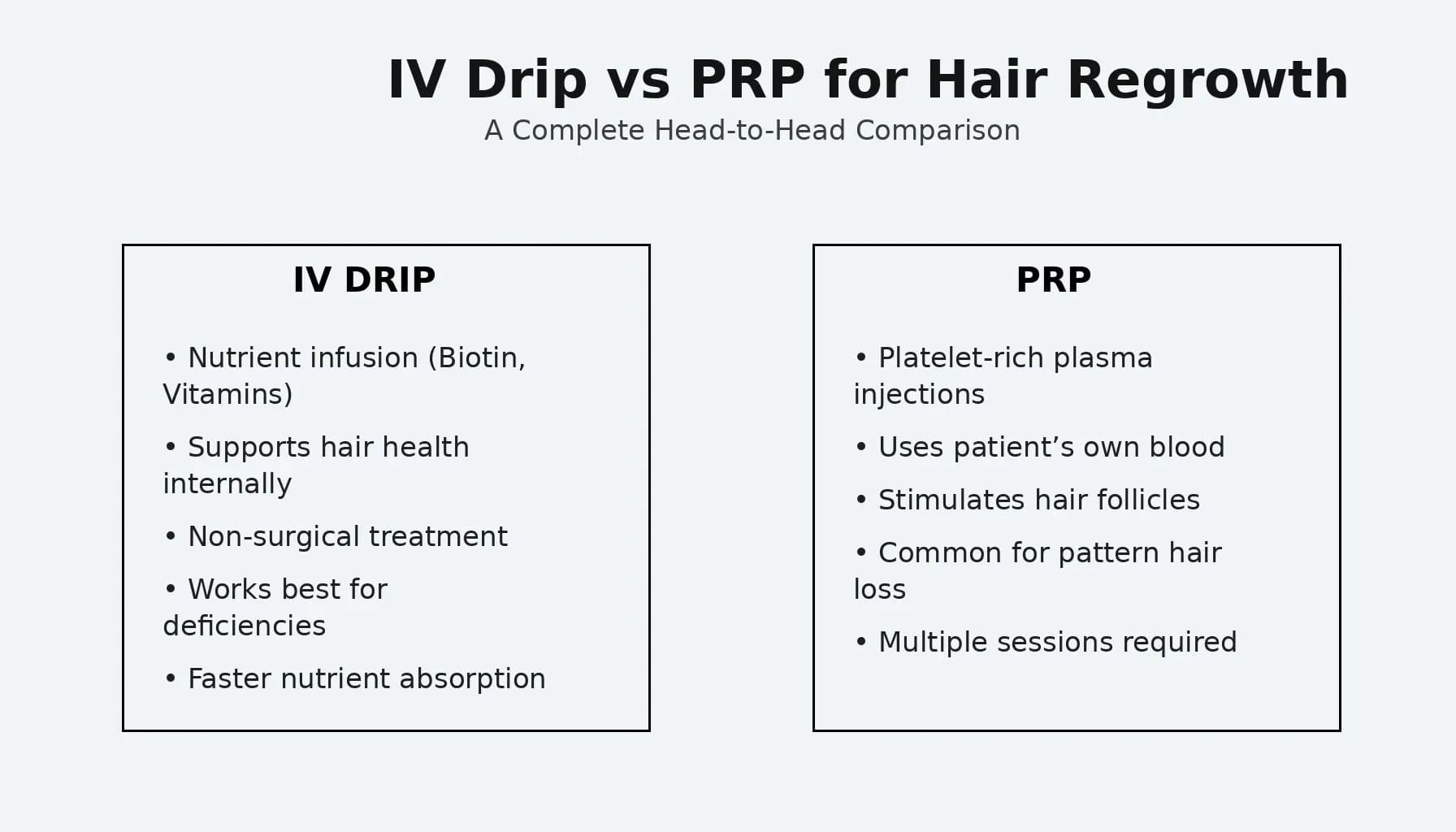
PRP (Platelet-Rich Plasma) therapy works locally at the level of your hair follicle. Your doctor draws blood, concentrates the growth factors, and injects them into your scalp to stimulate follicles directly.
An IV Hair Booster Drip works differently. It delivers vitamins, minerals, and antioxidants directly into your bloodstream, bypassing the digestive system. This allows your body to absorb almost 100% of the nutrients.
How PRP Therapy Works
Your doctor draws around 20 ml of blood from your arm. The blood is placed in a centrifuge that spins it at high speed to separate the components. The resulting platelet-rich plasma contains a concentration of platelets five to eight times higher than normal blood.
This plasma is injected into thinning areas of the scalp. A typical session lasts between 60 and 90 minutes. Growth factors like PDGF, VEGF, and TGF-beta stimulate stem cells in hair follicles, improve blood circulation, and reactivate dormant follicles. PRP works best when follicles are still alive. It cannot regrow hair where follicles are permanently lost. For a comparison with the newer growth factor approach, our GFC vs PRP comparison explains the differences.
Benefits of PRP:
- Reactivates dormant hair follicles
- Increases hair density and thickness
- Slows hair fall
- Improves scalp blood circulation
- Uses your own blood
- Supports hair transplant recovery
- Results usually visible from month 3
- Clinically researched treatment
How IV Hair Booster Drips Work
When you take oral supplements, your body absorbs only around 30 to 50 percent of the nutrients. The rest may be lost during digestion. An IV Hair Booster Drip delivers nutrients directly into your bloodstream, allowing near-complete absorption.
| Nutrient | Role in Hair Health |
|---|---|
| Biotin (Vitamin B7) | Supports keratin production and hair structure |
| Zinc | Helps regulate follicle function and repair tissue |
| Glutathione | Acts as an antioxidant to reduce oxidative stress |
| B-Complex Vitamins | Support oxygen delivery to the scalp |
| Vitamin C | Helps collagen production and improves iron absorption |
| Amino Acids | Provide building blocks for keratin |
| Calcium and Potassium | Support cellular signalling in follicles |
Benefits of IV Hair Drips:
- High nutrient absorption through IV delivery
- Corrects nutritional deficiencies
- Reduces hair fall caused by poor nutrition
- Improves hair strength and texture
- Protects follicles from oxidative stress
- Supports scalp circulation
- Enhances results of PRP or hair transplant
- No scalp injections required
For a deeper look at how biotin IV drips specifically support hair health, and for women dealing with hormonal hair loss, our guides on IV drip for PCOS hair loss and IV drip for postpartum hair loss cover these specific scenarios.
IV Hair Booster Drip vs PRP Therapy: Side-by-Side Comparison
| Factor | IV Hair Booster Drip | PRP Therapy |
|---|---|---|
| How it works | Nutrients delivered through bloodstream | Platelets injected directly into scalp |
| Best for | Nutritional deficiency and diffuse thinning | Pattern baldness and androgenetic alopecia |
| Session time | 30 to 45 minutes | 60 to 90 minutes |
| Comfort | Painless IV drip | Minor injections with numbing cream |
| Sessions needed | 4 to 6 sessions initially | 3 to 4 sessions spaced weeks apart |
| Results timeline | Reduced shedding after several sessions | Visible regrowth within 3 to 6 months |
| Evidence | Biological rationale with emerging trials | Multiple clinical studies available |
| Standalone treatment | Often used as supportive therapy | Can work as standalone treatment |
Which Treatment Is Right for You?
Hair loss can occur due to genetics, hormones, nutritional deficiencies, stress, or scalp inflammation. The right treatment depends on the underlying cause.
PRP may be suitable if you:
- Have androgenetic alopecia
- Notice pattern hair loss such as thinning crown
- Want a clinically researched treatment
- Are preparing for or recovering from hair transplant
IV Hair Booster Drip may be suitable if you:
- Have nutrient deficiencies such as vitamin D, biotin, or zinc
- Experience diffuse hair thinning
- Notice brittle hair or slow growth
- Prefer treatments without scalp injections
- Want to enhance PRP results
If you are unsure which category you fall into, a blood panel - checking ferritin, serum zinc, vitamin D, and hormones including DHT - before your first appointment will make the recommendation far more precise.
How Does IV Therapy for Hair Growth Actually Work?
Hair follicles are among the most metabolically active cells in your body. They require a constant supply of oxygen, micronutrients, and amino acids to complete each growth cycle. When that supply is interrupted - because of a nutrient deficiency, poor gut absorption, or chronic stress - follicles shorten their growth phase and shift prematurely into the resting phase.
IV delivery solves the absorption problem directly. When you take a biotin supplement by mouth, your gut absorbs only a fraction of it - clinical pharmacology research suggests oral bioavailability for water-soluble vitamins averages 30 to 50%, with the remainder excreted. An IV infusion bypasses the gastrointestinal tract entirely, delivering nutrients at near-100% bioavailability into the bloodstream within minutes.
Once in the bloodstream, those nutrients reach the dermal papilla - the structure at the base of each hair follicle that controls the growth cycle. Higher circulating levels of biotin, zinc, B-complex vitamins, and amino acids mean the dermal papilla has more raw material to sustain the anagen (growth) phase for longer.
Glutathione in the IV formula adds another mechanism. Oxidative stress - caused by pollution, UV exposure, and systemic inflammation - damages follicle DNA and is associated with premature hair miniaturisation. Glutathione neutralises free radicals at the follicle level, reducing this damage.
How Does PRP Therapy Work for Hair Loss?
PRP therapy works because your blood already contains the exact signals hair follicles need to grow - it just needs to be concentrated and delivered to the right place. The resulting PRP contains a concentration of platelets five to eight times higher than normal blood. Those platelets release specific growth factors when activated:
- PDGF (Platelet-Derived Growth Factor) - stimulates the proliferation of dermal papilla cells, which control follicle cycling
- VEGF (Vascular Endothelial Growth Factor) - promotes new blood vessel formation around follicles, increasing nutrient delivery
- TGF-beta (Transforming Growth Factor-beta) - regulates the transition between hair growth phases
- EGF (Epidermal Growth Factor) - promotes the regeneration of follicle epithelial cells
When this concentrated plasma is injected into the scalp's dermal layer, these growth factors bind to receptors on dormant follicle stem cells, pushing follicles from telogen (resting) back into anagen (growth). Critical limitation: PRP requires living follicle stem cells to work. It cannot regenerate follicles permanently replaced by scar tissue - which is why PRP is most effective in earlier stages of hair loss.
What Does the Research Say?
PRP has the stronger evidence base. A 2019 systematic review published in Dermatologic Surgery analysed 19 studies and found that PRP injections significantly increased hair density and thickness in patients with androgenetic alopecia compared to placebo, with improvements of 20 to 30 percent in hair count. A 2017 study in the Journal of Cosmetic Dermatology found that three sessions spaced one month apart produced a statistically significant reduction in hair loss at six months. A 2021 review in Aesthetic Plastic Surgery concluded that PRP is safe, minimally invasive, with sufficient evidence for early-stage androgenetic alopecia.
IV therapy for hair growth has a strong biological rationale, though direct clinical trials are more limited. Multiple studies confirm that deficiencies in biotin, zinc, iron, and B vitamins are directly associated with increased hair shedding. A 2017 review in Skin Appendage Disorders found that correcting iron and ferritin deficiency reduced telogen effluvium in women. Pharmacokinetic studies consistently show higher peak plasma concentrations with IV administration compared to oral supplementation.
Bottom line: PRP has Level I-II clinical evidence for androgenetic alopecia. IV therapy has strong mechanistic and nutritional evidence with emerging clinical support. Used together, they address complementary mechanisms.
What Results Can You Realistically Expect?
IV Therapy Timeline
| Timeframe | What Typically Happens |
|---|---|
| Sessions 1 to 2 (Weeks 1 to 2) | Nutrient levels begin rising; improved energy and nail strength before hair changes |
| Sessions 3 to 4 (Weeks 4 to 6) | Reduced daily shedding is often the first hair-specific change |
| Sessions 5 to 6 (Weeks 6 to 10) | Improved hair texture, less brittleness, reduced breakage |
| 3 to 4 months | Some patients report increased density where thinning was diffuse |
| 6+ months with maintenance | Sustained reduction in shedding; best results when combined with PRP |
PRP Therapy Timeline
| Timeframe | What Typically Happens |
|---|---|
| Month 1 (after session 1) | Mild initial shedding may increase temporarily as dormant follicles cycle out |
| Month 2 to 3 | Shedding begins to slow; scalp may feel less inflamed |
| Month 3 to 4 | First visible density improvements - finer hairs thickening |
| Month 6 | Full initial response; hair count improvements of 20 to 30 percent reported |
| 12+ months (with maintenance) | Sustained density; maintenance sessions prevent regression |
IV Therapy vs PRP vs Other Options
| Treatment | Best For | Evidence Level |
|---|---|---|
| IV Therapy | Nutritional deficiency, diffuse thinning | Mechanistic + emerging clinical |
| PRP Therapy | Androgenetic alopecia, early-to-moderate | Level I-II RCT evidence |
| Oral Supplements | Mild deficiency, early prevention | Strong for deficiency correction |
| Minoxidil | Androgenetic alopecia, all stages | Level I evidence |
| Hair Transplant | Advanced pattern baldness (Stage 4 to 6) | Established surgical evidence |
IV therapy is best understood as a foundation treatment - it prepares the body to respond to other interventions. PRP is a direct stimulation treatment that works better when your body is nutritionally replete. This is why combining IV therapy followed by PRP is a logical clinical sequence. For a broader overview of all available options, our non-surgical hair loss treatments comparison covers the full landscape.
How Much Does IV Therapy and PRP Cost?
| Treatment | Per Session | Typical Initial Course | Maintenance |
|---|---|---|---|
| IV Hair Booster Drip | Rs 3,000 to Rs 6,000 | Rs 15,000 to Rs 30,000 (4 to 6 sessions) | Rs 3,000 to Rs 6,000/month |
| PRP Therapy | Rs 5,000 to Rs 12,000 | Rs 15,000 to Rs 36,000 (3 to 4 sessions) | Rs 5,000 to Rs 12,000 every 4 to 6 months |
| IV + PRP Combined | Varies | Rs 25,000 to Rs 55,000 (combined course) | Ongoing per treatment |
Prices vary by clinic, city, and formulation. Always confirm pricing at consultation. For more detail on IV drip pricing in Mumbai specifically, our Mumbai IV drip guide covers local pricing.
Combining IV Therapy and PRP
Combining IV Hair Booster therapy with PRP often produces better outcomes than using either treatment alone. IV therapy improves your body's nutritional status and helps follicles respond better to PRP treatment. This combination is also commonly recommended after hair transplant procedures to support graft survival and reduce shedding.
What This Means for You
By completing a diagnostic blood panel and starting the right treatment - whether IV therapy, PRP, or both - most patients see a measurable reduction in daily shedding within 6 to 10 weeks and meaningful improvement in hair density within 3 to 6 months.
- Book a consultation with a qualified clinician who will run a blood panel before recommending anything - if a clinic recommends IV drips or PRP without first assessing your deficiency and hair loss stage, that is a red flag
- Get your baseline bloods done: ferritin, serum zinc, vitamin D, B12, thyroid panel, and DHT if pattern baldness is suspected
- Be honest about your timeline: both treatments require consistency over months, not sessions
- Consider combination therapy if your consultation reveals b...
Medical Disclaimer : Information from Kibo Hair Clinics is for educational purposes only. It does not replace diagnosis, trichoscopy, blood test interpretation, prescription treatment, procedure advice, or side-effect counselling from a qualified dermatologist or hair restoration doctor.