
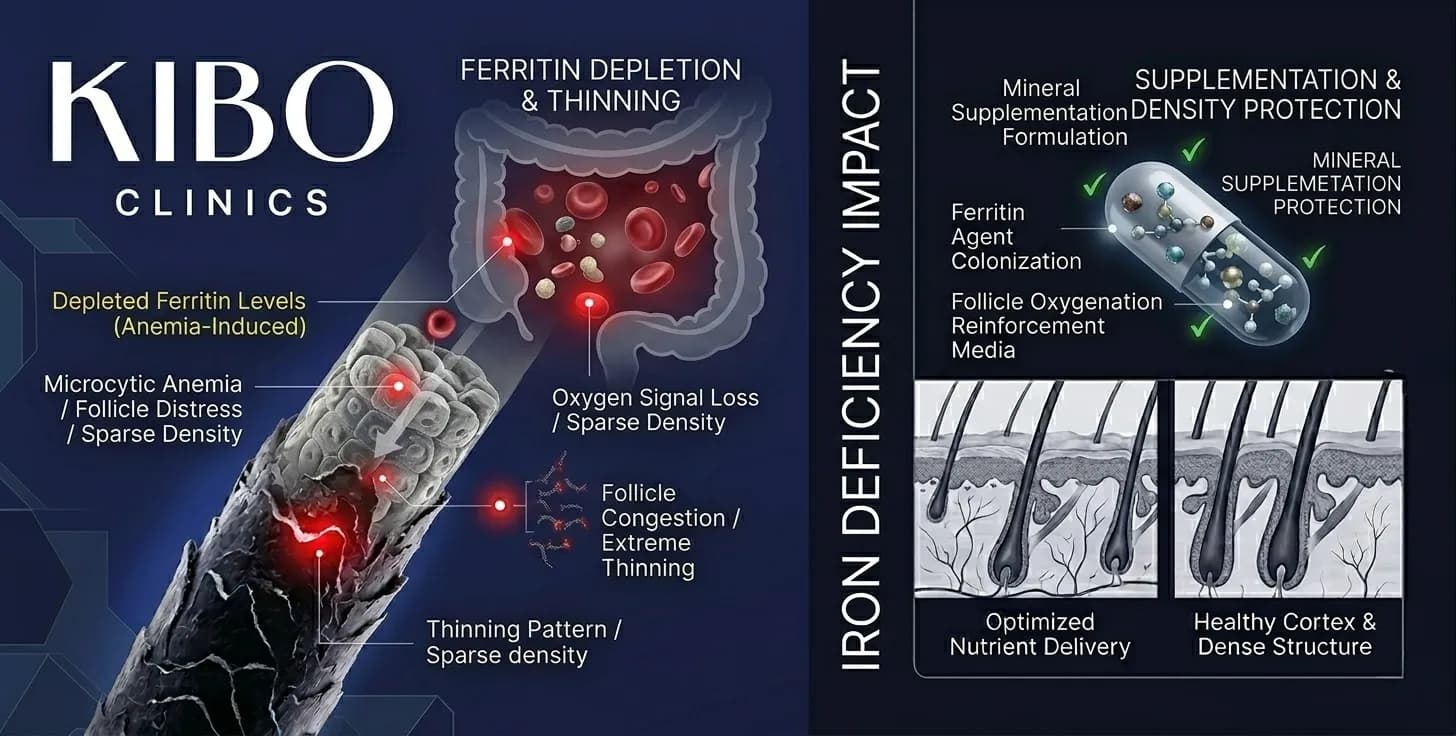
Who This Is For: Anyone who's seen a low ferritin result, noticed diffuse shedding, or been told their hair loss might be "just iron" and wants to actually understand what the number means.
Low iron stores may contribute to diffuse shedding or telogen effluvium, sometimes before anemia develops, but a low ferritin result does not prove that iron deficiency is the only cause of hair loss. Ferritin should be interpreted with a CBC, symptoms, inflammation status, blood-loss history, diet, absorption risks, and the hair-loss pattern. In otherwise well adults, ferritin below 15 µg/L is commonly diagnostic of iron deficiency and 15 to 30 µg/L is often considered probable deficiency; there is no universally accepted "ideal ferritin for hair growth."
What Is Ferritin?
Ferritin is the protein your body uses to store iron, and measuring it in blood gives a reasonable estimate of how much iron you have in reserve. Here's the catch that trips up a lot of self-interpretation, though: ferritin is also an acute-phase reactant, meaning it can rise during inflammation, infection, liver disease, or chronic illness, quite independently of how much iron you actually have stored. A "normal" or even elevated ferritin doesn't automatically rule out iron deficiency if something else is pushing the number up at the same time.
Iron Deficiency vs Iron-Deficiency Anemia
These aren't the same thing, and mixing them up leads to a lot of confused self-diagnosis. Ferritin, reflecting your iron stores, can fall well before hemoglobin does, so you can genuinely have depleted iron stores while your hemoglobin still reads normal on a standard blood test. A CBC is what actually assesses anemia and its severity. Ferritin and hemoglobin need to be read together, not as substitutes for one another.
Can Low Ferritin Cause Hair Loss?
A systematic review and meta-analysis pooling 36 studies and over 10,000 women found that women with nonscarring alopecia had lower average ferritin than comparison groups, and roughly a fifth had ferritin in a clearly low range. That's a real, statistically meaningful association. But the review's own background is explicit that this doesn't establish clear-cut causation, and the underlying studies were observational and genuinely heterogeneous. Read it as evidence that ferritin is worth checking in diffuse hair loss, not as proof that correcting it will fix every case.
A separate diagnostic study comparing 193 women with telogen effluvium, 104 with female androgenetic alopecia, and 183 healthy controls found meaningfully lower average ferritin in the telogen-effluvium group, and identified a statistical cut-off around 24.45 ng/mL that distinguished TE from healthy controls. But the discrimination was only moderate, with roughly 64% sensitivity and 74% specificity, and it performed worse at telling TE apart from pattern hair loss specifically. What this actually tells you: ferritin is a useful clinical clue a doctor can weigh alongside everything else, not a stand-alone test that can diagnose your hair loss on its own.
What Ferritin Levels Mean
| Ferritin (Otherwise Well Adult) | General Interpretation | Hair-Specific Caveat |
|---|---|---|
| <15 µg/L | Commonly diagnostic of iron deficiency in BC clinical guidance | A clinically important finding; assess the cause rather than assume hair loss is solely due to it |
| 15-30 µg/L | Probable iron deficiency | May be relevant in diffuse shedding, but diagnosis and response are not guaranteed |
| >30 µg/L | Iron deficiency less likely in otherwise well adults | Inflammation can make ferritin falsely reassuring; hair-specific "optimal" targets remain debated |
| 40-70 µg/L | Sometimes proposed in hair-loss practice or studies | Not a universal treatment threshold or proof that supplementation will help |
| >100 µg/L | Often described as normal stores in the cited BC guidance | Do not raise ferritin for hair alone or use iron without a clinical indication |
One practical note on units: ferritin is commonly reported as µg/L or ng/mL, and these are generally the same numerical value for this particular analyte, but always check the units and reference interval printed on your own lab report rather than assuming.
What Tests Are Used?
For an otherwise well person with diffuse shedding, a clinician will often start with a CBC and ferritin. Hemoglobin tells you whether you're anemic; ferritin estimates your iron stores. Beyond that initial pair, MCV, MCHC, platelet count, transferrin saturation, inflammatory markers like CRP, thyroid tests, B12, folate, or celiac testing may be appropriate depending on your specific history and symptoms, not as a blanket panel handed to everyone who mentions hair loss.
Why Is Iron Low?
Menstrual blood loss, pregnancy, restrictive diets, regular blood donation, gastrointestinal bleeding, celiac disease, inflammatory bowel disease, gastric surgery, and general malabsorption can all deplete iron over time. Menorrhagia is a genuinely common cause in premenopausal women, but it's worth being direct about this: unexplained deficiency in an adult man, a postmenopausal woman, or a premenopausal woman without heavy periods deserves proper medical investigation, including gastrointestinal and genitourinary evaluation where appropriate, rather than just being handed an iron supplement and sent home.
Treatment and Monitoring
Iron-containing foods can genuinely support your overall intake. Heme iron comes from meat and seafood; non-heme sources include legumes, leafy greens, fortified foods, nuts, seeds, and grains, and vitamin C can improve absorption of some non-heme iron. Diet alone, though, usually isn't enough to correct an already-established deficiency quickly or reliably.
Oral iron is almost always preferred over IV therapy for routine replacement, though gastrointestinal side effects such as nausea, constipation, diarrhoea, and dark stools are genuinely common. The specific preparation, dose, schedule, and duration should be clinician-directed based on your pregnancy status, the severity of deficiency, other health conditions, and how well you tolerate it, not a fixed protocol lifted from the internet. Iron can also be genuinely toxic to children, so it needs to be stored safely if you have kids at home. Absorption can be reduced by calcium, antacids, certain medications, tea, coffee, and milk, though exactly how to time doses around this depends on the specific formulation and how well you're tolerating it.
IV iron isn't a shortcut to faster hair growth. It's something a clinician might consider when oral iron genuinely isn't working, isn't tolerated, isn't being absorbed properly, or when rapid correction is medically necessary, and it requires proper medical assessment and monitoring either way.
On monitoring: hemoglobin often starts rising within a couple of weeks when treatment is actually working, but rebuilding your iron stores can genuinely take months. If ferritin or hemoglobin isn't responding as expected, it's worth considering whether you're actually taking the supplement consistently, whether bleeding is ongoing somewhere, whether absorption is the problem, whether inflammation is skewing the numbers, or whether the original diagnosis was even right in the first place. A single normal CBC isn't the finish line for hair recovery specifically.
Hair-Loss Mechanisms and What Else It Could Be
Iron deficiency may be one trigger for diffuse telogen shedding, but telogen effluvium can just as easily follow childbirth, fever, infection, surgery, rapid weight loss, severe stress, thyroid disease, a medication change, or another nutritional gap entirely, and shedding is often delayed after whatever the actual trigger was. Female pattern hair loss causes patterned miniaturisation and can genuinely coexist with low ferritin, but correcting the iron deficiency doesn't automatically reverse androgen-sensitive follicle miniaturisation, since that's a fundamentally different process. If the main thing you're actually seeing is short, fractured strands, split ends, or damage that looks more mechanical than diffuse, that's worth reading as hair breakage instead, since iron replacement genuinely won't repair an already-broken shaft. And pain, scale, pustules, redness, shiny skin, absent follicular openings, or patchy loss need a dermatology assessment regardless of what your ferritin says. Don't let a low iron result delay investigating something that actually needs its own workup.
Hair Recovery Timeline
| Phase | What May Happen | Caveat |
|---|---|---|
| Before treatment | Diffuse shedding, fatigue, cold intolerance, brittle or spoon nails may occur | Symptoms vary; some people are asymptomatic |
| First weeks after correction | Blood indices may begin improving | Hair shedding may continue because follicles operate on a delayed cycle |
| About 2-4 months | Shedding may begin to reduce in some telogen-effluvium cases | Not guaranteed and depends on the trigger and coexisting disease |
| 4-9+ months | New density may become more visible | Growth varies; pattern loss or ongoing deficiency can limit recovery |
| Longer term | Maintenance depends on correcting the cause | Persistent loss requires reassessment, not automatic additional iron |
When to See a Doctor Urgently
Severe fatigue, breathlessness, chest pain, fainting, a rapid heartbeat, black or bloody stool, unusually heavy bleeding, or pregnancy-related concerns need prompt medical attention rather than waiting for a routine follow-up. These can point to significant anemia or active bleeding that genuinely shouldn't sit on a supplement-and-wait plan.
Not sure if iron is actually behind your shedding, or something else entirely? Testing and a proper diagnosis settle it faster than guessing.
Kibo Clinics' Perspective on Iron and Hair Thinning
A ferritin number by itself doesn't explain your hair loss, and we think it's genuinely unhelpful when it gets treated like it does. It's one piece of a bigger picture that needs an actual diagnosis, not a single lab value you can self-manage from a search result.
At Kibo Clinics, we'd rather find out what's actually driving your shedding, iron or otherwise, than hand you a supplement and hope it happens to be the right answer.
If you've got a low ferritin result and ongoing shedding, or you're wondering whether a supplement is really what you need, a Kibo Clinics hair specialist can help you work out what's genuinely going on before you spend months guessing.
Frequently Asked Questions
Is ferritin 12 low enough to cause hair loss?
A ferritin of 12 is below common diagnostic thresholds for iron deficiency in otherwise well adults and deserves clinical evaluation. It may contribute to diffuse shedding, but the clinician should still assess other causes and identify why iron is low.
Is ferritin 30 too low for hair growth?
Ferritin around 30 sits at a threshold where interpretation varies. Some guidance considers iron deficiency less likely above 30 in otherwise well adults, while some hair-loss practices use higher targets. Inflammation, symptoms, CBC, blood loss, and the hair diagnosis matter more than a universal number.
Should I take iron if my hemoglobin is normal?
Do not self-prescribe solely from a hair-loss concern. Normal hemoglobin does not exclude low stores, but treatment should be based on ferritin, clinical context, the cause, and a safe plan.
Can heavy periods cause hair thinning?
Repeated menstrual blood loss can deplete iron stores and may contribute to diffuse shedding. Heavy or prolonged bleeding should be assessed and treated rather than managed only with iron tablets.
Why is my hair still falling after ferritin improves?
Hair cycles are delayed, and another trigger may be present. Pattern hair loss, thyroid disease, postpartum shedding, medication effects, ongoing bleeding, inflammation, or a different scalp disorder can coexist.
Can men have iron-deficiency hair loss?
Yes. Men can develop iron deficiency from diet, bleeding, malabsorption, donation, or other causes. Unexplained deficiency in an adult man deserves medical investigation.
Related Articles & Services
Hair Transplant
FUE Hair Transplant | Sapphire FUE Hair Transplant | Real-Time FUE Hair Transplant | Bio FUE Hair Transplant | Unshaven Hair Transplant | Direct Hair Transplant (DHT) | Body Hair Transplant | Corrective Hair Transplant | Hairline Correction
Hair Regrowth
PRP Therapy | GFC Therapy | Exosomes Therapy | IV Hair Boosters | Low-Level Laser Therapy | Mesotherapy for Hair Regrowth | Microneedling for Hair Regrowth | PDO Threads for Hair Regrowth
Must Read
Hair Growth Cycle and Mechanical Shedding | PCOS and Hair Thinning | Menopause and Hair Density | Dermatologist vs Trichologist
Relevant Blogs
Androgenetic Alopecia Explained | Stress-Induced Hair Loss | Vitamin D and Hair Follicles
Medical Disclaimer : Information from Kibo Hair Clinics is for educational purposes only. It does not replace diagnosis, trichoscopy, blood test interpretation, prescription treatment, procedure advice, or side-effect counselling from a qualified dermatologist or hair restoration doctor.