
Who This Is For: People who get regular salon blowouts and have started noticing dryness, frizz, split ends, shorter broken hairs or apparent thinning, and want to know whether the problem is heat damage, mechanical breakage or true hair loss.
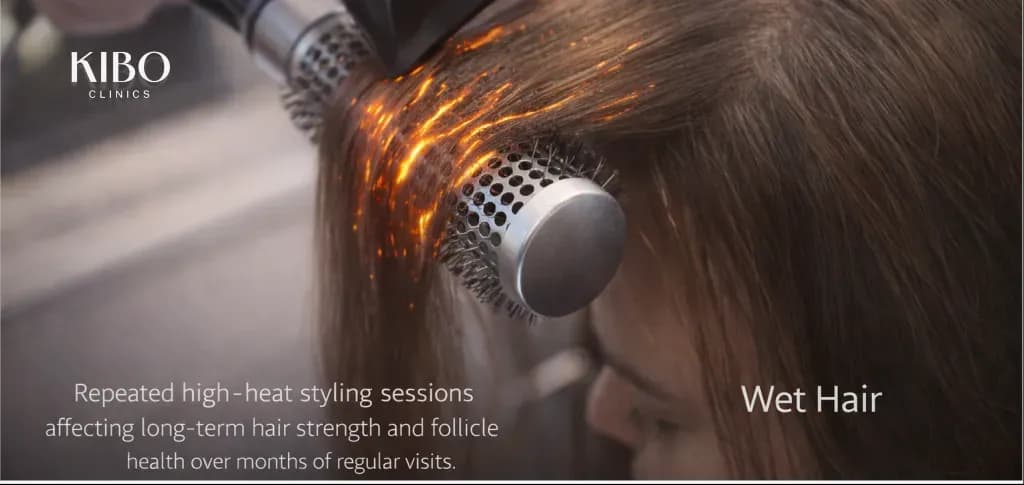
Frequent salon blowouts can damage the hair shaft, but they do not automatically cause hair loss from the follicle. The clearest risk is cumulative heat and mechanical damage: repeated hot-air exposure can roughen the cuticle and increase breakage, while strong round-brush tension can add pulling and friction. The effect depends on heat level, distance, movement, brush tension, hair condition and total styling frequency.
The current evidence does not support fixed claims that all professional dryers are hotter than home dryers, that every salon blowout reaches the same temperature, or that a weekly appointment inevitably causes traction alopecia. If your hair looks thinner after months of blowouts, the first step is to separate broken shafts from true shedding or pattern thinning.
What Does the Evidence Actually Show About Blow Drying?
The best-known controlled study on hair drying tested hair tresses under different dryer temperatures and distances. Surface damage increased as temperature increased. The same experiment found that drying from 15 cm away with continuous movement caused less surface damage than closer, hotter conditions. It also found a different type of damage in naturally dried hair, which is why the study should not be reduced to the claim that air drying is always better or that blow drying is always harmful.
That study was performed on hair tresses, not on living scalps or salon clients. Its temperature and distance values therefore describe an experimental setup, not universal safety limits. Kibo's dedicated guide to hair dryer heat and follicle safety explains the study conditions in more detail.
| Blowout Factor | What Evidence Supports | What Should Not Be Assumed |
|---|---|---|
| Higher heat | Higher tested temperatures caused more visible surface damage to hair fibres. | There is no universal salon temperature that applies to every dryer or every session. |
| Close distance | Closer dryer exposure produced greater surface damage in the controlled study. | A single distance is not a medical safety cut-off for every device. |
| Continuous movement | Keeping the dryer moving reduced concentrated heat in the study setup. | Movement does not make maximum heat risk-free. |
| Repeated styling | More heat sessions mean more opportunities for cumulative shaft damage. | A specific weekly or monthly schedule does not guarantee damage or safety. |
| Brush tension | Mechanical pulling can increase friction and breakage, especially in fragile hair. | Ordinary blowouts have not been proven to cause traction alopecia in every user. |
Are Salon Blowouts More Damaging Than Home Blow Drying?
Not necessarily. A salon can use strong airflow, concentrator nozzles and round-brush tension, but a trained stylist can also section hair efficiently, reduce repeated passes and adjust heat for the hair type. At home, someone can create just as much damage by holding high heat too close, repeatedly drying the same section or using a hot brush on soaking-wet hair.
The real comparison is total exposure. Ask how hot the tool feels on your scalp, how close the nozzle is, how many passes are made, how strongly the brush pulls, whether hair is already bleached or fragile, and whether you also use straighteners or curling irons between appointments. If you combine several hot tools in the same week, the guide to straightener and curling-iron heat stress is the more relevant comparison.
Not sure whether your salon routine is causing shaft breakage or whether you are actually losing hair from the root? A scalp and hair-shaft assessment can separate the two.
Hair Breakage vs Hair Loss After Blowouts
A blowout can make hair look thinner even when follicles are still producing hair. Repeated heat and brushing may snap strands at different lengths, reducing volume and creating flyaways. True hair loss is different because the problem is happening at the follicle or within the hair-growth cycle.
| What You Notice | More Suggestive of Blowout Breakage | More Suggestive of Hair Loss |
|---|---|---|
| Hair length | Short pieces, uneven lengths, split ends | Full-length hairs released from the root |
| Texture | Dry, rough, frizzy, brittle or tangled | Texture may remain normal while density reduces |
| Pattern | Damage concentrated on styled lengths, ends or repeatedly brushed sections | Widening part, temple recession, crown thinning, smooth patches or diffuse shedding |
| Response to gentler styling | New breakage may decrease when heat and pulling are reduced | Progressive density loss can continue despite gentler styling |
If you are mainly seeing snapping and split ends, start with the guide to hair breakage causes and treatments. If your hair feels unusually stretchy, weak or unable to tolerate styling, hair elasticity and stress resistance can help explain why already-compromised fibres break more easily.
Can Round-Brush Tension Damage Hair Roots?
Round-brush blowouts add a mechanical component because the hair is held under tension while it is heated and shaped. This can increase friction and shaft breakage, especially when the brush catches tangles, pulls hard near the hairline or repeatedly stretches already-fragile hair.
Traction alopecia, however, is a specific hair-loss condition caused by prolonged or repetitive tension on follicles. The strongest evidence involves tight braids, ponytails, buns, extensions, weaves and similar chronic pulling practices. There is much less evidence that an ordinary salon blowout, by itself, causes traction alopecia. If you want the broader mechanical-hair-loss context, see Kibo's guide to hair extensions and traction alopecia risk.
That distinction matters because temple or crown thinning should not automatically be blamed on a round brush. Pattern hair loss, telogen effluvium and inflammatory scalp conditions can occur at the same time as styling damage.
Why Starting With Soaking-Wet Hair Can Increase Styling Stress
Soaking-wet hair usually requires longer drying and more brushing. Wet fibres also behave differently from dry fibres, and aggressive detangling or pulling can increase mechanical damage. This is why gently blotting excess water and allowing partial air drying can reduce the amount of heat and handling needed.
The goal is not to leave hair wet for hours. It is to avoid the combination of dripping-wet hair, maximum heat and strong brush tension. The related guide on wet-hair styling and vulnerability covers the mechanical side of this routine in more detail.
Who Is More Likely to Notice Blowout Damage?
- Bleached, highlighted, relaxed or chemically straightened hair
- Fine or ageing hair with less structural reserve
- Curly or coily hair that is dry, tangled or repeatedly stretched straight
- Hair already showing split ends, roughness or low elasticity
- People who combine blowouts with flat irons, curling irons or hot brushes
- People whose stylists use strong round-brush tension on the same front or crown sections
- People with active scalp irritation, pain or inflammation
This is also why visible density and fibre strength should not be treated as the same problem. A person can have many follicles but poor shaft quality, or reduced follicle density with relatively strong remaining strands. Kibo's guide to hair density versus hair strength explains that difference.
How Often Is Too Often for a Salon Blowout?
There is no evidence-based universal interval such as every two weeks, every three weeks or once a month that is safe for everyone. Hair type, prior chemical damage, dryer technique and what you do between salon visits all change the total exposure.
Dermatology guidance is simpler: reduce the number of times you blow dry, use the lowest effective heat, and limit other hot tools. If weekly blowouts are followed by increasing frizz, roughness, split ends or breakage, increasing the time between sessions is a reasonable way to reduce cumulative exposure. That does not biologically repair the already-damaged shaft, but it can reduce new damage while healthier hair grows.
How to Make Salon Blowouts Less Damaging
You do not have to give up salon blowouts completely. The aim is to lower heat and mechanical stress while avoiding unnecessary repeat passes.
- Blot first. Remove excess water gently instead of rough towel rubbing.
- Let hair become damp. Partial air drying can shorten the time needed under direct heat.
- Use the lowest effective heat. Ask the stylist to reduce heat when possible, especially on bleached, fine or fragile hair.
- Keep the dryer moving. Avoid concentrating hot air on one section or the scalp for a long time.
- Reduce brush tension. The style should not require painful pulling at the roots or repeated force through tangles.
- Use heat protection appropriately. A product labelled for heat protection can help reduce styling stress, but it does not make excessive heat harmless.
- Avoid stacking hot tools. If the blowout already used significant heat, adding multiple flat-iron or curling-iron passes increases cumulative exposure.
- Stop when hair is dry enough to style. Repeatedly heating already-dry sections adds stress without improving hair health.
If you are already seeing visible breakage or density loss, get the pattern assessed before adding stronger salon treatments or more heat styling.
Do Heat Protectants Prevent Salon Blowout Damage?
Heat-protective leave-ins and styling products can be useful, particularly for processed or fragile hair. Dermatologists also note that some leave-in conditioners are specifically labelled to protect hair from heat-styling tools. Their role is supportive, not absolute. They cannot make repeated maximum-heat exposure or aggressive pulling harmless.
Product buildup is also not a proven mechanism for follicle damage simply because someone gets frequent blowouts. Cleanse according to your scalp and product load rather than following a fixed clarifying-shampoo schedule that may itself dry or irritate some hair types.
Air Drying vs Salon Blowout: Which Is Better?
Air drying avoids direct heat, but the answer is not simply that air drying is always healthy and blow drying is always damaging. In the 2011 laboratory study, natural drying caused less surface damage but showed changes in the cell membrane complex that were not seen in the dryer groups. The authors suggested that prolonged wet exposure may play a role.
For real-world hair care, a balanced routine is usually more useful: blot gently, allow some natural drying, then use controlled airflow and low or medium heat if you need a styled finish. Hair that is heavily processed or already brittle may benefit from fewer heat sessions overall.
Can Hair Recover From Frequent Blowout Damage?
The visible hair shaft cannot biologically heal because it is not living tissue. Once a strand is split, cracked or severely weakened, products can improve feel and reduce friction but cannot restore it to a completely undamaged state. The long-term strategy is to reduce new damage, condition appropriately and trim compromised ends while healthier hair grows from the follicle.
If your hair looks thin because of breakage, preserving new length can gradually improve visible fullness. If density is reducing at the scalp, that is a different problem and may not improve just by changing styling habits.
When the Blowout Is Probably Not the Main Cause of Thinning
Do not assume every hair-fall pattern is caused by styling. A widening part, progressive temple recession, crown thinning, smooth bald patches, sudden diffuse shedding, scalp scaling or persistent pain can point to a medical hair-loss condition. The broader guide to hair loss types, symptoms and causes can help you understand the main patterns before a consultation.
Heat styling can exist alongside androgenetic alopecia, telogen effluvium or scalp disease. A person may therefore have both shaft breakage and true hair loss at the same time. That is why diagnosis should come before procedures or regrowth treatments.
Kibo Clinics' Approach to Blowout-Related Hair Concerns
If the issue is mainly shaft damage, the priority is technique correction, lower cumulative heat, appropriate conditioning and trimming damaged length. PRP, GFC or other follicle-directed treatments are not automatic treatments for heat-damaged hair shafts.
If examination shows progressive follicle miniaturisation, traction alopecia, inflammatory scalp disease or another cause of true hair loss, the treatment plan changes. The point is to separate cosmetic fibre damage from follicle disease before deciding what needs treatment.
For people who regularly use styling tools, a broader long-term hair stress prevention plan is more useful than reacting only after breakage becomes obvious.
Still unsure whether you are dealing with damaged lengths or real hair loss? Get a diagnosis-first assessment before changing treatments.
Frequently Asked Questions
Do salon blowouts damage hair?
They can, especially when high heat, repeated passes and strong brush tension are used frequently. The most established risk is damage to the hair shaft, which can lead to roughness, split ends and breakage. A well-controlled blowout using lower heat, continuous movement and less tension can reduce that risk.
Are salon blowouts more damaging than blow drying at home?
Not automatically. There is no universal rule that salon dryers are hotter or that every salon blowout causes more damage than home drying. Risk depends on the temperature reaching the hair, distance, duration, number of passes, brush tension, hair condition and how often heat is used overall.
Can weekly blowouts cause hair loss?
Weekly blowouts can increase cumulative heat and mechanical exposure, but there is no evidence-based rule that one blowout per week automatically causes follicular hair loss. If you are seeing short broken hairs, the problem may be shaft damage. Receding, widening, patchy or persistent root-level shedding needs another explanation.
Can round-brush tension cause traction alopecia?
Traction alopecia is caused by prolonged or repetitive pulling on follicles, most clearly documented with tight hairstyles, extensions, braids and similar practices. A forceful blowout can add mechanical stress and breakage, but evidence specifically linking ordinary salon round-brush blowouts to traction alopecia is limited. Persistent temple or hairline thinning should be examined rather than assumed to be caused by the brush.
How hot is too hot for a salon blowout?
There is no universal safe temperature because heat at the hair depends on the dryer, airflow, nozzle, distance and movement. A laboratory study found more surface damage at higher temperatures and closer distances. Practically, use the lowest effective heat and stop if the scalp feels painfully hot.
How often can I safely get a salon blowout?
There is no medically established interval that is safe for everyone. The American Academy of Dermatology advises reducing how often you blow dry and using lower heat. If you are developing dryness, split ends or breakage, increasing the interval between sessions and reducing other heat styling lowers cumulative exposure.
Should I use heat protectant before a blowout?
A heat-protective product can be useful, especially on processed or fragile hair, but it does not make very high heat harmless. It should be combined with lower temperature, fewer repeated passes, reasonable dryer distance and gentler brush tension.
Is air drying always safer than a salon blowout?
No method is automatically best in every situation. Air drying avoids direct heat, while prolonged wet exposure changes the hair fibre. A controlled laboratory study found different damage patterns with natural drying and blow drying. A practical approach is gentle towel blotting, partial air drying and controlled low or medium heat when needed.
Can heat-damaged hair recover?
The damaged part of a hair shaft cannot biologically repair itself because the shaft is not living tissue. Conditioners and leave-in products can improve smoothness and reduce friction, while healthier hair grows from the follicle and damaged ends are gradually trimmed.
When should I see a dermatologist for thinning after salon blowouts?
The strongest direct evidence discussed here is laboratory research on hair fibres and dermatology guidance on heat styling. The 2011 hair-dryer study used hair tresses under controlled conditions. Its reported temperatures and distances should not be treated as universal safety thresholds for every salon dryer, hair type or scalp.
There is no established medical rule that professional salon blowouts are always more damaging than home blow drying, or that every salon dryer reaches a fixed temperature. Damage depends on the heat that reaches the hair, distance, airflow, movement, duration, repeated passes, brush tension and the condition of the hair being styled.
Traction alopecia is a recognised form of hair loss caused by prolonged or repetitive tension, but the strongest evidence involves chronic tight hairstyles and extensions. Evidence specifically proving that ordinary salon round-brush blowouts cause traction alopecia is limited. Progressive temple, hairline or crown thinning should therefore be medically assessed rather than attributed to styling alone.
Seek medical assessment if you develop a widening part, receding hairline, smooth bald patches, sudden heavy root-level shedding, persistent scalp pain, redness, scaling, pustules or any thinning that continues despite gentler styling.
Authoritative sources reviewed:
Lee Y. et al., Hair Shaft Damage from Heat and Drying Time of Hair Dryer, Annals of Dermatology
American Academy of Dermatology: Hair Styling Without Damage
American Academy of Dermatology: Tips for Healthy Hair
American Academy of Dermatology: Leave-In Conditioner and Heat Protection
American Academy of Dermatology: Hairstyles That Pull Can Lead to Hair Loss
Billero V. and Miteva M., Traction Alopecia: The Root of the Problem
Related Articles & Services
Hair Transplant
FUE Hair Transplant | Sapphire FUE Hair Transplant | Direct Hair Transplant DHT | Corrective Hair Transplant | Hairline Correction
Hair Regrowth
PRP Therapy | GFC Therapy | Mesotherapy for Hair Regrowth | Microneedling for Hair Regrowth | Low-Level Laser Therapy
Must Read
Dermatologist vs Trichologist | Sulfate-Free vs Regular Shampoo | Frequent Washing and Hair Loss | Hair Growth Cycle Explained | Daily Hair Protection
Relevant Blogs
AC and Indoor Dryness | Hair Sprays and Gels | Hair Ties vs Scrunchies vs Clips | Repeated Hair Parting Damage | Scalp Detox and Product Buildup
Medical Disclaimer : Information from Kibo Hair Clinics is for educational purposes only. It does not replace diagnosis, trichoscopy, blood test interpretation, prescription treatment, procedure advice, or side-effect counselling from a qualified dermatologist or hair restoration doctor.