
What Nashik Patients Miss When Choosing Clinics Only by Distance
Published on Mon Apr 13 2026
Article Information
Medically Reviewed By: Kibo Clinics Dermatology & Hair Restoration Team
Last Updated: April 2026
Reading Time: 8 minutes
Applies To: Nashik residents filtering hair transplant clinics by proximity
This article is for educational purposes only and does not replace professional medical advice.
Experiencing unusual hair loss or side effects from a treatment? Our board-certified doctors are here to help.
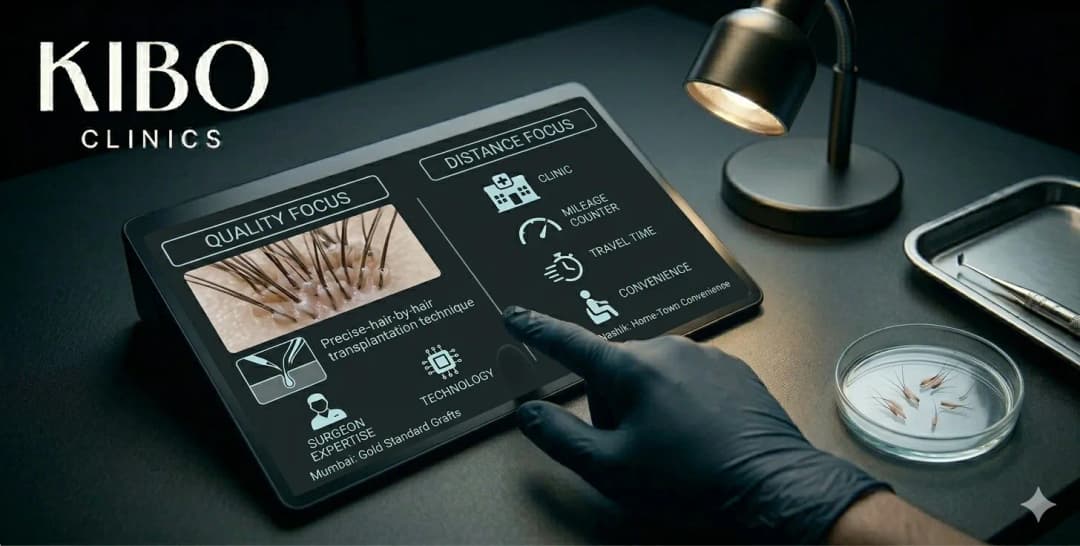
Talk to a DermatologistArun typed "best hair transplant near me" into Google from his Nashik home. The top results were all within 5 km. He booked the closest one. Six months later, his hairline looked patchy, the density was uneven, and his donor area showed visible thinning. When he consulted a Mumbai specialist for correction, the surgeon explained that the original clinic had overharvested his donor zone, limiting future options. Arun wished he had traveled 3 hours for the right surgeon instead of walking 5 minutes to the wrong one.
This guide explains what proximity-based clinic selection misses and what you should evaluate instead.
What Distance Does Not Tell You
Proximity tells you nothing about who performs the procedure (surgeon vs technician), the clinic's monthly case volume and experience with your specific hair loss pattern, graft handling and survival protocols, donor area management strategy for long-term preservation, or availability of multiple techniques (FUE, Sapphire FUE, DHT) matched to your case. These factors determine your results far more than the clinic's address.
Red Flags at Nearby Clinics
Watch for clinics that quote extremely low per-graft prices without explaining what is included, cannot show documented before-and-after photos of actual patients, are vague about who performs the extraction and implantation, promise "unlimited grafts" or "guaranteed density" without medical assessment, or pressure you to book immediately with discounts. These are well-documented hair mill red flags that indicate volume-driven operations prioritising revenue over patient outcomes.
What to Evaluate Instead
Surgeon credentials and personal involvement in every procedure. Published case results for patients with similar hair loss patterns to yours. Transparent pricing that details all inclusions. Structured aftercare protocols especially for outstation patients. A willingness to recommend non-surgical options when appropriate, suggesting the clinic prioritises your outcome over their revenue.
Frequently Asked Questions
Is it worth traveling from Nashik to Mumbai for a hair transplant?
Yes, if the Mumbai clinic offers surgeon-led procedures, higher graft survival rates, and structured aftercare. The 3-4 hour drive is a one-time inconvenience for permanent results you will live with for decades.
How do I verify a clinic is legitimate?
Check surgeon qualifications (dermatology board certification), Google reviews with detailed patient experiences, published before-and-after photos, and whether they provide transparent written quotes.
What if I need follow-up care but the clinic is in Mumbai?
Most reputable Mumbai clinics provide remote follow-up through photo reviews and video consultations for outstation patients, with in-person visits only when medically necessary.
Medical Disclaimer
This information is published by Kibo Clinics for educational purposes only. Individual results vary. Always consult a board-certified dermatologist.
Explore Kibo Clinic Services
Hair Transplant:
FUE | Sapphire FUE | DHT | Real Time FUE | Bio FUE | Unshaven | Hairline Correction | Corrective | BHT
Hair Regrowth:
PRP | GFC | IV Booster | LLLT | Mesotherapy | Microneedling | PDO Threads
Related Articles
Nashik Guides:
Best Option Nashik | Cost Comparison | Complete Guide | Why Choose Mumbai
Hair Transplant:
Complete Guide | Results Timeline | Norwood Scale | Mumbai Cost