
Why Many Nashik Patients Choose Mumbai for Hair Transplant Surgery – Complete Guide
Published on Mon Apr 13 2026
Article Information
Medically Reviewed By: Kibo Clinics Dermatology & Hair Restoration Team
Last Updated: April 2026
Reading Time: 8 minutes
Applies To: Why Nashik patients increasingly travel to Mumbai for hair transplants. Surgeon
Educational purposes only. Does not replace professional medical advice.
Experiencing unusual hair loss or side effects? Our board-certified doctors are here to help.
Talk to a DermatologistThree colleagues in a Nashik IT company had all experienced hair loss. One chose a local clinic for convenience. Two traveled to Mumbai. One year later, the Mumbai patients had natural, dense results. The local patient was researching corrective options. That visible difference convinced four more colleagues to choose Mumbai.
Surgeon Expertise and Specialisation
Mumbai's hair restoration ecosystem attracts and retains India's most experienced surgeons. Clinics with 3,000+ procedures of experience offer a level of hairline artistry, donor management, and complication handling that comes only from sustained high-volume practice. Nashik patients benefit from this concentrated expertise for a procedure they will live with permanently.
Advanced Technique Availability
Mumbai centers offer multiple techniques - FUE, Sapphire FUE, DHT, unshaven transplant - matched to each patient's specific case rather than defaulting to a single approach. This flexibility means your technique is chosen for medical reasons, not clinic limitations.
Structured Aftercare for Outstation Patients
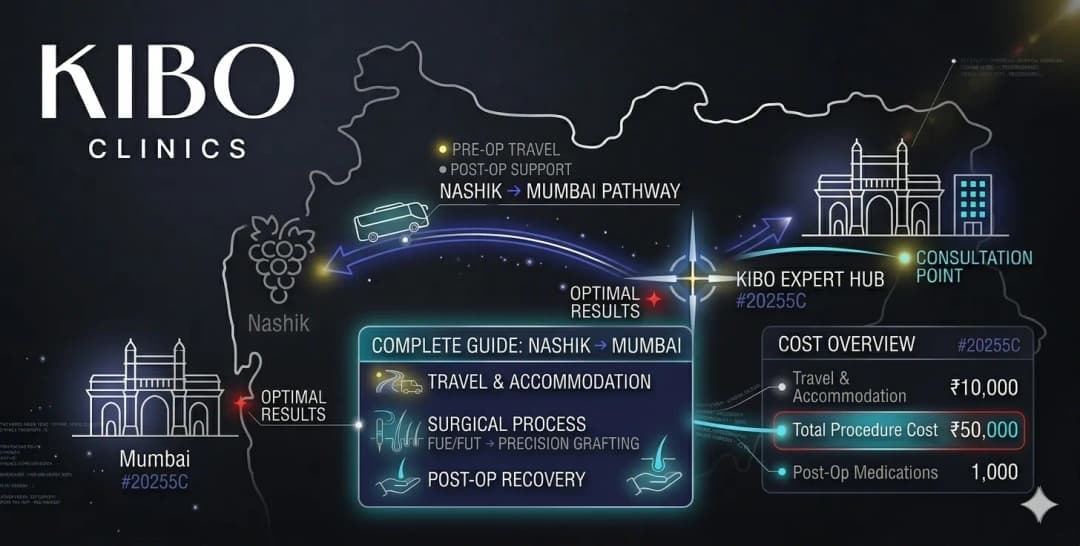
Reputable Mumbai clinics have developed specific protocols for outstation patients: remote follow-up via photo and video consultations, written recovery guides for each healing phase, dedicated patient coordinators for Nashik patients, and clear escalation procedures if concerns arise. This structured approach means you get the same level of post-operative support as local Mumbai patients despite being 165 km away. Recovery tips for outstation patients help you prepare for this phase.
Outcome Predictability
The combination of experienced surgeons, refined protocols, and high case volumes creates predictable outcomes. When you review a Mumbai clinic's before-and-after gallery, you are seeing results representative of their consistent standard, not cherry-picked best cases. This predictability is the primary reason Nashik patients choose to travel.
Frequently Asked Questions
Is the 3-4 hour drive from Nashik to Mumbai worth it?
For a permanent procedure you will live with for decades, the one-time travel investment is minimal. Most patients need only 2-3 days in Mumbai total.
Can Mumbai clinics handle Nashik patients remotely after surgery?
Yes. Structured remote follow-up via photos and video consultations is standard at reputable Mumbai centers. In-person visits are needed only at specific milestones.
Are Mumbai results really better than Nashik?
On average, yes - due to higher surgeon experience, case volumes, and protocol rigor. However, outcomes depend on the specific clinic and surgeon, not the city label alone.
Medical Disclaimer
This information is published by Kibo Clinics for educational purposes only. Individual results vary. Always consult a board-certified dermatologist.
Explore Kibo Clinic Services
Hair Transplant:
FUE | Sapphire FUE | DHT | Real Time FUE | Bio FUE | Unshaven | Hairline Correction | Corrective | BHT
Hair Regrowth:
PRP | GFC | IV Booster | LLLT | Mesotherapy | Microneedling | PDO Threads
Related Articles
Nashik Guides:
Best Option Nashik | Cost Comparison | Complete Guide | Why Choose Mumbai
Hair Transplant:
Complete Guide | Results Timeline | Norwood Scale | Mumbai Cost