
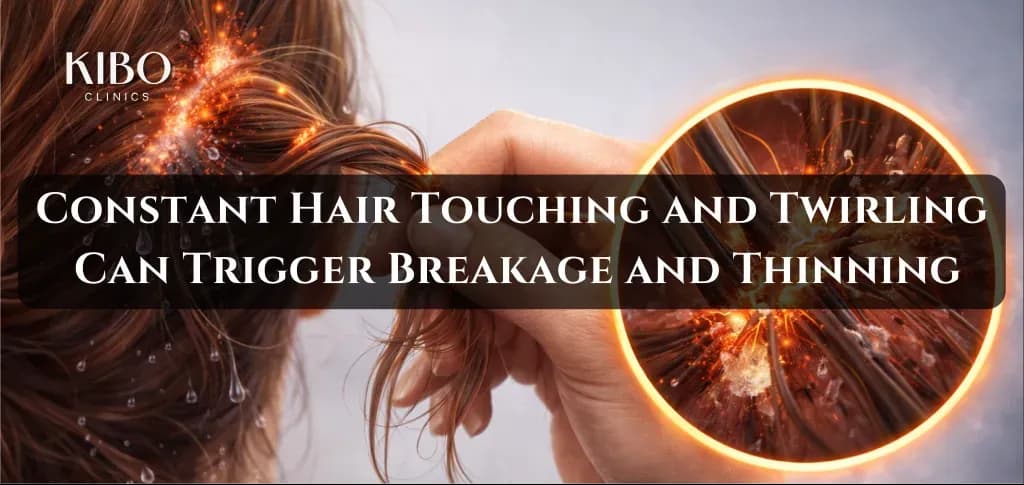
Who This Is For: People who frequently touch, twist, twirl or pull their hair; anyone noticing short broken hairs, uneven density or bald patches in the areas their hands repeatedly reach; parents concerned about hair twirling in children; and people trying to work out whether the problem is simple hair-shaft breakage, traction, another hair-loss condition or trichotillomania.
Occasionally touching your hair is unlikely to cause meaningful breakage or hair loss. The risk comes from what the hand is actually doing and how often: repeated twisting can add friction and tangling to the hair shaft, sustained tension can stress follicles, and recurrent pulling can remove hairs from the root. If you are only smoothing or briefly running fingers through healthy hair, that is very different from tightly wrapping the same strands around a finger, tugging them, searching for particular hairs and pulling them out, or repeatedly manipulating one patch for long periods.
Hair twirling is also not automatically trichotillomania. It may be a harmless fidget or self-soothing habit. Trichotillomania is a body-focused repetitive behaviour disorder involving recurrent hair pulling that causes hair loss, repeated attempts to reduce or stop, and clinically meaningful distress or impairment. The useful first step is therefore to work out whether you are seeing simple shaft breakage, hair being pulled from the follicle, or a separate hair-loss condition that only happens to be in the same area.
| Behaviour | Main Mechanical Effect | Likely Hair Finding | When to Take It Seriously |
|---|---|---|---|
| Occasional light touching | Minimal friction | Usually no meaningful damage | If touching becomes repetitive, forceful or is accompanied by thinning |
| Repeated twirling or twisting | Friction, bending, tangling and repeated shaft manipulation | Short broken hairs, split ends, knots or uneven length | If the same area is repeatedly manipulated or strands are pulled tight |
| Repeated tugging or pulling | Trauma to the hair and follicle | Broken hairs plus hairs removed from the root and patchy thinning | If visible gaps develop, the scalp becomes sore, or stopping feels difficult |
| Compulsive hair pulling | Repeated self-removal of hairs | Irregular patches with hairs of different lengths; possible skin damage | When hair loss, distress, repeated failed attempts to stop or functional impact is present |
Touching vs Twirling vs Pulling: They Are Not the Same Hair-Loss Risk
The current internet discussion often collapses every hand-to-hair behaviour into one category. That is too simplistic. Hair can tolerate normal daily handling. The important variables are force, repetition, duration, whether the strand is being bent or twisted repeatedly, and whether the hair is actually being pulled from the follicle.
Lightly touching the hair is mainly a surface-contact event. Twirling adds repeated bending and torsion to the shaft and can create tangles, especially when a strand is tightly wrapped around a finger. Pulling changes the problem again because force is transmitted to the follicle and may remove the hair. Persistent follicular traction from hairstyles is described as traction alopecia, while recurrent self-pulling associated with a behavioural disorder is trichotillomania. These conditions can look similar in a mirror but have different causes and management.
Hair Breakage vs Hair Loss: How Can You Tell What Twirling Is Doing?
Breakage is a hair-shaft problem; shedding or alopecia involves the follicle or hair cycle. With breakage, the strand snaps somewhere along its length, so you often see shorter pieces, flyaways, frayed ends or uneven lengths. With shedding, the whole hair detaches from the follicle. With alopecia, density can fall because fewer hairs are being retained or produced.
If you are finding many short pieces around the area you twirl, that supports shaft trauma. If you are seeing a patch with hairs at many different lengths, black dots at scalp level or obvious pulled hairs, self-induced pulling becomes more plausible. If the loss is smooth, rapidly progressive, inflamed, scaly or does not match the behaviour, another diagnosis needs to be considered. Kibo's guide to hair breakage causes and treatments explains the shaft-level differences in more detail.
What Repetitive Twirling Can Actually Do to the Hair Shaft
Hair fibres are mechanically strong, but they are not indestructible. Repeated friction, bending, grooming and abrasion can damage the cuticle, increase surface roughness and make already weathered hair more prone to snapping. This is why hair that has also been bleached, heat-styled, chemically straightened or repeatedly brushed may tolerate twirling less well than healthy, low-manipulation hair.
The evidence supports describing twirling as a potential source of mechanical shaft stress, not claiming that every finger pass permanently breaks internal keratin bonds or damages the follicle. There is also no validated clinical threshold such as “five touches per hour is safe but ten is harmful.” Damage depends on how the hair is handled, not on a universal touch count.
Hair Twirling, Traction Alopecia and Trichotillomania: What Is the Difference?
| Condition / Behaviour | Typical Driver | Typical Pattern | Main Intervention |
|---|---|---|---|
| Habitual hair twirling | Boredom, concentration, sensory habit or self-soothing | May have no visible loss; breakage can occur if manipulation is repetitive or tight | Awareness, reduce manipulation, competing hand activity |
| Traction alopecia | External sustained pulling from hairstyles, extensions or repeated tension | Loss follows where tension is highest, commonly scalp margins | Stop the traction early; longstanding cases can scar |
| Trichotillomania | Body-focused repetitive behaviour with focused or automatic pulling | Irregular patches, hairs of varying lengths, recurrent pulling and distress/impairment | Behavioural treatment such as habit reversal training, plus medical/mental-health assessment as needed |
The British Association of Dermatologists specifically distinguishes traction alopecia from trichotillomania. If a tight hairstyle is creating the pull, read Kibo's guide to traction alopecia from tight hairstyles. If your own hand repeatedly removes hairs and the behaviour is difficult to control, the behavioural-health pathway becomes more important.
When Does Hair Twirling Become Trichotillomania?
Hair twirling alone does not establish trichotillomania. The disorder involves recurrent hair pulling that results in hair loss, repeated attempts to decrease or stop the pulling, and clinically significant distress or impairment. Some people pull deliberately in response to an urge, sensation or a particular “wrong” hair; others pull automatically while reading, studying, watching television or feeling bored.
The distinction is useful because telling someone with a body-focused repetitive behaviour to “just stop touching your hair” is usually not enough. A clinician may need to address both the scalp findings and the behavioural pattern. People may also have nail biting or skin picking alongside hair pulling.
Signs That a Hair-Touching Habit Needs More Than Simple Hair Care
- You are pulling hairs out, not just touching them.
- You repeatedly target the same texture, colour or area.
- You have tried to stop or reduce the behaviour but keep returning to it.
- You see visible gaps, bald patches, broken hairs at many different lengths or scalp sores.
- The behaviour increases during stress, boredom, concentration or private time and may happen automatically.
- You feel relief, satisfaction, tension reduction, shame or distress around the behaviour.
- You pull eyebrows or eyelashes as well as scalp hair.
- You bite, chew or swallow pulled hairs. Swallowing hair needs medical attention because trichobezoars can become a gastrointestinal complication.
Does Breakage on One Side Prove That Hair Touching Is the Cause?
No. Asymmetry is a clue, not a diagnosis. A habit that repeatedly targets one temple or side can certainly create one-sided breakage or patchy loss. But asymmetric hair loss can also occur with alopecia areata, traction patterns, tinea capitis, temporal triangular alopecia, scarring alopecias and other local processes.
This is an important correction because the current page treats one-sided damage as almost diagnostic of mechanical touching. A dermatologist looks at the pattern, history, shaft lengths, scalp surface and trichoscopic signs before deciding whether the behaviour explains the loss.
What Can Trichoscopy Show in Hair-Pulling Damage?
Trichoscopy is useful when patchy hair loss could be trichotillomania, alopecia areata, traction or another localized condition. In trichotillomania, published systematic reviews and dermatology references describe hairs broken at different lengths as a common finding, along with features such as V-sign hairs, flame hairs, hair powder, coiled or hook hairs, black dots and tulip hairs.
These findings help build a diagnosis but should not be self-interpreted from a phone camera. Some signs overlap with other disorders, so the purpose of trichoscopy is to combine magnified scalp findings with the clinical history. If the pattern does not clearly match a touching or pulling habit, reviewing the broader types of hair loss helps frame what else may need to be ruled out.
Seeing a patch of short broken hairs or uneven density? A scalp assessment can help separate shaft breakage, traction, pattern hair loss and self-induced pulling before you choose a treatment.
How Do You Stop Touching or Twirling Your Hair Unconsciously?
For a mild fidgeting habit, the most useful strategy is to make the behaviour visible and replace it with something that is easier on the hair. For a compulsive pulling disorder, evidence-based behavioural treatment is more appropriate than relying only on hair-care hacks.
- Notice the earliest hand-to-hair movement. Instead of counting a “dangerous” number of touches, record where, when and what you were doing when the hand moved toward the hair.
- Identify triggers. Common contexts include boredom, studying, work calls, screen time, anxiety, fatigue and searching for hairs that feel coarse or “different.”
- Use a competing response. Habit reversal training commonly uses a response that physically prevents the unwanted action for about a minute, such as gently clenching the hands, folding them or placing them in a neutral position.
- Change the environment. Keep a fidget object nearby, move mirrors or tweezers if they trigger pulling, or use a loose low-manipulation hairstyle that reduces easy access without creating traction.
- Avoid “barrier” hairstyles that are tight. A tight bun or braid may stop twirling but can create a different traction problem. The barrier should be comfortable and low-tension.
- Track success by episodes interrupted, not perfection. Behaviour change is not an all-or-nothing event.
- Seek behavioural-health support when pulling is difficult to control. Habit reversal training is one of the best-supported behavioural approaches for trichotillomania and related body-focused repetitive behaviours.
What Is Habit Reversal Training for Hair Twirling or Hair Pulling?
Habit reversal training, or HRT, is a structured behavioural treatment used for hair twirling and trichotillomania. It is more than “use a stress ball.” Core components include awareness training, recognising triggers and early movements, and competing response training, where you practise an action that prevents the pulling or twirling response. Motivation, social support and generalisation to real-life trigger situations may also be included.
A 2026 updated meta-analysis of psychotherapeutic and pharmacological interventions adds to the existing evidence base for trichotillomania treatment, while earlier systematic reviews consistently found the strongest support for behavioural therapy with habit-reversal components. Medication may be considered in selected cases by mental-health clinicians, but there is no single medication that simply replaces behavioural treatment.
Will Hair Breakage Recover After You Stop Twirling?
A broken hair shaft cannot fuse itself back together. Once a strand has snapped or split, the goal is to prevent additional breakage while new hair continues to grow from a healthy follicle. This is why visible recovery is gradual and depends on where along the shaft the damage occurred, the person's growth rate and whether other stressors such as bleaching, heat or traction are still present.
There is no evidence-based promise that every twirling-related patch will “fill in within four to five months.” If the problem is only shaft breakage, length and appearance improve as new growth replaces the damaged section. If hairs have been repeatedly pulled from the root, the timeline is different and depends on whether the follicle remains intact.
Does Hair Grow Back After Repeated Pulling?
Often, yes, if the follicles have not been permanently scarred. Repeated pulling can produce patchy hair loss and skin irritation, but many non-scarring cases regrow after pulling stops. Chronic pulling can eventually cause scarring or permanent loss in some areas, so longstanding smooth patches deserve evaluation rather than an automatic promise of recovery.
The same principle applies to traction alopecia: early disease may recover once the pulling force is removed, whereas longstanding traction can destroy follicles permanently. Hair that fails to return after the behaviour has stopped should be assessed for scarring, coexisting androgenetic alopecia, alopecia areata or another diagnosis.
How Should You Care for Hair While It Recovers?
- Use conditioner after shampooing and detangle gently.
- Avoid aggressive towel rubbing, repeated brushing and pulling through knots.
- Reduce high heat, bleaching and chemical straightening while damaged hair is growing out.
- Choose loose, low-tension styles rather than tight braids, ponytails or buns used as a “barrier.”
- Trim severely split ends when needed; a cosmetic product cannot permanently rejoin a split fibre.
- Treat dandruff, itch or inflammatory scalp disease if scratching is adding another source of mechanical trauma.
- Photograph the same area in consistent lighting every four to eight weeks rather than checking it repeatedly every day.
Do PRP, GFC or Hair-Growth Treatments Fix Hair-Twirling Damage?
No procedure treats the behavioural urge to twirl or pull hair. The first intervention is to stop the damaging mechanical behaviour and establish whether the problem is shaft breakage, self-induced pulling, traction or another form of alopecia. Injecting or stimulating the scalp while the pulling continues does not solve the cause.
If trichoscopy shows a separate non-scarring follicular hair-loss process or persistent thinning after the behaviour is controlled, a dermatologist may discuss condition-specific options. Depending on the actual diagnosis, these can include PRP therapy for hair loss or GFC therapy for hair regrowth. These are not first-line treatments for trichotillomania and should not be marketed as a way to compensate for ongoing pulling.
When Should You See a Dermatologist or Mental-Health Professional?
| Situation | Best Next Step |
|---|---|
| Only mild twirling, no loss or distress | Use awareness and low-manipulation hair care; monitor rather than medicalise the habit. |
| Short broken hairs or recurrent tangles | Reduce manipulation and other shaft stressors; see a dermatologist if breakage persists. |
| Patchy loss, scalp sores, black dots or hairs at many lengths | Dermatology assessment and trichoscopy to distinguish pulling from other local alopecias. |
| Repeated urge to pull, failed attempts to stop or significant distress | Mental-health professional experienced with BFRBs / HRT, alongside scalp care when needed. |
| Swallowing hair, abdominal pain or vomiting | Prompt medical assessment because swallowed hair can form a trichobezoar. |
| Smooth longstanding bald patch after pulling has stopped | Evaluate for scarring/permanent follicular loss before discussing restoration options. |
If you are not sure whether you are seeing broken hair, pulled hair or another type of thinning, get the pattern assessed before spending on regrowth treatments.
Frequently Asked Questions
Does touching your hair cause hair loss?
Occasional gentle touching is unlikely to cause meaningful hair loss. Risk increases when touching becomes repeated twisting, tugging, tight wrapping or pulling that damages the shaft or removes hairs from the follicle.
Is hair twirling bad for your hair?
Hair twirling can contribute to tangling, split ends and breakage when it is frequent or tight, especially in hair already weakened by heat or chemicals. Light occasional twirling does not automatically cause follicle damage.
Is hair twirling a sign of trichotillomania?
Not by itself. Trichotillomania involves recurrent hair pulling that causes hair loss, attempts to reduce or stop the behaviour, and significant distress or impairment. Twirling can simply be a fidget or self-soothing habit.
How do I stop touching or twirling my hair?
Start by identifying when your hand moves toward your hair and what triggers it. Use a competing response such as folding or gently clenching your hands, reduce access with a loose low-tension style, and use habit reversal training with a qualified mental-health professional if the behaviour is difficult to control.
Can hair twirling cause a bald spot?
Simple twirling is more likely to cause shaft damage than a true bald patch. A bald or visibly sparse patch is more concerning when twirling includes repeated pulling, hairs are being removed from the root, or another hair-loss condition is present.
How can I tell hair breakage from shedding?
Breakage leaves shorter pieces and uneven lengths because the shaft snaps. Shedding removes the whole hair from the follicle. Patchy alopecia can also reduce density, so persistent or unclear cases should be examined rather than diagnosed from one loose hair.
Does one-sided breakage prove that I am touching that side too much?
No. A one-sided habit can create asymmetric damage, but asymmetry is not diagnostic. Alopecia areata, traction, tinea capitis, scarring conditions and other local causes can also be asymmetric.
What does trichoscopy show in trichotillomania?
Common findings include hairs broken at different lengths. More specific or supportive signs can include V-sign hairs, flame hairs, hair powder, coiled or hook hairs, black dots and tulip hairs. A dermatologist interprets these together with the history and scalp pattern.
Will hair grow back after I stop pulling it?
Hair often regrows if the follicle has not been permanently scarred. Chronic repeated pulling can cause irritation, scarring and permanent loss in some areas, so longstanding smooth patches should be assessed.
How long does hair take to recover after twirling-related breakage?
There is no fixed recovery deadline. Broken strands need to grow out from healthy follicles, so improvement depends on the location of the break, growth rate and whether other damage continues. Follicle-level loss from repeated pulling follows a different timeline.
Is habit reversal training useful for hair twirling?
Yes. Habit reversal training is used for hair twirling and has a strong evidence base as part of behavioural treatment for trichotillomania. It teaches awareness of triggers and a competing response that prevents the unwanted hand-to-hair action.
Do PRP or GFC treatments stop trichotillomania?
No. PRP and GFC do not treat the behavioural urge to pull hair. They should only be considered for a separately diagnosed scalp or follicular hair-loss problem after the damaging behaviour is being addressed.
Bottom Line
Touching your hair is not automatically damaging, and there is no evidence-based number of daily touches that defines harm. Repeated tight twirling can contribute to shaft breakage; recurrent pulling can produce patchy hair loss; and trichotillomania is a specific body-focused repetitive behaviour disorder rather than a label for every person who plays with their hair.
If the problem is mild, awareness, low-manipulation hair care and a competing hand activity may be enough. If you are pulling hairs out, cannot reliably stop, have visible patches, or the scalp pattern is unclear, combine dermatology assessment with evidence-based behavioural support rather than treating the problem as a cosmetic hair-care issue alone.
Related Articles & Services
Hair Transplant
FUE Hair Transplant | Sapphire FUE Hair Transplant | Direct Hair Transplant (DHT) | Corrective Hair Transplant | Hairline Correction
Hair Regrowth
Low-Level Laser Therapy | Microneedling for Hair Regrowth | Mesotherapy for Hair Regrowth
Must Read
Scalp Oil and Hair Friction | Hair Ties vs Scrunchies vs Clips | Low-Stress Hair Care | Daily Hair Protection | Repeated Hair Parting Damage
Relevant Blogs
Best Hairstyles to Minimise Hair Stress | Office Chair Headrest Hair Breakage | Hair Transplant Safety Myths and Facts | Hair Transplant Side Effects | Hair Transplant Long-Term Maintenance
Medical Disclaimer : Information from Kibo Hair Clinics is for educational purposes only. It does not replace diagnosis, trichoscopy, blood test interpretation, prescription treatment, procedure advice, or side-effect counselling from a qualified dermatologist or hair restoration doctor.