
Who This Is For: New parents noticing more shedding than usual after delivery, including after breastfeeding, miscarriage, or stillbirth, who want to know what is normal and when to get it checked.
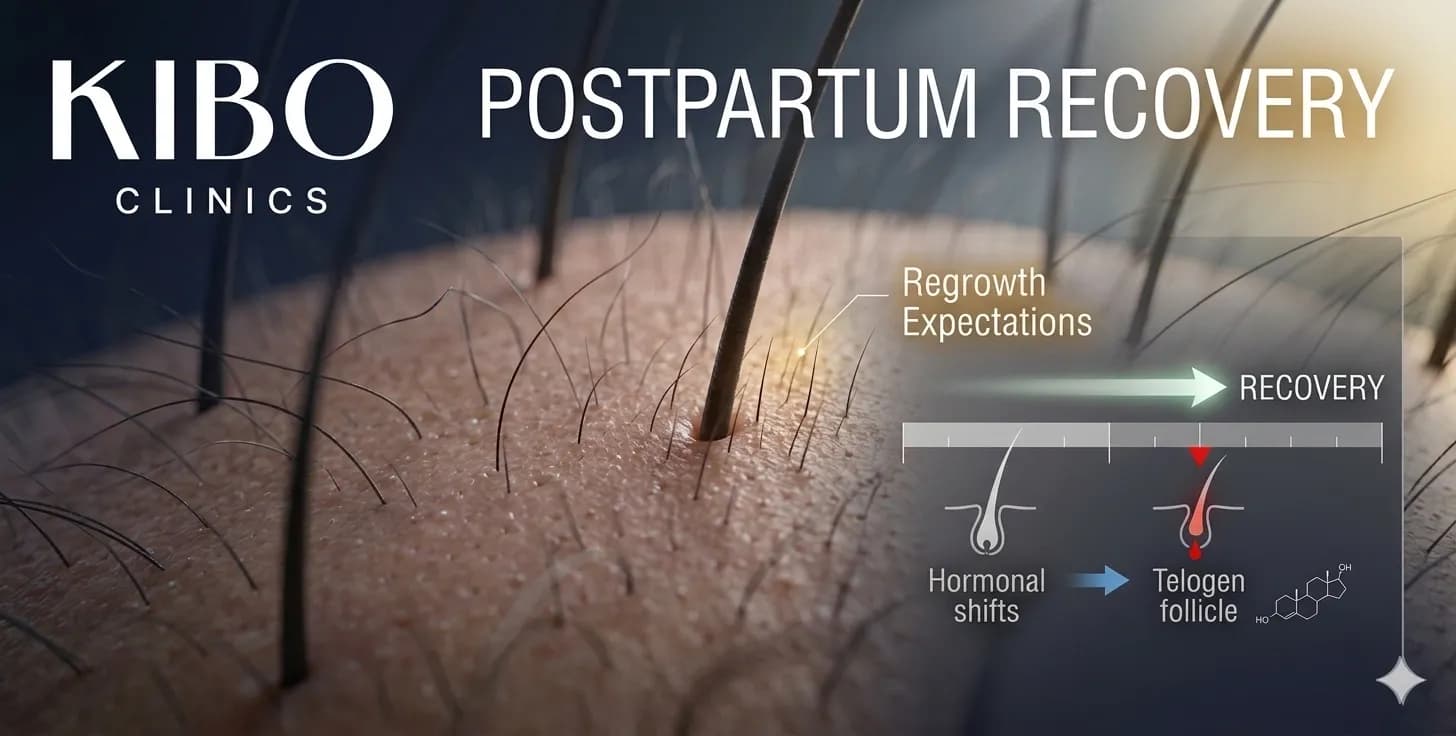
Postpartum hair shedding usually becomes noticeable around 2 to 4 months after delivery, often peaks by around 4 to 6 months, and gradually improves over the following months, with most people regaining their usual fullness by their baby's first birthday. This pattern is commonly called postpartum telogen effluvium. Patchy bald spots, scalp inflammation, marked pattern recession, or shedding that does not improve should be assessed by a clinician.
What Is Postpartum Hair Loss?
Postpartum hair loss is excessive diffuse hair shedding that develops after pregnancy. It is medically known as postpartum telogen effluvium, a temporary disruption of the normal hair growth cycle rather than a separate disease.
The hair follicle itself is usually not permanently damaged. Instead, a larger-than-usual number of hairs have shifted together through the resting phase of the hair cycle and are shedding around the same time, which is why the change can feel sudden. That said, this is still a real and visible loss of density for many people, not simply a cosmetic inconvenience, and it is reasonable to want to understand it and track your own recovery.
Why Does Hair Shed After Pregnancy?
Scalp hair normally cycles through three phases: an active growth phase (anagen), a short transitional phase (catagen), and a resting phase (telogen). At any given time, roughly 85% of scalp follicles are in the growth phase and around 15% are resting, according to the British Association of Dermatologists.
During pregnancy, rising estrogen and progesterone tend to prolong the growth phase, which is part of why hair can look thicker and fuller than usual while you're pregnant. After delivery, hormone levels fall back toward their pre-pregnancy range, and a larger proportion of follicles move into the resting phase together.
Resting hairs typically stay in the follicle for around 1 to 6 months, averaging about 3 months, before they are pushed out by new growth underneath. That delay is exactly why the shedding doesn't start the day you give birth. It shows up a few months later, once that whole resting group of hairs reaches the end of its hair growth cycle at roughly the same time.
When Does Postpartum Hair Loss Start, Peak, and Stop?
Timing varies between individuals and between studies, so treat the ranges below as a guide rather than a fixed schedule. A 2023 questionnaire-based study of 331 postpartum women published in the International Journal of Women's Dermatology found an average onset at 2.9 months, an average peak at 5.1 months, and an average end at 8.1 months. Major clinical sources such as Johns Hopkins Medicine and the Cleveland Clinic describe a slightly broader window: onset around three months, with recovery generally within 6 to 12 months.
| Stage | What's Happening | What To Do |
|---|---|---|
| 0-2 months postpartum | Hormone levels are falling, but visible shedding usually hasn't started yet. Hair may still look full from pregnancy. | No specific action needed. Continue gentle hair care and adequate nutrition. |
| Around 2-4 months postpartum | Shedding typically becomes noticeable around this window, in the shower, brush, or on the pillow. | Switch to gentle washing and detangling; avoid tight hairstyles and harsh heat styling. |
| Around 4-6 months postpartum | Shedding often reaches its peak in this window, though this can vary by a few months either way. | Continue gentle care; monitor for any patchy or unusual patterns rather than diffuse thinning. |
| 6-12 months postpartum | Shedding gradually slows for most people, and short regrowth ("baby hairs") often becomes visible along the hairline. | If shedding hasn't started slowing at all by this point, or if it's worsening, arrange a clinical assessment. |
| Around 12 months postpartum | Most people have regained their usual fullness by their baby's first birthday, though some take a little longer. | If there's still no meaningful improvement, see a dermatologist to check for another or additional cause. |
Will My Hair Grow Back?
For typical postpartum telogen effluvium, yes. The shedding itself usually slows within the timelines above, but visible fullness tends to take a bit longer to return than the point at which the shedding slows down, since new hairs need time to grow back out.
One important nuance: postpartum shedding can sometimes reveal a hair-loss pattern that was already present but not obvious before, such as early female-pattern hair loss or a receding hairline from traction. If your part has been steadily widening or your hairline keeps drawing back well past the usual recovery window, rather than simply looking thinner all over, that's a different situation worth having assessed separately.
Is This Shedding or Hair Breakage?
Postpartum telogen effluvium is shedding from the root: you'll usually see a small white or translucent bulb at the end of the strand. Hair breakage is different: strands snap partway along their length, often from tight hairstyles, heat styling, or chemical processing, and there's no bulb at the end. Both can happen at the same time in the postpartum period, since tired routines and quick, tight styles are common with a new baby, so it's worth looking at which pattern actually matches what you're seeing before assuming it's all hormonal.
What Can I Do During Recovery?
There is no treatment proven to switch off normal postpartum telogen effluvium faster, but gentle care can reduce additional damage and help your hair look its best while it recovers:
- Wash gently: washing doesn't cause the shedding, but rough handling of hair already in the shedding phase can make it more visible; use a gentle technique and avoid aggressive rubbing or detangling wet hair.
- Ease up on tension and heat: loosen tight ponytails, buns, braids, or extensions, and reduce heat styling and harsh chemical processing where you can.
- Eat adequately: a balanced diet with enough protein supports normal hair growth; avoid crash dieting in the postpartum period.
- Be patient with styling changes: a shorter style or different part can make thinning less noticeable while the underlying cycle recovers on its own.
Should I Take Iron, Biotin, Vitamin D, or Other Supplements?
Supplements are most appropriate when a deficiency or increased need has actually been established, not as a blanket postpartum routine. Adequate protein and overall food quality matter more broadly, but high-dose biotin is not a universal fix for postpartum shedding, and unnecessarily high doses can interfere with certain laboratory tests, including some thyroid assays. Vitamin D is sometimes raised too, but like biotin, it should only be supplemented at higher doses if a test has actually shown you're low, not as a routine add-on.
Iron should not be self-prescribed at high doses. Iron deficiency and low ferritin can contribute to hair shedding and may coexist with postpartum telogen effluvium, but ferritin interpretation is a clinical decision, not a fixed number to self-diagnose against. A clinician can decide which tests make sense based on your symptoms, dietary history, bleeding history, pregnancy course, and examination.
What Is Safe While Breastfeeding?
Medication decisions during breastfeeding need individualized clinical advice, not a blanket "safe" or "unsafe" label from a blog. The National Library of Medicine's LactMed database, last revised in May 2026, states that maternal topical minoxidil is acceptable once breastfeeding is established, but that the infant's skin should not come into contact with treated areas, since minoxidil can be absorbed and cause effects such as unwanted hair growth in the baby. Information on oral minoxidil during breastfeeding is more limited, so it warrants more caution.
This is a safety note, not a recommendation to start minoxidil for normal postpartum shedding. Whether any treatment makes sense at all, and which one, is a discussion for your obstetrician, dermatologist, or your baby's pediatric clinician, based on your specific situation.
When Is Postpartum Hair Loss Not Typical?
Typical postpartum telogen effluvium is diffuse: thinner more or less evenly, all over. A different pattern can mean a different or additional cause of hair loss is involved. Get it assessed by a clinician if you notice:
- Distinct bald patches rather than all-over thinning, which can suggest a separate condition such as alopecia areata, which causes patchy loss rather than diffuse shedding.
- Persistent recession at the temples or hairline, especially if you regularly wear tight braids, weaves, ponytails, buns, or extensions. This can reflect traction alopecia, which postpartum shedding sometimes reveals or worsens.
- Scalp redness, scaling, pustules, marked itching, pain, or burning.
- Broken hairs or shaft damage that doesn't match root shedding.
- Severe or progressive loss that shows no signs of slowing by around six months.
- No meaningful regrowth by around twelve months postpartum.
- Fatigue, cold intolerance, unexplained weight change, palpitations, or heavy bleeding, which can point to thyroid disease or significant iron deficiency.
This applies after pregnancy loss too. Significant hormonal shifts can follow a miscarriage or stillbirth, and shedding may follow a similar delayed pattern. Because pregnancy loss is physically and emotionally different for everyone, persistent or severe shedding in this situation is also worth discussing with a healthcare professional.
It's also worth naming the emotional side of this: hair loss after having a baby can be genuinely upsetting, and that reaction isn't vanity. It's fine to ask a partner or family member for extra help with meals, infant care, or appointments while it's weighing on you. But if you're noticing persistent low mood, severe anxiety, intrusive thoughts, or thoughts of self-harm, that needs proper mental-health support, not a hair-care fix. Please reach out to your doctor or a mental health professional directly.
What Tests Might a Clinician Consider?
Diagnosis usually starts with a history and a scalp examination, not an automatic long list of blood tests. Depending on what that assessment finds, a clinician may consider a complete blood count, iron-status testing (including ferritin), thyroid testing, or other targeted investigations. You shouldn't feel you need to order a broad panel yourself just because a blog recommends it. Let the pattern and history guide what's actually useful to check. If a persistent, patterned type of loss is suspected rather than temporary shedding, that's also when a clinician might discuss options such as a separate diagnosis and longer-term plan, but that's a conversation for after a proper diagnosis, not a starting assumption for ordinary postpartum shedding.
If your shedding doesn't match the usual pattern, a doctor-led assessment can tell you what's actually going on.
Kibo Clinics' Perspective on Postpartum Hair Loss
Most postpartum shedding is a normal, self-limiting process, not a condition that needs treatment. Our approach starts with figuring out whether what you're experiencing actually matches that typical pattern, rather than assuming every case is the same.
At Kibo Clinics, we believe reassurance should be backed by a real assessment, not just a generic "it'll grow back."
If your shedding is patchy, persistent well beyond a year, or accompanied by other symptoms, a Kibo Clinics hair specialist can examine your scalp, discuss whether any testing makes sense for your situation, and help you understand whether you're looking at ordinary postpartum telogen effluvium or a different hair loss pattern that needs its own treatment approach.
Frequently Asked Questions
How much hair loss is normal after pregnancy?
There is no reliable home hair-count cutoff. More hair in the shower or brush is common after delivery, but the pattern and trajectory matter more than counting individual strands. Diffuse shedding that gradually improves is more consistent with telogen effluvium than sharply defined patches or progressive recession.
Can postpartum hair loss happen after miscarriage or stillbirth?
Yes. Significant hormonal changes can occur after pregnancy loss, and shedding may follow the same delayed pattern. Because pregnancy loss is physically and emotionally individual, persistent or severe shedding should be discussed with a healthcare professional.
Does breastfeeding cause postpartum hair loss?
Postpartum hormonal change is the central explanation. A 2023 questionnaire study found an association between longer breastfeeding and postpartum hair loss, but it was observational and potentially affected by selection and recall bias, so it cannot prove that breastfeeding causes or prolongs shedding.
Should I stop washing my hair?
No. Washing does not create the shedding; hairs already in the shedding phase may simply become visible during washing. Wash according to your scalp and hair needs, use a gentle approach, and avoid aggressive rubbing or detangling.
Should I take biotin?
Biotin is not a universal postpartum hair-loss treatment. Deficiency is uncommon, and unnecessary high-dose biotin can interfere with some laboratory tests, including certain thyroid assays. Ask a clinician before taking high doses.
Can tight hairstyles cause postpartum hair loss?
Tight braids, extensions, ponytails, buns, or weaves can add traction and cause localized traction alopecia. Postpartum diffuse shedding may make an underlying traction problem more visible.
When should I see a dermatologist?
Seek assessment for patchy loss, inflammation, pain, progressive patterned recession, severe systemic symptoms, persistent worsening, or no meaningful improvement by around one year. Earlier evaluation is reasonable whenever the pattern is atypical or the emotional effect is substantial.
Is a hair transplant needed for postpartum hair loss?
Usually not. Typical postpartum telogen effluvium is temporary and does not call for transplantation. A specialist should first establish whether permanent patterned or scarring loss exists and whether the condition is stable.
Related Articles & Services
Hair Transplant
Real-Time FUE Hair Transplant | Sapphire FUE Hair Transplant | FUE Hair Transplant | Bio FUE Hair Transplant | Unshaven Hair Transplant | Direct Hair Transplant (DHT) | Body Hair Transplant | Corrective Hair Transplant | Hairline Correction
Hair Regrowth
PRP Therapy | GFC Therapy | Exosomes Therapy | IV Hair Boosters | Microneedling for Hair Regrowth | PDO Threads for Hair Regrowth | Low-Level Laser Therapy | Mesotherapy for Hair Regrowth
Must Read
Stress-Induced Hair Loss | Androgenetic Alopecia Explained | Can Hair Recover From Androgenetic Alopecia? | Dermatologist vs Trichologist | Seborrheic Dermatitis and Scalp Flaking | Hair Growth Stages
Relevant Blogs
PCOS and Hair Thinning | Menopause and Hair Density | Hair Loss in Women | Does Frequent Washing Cause Hair Loss? | Silk Pillowcases and Hair Health | Protecting New Hair Growth From Styling Damage
Medical Disclaimer : Information from Kibo Hair Clinics is for educational purposes only. It does not replace diagnosis, trichoscopy, blood test interpretation, prescription treatment, procedure advice, or side-effect counselling from a qualified dermatologist or hair restoration doctor.