
Hair Density vs Hair Strength: What's the Difference and Which One to Fix First
Published on Fri Apr 03 2026
Quick Summary
Hair density and hair strength are two different problems that look identical from the outside both make hair appear thin but require completely different interventions. Hair density is about how many follicles are actively producing hair per square centimetre of scalp; when density drops, it is because follicles are miniaturising or shutting down.
Hair strength is about how thick, elastic, and resistant to breakage each individual strand is; when strength drops, the follicles are fine but the strands they produce are snapping before they can grow long. Getting the diagnosis wrong means months of ineffective treatment protein shampoos will not restore a miniaturising follicle, and PRP will not fix breakage caused by heat styling.
A Real Story: When Thick Hair Was Not Actually Strong
Rohan, 32, from Pune, always had good volume. Over one year, he noticed heavy hair fall during showers. His scalp still looked covered, but strands snapped easily. He tried protein shampoos and home remedies for six months.
The shedding continued. Tests later showed early androgenetic thinning. His density had started reducing slowly, while existing strands had also become finer. The issue was not just breakage — it was follicle miniaturisation.
With structured treatment focusing on follicle health and scalp condition, shedding reduced over 4 to 6 months. The lesson was clear: density and strength are different problems, but both depend on follicle health and both require correct identification before any treatment can work.
What Is the Difference Between Hair Density and Hair Strength?
Hair density refers to the number of hair follicles actively producing strands in a given area of the scalp. It is largely genetic but influenced by hormones, nutrition, age, and medical conditions. Density loss is a follicle-level problem.
Hair strength refers to the quality of each individual strand — its thickness, elasticity, protein structure, and resistance to breakage. Strength loss is a shaft-level problem.
| Factor | Hair Density | Hair Strength |
|---|---|---|
| Definition | Number of active follicles producing hair per square centimetre | Thickness, elasticity, and breakage resistance of each individual strand |
| Main Influence | Genetics and hormones (DHT primarily) | Nutrition, heat styling, mechanical stress, chemical treatments |
| Visible Sign | Scalp becoming visible; widening part line; receding hairline | Short broken strands; split ends; hair snapping during combing |
| Where the problem lives | Inside the follicle — miniaturisation is happening below the scalp surface | Along the hair shaft — damage is above the scalp surface |
| Can Improve? | Sometimes — depending on follicle health and how early intervention begins | Yes — with proper care, nutrition, and reduced mechanical stress |
| Treatment approach | Follicle stimulation (PRP, GFC, DHT blockers) or transplantation for permanent loss | Nutritional correction, tension reduction, heat avoidance, protein-moisture balance |
How Do Follicles Actually Get Protected?
Protection starts at the scalp level. A healthy scalp maintains balanced oil production and blood circulation. Poor scalp health leads to inflammation, which weakens follicles over time and accelerates the miniaturisation that reduces density.
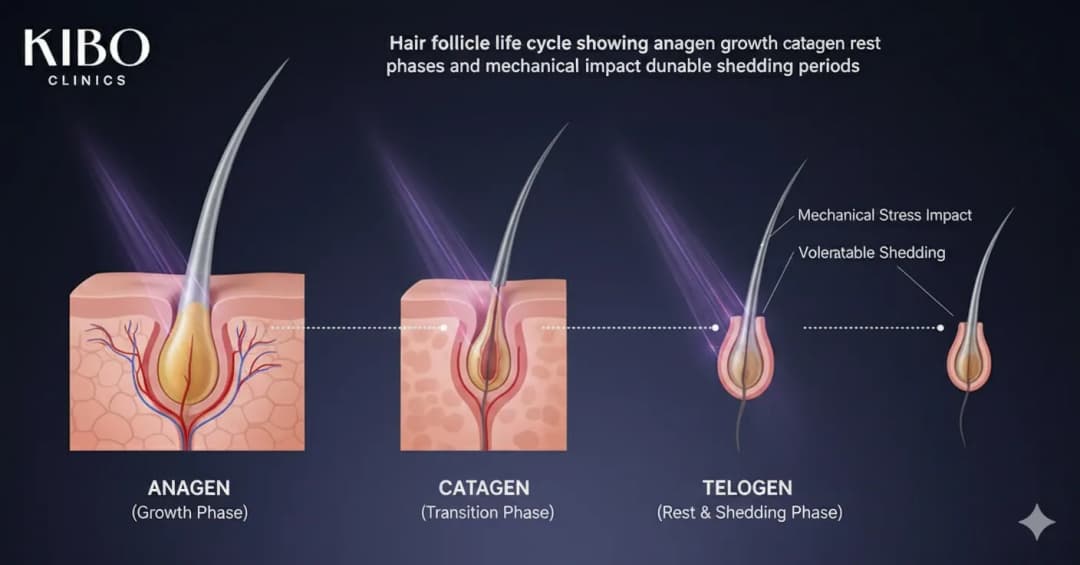
Follicle cycling — Each follicle cycles through growth (anagen), rest (telogen), and shedding phases. If this cycle shortens due to stress or hormones like DHT, density reduces because each follicle spends less time actively producing hair.
Hormonal factors — In genetic pattern hair loss, DHT binds to androgen receptors in susceptible follicles and progressively shrinks them. This reduces strand thickness first (strength decreases), then eventually reduces the number of strands being produced at all (density decreases). Understanding DHT blockers and hair loss management explains the medical interventions available at each stage of this process.
Lifestyle factors — Poor diet, chronic stress, and lack of sleep reduce nutrient supply to follicles. This weakens strand formation from the point of production and affects long-term follicle survival through inflammatory mechanisms.
Why Miniaturisation Matters More Than Breakage
Breakage happens above the scalp — it is a shaft problem. Miniaturisation happens inside the follicle — it is a follicle problem.
When follicles shrink, they produce progressively thinner strands. Over time, these become so fine that they stop emerging visibly. That is density loss. Improving strand strength (protein treatments, less heat styling) makes existing hair look and feel better, but it does not slow or reverse the miniaturisation that reduces the number of strands being produced. Protecting follicles from shrinkage is the only intervention that protects density long term.
What Should You Improve First — Density or Strength?
- If you see hair snapping mid-length — shorter broken pieces in your brush without root bulbs — focus on strength
- If you see widening part lines, receding hairline, or scalp visibility — focus on density and follicle health
- If both are happening — both need attention, but in the right order; improving strength without addressing density loss produces cosmetic improvement without slowing the underlying progression
Improving strength alone will not stop genetic hair thinning. Increasing density is difficult once follicles are permanently damaged. Early intervention offers the best chance to preserve both simultaneously — which is why the distinction between breakage and miniaturisation is one of the most clinically important calls in hair loss management.
How Does Hair Density vs Hair Strength Show in Men and Women?
In men, density loss usually starts at the temples or crown. Hair becomes finer (strength reduces) before bald patches appear (density reduces). The miniaturisation sequence means by the time a visible patch appears, the follicle has already been shrinking for years.
In women, density reduction often appears as widening of the central part line. Overall thinning is more common than complete bald patches. Women frequently experience breakage due to styling, colouring, and heat tools — so strength loss is often more visible and more urgent to address, even when density is relatively preserved.
Hormonal changes after pregnancy or during menopause can temporarily affect both density and strand strength simultaneously — which is why postpartum hair changes are often both a density and strength problem at the same time.
What Daily Habits Make It Better or Worse?
Habits that worsen both density and strength:
- Aggressive towel rubbing — increases breakage (strength problem) and creates scalp friction that disturbs follicle environment (density problem)
- Frequent heat styling — weakens protein bonds in strands (strength problem); sustained scalp heat over time contributes to follicle stress
- Crash dieting — reduces iron and protein levels, affecting both strand production quality (strength) and follicle cycling regularity (density)
- Tight hairstyles — cause traction stress, weakening follicles and reducing density in the highest-tension zones
Habits that support both density and strength:
- Protein-balanced diet with adequate iron, vitamin D, and B12 — these are the most commonly deficient nutrients in people experiencing both density and strength decline
- Regular gentle scalp cleansing — prevents inflammation that damages follicles (density) and removes buildup that blocks oil flow to shaft (strength)
- Managing stress through sleep and exercise — supports the hair growth cycle (density) and regulates hormone fluctuations that affect follicle miniaturisation
- Avoiding mixing too many treatments simultaneously — overloading the scalp with oils and chemicals can worsen inflammation and counteract clinical treatments
What Helps First — Practical Relief Steps
Start with a scalp assessment to understand whether the issue is miniaturisation or breakage. This single distinction determines everything that follows — the wrong treatment for the wrong problem wastes months and allows the real problem to progress.
Correct nutritional deficiencies within 6 to 8 weeks. Check ferritin (not just haemoglobin), vitamin D, and protein intake specifically. Deficiency-driven strength problems respond quickly to correction. Deficiency-driven density problems take longer — typically 3 to 4 months — because the follicle needs time to resume normal cycling.
Use mild shampoos and reduce heat exposure to stop adding new strength damage while any underlying density issue is being assessed and treated.
For density concerns specifically, understanding hair loss types, symptoms, and causes helps distinguish pattern hair loss from temporary telogen effluvium — two very different density problems that require opposite treatment approaches.
Noticeable density improvement, if possible, typically takes 6 to 9 months because hair grows slowly and follicle recovery cycles are long. Immediate improvement in strand strength can be felt within weeks if breakage was the main issue.
When to See a Hair Specialist
Do not wait if you notice:
- Rapid hair thinning within 3 to 6 months — accelerated miniaturisation needs early intervention
- Visible scalp patches requiring medical assessment to determine whether follicles are still viable
- Excessive shedding beyond 100 to 150 strands daily for months
- Scalp itching, burning, or pain — suggests inflammation affecting follicle stability
- Family history of baldness with early signs — early consultation preserves more follicles than delayed action
Delaying evaluation reduces the chance of preserving active follicles that are currently miniaturising but not yet permanently lost.
Common Myths About Hair Density vs Hair Strength
Myth 1: Oiling increases hair density. Oil can improve strand lubrication and surface condition but cannot create new follicles or reverse miniaturisation. It addresses strength, not density.
Myth 2: Thick hair means high density. You can have thick individual strands (high strength) but fewer follicles producing them (low density). Strand diameter and follicle count are independent variables.
Myth 3: Cutting hair makes it grow denser. Haircuts change the appearance of hair length and remove damaged ends. They do not affect follicle count or follicle cycling. Density is determined by what is happening inside the scalp, not at the scissors.
Myth 4: Supplements alone restore lost density. Supplements help only if deficiency was the primary cause. In genetic pattern hair loss, supplements reduce a contributing factor but do not address the DHT-driven miniaturisation that is the central mechanism.
Myth 5: Strong hair never falls. Even structurally strong strands shed naturally in the telogen phase. Normal shedding of 50 to 100 hairs per day occurs regardless of strand strength.
Why Kibo Clinics
Many patients choose Kibo Clinics for hair thinning because our approach addresses both follicle preservation and long-term planning. We begin with comprehensive scalp assessment, hair and follicle analysis, and thorough lifestyle and environmental review — specifically distinguishing miniaturisation-driven density loss from breakage-driven strength loss before any treatment is recommended.
Our No Ghost Surgery pledge ensures the consulting surgeon personally performs your entire procedure, maintaining consistent quality throughout the session. We do not delegate critical steps to technicians.
The Kibo Hair Analysis (scalp and follicle assessment) is the first step in understanding your specific condition. We provide education, guidance, and support without guarantees, exaggerated claims, or miracle cure promises.
For patients needing intervention, options may include PRP therapy, GFC therapy, IV hair boosters, or advanced FUE techniques where appropriate. We also provide structured 12-month monitoring to track density stability, shedding control, and follicle response over time.
Concerned about thinning or breakage? Start with a detailed scalp analysis before choosing any treatment.
Frequently Asked Questions
Q: Is hair density more important than hair strength? Both matter for overall appearance. Density determines how full your scalp looks — scalp coverage is a function of how many follicles are actively producing hair. Strength determines how long strands survive before breaking. If follicles are miniaturising, density becomes the clinical priority. If hair is snapping easily, strength needs attention first. In many cases, both require concurrent attention.
Q: Can you increase hair density naturally? Natural methods can help only if follicles are still active. Correcting nutritional deficiencies, reducing stress, and improving scalp care may stabilise shedding and allow temporarily dormant follicles to resume activity. However, new follicle creation is not possible naturally, and follicles that have permanently scarred cannot be reactivated. Early treatment offers significantly better results than intervention after established miniaturisation.
Q: Does PRP improve density or strength? PRP primarily supports follicle stimulation by delivering concentrated growth factors to miniaturising follicles, which may slow the miniaturisation process and improve apparent density over time. It does not directly change hair shaft structure, so its impact on strength is indirect. Results vary considerably between individuals based on follicle status at the time of treatment.
Q: Why does my hair feel thin but not fall excessively? This often indicates miniaturisation. The strand diameter reduces progressively even when shedding remains within normal range. The hair is still growing but is producing finer and finer strands with each successive cycle. Over time, this affects visible density significantly. A scalp dermoscopy evaluation can confirm this pattern.
Q: Can stress reduce hair density? Yes. Chronic stress can push follicles into the telogen shedding phase through cortisol elevation. This is usually temporary but may become prolonged if stress continues without resolution. In people with genetic hair loss predisposition, stress accelerates the miniaturisation process rather than simply increasing temporary shedding.
Q: At what age does hair density start reducing? For some individuals with strong genetic predisposition, miniaturisation can begin in the early 20s. Others notice changes after 35. Hormones and family history strongly influence timing — men with first-degree relatives affected by pattern baldness have a significantly higher risk of earlier onset.
Q: Is hair transplant the only way to restore density? Hair transplant redistributes existing follicles from donor areas to thinning zones. It is not the only option and is typically not the first intervention. Medical therapies including DHT blockers, PRP, and GFC are often tried first to stabilise active follicles before considering transplant for areas where follicles have already been permanently lost.
Key Takeaways
- Hair density vs hair strength are two distinct problems — density is a follicle count issue, strength is a shaft quality issue; treating the wrong one produces no results
- Hair density meaning — how many follicles are actively producing hair per square centimetre; miniaturisation reduces this progressively, usually starting with finer strands before actual visible bald areas appear
- Hair density loss causes include DHT-driven follicle miniaturisation (genetic), chronic stress pushing follicles into telogen, nutritional deficiency, and scalp inflammation — each requiring different management
- How to increase hair density depends entirely on the cause — nutritional correction for deficiency-driven loss, DHT blockers for genetic loss, PRP for follicle stimulation; no single approach works for all causes
- Breakage and miniaturisation can occur simultaneously — if both are happening, improving strength alone will not stop density loss from continuing
- The fastest improvement is in strength (weeks), the slowest is in density (6 to 9 months minimum) — setting realistic expectations before starting any treatment prevents premature abandonment of effective protocols
Disclaimer
This content is for informational purposes only and does not substitute personalized medical advice. Hair density and strength vary based on genetics, hormones, nutrition, and medical history. Treatment responses differ between individuals. No therapy guarantees complete restoration. Professional consultation is necessary for accurate diagnosis and appropriate management.
Hair Transplant
FUE Hair Transplant | Sapphire FUE Hair Transplant | Bio FUE Hair Transplant | Realtime FUE Hair Transplant | Direct Hair Transplant (DHT)
Hair Regrowth
PRP Therapy | GFC Therapy | IV Hair Boosters | Mesotherapy for Hair Regrowth | Microneedling for Hair Regrowth
Must Read
Hair Loss Types Symptoms Causes | Hair Breakage Causes Treatments | DHT Blockers Hair Loss Guide | Hair Transplant Good Or Bad | Understanding The Language Of Natural Hairline
Relevant Blogs
Hair Brushes Combs Scalp Stress | Hair Dryer Heat Follicle Safety | Straighteners and Curling Irons Hair Stress | Pollution Build Up Weakening Hair Roots | Scalp Oil Reducing Hair Friction