
Straighteners and Curling Irons: How Heat Tools Damage Hair Structure
Published on Tue Mar 31 2026
Quick Summary
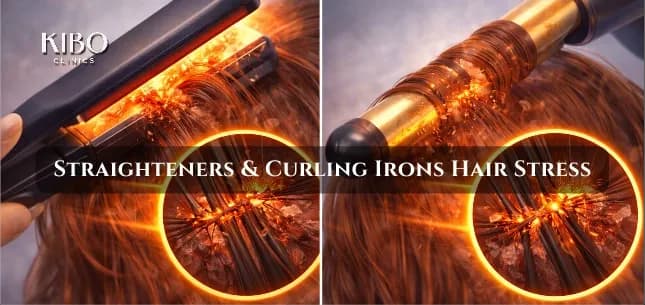
Flat irons and curling irons apply direct contact heat at 150 to 230 degrees Celsius — fundamentally different from blow drying where hot air passes over the hair. With straighteners and curling irons, heated plates make direct physical contact with the hair shaft, instantly transferring heat through the cuticle into the cortex. At these temperatures, structural proteins begin to denature, hydrogen bonds break and reform in altered configurations, moisture evaporates rapidly, and the cuticle scales lift and crack. Every clamping session creates permanent structural alteration. The styling effect and the structural damage come from the same process. How much damage accumulates depends entirely on temperature, hold time, proximity to the roots, and frequency of use — all variables within your control.
You Use Your Flat Iron or Curling Iron Every Day
Think about your styling routine. Maybe you flat iron your hair every morning to get that sleek straight look, or you use a curling iron several times per week to create waves or curls. You set the temperature to whatever feels hot enough to create the style quickly — usually somewhere between 180 and 230 degrees. You clamp down on sections of hair, hold for several seconds until the hair heats through, then release and move to the next section.
Every single time you clamp the iron on a section of hair, you are creating permanent structural changes to those hair shafts. The heat breaks and reforms bonds, evaporates moisture, and damages the cuticle. If you are doing this daily or several times per week, you are creating cumulative damage that builds up faster than your hair can grow out.
Most people who experience breakage and damage from heat styling tools assume it is an unavoidable trade-off for the styles they want. But the severity of damage is not fixed. It depends entirely on:
- The temperature you use
- How long you hold the iron on each section
- How close to the roots you clamp
- How frequently you style
Adjusting these variables can dramatically reduce structural harm while still achieving the styles you want. Understanding how heat tools contribute to hair breakage causes helps you identify when your styling tools are the primary driver of damage.
The Real Problem: Direct Contact Heat Creates Instant Protein Denaturation
Hair is made primarily of keratin — a structural protein arranged in long chains with cross-links that give the hair its shape, strength, and elasticity. These proteins are stable at normal temperatures, but when exposed to temperatures above 150 degrees Celsius, they begin to denature.
When you clamp a flat iron or curling iron onto your hair:
- Within 1 to 2 seconds of contact at 180 degrees, the outer cuticle layer reaches the iron temperature
- Within 3 to 5 seconds, heat penetrates through the cuticle into the cortex where the structural proteins are
- Denaturation begins — proteins lose their natural three-dimensional structure and reconfigure into altered shapes
- The longer you hold the iron, the deeper the heat penetrates and the more extensive the protein denaturation becomes
The visible styling effect you want comes from this denaturation. When you straighten hair, you break the natural bonds that create curl or wave and reform them in a straight configuration. When you curl hair, you break the straight bonds and reform them in a curved configuration. Both processes require protein denaturation to work — but the same denaturation that creates the style also creates permanent structural weakness.
The cuticle damage is particularly severe with direct contact heat. Cuticle scales are designed to lie flat and overlap smoothly. When heated to 180 to 230 degrees, they expand thermally, lifting away from the shaft surface. When the hair cools, the scales do not return to their original alignment — they remain slightly lifted, creating a rougher surface texture. With repeated heat styling, the cumulative cuticle lifting creates progressively more roughness. This is similar to the cuticle damage patterns seen in aggressive brushing techniques — though significantly more severe because direct heat is involved.
Temperature vs Damage — What Actually Happens at Each Range
| Temperature Range | What Happens to the Hair | Best For | Damage Level |
|---|---|---|---|
| Below 150°C | Minimal protein disruption; some hydrogen bond breaking; cuticle stays relatively flat | Very fine, fragile, or heavily processed hair | Minimal |
| 150°C – 170°C | Moderate hydrogen bond breaking; mild cuticle expansion; some moisture evaporation | Fine hair, color-treated hair, daily styling | Low to Medium |
| 170°C – 190°C | Significant hydrogen bond disruption; cuticle scale lifting begins; effective styling for most hair types | Normal to medium thickness hair — recommended range | Medium |
| 190°C – 210°C | Aggressive protein denaturation; significant cuticle damage; disulfide bonds begin to weaken | Thick or coarse resistant hair only — use sparingly | High |
| Above 210°C | Severe and rapid protein denaturation; burning of natural oils; cortex fracturing; irreversible structural damage | No hair type benefits — avoid entirely | Highest |
| Wet or damp hair at any temperature | Explosive steam formation inside cortex; microbubbles and fractures; most severe damage possible | Never — always style completely dry hair | Highest possible |
What Is Actually Happening During Heat Styling
When you turn on a flat iron or curling iron, the heating element brings the plates to the set temperature within 30 to 60 seconds. Professional-grade tools can reach temperatures exceeding 230 degrees Celsius. Consumer tools typically max out at 200 to 210 degrees.
When you clamp the iron onto a section of hair, the contact surfaces create direct thermal conduction. Heat flows from the hotter plates into the cooler hair shaft following the temperature gradient. The rate of heat transfer depends on the temperature difference, the contact pressure, and the thermal conductivity of the hair. Moisture in the hair conducts heat more efficiently than dry hair, which is why styling even slightly damp hair creates more severe damage.
As the hair heats up, multiple simultaneous changes occur:
- Moisture within the cortex evaporates, creating temporary brittleness
- Hydrogen bonds holding the keratin chains in their natural configuration break
- Disulfide bonds begin to weaken at temperatures above 200 degrees
- Cuticle scales expand and lift
- Natural oils and sebum on the shaft can burn or oxidize at very high temperatures
When you release the iron and the hair cools, the broken hydrogen bonds reform in the new configuration — which is why the style holds. But the cuticle scales do not return to their original alignment. The evaporated moisture does not return unless you add it back through conditioning. The denatured proteins remain altered. Each styling session adds another layer of cumulative structural alteration.
If you clamp the iron very close to the scalp — within 1 to 2 centimeters of the roots — some heat conducts through the hair shaft to the scalp surface and potentially down to the follicle. Understanding how heat affects follicle safety at different distances helps you recognize why clamping distance matters beyond just the shaft.
Early Signs People Miss
The earliest sign is not breakage. It is change in hair texture. If your hair feels rougher, drier, or more straw-like after several weeks of regular heat styling, the cuticle is already damaged from cumulative thermal stress. Virgin healthy hair feels smooth and has natural slip. Heat-damaged hair feels rough and catches on itself because lifted cuticle scales create friction points.
Other early signals to watch for:
- Loss of elasticity — healthy hair stretches 30 to 40 percent of its length when wet and returns without breaking. Heat-damaged hair snaps immediately or stretches and does not return to its original length. Test a single wet hair by gently pulling. If it snaps or fails to return, internal structure is compromised.
- Accelerating split ends — if you are developing splits faster than you can trim them off, heat damage is outpacing your hair growth
- Short broken hairs with blunt ends at mid-length — not just at the tips; these indicate shaft breakage from weak points created by repeated heat stress at the same locations
- Needing higher temperatures or longer hold times to achieve the same styling results — if you used to straighten effectively at 170 degrees but now need 190 or 200, your hair's protein structure has been so altered that it no longer responds normally; this is a sign of severe cumulative damage
Understanding how hair structure changes under stress helps you recognise when damage has crossed from moderate to severe territory.
Daily Habits Making It Worse
Using temperatures above 200 degrees Celsius creates protein denaturation that is more severe and less reversible than damage at 170 to 190 degrees. For most hair types, 170 to 180 degrees is sufficient for effective styling with dramatically less structural damage. High temperatures are unnecessary and create excess damage without proportional styling benefit.
Holding the iron on each section for longer than necessary creates deeper heat penetration and more extensive protein denaturation. The correct technique is to clamp, count to 3 or 4 seconds maximum, and release. Holding for 8 to 10 seconds or longer creates no additional styling benefit but significantly more cumulative damage.
Styling damp or wet hair rather than completely dry hair creates explosive moisture evaporation that damages the internal structure of the cortex. When water inside the hair shaft turns to steam from the heat of the iron, it expands rapidly and can create microbubbles and fractures in the cortex. This is far more damaging than styling dry hair. This is the same principle behind wet hair vulnerability to all styling damage.
Not using heat protectant products before styling means there is no barrier layer reducing direct heat transfer into the hair shaft. Heat protectants create a coating that insulates the hair and distributes heat more evenly, reducing peak temperatures the shaft experiences. Consistent use makes a measurable difference in cumulative structural integrity over months of regular styling.
Heat styling daily or multiple times per week creates damage accumulation that exceeds the hair's ability to recover or grow out before being re-damaged. Even with perfect technique and products, daily flat ironing creates chronic structural stress that manifests as progressive weakening and breakage.
What Helps in Real Life
-
Lower your temperature to 170 to 180 degrees Celsius for most hair types. Fine or color-treated hair should use 150 to 160 degrees. Only coarse resistant hair genuinely benefits from temperatures above 190 degrees. Start at the lower end and only increase if absolutely necessary for your specific hair type.
-
Limit hold time to 3 to 4 seconds maximum per section. Count out loud to prevent unconscious over-holding. Clamp, count to three, release. If the section needs more styling, make a second quick pass rather than holding the first pass longer. Multiple short passes create less cumulative damage than one prolonged pass.
-
Always style completely dry hair, never damp or wet. Blow dry or air dry your hair until it is 100 percent dry before using any direct heat styling tools. Test by running your fingers through and feeling for any coolness or dampness. Even slightly damp hair experiences dramatically more internal damage when heat-styled.
-
Apply heat protectant spray or serum to every section before styling. This is non-negotiable for protecting hair structure. Spray, comb through to distribute evenly, let it absorb, then style. The barrier layer reduces peak temperatures your hair experiences and prevents hot spots and concentrated damage.
-
Keep the iron moving smoothly through each section rather than clamping and holding static. For flat irons, clamp at the root and glide smoothly down to the ends in one continuous motion. This creates even heat distribution and prevents any single point from experiencing prolonged thermal stress.
-
Stay at least 2 to 3 centimeters away from the scalp when clamping near the roots. The small amount of unstyled hair at the very roots is not worth the thermal stress on your follicles. Leave a small buffer zone between the iron and your scalp surface.
-
Reduce styling frequency to two to three times per week maximum. On non-heat days, use heatless styling methods — braiding for waves, or embrace your natural texture. For people building comprehensive protective habits, reading about daily hair protection strategies provides a complete framework.
When Lifestyle Changes Are Not Enough
For most people, reducing temperature, limiting hold time, and decreasing frequency reduces breakage and improves hair texture noticeably within a few weeks. The damaged hair that already exists needs to grow out over 6 to 12 months depending on length, but preventing new damage allows visible improvement as healthier hair gradually replaces the heat-damaged sections.
However, if you have been heat styling daily at high temperatures for years, particularly if you also have chemical treatments like colouring or relaxing, the cumulative damage may be severe enough that the hair is structurally compromised beyond what reduced heat exposure can fix. In some cases, the hair shaft structure is so altered that it continues breaking even after you stop heat styling because the damage has created permanent weak points that fail under normal mechanical stress.
If you have implemented the heat reduction strategies above, given it several months, and you are still experiencing severe breakage or progressive deterioration of hair texture, professional assessment can determine whether your hair can recover with continued gentle care or whether you need to cut off the damaged sections and start fresh with a protective regimen. Building a comprehensive low-stress hair care routine alongside reduced heat exposure maximises your hair's recovery potential.
Why Kibo Clinics
When you come to us concerned about breakage or damage that seems connected to heat styling, we examine your hair shaft structure under magnification to determine the severity and distribution of the thermal damage. We can see cuticle lifting, cortex fractures, and weak points that predict future breakage — which helps us give you realistic expectations for recovery and recommendations for moving forward.
For patients where the damage is moderate and the hair structure is still somewhat intact, the solution is usually technique modification, temperature reduction, and intensive conditioning treatments to support the damaged sections while healthy hair grows in. For patients where the damage is severe and the hair is structurally compromised beyond repair, we provide honest guidance on cutting off the damaged length and starting fresh with a heat protection plan to prevent re-creating the same damage cycle.
We also help you find styling alternatives and techniques that achieve similar looks without the same level of thermal stress. Our goal is helping you have the hair you want without destroying its structure in the process. You deserve styling solutions that work with your hair health, not against it.
Get a call back to understand your hair loss stage and the best next step by certified doctor.
Frequently Asked Questions
Q: What temperature should I use for flat iron or curling iron? For fine or color-treated hair, use 150 to 160 degrees Celsius. For normal to medium hair, use 170 to 180 degrees. For thick coarse hair, use up to 190 degrees maximum. Temperatures above 200 degrees create severe protein denaturation that is largely unnecessary for most styling needs and dramatically increases cumulative damage. Start at the lower temperature for your hair type and only increase if you genuinely cannot achieve the style you want.
Q: Can heat damage from straighteners be reversed? Heat damage to the hair shaft structure is permanent and cannot be reversed through treatments or products. Once the proteins are denatured and the cuticle is damaged, that section of hair remains compromised until it is cut off. However, you can prevent further damage by reducing temperature and frequency, and you can improve the appearance of damaged hair through intensive conditioning and protein treatments that temporarily strengthen and smooth the surface.
Q: Should I use a flat iron on wet or dry hair? Always use flat irons and curling irons on completely dry hair only. Styling damp or wet hair creates explosive moisture evaporation inside the cortex when the water turns to steam, causing internal fractures and bubbles that severely damage the hair structure. Blow dry or air dry your hair to 100 percent dry before using any direct contact heat styling tools.
Q: How often can I safely use a straightener without damaging my hair? For most hair types, limiting flat iron or curling iron use to two to three times per week maximum prevents the most severe forms of cumulative damage while still allowing regular styling. Daily heat styling creates chronic structural stress that accumulates faster than hair can recover. If you must style more frequently, alternate between heat styling and heatless methods and give your hair extended recovery periods.
Q: Do heat protectant sprays actually work? Yes, heat protectants measurably reduce thermal damage when used correctly. They create a barrier layer that insulates the hair and distributes heat more evenly, reducing peak temperatures the shaft experiences during styling. Studies show heat protectants can reduce protein denaturation and moisture loss by 30 to 50 percent compared to unprotected styling at the same temperature. They reduce harm, they do not prevent it entirely — proper temperature and technique are still required.
Q: Why does my hair need higher heat now than it used to? If your hair requires progressively higher temperatures or longer hold times to achieve the same styling results, the cumulative heat damage has so altered the protein structure that the hair no longer responds normally to thermal reshaping. Severely damaged hair becomes more resistant to styling because the bonds have already been broken and reformed incorrectly so many times. The solution is not higher heat, but rather cutting off the damaged sections and protecting new growth from accumulating the same damage.
Key Takeaways
- Straighteners and curling irons apply direct contact heat — fundamentally more damaging than blow drying where hot air passes over the hair without direct plate contact
- The optimal temperature range is 170 to 180°C for most hair types; temperatures above 200°C create severe protein denaturation that no hair type needs
- Hold time matters as much as temperature — 3 to 4 seconds maximum per section; two quick passes are safer than one prolonged one
- Styling wet or damp hair with curling irons and straighteners is the most damaging action possible — explosive steam formation creates cortex fractures
- Heat protectant reduces but does not eliminate damage — it is essential but does not replace correct temperature and technique
- Needing higher heat over time to achieve the same result is a sign of severe cumulative damage — the answer is a trim and a fresh protective regimen, not more heat
Hair Transplant
FUE Hair Transplant | Sapphire FUE Hair Transplant | Direct Hair Transplant (DHT) | Corrective Hair Transplant | Hairline Correction
Hair Regrowth
PRP Therapy | GFC Therapy | Mesotherapy for Hair Regrowth | Microneedling for Hair Regrowth | Low Level Laser Therapy (LLLT)
Must Read
Hair Breakage Causes and Treatments | Hair Loss Types, Symptoms and Causes | Hair Dryer Heat and Follicle Safety | Wet Hair Styling and Root Vulnerability | Hair Elasticity and Stress Resistance
Relevant Blogs
Best Hairstyles to Minimise Stress on Hair Follicles | Hair Brushes and Combs Scalp Stress | Round Brush vs Flat Brush Hair Roots | Daily Hair Protection for Active Lifestyles | Low-Stress Hair Care for Busy Professionals