
How Hair Brushes and Combs Differ in Stress Impact on the Scalp
Published on Tue Mar 31 2026
Quick Summary
The brush or comb you use every day creates a specific pattern of mechanical stress on your hair and scalp. A wide-tooth comb allows tangles to release gradually with minimal follicle tension. A fine-tooth comb creates dozens of concentrated snag points per stroke. A paddle brush distributes pressure across the whole scalp surface. A boar bristle brush grips the cuticle more aggressively. A round blow-dry brush combines heat with traction. Hair fall while combing and hair breakage that people blame on stress or diet is often coming directly from the wrong grooming tool used the wrong way, every single day. The goal is not to stop brushing. The goal is understanding which tools cause the least harm for your specific hair type.
You Use the Same Brush You Have Been Using for Years
Think about the brush or comb sitting on your bathroom counter right now. How long have you owned it? Did you choose it specifically for your hair type and scalp sensitivity, or did you just grab whatever was convenient at the store?
Most people use the same grooming tool for years without thinking about whether it is actually appropriate for their hair or whether it might be causing damage with every use.
Your brush or comb contacts your scalp and hair at least once or twice daily — usually more if you style your hair multiple times throughout the day. If you are using a tool that creates high friction, pulls too aggressively on tangles, or applies concentrated pressure on small areas of your scalp, you are creating repetitive mechanical stress that accumulates over weeks, months, and years.
This is not dramatic one-time damage. This is subtle cumulative stress that most people never connect to their grooming tools until the hair breakage causes become impossible to ignore.
The Real Problem: Different Tools Create Different Stress Patterns
When you brush or comb your hair, you create friction between the tool and your hair shaft, and apply force to the follicles when the tool encounters resistance from tangles or snags. The type of tool determines how that friction and force is distributed.
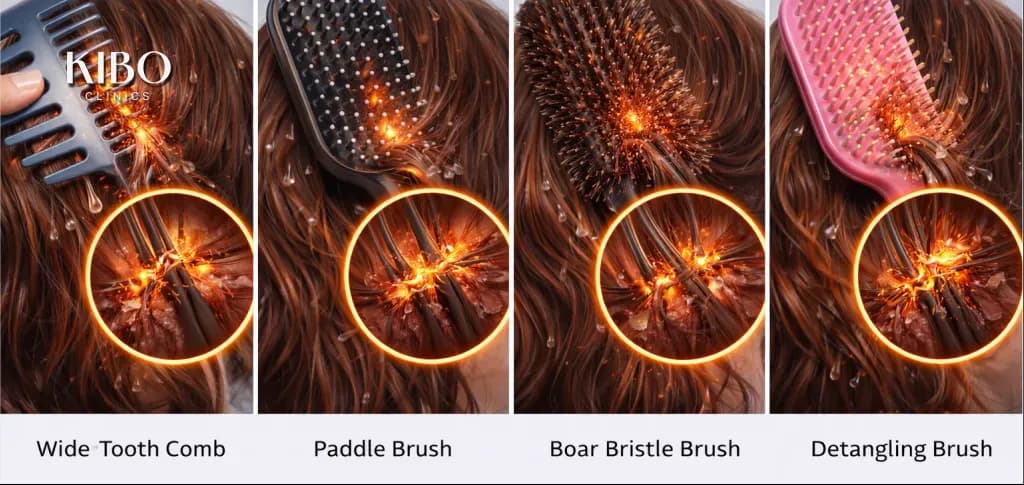
Wide-tooth comb — large gaps between teeth allow only a small number of hairs to be contacted per stroke. When it encounters a tangle, the wide spacing gives the hair room to move and adjust, allowing the tangle to release gradually without sharp pulling forces on the follicle.
Fine-tooth comb — narrow spacing catches many more hairs per stroke. When it encounters a tangle, there is no room for the hair to adjust. The teeth lock into the tangle and create concentrated pulling force directly on every follicle involved. Forcing the comb through either breaks the shaft or yanks on the follicle hard enough to cause pain.
Paddle brush — a wide flat base with many bristles distributes pressure across dozens of contact points simultaneously. Each individual follicle experiences only a fraction of the total force. The flexible cushioned base absorbs pressure and conforms to scalp contours, reducing peak pressure at any single point.
Boar bristle brush — natural bristles have a rough textured surface that creates more friction against the hair cuticle than smooth synthetic bristles. This can roughen the cuticle over time and makes these brushes more likely to snag, particularly on already-damaged hair. The benefit of distributing scalp oils comes at the cost of higher mechanical stress per session.
Round brush (blow drying) — wrapping hair around the barrel under tension while applying heat combines thermal stress with mechanical tension. The smaller the barrel diameter, the tighter the wrap and the higher the traction on the follicles at the root. Understanding tension-based hair damage explains why round brush blow drying can be particularly damaging.
Hair Brush vs Comb — Stress Profile Comparison
| Tool | Friction Level | Follicle Tension | Scalp Pressure | Best Used For | Overall Damage Risk |
|---|---|---|---|---|---|
| Wide-tooth comb | Very Low | Low — tangles release gradually | Minimal | Detangling, curly or thick hair, wet hair | Lowest |
| Paddle brush (ball-tip synthetic) | Low | Low — distributed across wide base | Low — flexible cushioned base | Daily grooming, smoothing, straight or wavy hair | Low |
| Boar bristle brush | Medium-High — rough natural bristles grip cuticle | Medium — catches on damaged hair | Medium | Occasional use for oil distribution on healthy hair | Medium |
| Fine-tooth comb | High — many snag points per stroke | High — locks into tangles, concentrated pull | Medium | Precise parting only — not general detangling | High |
| Round brush (blow dry) | High — hair wrapped under sustained tension | Very High — heat + traction combined | High at root contact point | Occasional styling only — not daily grooming | Highest |
| Metal-bristle brush | Very High — sharp edges abrade cuticle and scalp | High | High — rigid base concentrates pressure | Avoid entirely for scalp contact | Highest |
What Is Actually Happening When You Brush
Every time you run a brush or comb through your hair, the bristles or teeth make contact with the hair shafts along their length. The amount of friction depends on the material of the tool, the smoothness of its surface, and how tightly it grips the hair.
When the tool encounters a tangle, it creates a snag point where multiple hair shafts are interlocked:
- If you brush gently from the ends toward the roots, tension is distributed over time and released in stages as the tangle loosens
- If you force the brush from roots to ends, you create a sharp pulling spike that can yank on follicles hard enough to cause immediate pain or pull hairs out
The scalp itself experiences pressure from the brush or comb base pressing against it during each stroke. A rigid base concentrates all the pressure on the small contact area. A cushioned flexible base spreads the pressure and conforms slightly to your scalp shape — reducing peak pressure at any single point across hundreds of brush strokes per session.
The direction you brush also matters. Brushing from roots to ends in the direction of hair growth is generally less damaging than brushing backward against the growth direction, because moving with the cuticle scale direction minimizes scale lifting. Brushing backward lifts the cuticle scales, roughens the shaft, and creates a feedback loop where each subsequent session causes progressively more damage.
Early Signs People Miss
The earliest sign is not hair loss. It is pain or discomfort during brushing. If you regularly feel pulling, stinging, or soreness on your scalp while brushing, your tool is creating too much tension or concentrated pressure. Brushing should feel neutral or mildly stimulating — not painful.
Other early signals to watch for:
- Hair accumulating in your brush faster than normal — check whether the hairs have the root bulb attached; if they do, they were yanked from the follicle rather than broken mid-shaft
- Hair looks rougher or frizzier after brushing than before — a good tool should leave hair smoother and more organized, not more disheveled; if it looks worse, the tool is damaging the cuticle
- Progressive increase in tangling over time — if your hair is getting more prone to tangling despite regular brushing, the tool is likely roughening the cuticle and creating more surface friction between strands, feeding a cycle of increasing damage
- Scalp redness or tenderness in the areas you brush most frequently — low-grade inflammation around follicle openings from mechanical irritation can trigger increased shedding over time
- Thinning concentrated at the top or crown — these are the zones most aggressively brushed, and chronic mechanical stress in these specific areas is a signal the grooming tool and technique need changing
Daily Habits Making It Worse
Brushing wet or damp hair dramatically increases damage because wet hair is structurally weaker and more elastic. The cuticle swells when wet, lifting the scales and making them more vulnerable to catching and breaking. Wet hair also stretches more under tension before breaking, which means brushing can create more pulling force on the follicles before the tangle releases. This is the same principle behind wet hair root vulnerability from all styling damage.
Brushing from roots to ends in one continuous stroke forces the brush to push through every tangle along the entire shaft. This creates maximum tension on the follicles because the brush pulls on the roots while working against resistance further down. The correct technique — start at the ends, work upward in sections — minimizes the pulling force transmitted to the follicles.
Using a brush or comb with damaged bristles or teeth creates uneven stress and new snag points. Bent or broken bristles with sharp edges catch on hair more aggressively than intact smooth bristles. Metal combs with rough edges scrape the scalp and damage the cuticle. Replace brushing tools every six to twelve months depending on frequency of use.
Brushing too frequently throughout the day creates cumulative mechanical stress that exceeds what your hair and scalp can recover from between sessions. Brushing five to ten times per day without a specific styling need creates unnecessary friction and tension — particularly if it has become an unconscious fidgeting habit.
Combining aggressive brushing with other stressors like tight hairstyles or heat styling creates multiplicative damage. Using gentle hair accessories after a brushing session reduces the total daily follicle stress significantly.
What Helps in Real Life
-
Use a wide-tooth comb for detangling, especially on wet or curly hair. Start at the ends and work upward in sections, detangling each section completely before moving higher. Never force the comb through resistant tangles — work them gently from multiple angles until they release.
-
Choose a paddle brush with flexible ball-tipped synthetic bristles for daily brushing. The wide flat base distributes pressure across a large scalp area. Ball-tipped bristles have smooth rounded ends that glide over the scalp without scratching or creating concentrated pressure points.
-
Avoid fine-tooth combs unless you specifically need them for precise parting. Reserve them for creating clean parts or working with very short hair — use wide-tooth combs or brushes for all other detangling and grooming.
-
Replace boar bristle brushes with smooth synthetic alternatives if you have fragile or damaged hair. Synthetic bristles provide adequate detangling and smoothing with significantly less cuticle abrasion. If you prefer the oil-distributing benefit of natural bristles, use them occasionally rather than daily.
-
Be extremely gentle with round brushes during blow drying. Do not wrap hair so tightly around the barrel that you create visible tension at the roots. Use larger barrel diameters which require less wrap tension. Keep the dryer moving rather than holding heat in one spot.
-
Let your hair air dry to 70 to 80 percent before brushing or combing. This allows the cuticle to close back down from its swollen wet state. If you must detangle while very wet, use a specialized wet brush designed with extremely flexible bristles.
-
Limit brushing frequency to once or twice daily for most hair types. More frequent brushing does not provide additional benefit and only creates cumulative friction damage. For people developing comprehensive protective habits, reading about daily hair protection strategies provides a complete framework.
When Lifestyle Changes Are Not Enough
For most people, switching to gentler brushing tools and using proper detangling technique reduces breakage and shedding noticeably within two to three weeks. The hair that has already been damaged needs to grow out over three to six months, but preventing new damage allows the visible recovery to happen naturally.
However, if you have been using aggressive brushing tools and techniques for years, particularly if you also have naturally fragile hair or chemical processing that has weakened your hair structure, simply changing tools may not be sufficient.
In some cases, chronic aggressive brushing can create enough sustained follicle stress that the follicles have shifted into producing progressively thinner, weaker hair — one of the less recognised weak hair roots causes — or are cycling into resting phase more frequently than normal.
If you have switched to gentler tools, corrected your brushing technique, and given it several months, but you are still seeing excessive shedding or progressive thinning, a professional trichoscopy assessment will tell you whether your follicles are recovering normally or whether there is underlying damage that needs treatment support.
Why Kibo Clinics
When you come to us concerned about hair breakage or shedding that seems connected to your grooming routine, we examine both your hair shafts and your scalp to understand whether the damage is purely mechanical from brushing technique, or whether chronic brushing stress has created follicle-level changes that need intervention beyond just tool and technique adjustments.
For patients where the damage is primarily shaft breakage from excessive friction and cuticle roughening, the solution is often straightforward: switch to appropriate tools, correct the technique, and give the hair time to grow out. For patients where years of aggressive brushing have created follicle stress or low-grade scalp inflammation, we use treatments like PRP therapy or GFC therapy to strengthen the follicles and support their return to normal function.
We also provide practical guidance on tool selection for your specific hair type, density, and texture. What works for thick straight hair does not work for fine curly hair. What works for someone with a sensitive scalp does not work for someone with a more resilient scalp. Our 12-month care approach means we track how your hair and scalp respond to the changes over time and adjust recommendations if the initial modifications are not producing the expected results. You deserve solutions that actually work for your specific situation, not generic advice that might not apply to your hair.
Get a call back to understand your hair loss stage and the best next step by certified doctor.
Frequently Asked Questions
Q: Which is better for your hair — a brush or a comb? Wide-tooth combs are generally gentler for detangling because the wide spacing allows tangles to release gradually without creating concentrated tension on follicles. Paddle brushes with flexible ball-tipped bristles are better for smoothing and general grooming because they distribute pressure across a large surface area. Fine-tooth combs create too many snag points and should only be used for precise parting. For detangling, use a wide-tooth comb. For daily grooming and smoothing, use a quality paddle brush with flexible synthetic bristles.
Q: Are boar bristle brushes actually better for hair? Boar bristle brushes distribute natural scalp oils along the hair shaft, which can improve shine and moisture distribution. However, natural bristles have a rough textured surface that creates more friction against the hair cuticle compared to smooth synthetic bristles. This increased friction can roughen the cuticle over time, particularly if your hair is already damaged or fragile. For most people, a smooth synthetic bristle brush provides adequate grooming with significantly less mechanical stress.
Q: Should I brush my hair when it is wet or dry? You should always brush hair when it is dry or at least 70 to 80 percent air dried. Wet hair is structurally weaker, more elastic, and has a swollen cuticle with lifted scales that are vulnerable to breaking when a brush or comb passes through. If you must detangle while wet, use a wide-tooth comb or a specialized wet brush with extremely flexible bristles, starting from the ends and working upward.
Q: How often should I replace my hairbrush? Hair brushes and combs should be replaced every six to twelve months depending on frequency of use. Bristles become bent, broken, or develop rough edges over time. The cushioned base in paddle brushes loses flexibility. Inspect your tools regularly and replace them when you see visible wear, bent bristles, or when they start catching on your hair more than they used to.
Q: Can aggressive brushing cause hair loss? Aggressive brushing does not typically cause permanent follicle-level hair loss, but it can cause significant breakage and stress follicles enough to push them into premature shedding. If you brush so forcefully that you regularly feel pain or pull out hairs with the root bulb attached, you are creating traction stress on the follicles. Most brushing-related hair loss is actually breakage where the shaft snaps rather than true follicle loss, but the visual result is similar.
Q: What is the gentlest way to detangle hair? The gentlest detangling method is using a wide-tooth comb on hair that is at least partially dry, starting at the very ends and working upward in small sections. Hold the section of hair above where you are working to prevent pulling on the roots. Detangle each section completely before moving higher toward the scalp. Never force the comb through resistant tangles. For extremely tangled hair, apply a leave-in conditioner or detangling spray to add slip before combing.
Key Takeaways
- The hair brush vs comb decision depends on what you are doing — wide-tooth comb for detangling, paddle brush for daily grooming, fine-tooth comb for parting only
- Wide-tooth comb benefits include the lowest follicle tension of any grooming tool — the wide spacing allows tangles to release gradually without sharp pulling forces
- Hair fall while combing that produces hairs with root bulbs attached indicates the tool is creating enough traction to yank follicles, not just breaking shafts
- Wet hair is the highest-risk state for brushing damage — always detangle on at least partially dry hair
- Replace brushes and combs every six to twelve months — worn tools create more damage than new ones
- Persistent shedding after switching to gentler tools and correct technique needs professional trichoscopy to assess follicle-level damage
Hair Transplant
FUE Hair Transplant | Sapphire FUE Hair Transplant | Direct Hair Transplant (DHT) | Corrective Hair Transplant | Hairline Correction
Hair Regrowth
PRP Therapy | GFC Therapy | Mesotherapy for Hair Regrowth | Microneedling for Hair Regrowth | Low Level Laser Therapy (LLLT)
Must Read
Hair Breakage Causes and Treatments | Hair Loss Types, Symptoms and Causes | Tension-Based Hair Damage During Styling | Wet Hair Styling and Root Vulnerability | Scalp Oil and Reducing Hair Friction
Relevant Blogs
Best Hairstyles to Minimise Stress on Hair Follicles | Hair Ties vs Scrunchies vs Clips | Hair Touching and Twirling Breakage | Daily Hair Protection for Active Lifestyles | Low-Stress Hair Care for Busy Professionals