
Benefits of Oiling Hair: How Scalp Oil Reduces Friction and Prevents Breakage
Published on Fri Apr 03 2026
Quick Summary
Oiling hair before washing reduces protein loss from the shaft, smooths the cuticle layer, and restores the natural lubrication that prevents friction-based breakage during combing, tying, and sleeping. The benefits of hair oiling are not about promoting growth directly sebum and applied oil work by coating the hair shaft to reduce the mechanical wear that accumulates silently from everyday contact with combs, towels, pillowcases, and other strands.
When the scalp's natural oil production is disrupted by frequent shampooing, stress, or hormonal changes, the hair cuticle lifts, surface roughness increases, and strands begin snapping mid-shaft rather than shedding from the root a distinction that changes the entire treatment approach.
Why Does Hair Break More When It Is Dry?
Rohit, a 29-year-old software engineer from Bengaluru, noticed more hair on his desk and pillow during a stressful project phase. He had switched to a strong anti-dandruff shampoo and washed his hair daily. Within weeks, his hair felt rough, tangled easily, and snapped while combing.
He assumed it was hair fall. But on closer observation, most strands were shorter and broken at different lengths. His scalp felt tight and slightly itchy. The real issue was not hair shedding from the root — it was friction-based breakage due to an overly dry scalp and stripped natural oil.
After adjusting his wash frequency, using a milder cleanser, and adding light scalp oiling twice a week, the texture improved in a month. Breakage reduced gradually because the hair shaft regained flexibility and lubrication.
What Exactly Is Friction-Based Hair Damage?
Friction-based damage happens when repeated mechanical stress weakens the outer hair layer (cuticle). Here is how it develops:
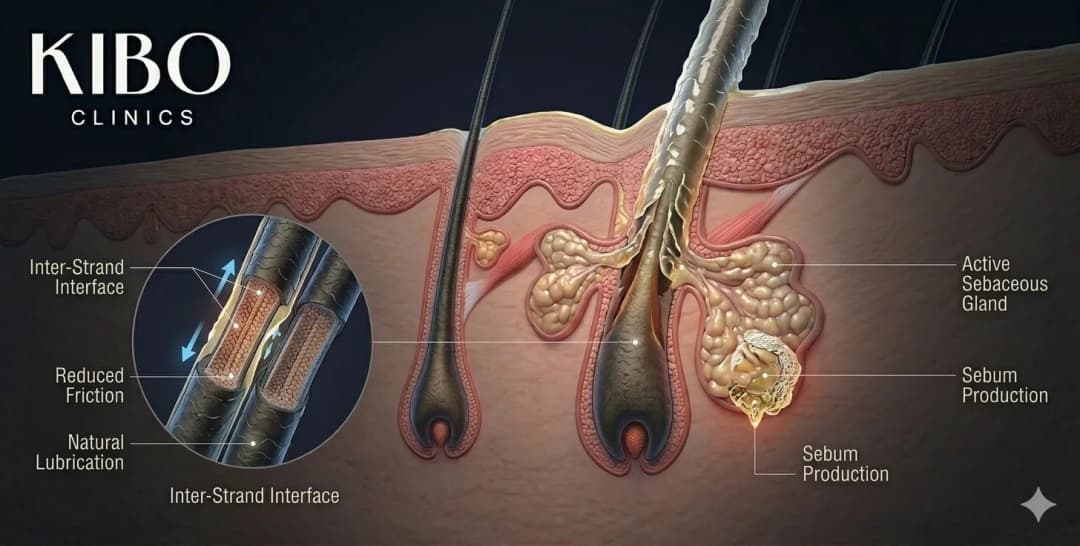
Healthy scalp → balanced sebum production → smooth hair cuticle → reduced friction between strands.
When the scalp is overly dry, sebum production may be insufficient or poorly distributed. Without natural lubrication, the cuticle lifts. Raised cuticles increase surface roughness. Rough strands rub against each other, against comb teeth, towel fibres, or pillow fabric.
Over time, this constant friction leads to split ends, mid-shaft breakage, increased tangling, dull appearance, and static buildup.
Hormones, stress, harsh shampoos, pollution, and dehydration can all affect oil production. High stress may disturb sebaceous gland function. Aggressive cleansing strips natural oil faster than the scalp can replace it. Air-conditioned environments often dry out both scalp and hair simultaneously — the same mechanism described in indoor dryness and hair brittleness.
How Does Sebum Protect the Hair Shaft?
Sebum is a lipid-rich substance produced by sebaceous glands attached to hair follicles. It travels down the hair shaft and acts as a natural conditioner through four specific mechanisms:
- Reduces water loss from the strand
- Smooths the cuticle, making the surface less abrasive during contact
- Increases flexibility, so hair bends instead of snapping under mechanical stress
- Forms a barrier against environmental pollutants and moisture disruption
However, too much oil can trap dust and clog follicles. Balance — not excess — is the goal.
Scalp Oil Benefits — What Happens at Each Stage
| Time Frame | What You May Notice | Why It Happens | Action to Reinforce |
|---|---|---|---|
| 1–2 weeks | Less rough texture; easier detangling | Cuticle smoothing begins as oil coating restores surface | Maintain 2x weekly pre-wash oiling; reduce wash frequency |
| 3–4 weeks | Reduced breakage while combing; fewer short snapped strands | Improved shaft flexibility reduces mid-shaft fracture rate | Switch to wide-tooth comb; avoid heat styling on oil days |
| 6–8 weeks | Healthier shine, fewer split ends, reduced static | Better oil balance and moisture retention across the shaft length | Trim split ends; assess if breakage has fully resolved |
| Beyond 8 weeks — no improvement | Persistent breakage or shedding despite habit correction | Underlying cause — hormonal, nutritional, or pattern loss — needs assessment | Professional scalp evaluation; blood markers check |
How Can You Tell If Breakage Is From Friction or Hair Fall?
Many people confuse breakage with hair fall from the root. Understanding hair breakage causes and treatments covers this distinction in detail, but the key practical test is:
- Hair fall (shedding) — strand has a visible white bulb at one end; strand is full-length; follicle released the hair
- Friction breakage — strand is shorter, uneven, without a visible bulb; shaft snapped under mechanical stress
If the scalp feels tight, dry, or flaky without severe dandruff, lack of oil balance may be the primary contributing factor. Both men and women experience friction-based damage, especially those with long hair, chemically treated hair, or frequent heat styling habits.
How Does Scalp Oil Show in Men and Women?
Men often have higher sebum production due to androgens. However, frequent shampooing, gym sweat, and styling products can strip oil aggressively. This leads to a cycle of dryness followed by rebound oiliness — where the scalp overproduces to compensate for stripping.
Women may experience fluctuating oil production due to hormonal shifts — menstruation, pregnancy, postpartum phase, or menopause. Long hair also means natural oil may not travel fully down to the ends, leaving mid-lengths dry and friction-prone despite an oily scalp at the roots.
In men, friction damage is common at the crown and front due to short, rough styling practices. In women, it is common at the ends and around the hairline due to tying, braiding, and pillow friction throughout the night.
What Daily Habits Make It Better or Worse?
Habits that worsen friction damage:
- Overwashing with strong shampoos — strips protective oil faster than the scalp can replace it
- Vigorous towel drying — roughens the cuticle at the moment of highest vulnerability
- Using tight hairstyles on dry hair — pulls unlubricated strands repeatedly, compounding breakage
- Sleeping on cotton pillowcases — increases nighttime friction across every movement
- Frequent heat styling — removes moisture and weakens protein bonds, eliminating the flexibility that prevents snapping
Habits that help:
- Using a mild, pH-balanced shampoo — maintains oil balance without stripping the protective layer
- Light oil massage before washing — the most evidence-supported benefit of hair oiling; reduces protein loss during the wash
- Using a wide-tooth comb on slightly damp hair — reduces mechanical stress at the point of highest friction
- Switching to satin or silk pillowcase — lowers nighttime friction that accumulates across 6 to 8 hours
- Staying hydrated internally — supports sebaceous gland function from within
Mistake to avoid: applying heavy oil daily without washing can clog follicle openings and worsen scalp buildup — the same problem described in scalp buildup and hair fall. The benefit of oiling is specifically from pre-wash application, not leave-in daily coating.
What Helps First — Practical Relief Steps
Start with correcting washing habits. Reduce shampoo frequency to 2 to 3 times a week unless medically required otherwise. Choose sulphate-mild cleansers that clean without stripping.
Introduce light scalp oiling once or twice weekly before washing. Coconut oil, when used moderately before washing, has shown in studies the ability to reduce protein loss from hair — making it one of the most evidence-backed benefits of oiling hair. Apply 30 to 60 minutes before shampooing, not as a leave-in product.
Avoid aggressive rubbing while drying. Pat dry with a microfiber towel rather than a cotton one — microfibre creates significantly less friction against lifted post-wash cuticle scales.
Trim split ends to prevent upward splitting that progresses further with each friction event.
When to See a Hair Specialist
Do not wait if:
- Breakage is accompanied by visible scalp redness or severe itching
- You notice thinning patches or widening part lines alongside the breakage
- Hair shedding exceeds 100 to 150 strands daily consistently
- Persistent dandruff is not responding to basic care — may indicate seborrheic dermatitis requiring clinical treatment
- You have underlying conditions like thyroid imbalance or PCOS that affect sebum production
Professional evaluation helps differentiate between mechanical friction damage and medical hair loss that happens to also cause breakage. The two require completely different treatment approaches.
Common Myths About Scalp Oil and Hair Breakage
Myth 1: Oily scalp means healthy hair. Excess oil can clog follicles and attract dust and pollutants. Balance is healthier than overproduction — excess sebum creates its own set of problems.
Myth 2: Daily shampooing keeps hair strong. Over-cleansing weakens the natural protective barrier faster than the scalp can restore it. Daily washing is appropriate for very oily scalps or heavy sweaters, but most people damage their hair by washing too frequently.
Myth 3: More oiling means faster hair growth. Oil supports shaft lubrication and protein protection, not direct follicle stimulation. Hair growth rate is determined by follicle biology, not surface oil application.
Myth 4: Breakage and hair fall are the same. Breakage happens along the shaft from mechanical stress. Hair fall occurs at the root from follicle-level causes. The difference determines whether the solution is oil balance correction or clinical treatment.
Why Kibo Clinics
Many patients choose Kibo Clinics for scalp-related hair damage because our approach addresses both scalp oil balance and long-term follicle planning. We begin with comprehensive scalp assessment, hair and follicle analysis, and thorough lifestyle and environmental review — because friction breakage and root-level hair loss can look identical from the outside but require completely different treatment strategies.
Our No Ghost Surgery pledge ensures the consulting surgeon personally performs your entire procedure, maintaining consistent quality throughout the session. We do not delegate critical steps to technicians.
The Kibo Hair Analysis (scalp and follicle assessment) is the first step in understanding your specific condition. We provide education, guidance, and support without guarantees, exaggerated claims, or miracle cure promises.
Our 12-month monitoring and support process allows us to track scalp recovery, adjust treatments when necessary, and guide patients through seasonal or hormonal changes affecting oil balance. Options may include PRP therapy or GFC therapy when follicle-level support is needed alongside scalp hygiene correction.
If you are noticing repeated hair snapping, rough texture, or confusion between breakage and hair fall, a structured scalp evaluation can clarify the cause and next steps.
Frequently Asked Questions
Q: What are the benefits of oiling hair? The primary benefits of hair oiling are reduction of friction-based breakage and protection against protein loss during washing. Oil coats the hair shaft and smooths the cuticle layer, reducing the mechanical wear that accumulates from combing, tying, sleeping, and contact with towels or pillowcases. Pre-wash oiling specifically reduces the amount of protein the hair shaft loses during the swelling and rubbing that occurs when hair is washed. Scalp oil benefits do not extend to directly stimulating hair growth or reversing follicle-level hair loss.
Q: Does scalp oil directly stop hair fall? Scalp oil mainly reduces friction and breakage. It does not directly control hormonal or genetic hair fall. Balanced oil improves shaft strength and reduces mechanical shedding, but root-level shedding needs separate evaluation. Supporting scalp health through oil balance is part of a broader hair care routine, not a standalone hair loss treatment.
Q: How often should I oil my scalp? For most people, once or twice weekly is sufficient. Apply before washing, not as a daily leave-in product. Frequency depends on scalp type, climate, and activity level. Oily scalps may benefit from less frequent oiling. Dry scalps or those experiencing breakage from over-shampooing may benefit from twice weekly. Adjust based on how your scalp feels after washing.
Q: Can oily scalp still have dry hair ends? Yes. Natural sebum may not travel fully down long strands. This leaves ends dry and friction-prone despite an oily scalp. Conditioning products applied to mid-lengths and ends, combined with minimal heat exposure, help address this distribution gap.
Q: Is coconut oil better than other oils for hair breakage? Coconut oil has published evidence for reducing protein loss from hair shafts, which makes it one of the best-studied options for friction-related breakage. However, individual tolerance varies — some people experience buildup or find it too heavy. Lighter oils like argan or jojoba may suit those prone to scalp clogging. The application method (pre-wash rather than leave-in) matters more than the specific oil type.
Q: Can friction damage cause permanent hair loss? Friction mainly damages the hair shaft, not the follicle directly. Severe chronic traction from tight styling can harm follicles over time and contribute to traction alopecia. Early correction prevents long-term issues. Most friction-related breakage is fully reversible within 6 to 8 weeks of corrective habits.
Q: How long does it take to repair friction damage? Texture improvement may start within 2 to 4 weeks. Split ends need trimming to remove already-damaged sections. Full improvement depends on hair length and care consistency. If breakage does not improve after 8 weeks of corrective habits, underlying causes such as nutritional deficiency or hormonal imbalance should be assessed.
Key Takeaways
- Benefits of hair oiling are primarily mechanical protection — oil reduces cuticle friction, protein loss during washing, and the breakage that accumulates from daily handling
- Oiling hair before washing is the most evidence-supported application method — leaving oil in daily without washing can clog follicle openings and worsen scalp buildup
- Friction breakage and root-level hair fall look the same in the shower drain but require completely different treatment — check for a white bulb on shed strands to differentiate
- Scalp oil benefits for hair breakage work best at 1 to 2 applications per week combined with reduced wash frequency and a mild sulphate-free shampoo
- Most friction-related damage shows improvement within 6 to 8 weeks of corrective habits; persistent shedding beyond that needs clinical assessment to rule out medical causes
- Tea tree oil scalp benefits include mild antimicrobial and anti-inflammatory properties that can help with scalp irritation and dandruff-related clogging, but it should always be diluted in a carrier oil before scalp application
Disclaimer
This content is for informational purposes only and does not substitute personalized medical advice. Scalp oil production varies by individual, age, hormones, and climate. Treatment responses differ, and no method guarantees prevention of hair breakage or hair loss. Professional consultation is recommended for persistent or worsening symptoms.
Hair Transplant
FUE Hair Transplant | Sapphire FUE Hair Transplant | Bio FUE Hair Transplant | Realtime FUE Hair Transplant | Direct Hair Transplant (DHT)
Hair Regrowth
PRP Therapy | GFC Therapy | IV Hair Boosters | Mesotherapy for Hair Regrowth | Microneedling for Hair Regrowth
Must Read
Hair Loss Types Symptoms Causes | Hair Breakage Causes Treatments | DHT Blockers Hair Loss Guide | Hair Transplant Good Or Bad | Understanding The Language Of Natural Hairline
Relevant Blogs
Hair Brushes Combs Scalp Stress | Hair Dryer Heat Follicle Safety | Straighteners and Curling Irons Hair Stress | Pollution Build Up Weakening Hair Roots | Hair Follicle Anchoring Strength