
The Hair Growth Cycle and Its Role in Mechanical Shedding
Published on Fri Apr 03 2026
Quick Summary
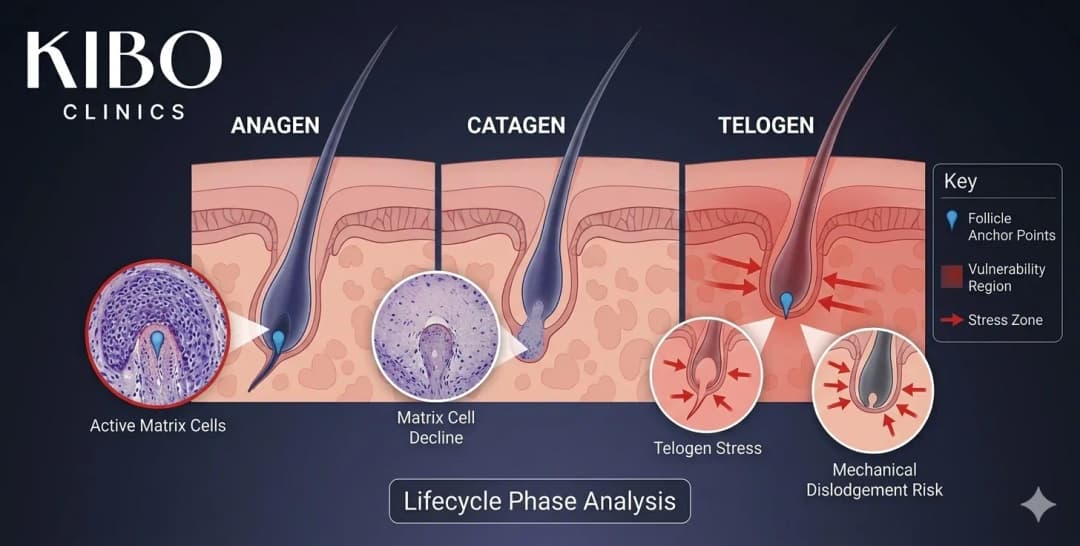
The hair growth cycle has three stages anagen (active growth), catagen (transition), and telogen (resting and shedding) and most people who panic about hair fall are actually experiencing mechanical shedding of telogen-phase hair that was already ready to detach, not new follicle loss.
At any given moment, 85 to 90 percent of your scalp hair is in anagen and 5 to 15 percent is in telogen. Combing, towel drying, tight styling, and helmet friction do not cause new follicle damage they simply dislodge telogen hair earlier and more visibly than it would have shed naturally. The distinction matters enormously because mechanical shedding resolves in weeks once triggers are removed, while true pattern hair loss requires months of clinical treatment.
A Story Many Patients Share
Ritika, 29, from Mumbai, started noticing heavy hair fall after she changed jobs. Long commutes, daily helmet use, and tight ponytails became routine. Every evening, her hairbrush looked fuller than before. She panicked, assuming permanent hair loss had started.
For months, she switched shampoos and oils. Nothing seemed to help. She avoided combing to "save" hair, but shedding continued, especially on wash days. Her scalp felt slightly itchy, but there were no bald patches.
After a detailed scalp assessment, it became clear that most of her shedding was mechanical. Her hair was already in the telogen resting phase, and constant pulling, friction, and stress accelerated its release. Once her scalp care improved and styling habits changed, shedding reduced within weeks.
What Is the Hair Growth Cycle and Why Does It Matter?
The hair growth cycle has three main phases: anagen, catagen, and telogen.
Anagen — active growth phase: Around 85 to 90 percent of your scalp hair is usually in this stage. Hair grows steadily during this period, which can last 2 to 6 years depending on genetics and health. The longer the anagen phase, the more length the hair achieves before shedding.
Catagen — transition phase: The follicle shrinks slightly and detaches from its blood supply. This brief transitional stage lasts a few weeks and involves no active hair production.
Telogen — resting phase: About 5 to 15 percent of hair is normally in this phase at any time. After resting for 2 to 3 months, the hair naturally sheds and a new strand begins growing from the same follicle. This is the hair you see in your brush and drain.
Mechanical shedding happens when external force pulls out telogen hair earlier or more visibly than natural shedding would. Brushing, towel drying, tight hairstyles, helmets, pillow friction, and even scratching can dislodge hair that was already in the telogen phase and ready to fall.
Understanding what causes hair loss, its types, and symptoms is the most reliable way to distinguish whether increased shedding reflects mechanical release of telogen hair or progressive follicle miniaturisation that requires clinical intervention.
How Is Mechanical Shedding Different From Pattern Hair Loss?
Mechanical shedding — physical force removes telogen-phase hair that was already detaching; hair thickness in the anagen-phase strands remains normal; shedding reduces when mechanical triggers are removed.
Pattern hair loss — gradual follicle miniaturisation from DHT sensitivity; strands become progressively thinner over successive cycles before visible thinning appears; continues regardless of mechanical trigger removal.
Both can overlap. Someone with early pattern hair loss may notice dramatically increased shedding when mechanical stress is added — the miniaturised follicles release hair more easily under the same mechanical forces.
Hair Growth Cycle — Anagen Catagen Telogen Overview
| Phase | Duration | % of Hair at Any Time | What Happens | How It Goes Wrong |
|---|---|---|---|---|
| Anagen (Growth) | 2–6 years | 85–90% | Follicle actively produces hair; root firmly anchored; hair grows approximately 1 cm per month | DHT, stress, and nutritional deficiency shorten anagen — producing thinner, shorter hair in each successive cycle |
| Catagen (Transition) | 2–3 weeks | 1–2% | Follicle detaches from blood supply; hair shaft stops growing; club root forms at base | Cannot be significantly altered; early entry into catagen signals disrupted anagen |
| Telogen (Resting) | 2–3 months | 5–15% | Hair loosely attached at surface; white club root forms; shedding begins; new anagen follicle forming beneath | Mechanical force (combing, friction) releases telogen hair earlier than natural; stress and illness push too many follicles into telogen simultaneously (telogen effluvium) |
| Normal daily shedding | Ongoing | 50–100 strands per day | Telogen hair releasing naturally; replaced by new anagen growth; balanced cycle | Exceeding 150 per day consistently for more than 6 weeks signals cycle disruption requiring assessment |
How Does Mechanical Shedding Happen in Daily Life?
- Daily combing removes hair that has already entered the telogen phase — the comb does not create new follicle loss, it releases detached hair more efficiently
- Tight braids, ponytails, buns, or extensions create traction; repeated tension can weaken the follicle over time, eventually pulling anagen hair and damaging anchoring structures
- Frequent helmet use without scalp hygiene causes sweat buildup, itching, and friction that dislodges telogen hair while simultaneously irritating follicle openings
- Rough towel drying and aggressive detangling increase both breakage (shaft snapping) and shedding (follicle release) simultaneously
- Chemical treatments weaken the hair shaft, making it easier to pull out during routine handling even when the follicle anchoring remains intact
The most common mistake is stopping hair washing completely out of fear. This leads to accumulation of shed hair and makes fall appear dramatically worse all at once on the next wash day — creating the impression that washing "caused" the shedding.
How Does the Hair Growth Cycle Show in Men and Women?
In men, mechanical shedding often becomes noticeable when early male pattern thinning is already present. The combination of miniaturised hair from genetic follicle reduction and physical friction from daily styling makes hair fall appear severe — the underlying pattern loss makes each mechanical dislodgement visible because density has already reduced.
In women, hormonal shifts during menstruation, pregnancy, postpartum, or thyroid imbalance can push more hair into the telogen phase simultaneously. If tight hairstyles or extensions are common at the same time, shedding increases dramatically because the hormonal telogen push and mechanical release happen together.
Women also tend to use heat styling more frequently, which weakens the shaft and increases mechanical loss during brushing even when follicle health remains normal.
What Daily Habits Make It Better or Worse?
Habits that worsen mechanical shedding:
- Over-tight hairstyles — worsen shedding and risk crossing from mechanical release into actual follicle damage
- Skipping scalp washing for many days — allows oil and sweat buildup that irritates follicles and makes shedding appear dramatically worse on the next wash day as all accumulated telogen hair exits at once
- Crash dieting — reduces protein and iron intake, weakening the anagen phase and shortening growth cycles
- Constant scratching due to dandruff — mechanically dislodges resting hair in addition to irritating follicle openings
- Aggressive towel rubbing — the highest-friction moment in any hair care routine, occurring when hair is at its most structurally vulnerable
Habits that reduce mechanical shedding:
- Using a wide-tooth comb on damp hair — reduces pulling force significantly compared to dry detangling
- Letting hair partially air dry before combing — structural vulnerability is highest when hair is soaking wet
- Sleeping on smooth pillowcases — reduces 6 to 8 hours of nightly friction that accumulates across telogen-phase hair
- Washing scalp regularly with mild cleanser — prevents buildup that irritates follicle openings and contributes to early telogen entry
Understanding hair brushes, combs, and scalp stress covers specific tool choices that reduce mechanical shedding during detangling.
What Helps First — Practical Relief Steps
Switch to gentle detangling methods immediately. This is the fastest intervention — reducing mechanical force on telogen hair reduces visible shedding within days without any product change.
Loosen hairstyles and avoid constant tension. Telogen hair that is being held under sustained traction releases more easily and more visibly. Removing the tension source reduces both the mechanical shedding rate and the traction stress on anagen follicles simultaneously.
Wash scalp regularly with a mild cleanser. Accumulated sweat, oil, and product residue irritate follicle openings and can push healthy follicles into earlier telogen entry. Regular cleansing removes this ongoing stressor.
Address dandruff or itching early. Scratching related to scalp irritation is one of the highest mechanical shedding triggers because it combines friction with inflammation at the follicle level. Scalp oil balance and friction reduction covers the cleansing and oil management approach for resolving this simultaneously.
Most people notice visible reduction in excessive mechanical shedding within 4 to 8 weeks once mechanical triggers are controlled. If the anagen phase was shortened due to stress or illness (telogen effluvium), regrowth may take 3 to 6 months to become noticeable even after shedding reduces.
When to See a Hair Specialist
Do not wait if you notice:
- Shedding exceeding 150 to 200 hairs daily for more than 6 to 8 weeks
- Visible thinning at the crown, temples, or hairline — suggests pattern loss rather than pure mechanical shedding
- Sudden heavy shedding after fever, surgery, COVID infection, or severe stress — may indicate telogen effluvium requiring specific management
- Itching, redness, pain, or scalp scaling along with shedding — requires scalp examination to rule out seborrheic dermatitis or folliculitis
- Patchy bald spots or rapid density loss — need urgent medical attention; may indicate alopecia areata
Professional evaluation differentiates mechanical shedding (which resolves with habit changes) from pattern loss or telogen effluvium (which require clinical treatment for months before improvement appears).
Common Myths About Mechanical Shedding
Myth 1: Combing causes hair loss. Combing only removes hair that has already detached in the telogen phase. Rough combing increases breakage but does not create new follicle loss or push healthy anagen hair into shedding.
Myth 2: Washing hair frequently increases fall. Washing reveals shed hair that has been accumulating in the scalp but does not increase follicle shedding when done gently. Avoiding washing makes subsequent wash-day shedding appear dramatically worse.
Myth 3: Cutting hair stops shedding. Hair length has no impact on follicle cycling inside the scalp. The shedding phase occurs inside the follicle regardless of how much hair is above the scalp surface.
Myth 4: Oil massage can stop all hair fall. Gentle massage may temporarily improve blood flow to follicles. Aggressive rubbing increases mechanical shedding by dislodging telogen hair faster than it would naturally shed.
Why Kibo Clinics
Many patients choose Kibo Clinics for hair shedding concerns because our approach addresses both current hair fall and long-term follicle planning. We begin with comprehensive scalp assessment, hair and follicle analysis, and thorough lifestyle and environmental review — specifically identifying whether increased shedding is purely mechanical, represents telogen effluvium from a systemic trigger, or indicates early pattern miniaturisation that requires active treatment.
Our No Ghost Surgery pledge ensures the consulting surgeon personally performs your entire procedure, maintaining consistent quality throughout the session. We do not delegate critical steps to technicians.
The Kibo Hair Analysis (scalp and follicle assessment) is the first step in understanding your specific condition. We provide education, guidance, and support without guarantees, exaggerated claims, or miracle cure promises.
Patients undergoing medical or procedural treatments receive structured 12-month monitoring. This helps track shedding cycles, density changes, and response to therapies like PRP therapy or GFC therapy, adjusting the plan when needed.
If you are unsure whether your shedding is normal or a sign of deeper follicle stress, a structured scalp analysis can give clarity.
Frequently Asked Questions
Q: What are the 3 stages of the hair growth cycle? The three stages of the hair growth cycle are anagen (active growth, lasting 2 to 6 years), catagen (brief transition phase lasting 2 to 3 weeks where the follicle detaches from its blood supply), and telogen (resting phase lasting 2 to 3 months before natural shedding occurs and a new anagen cycle begins). At any moment, approximately 85 to 90 percent of scalp hair is in anagen and 5 to 15 percent is in telogen.
Q: How many hairs shed daily in a normal cycle? Losing 50 to 100 hairs per day is considered normal. This represents telogen hairs naturally exiting the scalp as part of the healthy cycle. On wash days, shedding may appear higher because accumulated loose hair from previous days exits together. If shedding consistently exceeds 150 to 200 daily for several weeks, evaluation is needed.
Q: Can mechanical shedding cause permanent hair loss? Short-term mechanical shedding usually does not cause permanent loss — it releases telogen hair that was already detaching. However, chronic traction from tight hairstyles can damage follicle anchoring structures over time. Early correction prevents long-term thinning. Severe untreated traction may eventually reduce regrowth capacity.
Q: Why does hair fall more on wash days? Hair that has already entered the telogen resting phase and loosened from the follicle gets released during washing and combing. It appears dramatic but reflects accumulated shedding from the previous days rather than increased follicle loss. Gentle washing does not increase the follicle's shedding rate — avoiding washing makes the eventual wash-day shedding appear worse.
Q: How long does the telogen phase last? The telogen phase typically lasts 2 to 3 months. After this, the hair sheds and new anagen growth begins from the same follicle. If many hairs enter telogen together due to stress or illness, noticeable diffuse shedding occurs 2 to 3 months after the trigger event — not immediately.
Q: Can stress shorten the hair growth phase? Yes. Chronic stress increases cortisol levels, which can shift hair from anagen to telogen earlier than normal. This leads to increased shedding 2 to 3 months later — which is why people often do not connect the shedding they are experiencing with the stressful period that caused it.
Q: When should I worry about hair shedding? Concern is justified if shedding is heavy for more than 6 to 8 weeks, if thinning becomes visible at the crown or hairline, or if patchy bald spots appear. Scalp pain, redness, scaling, or itching alongside shedding also require medical review.
Key Takeaways
- Hair growth cycle has three stages — anagen (growth, 2 to 6 years), catagen (transition, 2 to 3 weeks), and telogen (resting and shedding, 2 to 3 months); at any moment 85 to 90 percent of hair is growing and 5 to 15 percent is resting and ready to shed
- Hair growth cycle anagen catagen telogen determines what you see in your brush — shedding is telogen hair releasing, not new follicle damage
- Mechanical shedding (combing, friction, washing) releases telogen hair earlier but does not create new follicle loss; the hair was already ready to detach
- Telogen effluvium occurs when too many follicles enter telogen simultaneously — due to stress, illness, or nutritional shock — producing diffuse shedding 2 to 3 months after the trigger
- Hair growth cycle time from anagen start to telogen shed can range from 2 to 7 years per hair; shortening of anagen phase by DHT or stress produces finer hair and shorter growth across each successive cycle
- Shedding exceeding 150 strands daily for more than 6 weeks needs clinical assessment to distinguish mechanical shedding from telogen effluvium or pattern hair loss
Disclaimer
This content is for informational purposes only and does not substitute personalized medical advice. Hair growth cycles and shedding patterns vary between individuals. Treatment responses differ based on underlying causes, health status, and genetic factors. Professional evaluation is necessary before starting any medical or procedural treatment.
Hair Transplant
FUE Hair Transplant | Sapphire FUE Hair Transplant | Bio FUE Hair Transplant | Realtime FUE Hair Transplant | Direct Hair Transplant (DHT)
Hair Regrowth
PRP Therapy | GFC Therapy | IV Hair Boosters | Mesotherapy for Hair Regrowth | Microneedling for Hair Regrowth
Must Read
Hair Loss Types Symptoms Causes | Hair Breakage Causes Treatments | DHT Blockers Hair Loss Guide | Hair Transplant Good Or Bad | Understanding The Language Of Natural Hairline
Relevant Blogs
Hair Brushes Combs Scalp Stress | Hair Dryer Heat Follicle Safety | Straighteners and Curling Irons Hair Stress | Pollution Build Up Weakening Hair Roots | Scalp Oil Reducing Hair Friction