
Hair Ties vs Scrunchies vs Clips: Which One Damages Your Hair Less?
Published on Tue Mar 31 2026
Quick Summary
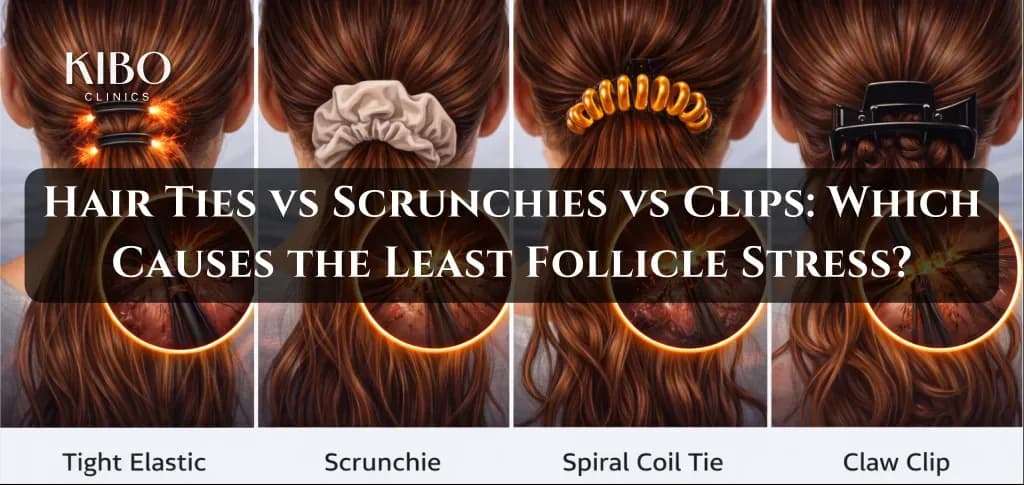
Not all hair accessories damage your hair equally. A thin elastic band concentrates all holding tension on a narrow strip of follicles. A scrunchie spreads that same force across a surface six to eight times wider, reducing peak follicle stress by 60 to 70 percent. Claw clips remove elastic tension entirely but create pressure points at the grip. Spiral coil ties cut friction but still pull if worn too tight. Choosing the right accessory — and rotating tie positions daily — is one of the simplest, most effective habits for long-term hair health.
You Tie Your Hair the Same Way Every Single Day
Think about your routine for a second. You wake up, maybe shower, and at some point you pull your hair back into a ponytail, bun, or clip to get it out of your way. You use the same elastic band or the same hair tie you have been using for weeks, maybe months. You pull it tight enough that it stays in place all day without slipping.
By the end of the day, you take it out and there is a visible crease in your hair exactly where the band was sitting. Maybe you notice a few hairs stuck in the elastic when you remove it. Maybe your scalp feels sore at the tie point.
Most people do not think twice about this. It is just part of getting ready. But if you are doing this every single day with the same type of accessory in the same location on your head, you are creating cumulative mechanical stress on a very specific set of follicles and hair shafts.
Over time, that stress shows up as breakage, thinning, or even a form of traction damage that looks surprisingly similar to early pattern hair loss, except it is concentrated exactly where you tie your hair.
The type of accessory you use determines how much of that stress is unavoidable and how much of it you can eliminate just by switching to something gentler.
The Real Problem: Not All Hair Ties Spread the Load
When you tie your hair, you are concentrating all the holding force into a very small section of hair at the tie point. A standard thin elastic band might be 3 to 5 millimeters wide. All the tension required to hold your entire ponytail in place is being applied through that narrow band onto a small ring of hair shafts and the follicles beneath them. The tighter you pull, the more concentrated that force becomes.
A scrunchie, by contrast, might be 25 to 40 millimeters wide depending on the design. The same holding force is now distributed across a surface area six to eight times larger. This means each individual hair shaft and follicle experiences only a fraction of the tension compared to a thin elastic. The material also matters — a fabric scrunchie has a softer surface texture than rubber or plastic, which reduces the friction coefficient every time the hair moves against it during the day.
Clips introduce a different kind of stress. Instead of wrapping around and compressing the hair, they grip it between two surfaces. The stress is concentrated at the contact points where the clip teeth or jaws press into the hair shaft. If the clip is tight, it can create kinks and weak points along the shaft. But clips also eliminate the circular tension that elastics create, which means they do not pull the hair constantly in one direction the way a ponytail does.
Spiral coil ties reduce surface friction because hair sits in the gaps between the coils rather than being compressed against a solid band. But they still create tension if you wrap them tightly, and they can pull on the hair at the tie point just like any other elastic if worn in the same spot every day.
Hair Accessory Damage Comparison
| Accessory | Tension Type | Friction Level | Damage Risk | Best For |
|---|---|---|---|---|
| Thin Elastic Band | Concentrated circular compression on 3–5mm strip | High — rubber/plastic grips cuticle | Highest | Avoid for daily use |
| Fabric Scrunchie | Distributed across 25–40mm surface area | Low — soft fabric reduces cuticle abrasion | Lowest | Everyday daily use |
| Claw Clip | Pressure points at grip teeth — no circular pull | Medium — depends on teeth material | Low to Medium | Casual updos, half-up styles |
| Spiral Coil Tie | Intermittent coil contact — less continuous grip | Very Low — hair sits in gaps between coils | Low | Exercise, active days, damp hair |
| Metal-jointed Elastic | Concentrated + sharp pressure at metal connector | Very High — metal edges abrade cuticle | Highest | Avoid entirely |
| Silk/Satin Scrunchie | Distributed across wide surface area | Minimal — silk has lowest friction of all materials | Lowest | Daily use + overnight containment |
What Is Actually Happening at the Tie Point
When you wrap an elastic band around a section of hair, you are creating a compression zone. The hair shafts at that point are being squeezed together and held under constant tension. This tension pulls on the follicles at the scalp end of those shafts, creating a sustained traction force that the follicles were not designed to handle for eight or ten hours a day.
Follicles anchor hair through a complex root structure that sits in the dermis layer of the scalp. When you pull on the shaft, that pulling force transmits down to the root and stresses the anchor. Occasional pulling is fine. Sustained pulling for hours every day starts to weaken the anchor structure over time.
The follicle adapts by loosening its grip, which eventually makes the hair easier to shed. This is the mechanism behind traction alopecia, and while a ponytail is not as severe as cornrows or tight braids, it operates on the same principle if the tension is high enough and consistent enough.
The hair shaft itself also suffers at the tie point. The constant compression from the elastic flattens the shaft and can create a weak spot along its length where the compressed section meets the uncompressed section above and below. When you brush or comb your hair later, or when you remove the tie, the hair is most likely to break at that weak transition point.
Friction is the third component. Every time you adjust your ponytail, turn your head, or the hair shifts against the elastic during movement, there is a friction event between the hair cuticle and the tie surface. Understanding hair elasticity and stress resistance helps you see why the material and width of your tie matters so much.
Early Signs People Miss
The earliest sign is not hair loss. It is the visible crease or dent in your hair exactly where the tie was sitting. When you take your ponytail down and your hair has a sharp bend or kink at that point that takes time to relax, that is physical evidence that the hair shaft was compressed and deformed by the accessory.
Another early sign is hairs stuck in the elastic or clip when you remove it. A few hairs is normal shedding. But if you are consistently pulling out 10, 15, 20 hairs every time you take your ponytail down, that is more than normal shedding. Those are hairs being yanked out by the friction and tension of the removal process.
Scalp soreness or tenderness at the tie point after wearing a ponytail all day is a direct signal that the follicles in that area are under stress. You should not feel pain or discomfort from a hairstyle. If you do, the tension is too high and the follicles are being pulled beyond their comfortable tolerance.
Look closely at the hair around your temples and the front of your hairline if you wear your hair back regularly. Are there shorter, broken hairs or baby hairs that seem to be growing back in but never get longer? This is often a sign of chronic breakage or early traction damage at the hairline where the tension from pulling your hair back is concentrated.
Pay attention to whether you are tying your hair tighter as time goes on to get the same hold. If your usual elastic or clip is not holding as well as it used to and you find yourself pulling tighter or using multiple ties, that can mean the hair itself has thinned or weakened at the tie point. Recognising these patterns early is exactly what helps when you are trying to implement a low-stress hair care routine for busy professionals.
Daily Habits Making It Worse
Wearing your hair in a tight high ponytail every single day concentrates the maximum tension on the hairline and crown follicles while also pulling the hair straight back against its natural growth direction. High ponytails create more follicle stress than low ponytails because all the hair weight is cantilevered off a small anchor point rather than being supported closer to the scalp.
Using the same elastic band for weeks until it loses its stretch forces you to wrap it tighter and tighter to get the same hold. An overstretched elastic has less give, which means it creates more rigid tension on the hair rather than flexing with movement. Replace your elastics regularly, ideally every few weeks.
Tying wet hair is one of the most damaging combinations possible. Wet hair is structurally weaker and more elastic than dry hair. When you tie wet hair and it dries in that compressed, pulled state, it sets the damage into the shaft. The hair also shrinks slightly as it dries, which can increase the effective tension of the tie even if you did not pull it tight when wet. This is the same reason why wet hair styling increases root vulnerability.
Sleeping in a tight ponytail or bun extends the tension period from a daytime eight hours to a full 24-hour cycle if you tie your hair before bed and do not take it down until the next evening. Your follicles never get a break. Even if you use a scrunchie, wearing it overnight adds six to eight hours of sustained compression that compounds the daytime damage.
Pulling your hair back immediately after applying styling products like gels, mousses, or sprays glues the hair together at the tie point, making it harder to remove the accessory later without pulling out hairs. If you use product, apply it to the lengths and ends rather than at the root and tie point, or let the product dry before pulling your hair back.
What Helps in Real Life
-
Switch to fabric scrunchies for daily use. This is the single most effective swap you can make. A fabric scrunchie distributes tension across a much wider surface area than a thin elastic, reducing peak stress on any individual follicle by 60 to 70 percent. The soft fabric also has far less friction than rubber or plastic elastics, protecting the cuticle during wear and removal. Choose scrunchies made from silk, satin, or soft cotton for the lowest friction coefficient.
-
Use spiral coil ties for exercise or active days. Spiral ties stay in place during movement without gripping the hair continuously, which reduces friction while still providing hold. They are particularly good for workouts because they do not absorb sweat the way fabric scrunchies do and they are easy to remove without snagging even when your hair is damp. Just make sure not to wrap them too tightly.
-
Choose claw clips for low-stress updos. Claw clips eliminate the circular compression and sustained tension of elastic ties entirely. They work well for messy buns, half-up styles, and quick updos. Look for clips with smooth rounded teeth rather than sharp metal ones. Avoid wearing them in the exact same position every day to prevent concentrated pressure points.
-
Alternate your tie position throughout the week. If you wear a ponytail daily, vary the height and location. High ponytail on Monday, mid-height on Tuesday, low ponytail on Wednesday. This distributes the follicle stress across different zones rather than hammering the same follicles every single day.
-
Take your hair down for breaks during the day. If you tie your hair for work, take it down during lunch or breaks to give the follicles temporary relief from the sustained tension. Even 15 to 20 minutes of downtime allows blood flow to normalise at the tie point and reduces the total daily stress accumulation.
-
Never pull the elastic through your hair to remove it. Always unwind or unroll the tie gently rather than yanking it out. This single habit change can reduce removal-related hair loss by 80 percent or more. With scrunchies, you can usually slide them off without pulling. With spiral ties, uncoil them completely before removal. With standard elastics, cut them off if they are tangled rather than forcing them through.
-
Avoid metal elastics with metal connectors or decorative hardware. The metal pieces create sharp pressure points and have rough edges that abrade the cuticle. If you like the look of decorated hair ties, choose ones where the decorative element is separate from the part that touches your hair. For people managing multiple daily stressors on their hair, reading about daily hair protection for active lifestyles gives you a complete framework.
When Lifestyle Changes Are Not Enough
For most people, switching from tight elastics to scrunchies or spiral ties and varying the tie position weekly will stop new damage within two to three weeks. You will notice less hair coming out when you remove your tie, less visible creasing, and reduced scalp soreness. The hair that has already been broken or weakened needs to grow out over three to six months, but preventing new damage allows the recovery to happen naturally.
However, if you have been wearing very tight ponytails or buns in the same position for years, particularly high tight styles that pull on the hairline, the follicle damage may be more significant than just shaft breakage. Chronic traction on the same follicles can transition from reversible stress to early follicle miniaturisation or permanent traction alopecia if the pulling has been severe and sustained enough over a long period.
If you have switched to gentler accessories, varied your styling, and given it several months, but you are still seeing thinning or hairline recession at the tie zones, a professional trichoscopy assessment will tell you whether you are dealing with pure mechanical damage that just needs more time to recover or whether there is follicle-level damage that needs treatment support. Building a targeted night-time hair care routine to reduce breakage alongside daytime habit changes maximises your recovery potential.
Why Kibo Clinics
When you come to us concerned about thinning at your ponytail line or hairline recession that matches your styling pattern, we use trichoscopy to examine the actual state of the follicles in those zones. We can see whether the follicles are healthy but producing broken shafts, whether they are under active traction stress, or whether chronic pulling has started to cause miniaturisation that needs intervention beyond just changing your accessories.
For patients where the damage is purely mechanical and the follicles are still healthy, the solution is often straightforward: change the styling habits, give it time, and support the recovery with targeted scalp care. For patients where years of traction have created early follicle stress, we use treatments like PRP therapy or GFC therapy to strengthen the follicles and help them recover their normal anchor structure and production capacity.
We also work with you on practical styling solutions that fit your actual life. If you are a dancer, an athlete, or someone whose job requires you to tie your hair back, we are not going to tell you to just stop. We will help you find the accessories, positions, and techniques that let you do what you need to do while minimising the damage. Our 12-month care approach means we track how your hair responds over time and adjust if the initial plan is not producing the results we expected. You deserve a plan that works with your life, not against it.
Get a call back to understand your hair loss stage and the best next step by certified doctor.
Frequently Asked Questions
Q: Are scrunchies actually better for your hair than regular elastics? Yes, significantly. Scrunchies distribute the holding force across a much wider surface area than thin elastic bands, reducing the peak tension on any individual hair shaft or follicle by 60 to 70 percent. The fabric material also has a much lower friction coefficient than rubber or plastic, which means less cuticle damage during wear and especially during removal. Independent testing shows that people who switch from tight elastics to fabric scrunchies see measurable reductions in breakage and shedding at the tie point within just a few weeks.
Q: Do spiral coil hair ties prevent damage? Spiral coil ties reduce friction damage significantly because they do not grip the hair continuously along their length. Hair sits in the gaps between the coils rather than being compressed against a solid band. However, they can still create tension if wrapped too tightly, and they still pull on the follicles at the tie point if worn in the same position daily. The main advantage is much easier and gentler removal compared to standard elastics, which reduces the hair loss that happens when you take your tie out.
Q: Can wearing ponytails cause permanent hair loss? Wearing very tight ponytails in the same position for years can cause a form of permanent hair loss called traction alopecia, where chronic pulling damages the follicle anchors to the point that they stop producing hair. However, this typically requires sustained high tension over many years. Most ponytail-related damage is reversible shaft breakage and temporary follicle stress that recovers once you change your habits. The key is catching it early and switching to gentler accessories before the damage crosses from temporary to permanent.
Q: What is the least damaging way to tie hair for sleep? The least damaging approach is a very loose low braid or a loose bun secured with a fabric scrunchie. The goal is gentle containment to prevent tangling rather than tight securing. Avoid high ponytails for sleep because they concentrate tension on the hairline and crown follicles for six to eight hours straight. If you must tie your hair overnight, make it as loose as possible while still keeping the hair contained, and vary the position from night to night to distribute the stress.
Q: Are claw clips bad for your hair? Claw clips are not inherently bad, but they do create concentrated pressure points where the teeth grip the hair. If the clip is very tight or has sharp metal teeth with rough edges, it can create kinks in the shaft and abrade the cuticle at those pressure points. The advantage of claw clips is that they eliminate the circular compression and sustained tension that elastic ties create. Choose clips with smooth rounded teeth, avoid wearing them in the exact same position every day, and do not clamp them so tight that they create deep creases in your hair.
Q: How can I tell if my hair tie is too tight? If you feel scalp soreness or tenderness at the tie point after wearing your hair up, the tension is too high. If your hair has a deep visible crease or kink that takes more than 30 minutes to relax after you take the tie out, the compression was significant. If you are consistently pulling out more than a few hairs when removing the tie, the friction and tension during removal are too high. A properly fitted tie should hold your hair comfortably without pain, leave only a slight temporary mark, and come out with minimal hair loss.
Key Takeaways
- Thin elastics concentrate all holding force on a 3–5mm strip of follicles — the highest damage risk of any accessory
- Fabric scrunchies reduce peak follicle stress by 60–70 percent and should be the default for daily use
- Spiral coil ties are best for active days — lower friction and gentler removal
- Claw clips eliminate circular tension but create pressure points — use smooth-toothed clips and vary position daily
- Always unwind ties gently — never pull through — to reduce removal-related shedding by up to 80 percent
- Tying wet hair significantly amplifies damage — always let hair dry first
- Persistent thinning at tie zones after switching accessories needs professional trichoscopy assessment
Hair Transplant
FUE Hair Transplant | Sapphire FUE Hair Transplant | Direct Hair Transplant (DHT) | Corrective Hair Transplant | Hairline Correction
Hair Regrowth
PRP Therapy | GFC Therapy | Mesotherapy for Hair Regrowth | Microneedling for Hair Regrowth | Low Level Laser Therapy (LLLT)
Must Read
Hair Breakage Causes and Treatments | Hair Loss Types, Symptoms and Causes | Tension-Based Hair Damage During Styling | Hair Extensions and Traction Alopecia Risk | Hair Elasticity and Stress Resistance
Relevant Blogs
Best Hairstyles to Minimise Stress on Hair Follicles | Wet Hair Styling and Root Vulnerability | Daily Hair Protection for Active Lifestyles | Low-Stress Hair Care for Busy Professionals | Night-Time Hair Care to Reduce Breakage