
Hair Elasticity: What It Means, How to Test It, and How to Fix Low Elasticity
Published on Fri Apr 03 2026
Quick Summary
Hair elasticity is the strand's ability to stretch under tension and return without breaking — and when it fails, it signals internal structural damage no surface product can reverse. Healthy elasticity depends on balanced moisture and protein: moisture allows the strand to flex, keratin bonds provide the structure that pulls it back. When heat, chemicals, hormones, or nutritional deficiency disrupt this balance, disulfide bonds inside the cortex weaken and strands snap instead of spring.
A Story of Hair That Lost Its Bounce
Ritika, 29, from Pune, loved styling her hair. Regular straightening, tight ponytails, and occasional colouring were part of her routine. Over time, she noticed something different — her hair did not stretch anymore. It snapped while combing, especially when wet.
Initially, she blamed shampoo. Then she switched oils and conditioners. Nothing changed. Within six months, she saw more hair on her pillow and breakage around the crown.
A scalp and hair analysis later showed low moisture retention, cuticle damage, and stress-related shedding. Once she corrected her scalp care, reduced heat exposure, and addressed nutritional gaps, the elasticity slowly improved over three to four months.
What Is Hair Elasticity and Why Does It Matter?
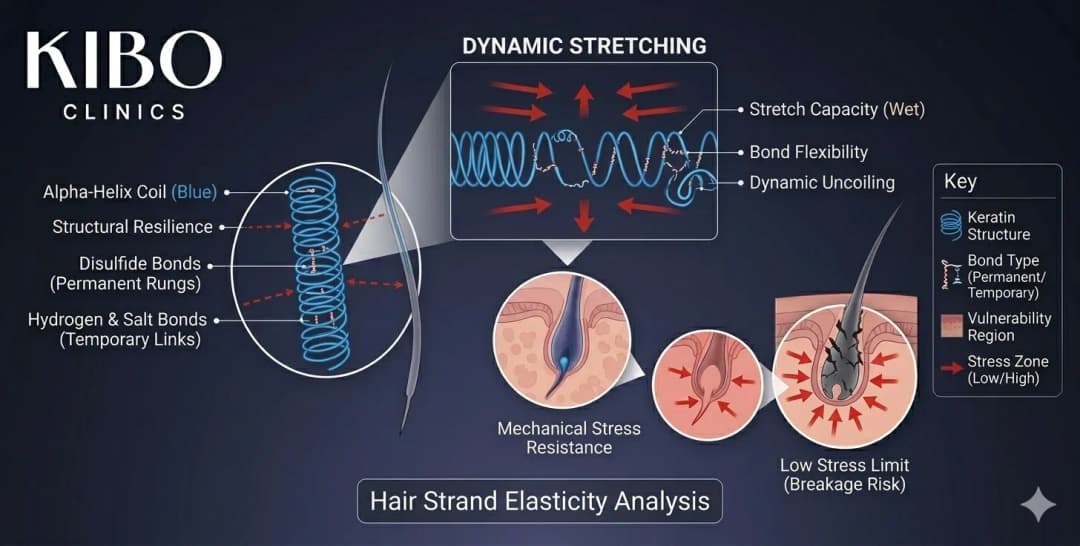
Hair elasticity is the ability of a strand to stretch and return to its original length without breaking. A strand with good elasticity can extend up to 30 percent of its length when wet before snapping. Low elasticity hair breaks almost immediately under minimal tension.
Scalp health affects follicle nutrition — Healthy follicles receive the blood flow and nutrients needed to produce strong keratin fibres from the point of growth.
Structural bonds determine flexibility — The cortex contains keratin protein chains connected by disulfide bonds. These bonds allow hair to stretch under tension and spring back. When moisture levels are balanced and protein structure is intact, elasticity remains healthy.
Hormones influence keratin production cycles — Stress hormones like cortisol disrupt the growth cycle and reduce keratin quality produced in each anagen phase, producing weaker strands with each successive cycle.
Lifestyle factors break the chain — Heat styling, chemical treatments, pollution, and poor nutrition weaken structural bonds progressively — first reducing elasticity, then producing visible brittleness and breakage.
How Do Protein and Moisture Balance Affect Elasticity?
Too much protein without hydration makes hair stiff and brittle — the bonds are intact but the strand cannot flex, so it snaps rather than stretching. Too much moisture without structural support makes hair overly stretchy and gummy — it extends far beyond normal range without springing back, indicating disulfide bond damage.
Understanding hair breakage causes and treatments covers the diagnostic approach for identifying which imbalance is driving the problem before choosing any treatment.
Hair Elasticity — What Affects It and How
| Factor | How It Affects Elasticity | What You Notice | Recovery |
|---|---|---|---|
| Repeated heat styling | Dehydrates strands and weakens disulfide bonds in the cortex with each session | Snaps quickly on stretching; rough after washing | 4–8 weeks heat reduction; new growth replaces damaged strands in 3–6 months |
| Chemical treatments (bleach, colour, relaxers) | Break disulfide bonds — most direct cause of structural elasticity failure | Gummy stretch without spring-back when wet; excessive mid-shaft breakage | Damaged strands cannot be repaired — new growth needed; protein-moisture care prevents further loss |
| Nutritional deficiency (protein, iron, zinc) | Reduces quality of keratin produced — weaker structural bonds from the point of growth | Gradual brittleness across entire scalp; shedding alongside breakage | 3–6 months after dietary correction as new quality strands grow |
| Chronic stress (elevated cortisol) | Disrupts keratin formation and pushes follicles into telogen — new strands produced are structurally weaker | Increased shedding alongside reduced strand resilience; hair feels limp | 3–6 months after stress levels normalise |
| Hormonal imbalance (thyroid, PCOS) | Alters keratin production cycle; changes strand diameter and internal bond density | Texture changes across scalp without specific styling trigger | Depends on hormonal stabilisation through medical treatment |
| UV and environmental exposure | Degrades keratin proteins and increases porosity so moisture escapes faster from the shaft | Frizz, roughness, colour lightening, and breakage after outdoor exposure | 4–8 weeks with UV protection and moisture restoration |
How Does Hair Elasticity Show in Men and Women?
In men, reduced elasticity often appears in areas affected by pattern thinning. As follicles miniaturise under DHT influence, strands become finer and less resistant to stress — men may misinterpret this breakage as accelerating balding when it is actually structural weakening of thinner strands that snap more visibly.
In women, breakage along the hairline or crown is more common due to styling stress, chemical treatments, and postpartum hormonal shifts. Women may mistake hormonal shedding for simple dryness, using conditioning products that address surface texture without resolving the internal bond damage driving the elasticity loss.
In both cases, reduced elasticity accelerates visible thinning — brittle hair snapping at the shaft reduces density faster than normal telogen shedding would.
| Factor | Men | Women |
|---|---|---|
| Hormonal influence | Androgen-driven thinning reduces strand thickness and elasticity in affected zones | Oestrogen fluctuations affect moisture retention and strand resilience |
| Styling impact | Frequent gels and harsh shampoos strip scalp oils that protect elasticity | Heat styling and chemical treatments directly break cortex disulfide bonds |
| Common misinterpretation | Breakage mistaken for accelerating balding progression | Hormonal shedding mistaken for simple dryness |
What Daily Habits Make It Better or Worse?
Habits that reduce hair elasticity:
- Very hot water — strips natural oils and removes the moisture layer that allows strands to flex
- Aggressive towel rubbing — damages the cuticle at maximum vulnerability; wet hair is already more elastic and more fragile simultaneously
- Tight hairstyles — concentrate mechanical stress at the weakest points of already-compromised strands
- Skipping protein-rich foods — limits the keratin building blocks needed for structurally sound new strand production
- Layering multiple chemical treatments — each compounds disulfide bond damage before recovery can occur
Habits that restore and protect elasticity:
- Mild sulphate-free cleansers — preserve sebum and the moisture layer that allows flexibility
- Conditioner application — maintains moisture balance at the cuticle surface, reducing friction-driven water loss
- Iron, zinc, biotin, and adequate dietary protein — support keratin production quality from the follicle outward
- Stress management — reduces cortisol-driven disruption of the keratin production cycle
For scalp-level protection that supports strand flexibility, scalp oiling before washing reduces protein loss during the wash process — one of the most evidence-supported habits for maintaining elasticity in heat-damaged hair.
What Helps First — Practical Relief Steps
Start with the strand elasticity test. Wet a strand and gently stretch between two fingers. Healthy hair stretches slightly and returns. Immediate snapping means low elasticity. Gummy over-stretch without spring-back means protein bond damage.
Reduce heat styling for at least 6 to 8 weeks. This is the highest-impact intervention for heat-driven elasticity loss — removing the primary dehydration source allows remaining intact strands to retain flexibility.
Switch to sulphate-free cleansers and balanced conditioners. Harsh cleansers strip moisture that wet hair needs to flex without snapping.
The wet-hair vulnerability window is the highest-risk moment for elasticity breakage. Wet hair styling and root vulnerability explains why elastic yet fragile wet strands require specific handling during the most vulnerable phase of any hair care routine.
Increase dietary protein intake through eggs, lentils, paneer, and lean meat — hair is 95 percent keratin and structural improvement requires the raw material to produce better-quality new strands.
Most people notice reduced breakage within 4 to 6 weeks. Improved strand thickness and elasticity in new growth may take 3 to 6 months depending on the hair cycle and the original cause.
When to See a Hair Specialist
Do not wait if you notice:
- Hair snapping excessively even with minimal styling and no heat exposure
- Shedding exceeding 100 to 150 strands daily for more than three months
- Scalp itching, burning, or scaling alongside breakage
- Sudden thinning after illness, crash dieting, or childbirth
- Family history of pattern baldness combined with increased fragility
Early scalp evaluation prevents long-term follicle miniaturisation from compounding structural elasticity damage into irreversible density loss.
Common Myths About Hair Elasticity
Myth 1: Oiling alone fixes brittle hair. Oil reduces surface dryness and friction but cannot repair internal disulfide bond damage. Internal protein structure requires either dietary protein input or time for new strands to grow with intact bonds.
Myth 2: Cutting hair improves elasticity. Trimming removes split ends and prevents upward splitting but does not change follicle output quality. The source of the elasticity problem remains untreated.
Myth 3: More protein masks always help. Excess protein without moisture balance makes hair stiffer and more brittle — counterproductively increasing breakage at the same points the treatment was meant to protect.
Myth 4: Hair breakage equals hair loss. Breakage happens along the shaft when elasticity fails — the follicle is intact. Hair loss occurs from the root when the follicle releases the strand. Both reduce visible density but require completely different treatments.
Myth 5: Stress only affects hair fall, not hair quality. Chronic stress impacts keratin formation quality and strand resilience — producing structurally weaker strands from the follicle even when the growth cycle appears intact.
Why Kibo Clinics
Many patients choose Kibo Clinics for hair fragility concerns because our approach addresses both scalp biology and long-term planning. We begin with comprehensive scalp assessment, hair and follicle analysis, and thorough lifestyle and environmental review — distinguishing structural elasticity failure from follicle-level miniaturisation before any treatment is recommended.
Our No Ghost Surgery pledge ensures the consulting surgeon personally performs your entire procedure, maintaining consistent quality throughout the session. We do not delegate critical steps to technicians.
The Kibo Hair Analysis (scalp and follicle assessment) is the first step in understanding your specific condition. We provide education, guidance, and support without guarantees, exaggerated claims, or miracle cure promises.
For patients with progressive thinning or structural weakening, supportive therapies like PRP therapy, IV hair boosters, or advanced transplant planning may be discussed based on suitability. Our 12-month monitoring programme tracks elasticity improvement, shedding patterns, and follicle health to guide adjustments responsibly.
Concerned about brittle, snapping hair? Get a professional scalp and elasticity evaluation at Kibo Clinics before damage progresses.
Frequently Asked Questions
Q: What is hair elasticity and why does it matter? Hair elasticity is the ability of a strand to stretch under tension and return without breaking. It reflects the integrity of disulfide bonds inside the cortex and the moisture balance that allows flexibility. When elasticity fails, hair breaks instead of flexing — producing accumulating breakage and density loss that most people misidentify as hair loss.
Q: How can I test my hair elasticity at home? Wet a strand and gently stretch it between two fingers. Healthy elasticity means it stretches slightly and returns without breaking. Immediate snapping signals low elasticity. Gummy over-stretch without spring-back signals protein bond damage. This is directional guidance, not a medical diagnosis.
Q: How to improve hair elasticity? Reduce heat styling for 6 to 8 weeks. Switch to sulphate-free cleansers and conditioners that maintain moisture balance. Increase dietary protein, iron, and zinc to improve new strand quality. Address hormonal or nutritional imbalances with medical guidance if breakage persists despite habit correction.
Q: Does low elasticity mean I am going bald? Not always. Low elasticity usually indicates shaft weakness — the follicle is intact. However, if combined with thinning at the roots and a receding pattern, underlying miniaturisation may be occurring simultaneously. A scalp examination differentiates the two.
Q: How long does it take to restore hair elasticity? Mild damage may improve in 4 to 8 weeks with consistent protective care. Severe chemical damage cannot be repaired in existing strands — new growth replaces them. Improvement in new strand quality takes 3 to 6 months as the growth cycle produces strands with better structural integrity.
Q: Do hormonal problems affect hair elasticity? Yes. Thyroid imbalance, PCOS, and androgen sensitivity can change strand thickness and the quality of keratin bonds produced — reducing both elasticity and resilience. Treating the underlying hormonal issue improves long-term results in ways that surface products cannot achieve.
Q: Can PRP therapy improve hair elasticity? PRP therapy may stimulate follicles and improve strand thickness over time — producing structurally stronger new strands. It does not repair already-damaged existing hair shafts. Results vary and require multiple sessions alongside correct nutritional and styling habits.
Key Takeaways
- Hair elasticity depends on disulfide bond integrity in the cortex and moisture balance — when either fails, hair snaps instead of springs
- Hair elasticity test — wet a strand and stretch gently; immediate snapping means low elasticity; gummy over-stretch means protein bond damage; slight stretch with return means healthy
- Low elasticity hair is caused by heat damage, chemical treatments, nutritional deficiency, stress-driven keratin disruption, or hormonal imbalance — each requiring a different fix
- How to improve hair elasticity — reduce heat for 6 to 8 weeks, switch to mild cleansers, increase dietary protein and iron, address hormonal factors clinically if needed
- Breakage from low elasticity is a shaft problem — follicles are intact; but persistent shaft breakage reducing density can be confused with root-level hair loss without professional evaluation
- Elasticity improvement in new growth takes 3 to 6 months; damaged existing strands cannot be repaired and must grow out naturally
Disclaimer
This content is for informational purposes only and does not substitute personalized medical advice. Hair elasticity varies based on genetics, nutrition, hormones, and lifestyle. Treatment responses differ between individuals. No therapy guarantees complete restoration, and professional consultation is necessary for accurate diagnosis and personalized planning.
Hair Transplant
FUE Hair Transplant | Sapphire FUE Hair Transplant | Bio FUE Hair Transplant | Realtime FUE Hair Transplant | Direct Hair Transplant (DHT)
Hair Regrowth
PRP Therapy | GFC Therapy | IV Hair Boosters | Mesotherapy for Hair Regrowth | Microneedling for Hair Regrowth
Must Read
Hair Loss Types Symptoms Causes | Hair Breakage Causes Treatments | DHT Blockers Hair Loss Guide | Hair Transplant Good Or Bad | Understanding The Language Of Natural Hairline
Relevant Blogs
Hair Brushes Combs Scalp Stress | Hair Dryer Heat Follicle Safety | Straighteners and Curling Irons Hair Stress | Pollution Build Up Weakening Hair Roots | Scalp Oil Reducing Hair Friction