
How to Create a Low-Stress Hair Care Schedule for Busy Professionals
Published on Fri Apr 03 2026
Quick Summary
A hair care routine for busy people does not need to be complex — it needs to be consistent. Stress, irregular sleep, poor nutrition, and scalp neglect during high-pressure work phases are four of the most common and most correctable causes of hair fall in urban professionals. Cortisol elevation from chronic stress pushes follicles into the shedding phase 2 to 3 months after the stressful period, which is why most professionals do not connect the shedding they see to the deadline or crisis that caused it. A realistic weekly structure of 5 to 7 minutes daily and 20 to 30 minutes once or twice weekly addresses all four factors without adding another demand to an already loaded schedule.
A Story Many Professionals Relate To
Rohit, 34, works in finance in Mumbai. His days start at 7 AM and end late at night. Client calls, deadlines, and travel became normal. Within a year, he noticed increased hair fall while showering and a widening hairline.
At first, he blamed shampoo. He kept switching products, tried random oils on weekends, and skipped wash days due to exhaustion. Nothing changed. In fact, stress increased because he worried about hair loss daily.
Once he followed a structured, low-effort weekly hair care schedule and improved sleep and diet, his shedding reduced over three months. The change was not dramatic overnight, but it was steady and manageable. The biggest relief was stopping the guilt about "not doing enough."
What Causes Hair Problems in Busy Professionals?
Hair health begins at the scalp. When the scalp is inflamed, oily, dry, or clogged, follicles cannot function at their best.
Chronic stress and cortisol — High cortisol can push more hair follicles into the resting (telogen) phase, leading to increased shedding. This is why the connection between a stressful quarter at work and the shedding that appears 2 to 3 months later is so often missed. Understanding hair growth cycle and mechanical shedding clarifies why the shedding peak follows the stressor rather than coinciding with it.
Nutritional gaps — Irregular meals and crash diets reduce protein, iron, vitamin D, and B12 levels. Hair is not a priority organ for the body — when nutrients drop, hair growth slows first before any other visible system is affected.
Sleep deprivation — Late nights and screen exposure disturb hormonal balance, reducing the cellular repair cycle that follicles need during the night. Both men and women are affected, but the impact on hormonal fluctuations is particularly significant in women.
Environmental exposure — Pollution, hard water, sweat from long commutes, and air-conditioned offices dry out the scalp and weaken strands — a compounding environmental stress on top of the internal hormonal and nutritional pressures of a demanding work life.
Why Does Stress Directly Affect Hair Growth?
When you are constantly under pressure, your body releases cortisol and adrenaline. These shift energy away from non-essential functions like hair growth.
Prolonged stress triggers telogen effluvium — where more hair enters the shedding phase simultaneously. This typically appears 2 to 3 months after a stressful event such as a job change, illness, major project deadline, or emotional strain.
In men with genetic predisposition, stress may accelerate pattern thinning by compressing the timeline of miniaturisation. In women, stress can worsen PCOS-related hair thinning or postpartum shedding. Reducing stress does not immediately regrow hair — it stabilises the environment in which follicles operate. Visible improvement usually appears after 3 to 6 months of consistent habits.
Low-Stress Hair Care Schedule — Busy Professional Weekly Plan
| Frequency | Action | Time Required | Why It Matters |
|---|---|---|---|
| Daily | One protein-rich meal (eggs, dal, paneer, fish); 7+ hours sleep; 2 litres water | 0 extra minutes — built into existing meals and sleep | Provides keratin building blocks and the recovery cycle that follicles need nightly |
| Alternate days or 3–4x weekly | Mild shampoo wash with lukewarm water; pat dry, no towel rubbing | 5–7 minutes | Removes sweat, oil, and pollution buildup that clogs follicle openings and causes inflammation |
| Once weekly | Light scalp oil massage (fingertip pads only, not nails); conditioner mid-lengths only | 10–15 minutes | Improves blood circulation to follicles; restores moisture to shaft without clogging scalp |
| Once or twice weekly | Deep conditioning mask if hair feels dry or chemically treated | 10 minutes (applied before shower) | Restores elasticity and reduces breakage in heat or chemically damaged strands |
| Every 8–12 weeks | Trim split ends; review shedding pattern; check scalp for itching or sensitivity | 30 minutes (salon or home trim) | Prevents breakage from travelling upward; tracks whether shedding is stabilising or progressing |
| Monthly | Review stress level and sleep quality; note if shedding has increased or decreased; consider professional review if fall continues 3+ months | 5 minutes self-assessment | Creates the feedback loop needed to catch pattern loss early before it reaches the irreversible stage |
How Does Low-Stress Hair Care Show in Men and Women?
In men, busy schedules combined with genetic DHT sensitivity can speed up visible hairline changes. Recession at the temples or thinning at the crown that would have progressed slowly over years can become noticeable within months when chronic stress, poor nutrition, and scalp neglect compound the genetic baseline.
In women, the presentation is usually overall thinning, wider parting, or reduced hair volume rather than a defined recession pattern. Tight work hairstyles and hormonal shifts compound the lifestyle stressors — making it easy to misattribute what is actually stress-driven telogen effluvium to a styling or product problem.
Both benefit from structured washing schedules, stress management, and balanced nutrition applied consistently rather than intensively on occasional weekends.
What Daily Habits Make It Better or Worse?
Habits that worsen hair during busy periods:
- Skipping meals — protein intake drops, directly reducing the amino acids needed for keratin production
- Overusing styling products — buildup and follicle blockage that compounds the scalp health disruption from stress
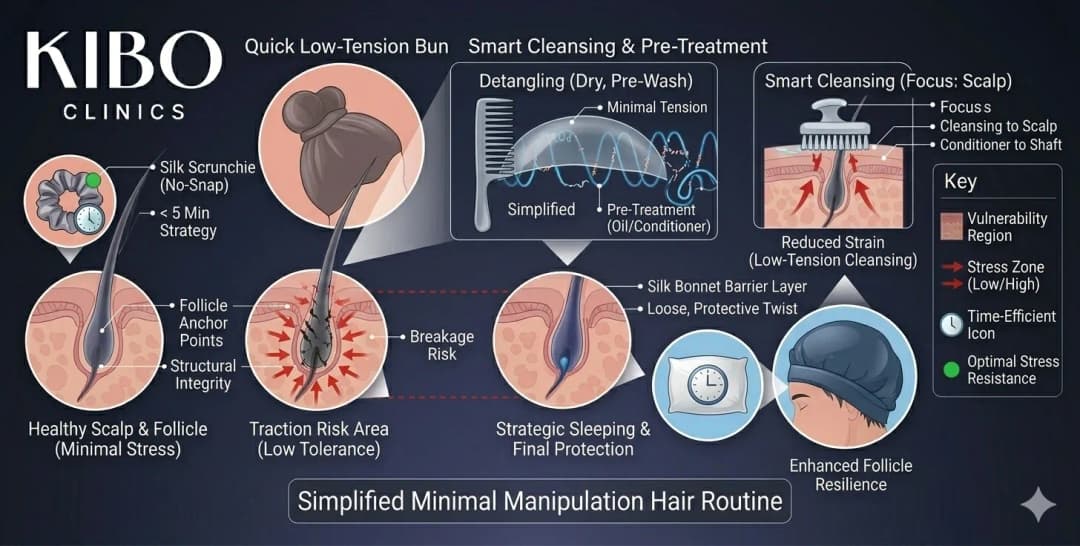
- Tight ponytails or buns for long work days — adds traction stress on top of the stress-hormonal follicle pressure
- Frequent late nights — hormonal imbalance that affects both men's testosterone-to-DHT pathways and women's oestrogen fluctuations
- Trying too many treatments simultaneously — the frustration from lack of immediate results increases the stress that is already causing the shedding
Habits that help:
- Short breathing exercises between calls — reduces acute cortisol spikes that accumulate across a long work day
- Regular hydration — supports scalp circulation that sweat and air-conditioned office environments deplete
- Mild scalp massage once weekly — improves blood flow to follicles; scalp oil balance and friction reduction explains the protective mechanism of light pre-wash oiling
- Limiting heat styling — removes one avoidable damage source from an already stressed scalp environment
What Helps First — Practical Relief Steps
Scalp cleansing regularity — weeks 1 to 2. This alone reduces itching and shedding from pollution and sweat buildup within 2 to 4 weeks. It is the lowest-effort highest-impact starting point for the hair care routine of any busy professional.
Improve sleep — weeks 3 to 8. Many people notice reduced hair fall after 6 to 8 weeks of better sleep. Even adding 30 minutes consistently improves the nocturnal hormonal repair cycle that follicles depend on.
Add protein daily — weeks 4 to 12. Results in hair strength appear in 8 to 12 weeks as new strands grow with better structural integrity.
Reduce stress through structured breaks. Hair cycle stabilisation from cortisol reduction takes about 3 months — because the follicles that entered telogen during the stress peak need to complete their shedding cycle before new anagen growth becomes visible.
For anyone experiencing persistent shedding, understanding weak hair roots and follicle anchoring provides the framework for identifying whether the shedding is reversible telogen effluvium or has progressed to follicle miniaturisation requiring clinical management.
When to See a Hair Specialist
Do not wait if you notice:
- Hair fall lasting more than 3 months without improvement despite routine correction
- Visible scalp patches or sudden bald spots
- Rapid hairline recession at the temples or crown
- Severe itching, burning, or scaling alongside shedding
- Hair loss after major illness or COVID that does not slow down
- Family history of early baldness with current signs of thinning
Professional evaluation differentiates stress-related shedding (reversible), nutritional deficiency (correctable), hormonal imbalance (treatable), and genetic hair loss (requires ongoing management) — four different problems that look identical from the outside.
Common Myths About Low-Stress Hair Care
Myth 1: Oiling daily stops hair fall. Excess oiling without adequate washing can clog follicle openings — worsening the buildup problem that busy scalp environments already create. Weekly gentle oiling before washing is the evidence-supported approach.
Myth 2: Busy people cannot maintain healthy hair. Simple 5 to 7-minute daily habits consistently applied produce better results than intensive weekend treatments without weekday consistency.
Myth 3: Stress hair loss is permanent. Most stress-related shedding (telogen effluvium) is reversible once the trigger is managed. The follicles remain intact and resume normal production once cortisol levels stabilise.
Myth 4: Expensive products work better. Consistency and scalp hygiene matter more than product price. A mild sulphate-free shampoo used consistently produces better outcomes than premium products used sporadically.
Myth 5: Washing hair daily causes baldness. A mild shampoo suited to your scalp type used daily does not cause permanent hair loss. The problem is harsh daily cleansers that strip the scalp barrier — not the act of washing itself.
Why Kibo Clinics
Many patients choose Kibo Clinics for stress-related hair thinning because our approach addresses both hair restoration and long-term planning. We begin with comprehensive scalp assessment, hair and follicle analysis, and thorough lifestyle and environmental review — identifying whether increased shedding reflects correctable telogen effluvium or early pattern miniaturisation that requires active clinical management.
Our No Ghost Surgery pledge ensures the consulting surgeon personally performs your entire procedure, maintaining consistent quality throughout the session. We do not delegate critical steps to technicians.
The Kibo Hair Analysis (scalp and follicle assessment) is the first step in understanding your specific condition. We provide education, guidance, and support without guarantees, exaggerated claims, or miracle cure promises.
We also provide structured 12-month monitoring and support. Hair growth cycles take time, and steady tracking helps adjust care plans with PRP therapy or GFC therapy when required based on how the scalp responds over time.
Take control of your schedule without sacrificing your hair health. Book a structured scalp assessment and get a practical, time-efficient plan tailored to your lifestyle.
Frequently Asked Questions
Q: Can stress alone cause noticeable hair thinning? Yes, prolonged stress triggers telogen effluvium — a condition where more hair enters the shedding phase simultaneously. It does not cause complete baldness in most cases. If genetic hair loss exists, stress accelerates the visible timeline. Most stress-related shedding improves within 3 to 6 months after lifestyle correction.
Q: How many times should busy professionals wash their hair? Oily scalps may need alternate-day washing; dry scalps may need 2 to 3 washes weekly. The goal is removing sweat, oil, and pollution buildup without stripping the scalp barrier. Overwashing with harsh shampoos increases dryness; underwashing causes follicle-clogging buildup.
Q: Does sleeping late really affect hair growth? Chronic sleep deprivation disrupts hormonal balance and the nightly cellular repair cycle that follicles depend on. Occasional late nights are manageable. Regular sleep loss for months shows follicle impact in 2 to 3 months through increased shedding and reduced strand quality in new growth.
Q: Are supplements necessary for hair health? Only if blood tests confirm deficiencies. Random supplementation without testing may not help and can sometimes create imbalances. Iron, vitamin D, and B12 are the most commonly deficient nutrients in urban professionals — all of which can be tested and corrected specifically.
Q: How long does it take to see improvement after reducing stress? Shedding may reduce within 6 to 8 weeks of corrective lifestyle changes. Visible density improvement usually takes 3 to 6 months because hair growth cycles are slow and the follicles that entered telogen during the stress peak must complete their cycle before new anagen growth becomes visible.
Q: Can a tight work hairstyle cause hair loss? Yes, constant tight ponytails or buns can cause traction alopecia at the hairline and temples. Early stages are reversible if tension is reduced promptly. Long-term pulling causes follicle scarring that may not recover without clinical treatment.
Key Takeaways
- Hair care routine for busy people — 5 to 7 minutes daily (mild wash, one protein meal, 7 hours sleep) plus 20 to 30 minutes once weekly (oil, condition) is sufficient to prevent most stress-related hair damage
- Does stress cause hair fall? Yes — elevated cortisol pushes follicles into telogen; shedding peaks 2 to 3 months after the stressful period, not during it, which is why the connection is so often missed
- Hair loss due to work stress is reversible telogen effluvium in most cases — the follicle is intact and resumes growth once cortisol stabilises, typically within 3 to 6 months of consistent habit correction
- Consistency beats intensity — monthly intensive treatments with no weekday routine produce far worse outcomes than simple daily habits applied consistently
- If shedding continues beyond 3 months of lifestyle correction, clinical evaluation distinguishes correctable telogen effluvium from genetic miniaturisation that requires active medical management
- Simple weekly hair care plan — alternate-day mild wash, weekly pre-wash oiling, monthly self-assessment of shedding trend, and a single protein-rich meal daily covers all the bases a busy professional needs
Disclaimer
This content is for informational purposes only and does not substitute personalized medical advice. Hair loss causes vary between individuals, and treatment responses differ based on genetics, health status, and consistency. No routine or procedure guarantees permanent results. Always consult a qualified professional for accurate diagnosis and personalized care.
Hair Transplant
FUE Hair Transplant | Sapphire FUE Hair Transplant | Bio FUE Hair Transplant | Realtime FUE Hair Transplant | Direct Hair Transplant (DHT)
Hair Regrowth
PRP Therapy | GFC Therapy | IV Hair Boosters | Mesotherapy for Hair Regrowth | Microneedling for Hair Regrowth
Must Read
Hair Loss Types Symptoms Causes | Hair Breakage Causes Treatments | DHT Blockers Hair Loss Guide | Hair Transplant Good Or Bad | Understanding The Language Of Natural Hairline
Relevant Blogs
Hair Brushes Combs Scalp Stress | Hair Dryer Heat Follicle Safety | Straighteners and Curling Irons Hair Stress | Pollution Build Up Weakening Hair Roots | Scalp Oil Reducing Hair Friction