
Botox Hair Treatment Side Effects: Is It Safe for Damaged Hair?
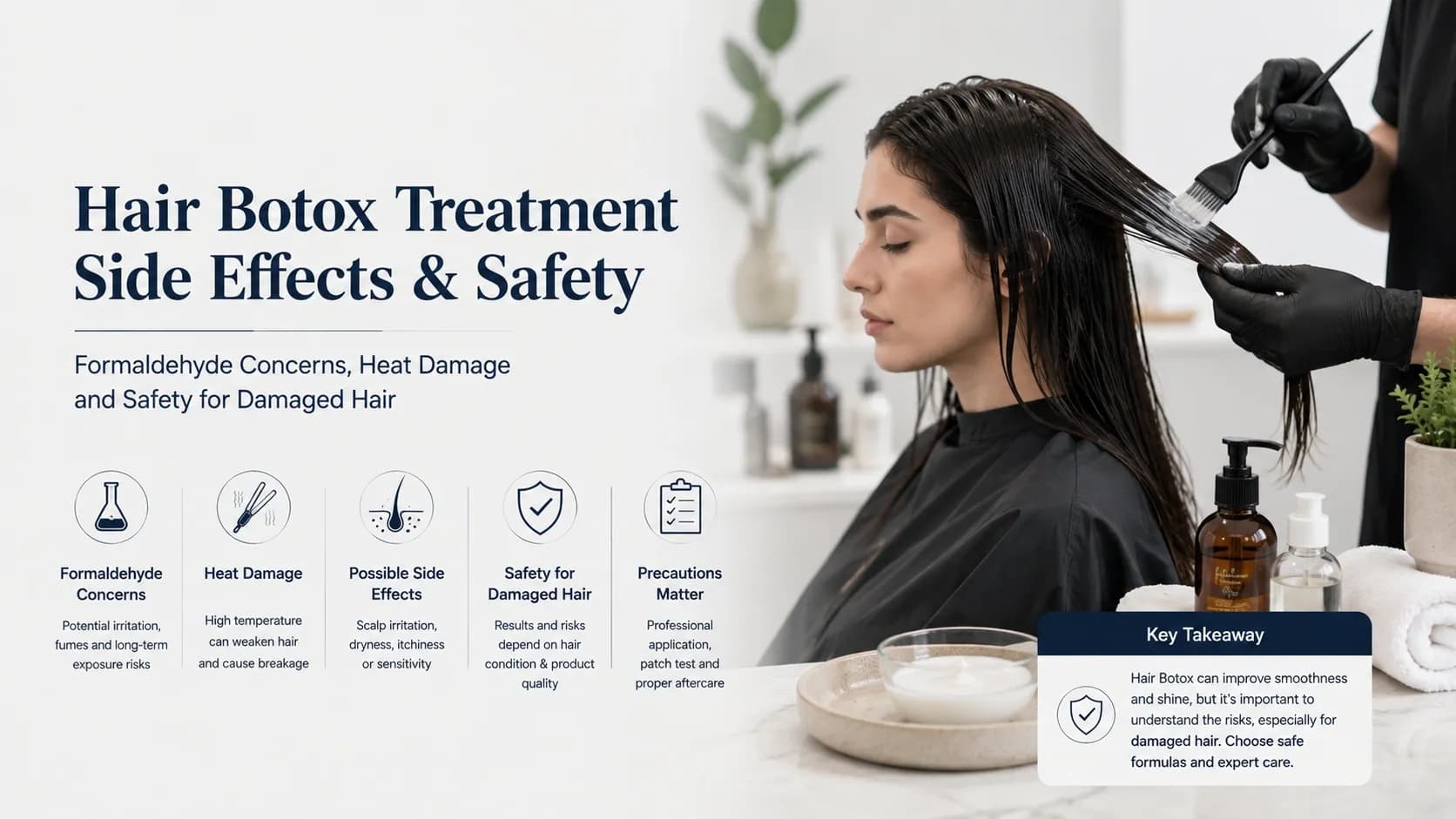
Hair Botox is a salon conditioning treatment that can temporarily improve hair smoothness, shine, and manageability. However, side effects can include scalp irritation, chemical sensitivity, dryness, texture changes, and hair breakage, particularly when fragile hair is exposed to chemical or heat stress.
Hair Botox is not a standardised treatment, so its ingredients and safety profile vary by product. Some smoothing formulations may contain or release formaldehyde-related chemicals when heated, while high heat itself can damage the hair shaft.
What Is Hair Botox and How Is It Different From Injectable Botox?
Hair Botox is a salon conditioning treatment designed to improve the smoothness, shine, and manageability of the hair shaft; it is not an injection and does not contain botulinum toxin.
Some hair Botox products use conditioning ingredients such as proteins, oils, or other film-forming agents to temporarily improve the feel and appearance of damaged hair. However, the product label and salon process matter because some smoothing treatments involve chemicals and high heat that can affect the hair shaft or scalp.
Note: Botulinum toxin is a potent neurotoxic protein produced by the bacterium Clostridium botulinum. In medical treatments, it temporarily blocks the release of acetylcholine, a chemical that nerves use to signal muscles, causing the treated muscle to relax.
Think of botulinum toxin as temporarily switching off the signal between a nerve and muscle. Hair Botox does not work this way; it contains no botulinum toxin and does not act on nerves or muscles.
How Does Hair Botox Work on the Hair Shaft?
Hair Botox works mainly by coating the hair shaft and smoothing or filling tiny gaps and rough areas along the cuticle, which can make damaged hair feel smoother and look shinier.
Depending on the formulation, Botox hair treatment may contain conditioning ingredients such as hydrolysed proteins, amino acids, collagen, vitamins, or lipids that help improve the hair's surface and manageability.
Some salon treatments also use heat during application, which can add further stress to the hair shaft, particularly when hair is already bleached, chemically treated, or fragile.
Note: The treatment works on the hair shaft rather than the hair follicle, so it can improve the appearance and feel of damaged hair but does not treat the underlying cause of hair loss.
What Are the Botox Hair Treatment Side Effects?
Hair Botox is usually well tolerated, but possible side effects include scalp irritation, chemical sensitivity, dryness, stiffness, changes in texture, and hair breakage.
The risk depends on the product formulation, heat used during treatment, and the condition of your hair and scalp.
These effects do not occur with every treatment. Because hair Botox is not a standardised formula, the ingredients and salon process can affect how your hair and scalp respond.
Can Hair Botox Cause Scalp Irritation or Chemical Sensitivity?
Yes, hair Botox can cause scalp irritation or chemical sensitivity, particularly when the formulation contains irritating ingredients or when a smoothing product releases fumes during high-heat application.
Symptoms may include itching, redness, burning, or discomfort. Some smoothing products can contain or release formaldehyde when heated, although this does not apply to every hair Botox product.
Can Hair Botox Cause Dryness, Stiffness, or Product Buildup?
Yes, hair Botox can cause dryness, stiffness, or a coated, heavy feeling. Conditioning ingredients can build up on the hair shaft, while chemical or heat exposure during the treatment may add further stress, particularly to already damaged hair.
Can Hair Botox Cause Hair Breakage or Texture Changes?
Yes, hair Botox can contribute to hair breakage or texture changes, particularly when already bleached or damaged hair is exposed to chemical processing or high heat.
Repeated chemical and thermal stress can make fragile strands more prone to breakage.
Can Hair Botox Cause Hair Fall or Shedding?
No, hair Botox is not recognised as a direct cause of true hair shedding from the roots. Because the treatment is applied to the hair shaft, hair noticed after treatment may instead be breakage caused by chemical or heat stress.
However, scalp inflammation or an unrelated hair-loss condition can also cause true shedding.
Does Hair Botox Contain Formaldehyde?
It depends on the product. Hair Botox is not a standardised formula, so its ingredients can vary between products and salons. Some formulations are primarily conditioning treatments, while others may contain chemicals used in smoothing treatments.
Some hair-smoothing products can contain or release formaldehyde when heated, which is why checking the exact product and its ingredients matters.
Why Do the Exact Ingredients and Heat Used Matter?
The exact ingredients and heat used in hair Botox matter because they determine whether the treatment primarily conditions the hair or adds chemical and thermal stress. The table shows some key factors you need to check before the treatment and why they matter:
| Factors | Why Does It Matter? |
|---|---|
| Formaldehyde and related chemicals | Some products can contain or release formaldehyde when heated, increasing chemical exposure during treatment. |
| Conditioning ingredients | Proteins, oils, acids, and other conditioning agents can change the hair’s surface and feel, but formulations vary between products. |
| Potential irritants | Certain ingredients can irritate the scalp or trigger sensitivity, particularly when the scalp is already sensitive. |
| Heat level | High heat can damage the hair cuticle and cortex, particularly when hair is already bleached or chemically treated. |
| Heat used with smoothing products | Heat can cause some smoothing products to release formaldehyde, increasing exposure to fumes during treatment. |
| Current hair condition | Bleached, chemically treated, or brittle hair can be more vulnerable to additional chemical and thermal stress. |
Is Formaldehyde-Free Hair Botox Completely Safe?
No. “Formaldehyde-free” does not automatically mean a hair Botox or smoothing treatment is completely safe. Some hair-smoothing products marketed as formaldehyde-free have been found to contain or release formaldehyde when heated.
Safety depends on the entire formulation and treatment process, including the ingredients used, the heat applied, ventilation, and the condition of your hair and scalp. The FDA recommends checking the ingredient list and asking the salon for the product’s Safety Data Sheet (SDS) when considering a smoothing treatment.
Note: Formaldehyde is a colourless, strong-smelling chemical that can irritate the eyes, skin, and airways and may be released as a gas when certain hair-smoothing products are heated.
Key Ingredients to Check Before Your Hair Botox Session
Check the product label and Safety Data Sheet (SDS) before your treatment, particularly for ingredients that contain or can release formaldehyde when heated. The FDA specifically recommends looking for formaldehyde, formalin, and methylene glycol in hair-smoothing products.
- Formaldehyde: Can be released as a gas when heated and may irritate the eyes, skin, nose, and airways.
- Formalin: Indicates the presence of a formaldehyde solution and potential formaldehyde exposure during treatment.
- Methylene glycol: Can release formaldehyde during heated treatment.
- Other formaldehyde-releasing chemicals: May release formaldehyde when heated, even if “formaldehyde” is not listed on the label.
If the salon cannot provide the ingredient list or SDS, consider choosing a different treatment. The FDA also recommends asking whether the product contains formaldehyde-related ingredients, whether the salon has adequate ventilation, and whether the stylist is trained to use the product safely.
Can High Heat During Hair Botox Damage Your Hair?
Yes, high heat during hair Botox can damage your hair shaft, especially if your hair is already bleached, chemically treated, or fragile. It can increase dryness, brittleness, and breakage.
Your risk depends on the heat used, how it is applied, and the condition of your hair beforehand.
Is Hair Botox Safe for Damaged, Bleached, or Fragile Hair?
Hair Botox may be suitable for some hair types, but your hair condition, scalp health, and the treatment formula all affect the risk of damage. The table below shows what you should consider before choosing the treatment:
| If You Have? | What Should You Consider? |
|---|---|
| Damaged, bleached, or chemically treated hair | You may be more vulnerable to additional chemical and heat stress, which can increase dryness, brittleness, and breakage. |
| Fine, thin, curly, or coily hair | You may notice changes in volume, texture, or curl pattern, depending on the product and heat used during treatment. |
| A sensitive or inflamed scalp | You may experience more irritation or discomfort, particularly if the formulation contains irritating ingredients or is applied close to your scalp. |
Your safest choice depends on the condition of your hair and scalp, the exact product being used, and how the treatment is performed.
Is Hair Botox Safer Than Keratin Treatments?
Not necessarily. Neither treatment is automatically safer for you, as the risks depend on the exact formulation, ingredients, heat used, and the condition of your hair.
Hair Botox is generally marketed as a conditioning and smoothing treatment, while keratin treatments are designed to smooth and alter the hair’s texture. However, some products used for either treatment may involve chemical exposure and high heat.
Before choosing either treatment, check the product ingredients, ask about the heat used, and consider how your hair and scalp may respond.
How Can You Prevent Hair Botox Side Effects?
You can reduce the risk of hair Botox side effects by choosing a qualified professional, checking the product ingredients, asking about the heat used, patch testing when appropriate, spacing treatments to avoid repeated stress, and following suitable aftercare.
What Should You Ask Your Salon Before Hair Botox Treatment?
Before your treatment, ask your salon which product will be used, what ingredients it contains, what heat will be applied, and whether the salon can provide the product’s Safety Data Sheet (SDS). You should also ask whether the treatment is suitable for your current hair and scalp condition.
- Product name and ingredients: Ask for the exact product name and ingredient list.
- Formaldehyde-related ingredients: Confirm whether the product contains formaldehyde or releases it when heated.
- Heat level and application: Confirm how heat will be applied and whether the temperature is suitable for the hair’s condition.
- Safety Data Sheet (SDS): Request the product’s SDS for detailed ingredient and safety information.
- Hair suitability: Confirm whether the treatment is appropriate for bleached, chemically treated, brittle, or damaged hair.
- Scalp suitability: Discuss any existing scalp irritation, sensitivity, or inflammation before treatment.
How Often Can You Get Hair Botox?
There is no medically established interval for repeating hair Botox because “hair Botox” is not a standardised treatment with one fixed formulation or protocol.
If your hair is already dry, brittle, bleached, or breaking, avoid repeating the treatment until your hair has recovered and a professional has assessed whether another chemical or heat-based treatment is appropriate.
When Should You Avoid Repeating Hair Botox?
Avoid repeating hair Botox if your hair is already brittle, breaking, or showing significant chemical or heat damage. Also, wait if your previous treatment caused scalp irritation or a sensitivity reaction.
If you have ongoing hair shedding or thinning, see a board-certified hair transplant surgeon before repeating hair Botox, as cosmetic treatments do not address underlying hair-loss conditions.
Can Hair Botox Cause Hair Loss?
No, hair Botox does not treat hair loss or thinning because it works on the hair shaft rather than the hair follicle. Hair breakage after treatment can make your hair appear thinner, but ongoing shedding or progressive thinning may have an underlying cause that requires a board-certified hair transplant surgeon’s assessment.
Kibo’s Perspective on Hair Botox Treatment Side Effects?
Choosing hair Botox should depend on your hair condition, scalp health, and the product being used, not the treatment label alone. While it may temporarily improve the appearance and manageability of damaged hair, it does not treat underlying hair loss or thinning.
At Kibo Clinics, we believe the right approach starts with understanding your hair and scalp rather than relying on a one-size-fits-all cosmetic treatment. If your hair is breaking, shedding, or becoming thinner, identifying the underlying cause is more important than masking the symptoms.
If you're unsure whether hair Botox is right for you, a Kibo Clinics board-certified hair transplant surgeon can assess your hair and scalp, identify potential causes of hair loss, and recommend a personalised treatment plan.
Frequently Asked Questions
1. Is hair Botox safe for damaged hair?
Hair Botox may improve the appearance of damaged hair, but heat and chemical exposure can add stress to it. Severely damaged or breaking hair may need time to recover before another treatment.
2. Can hair Botox cause hair breakage?
Yes. Hair Botox can contribute to breakage when chemical processing or high heat stresses the hair shaft, particularly if your hair is already bleached, fragile, or damaged.
3. Does hair Botox contain formaldehyde?
It depends on the product. Hair Botox is not standardised, and some smoothing products can contain or release formaldehyde when heated. Check the ingredient list and Safety Data Sheet.
4. How long does hair Botox last?
The duration varies by product and treatment, so there is no medically established timeframe for every hair Botox treatment. Some reported cosmetic effects last for several weeks to a few months.
5. Can hair Botox treat hair loss or thinning?
No. Hair Botox works on the hair shaft and does not treat the hair follicle or underlying causes of hair loss. Persistent thinning or shedding should be evaluated by a board-certified hair transplant surgeon
Hair Botox is not a standardised medical treatment. Product ingredients, heat exposure, salon technique, scalp sensitivity, and the condition of the hair shaft can change the risk of irritation, dryness, texture change, or breakage.
Persistent shedding, progressive thinning, scalp inflammation, or unexplained hair loss should be medically assessed rather than attributed to a cosmetic salon treatment alone.
Authoritative sources supplied with this article:
U.S. Food and Drug Administration. (2023). BOTOX (onabotulinumtoxinA) Prescribing Information. U.S. Food and Drug Administration.
U.S. Food and Drug Administration. Hair Smoothing Products That Release Formaldehyde When Heated. U.S. Food and Drug Administration.
Occupational Safety and Health Administration. Formaldehyde in Your Products: Hair Salons. U.S. Department of Labor.
U.S. Food and Drug Administration. Formaldehyde in Hair Smoothing Products: What You Should Know. U.S. Food and Drug Administration.
Related Articles & Services
Hair Transplant
FUE Hair Transplant | Sapphire FUE Hair Transplant | Direct Hair Transplant DHT
Hair Regrowth
PRP Therapy | GFC Therapy | Low Level Laser Therapy | Microneedling for Hair Regrowth | Mesotherapy for Hair Regrowth
Must Read
Hair Density vs Hair Strength | Hair Myths: Fact vs Fiction | Why Scalp Hygiene Matters | Long-Term Hair Stress Prevention
Relevant Blogs
Frequent Salon Blowouts and Hair Damage | Straighteners and Curling Irons Hair Stress | Hair Elasticity and Stress Resistance | Wet-Hair Styling and Vulnerability
Medical Disclaimer : Information from Kibo Hair Clinics is for educational purposes only. It does not replace diagnosis, trichoscopy, blood test interpretation, prescription treatment, procedure advice, or side-effect counselling from a qualified dermatologist or hair restoration doctor.