
Reviewed By:
Shritej Mali
Independent Research Reviewer
Reviewing peer-reviewed studies and medical literature for evidence-based accuracy.
Written By: Kibo Clinics Content Team
Sources Referenced: American Academy of Dermatology, ISHRS, DermNet NZ, NCBI Bookshelf StatPearls, Cleveland Clinic
Last Updated: June 17, 2026, 2:43 PM IST
Reading Time: 12 minutes
֎ Show Quick Answer AI Quick answer summary
- The hair growth cycle has four practical stages: anagen for growth, catagen for transition, telogen for rest, and exogen for shedding.
- Normal shedding is not always hair loss: many people shed about 50 to 100 hairs daily because follicles do not all cycle together.
- Sudden heavy shedding is usually delayed: stress, fever, illness, childbirth, surgery, crash dieting, or medication changes can push more follicles into telogen, with shedding often showing up weeks to months later.
- Pattern thinning is different from shedding: male pattern baldness and female pattern hair loss usually involve gradual follicle miniaturisation, not just a temporary shedding phase.
- You cannot force the cycle overnight: the right plan is to identify the trigger, correct deficiencies or scalp disease, and treat pattern hair loss early if it is present.
What Is the Hair Growth Cycle?
The hair growth cycle is the repeating biological process that controls how each follicle grows a strand, slows down, rests, sheds the old strand, and starts again. A follicle is not a permanent hair-producing machine. It moves through active and resting states, and the visible hair on your scalp is only the part of that cycle you can see.
The useful point is this: hair fall is not always a sign that the follicle is dead. A strand can shed because it has completed its cycle. It can also shed because illness, stress, hormones, deficiency, medication, scalp inflammation, or pattern hair loss has disturbed the cycle. That is why two people can both say “my hair is falling,” but need completely different next steps.
In normal scalp hair, follicles do not cycle together. Some are growing, some are resting, and some are shedding at the same time. This is why daily shedding can happen without visible loss of density. The concern begins when the amount, pattern, duration, or scalp symptoms change from your usual baseline.
This also explains why treatments take months. A follicle that is resting cannot produce a long visible strand in a few days. It has to re-enter anagen, form a new fibre, and push that fibre through the scalp. If your goal is to understand timelines, this cycle is the base of every honest hair recovery plan.
Evidence basis: ISHRS, “Hair Loss and the Hair Growth Cycle”; DermNet NZ, “Hair Shedding”; NCBI Bookshelf StatPearls, “Physiology, Hair.”
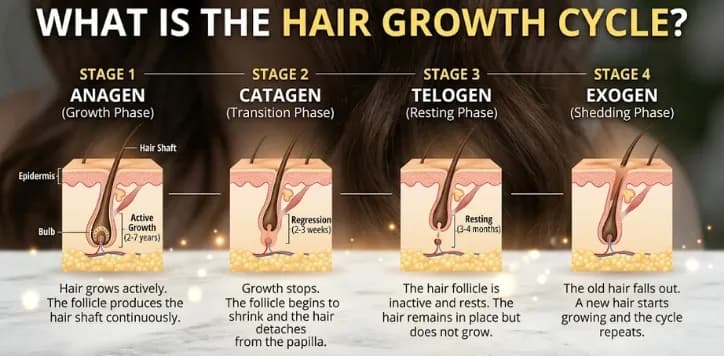
Hair Growth Cycle Stages: Anagen, Catagen, Telogen and Exogen
Most patient-friendly explanations use four stages: anagen, catagen, telogen, and exogen. Some medical texts describe three main phases and treat exogen as the shedding part of telogen. For a reader trying to understand daily shedding, the four-stage version is clearer because it separates “resting” from “falling out.”
| Stage | Simple Meaning | What Happens | Typical Timing |
|---|---|---|---|
| Anagen | Growth phase | The follicle actively produces the hair fibre. This phase builds length and much of visible density. | Usually several years for scalp hair |
| Catagen | Transition phase | Growth slows, the lower follicle regresses, and the strand prepares to move toward rest. | Around 2 to 3 weeks |
| Telogen | Resting phase | The old hair is no longer actively growing, but it may remain anchored while the follicle resets. | Often about 2 to 4 months |
| Exogen | Shedding phase | The old strand releases. You see it on the pillow, comb, shower drain, floor, or clothing. | Part of normal renewal |
Anagen phase: where hair length and density are built
Anagen is the active growth stage. Cells in the lower follicle divide and form the hair shaft. This is the phase that lets scalp hair grow long. A longer anagen phase means a strand can keep growing for more time before it naturally transitions. A shorter anagen phase means the strand may shed before it reaches the length you want.
Most scalp follicles are usually in anagen at any given time. That is why a healthy scalp can keep a stable appearance even while some hairs are shedding. The length of anagen varies with genetics, age, hormones, body site, nutrition, and health. Eyebrow hair stays short because its anagen phase is much shorter than scalp hair.
In male pattern baldness and androgenetic alopecia, sensitive follicles gradually miniaturise. Over repeated cycles, the anagen phase may shorten and the hair shaft becomes finer, shorter, and less visible. This is why pattern thinning is not just “hair fall.” It is a change in follicle behaviour over time.
Catagen phase: the short transition before rest
Catagen is brief. Hair production slows, the lower part of the follicle regresses, and the strand loses the same active support it had in anagen. You usually cannot feel catagen happening. There is no specific “catagen symptom” that a person can spot in the mirror.
The main value of understanding catagen is that it prevents panic. A hair does not suddenly fall the moment growth stops. It transitions, rests, and then sheds later. That delay is why the cause of shedding is often not something that happened yesterday.
Telogen phase: the resting stage that explains delayed shedding
Telogen is the resting phase. The strand is no longer growing, but it can remain in the follicle for weeks or months. When many follicles enter telogen together, the shedding may appear suddenly later. This is the reason a fever, illness, childbirth, crash diet, or emotional stress can be followed by hair fall after a delay.
This delayed pattern is commonly discussed as telogen effluvium. The follicle is usually still alive in this situation. The issue is that too many follicles shifted into rest at the same time. If the trigger stops and no other condition is active, the cycle can gradually rebalance.
Exogen phase: the hair you actually see falling
Exogen is the visible shedding stage. This is the full-length strand you see after washing, brushing, oiling, sleeping, or running your fingers through your hair. A shed strand may have a small pale club-shaped end. That does not mean the living root has been permanently pulled out. The active follicle sits deeper in the scalp.
A wash day can look dramatic because loose telogen hairs collect and come out together. Long hair also looks more alarming than short hair because each shed strand has more visible volume. The important question is not whether any hair came out. The question is whether shedding is far above your baseline, lasting too long, or paired with visible thinning or scalp symptoms.
Evidence basis: ISHRS, “Hair Loss and the Hair Growth Cycle”; DermNet NZ, “Hair Shedding”; Healthline medically reviewed hair-growth-cycle explainer; NCBI Bookshelf StatPearls, “Physiology, Hair.”
How Fast Does Hair Grow?
Scalp hair commonly grows around 1 cm per month, but the visible result depends on more than growth speed. The length you see depends on how long the follicle stays in anagen, how much breakage occurs, how thick each strand is, and whether the follicle is healthy enough to keep producing a strong fibre.
This is why “my hair is not growing” can mean different things. In some people, the hair is growing but breaking before it gains length. In others, anagen may be shortened by age, deficiency, hormonal triggers, or pattern hair loss. In others, frequent shedding makes the ends look thinner even though short regrowth is present near the scalp.
A practical timeline is easier than daily checking. If shedding is triggered by telogen effluvium, it may take months for shedding to settle and months more for new short hairs to create visible density. If pattern hair loss is active, the timeline depends on early diagnosis and whether miniaturised follicles are still responsive. For better tracking, use consistent lighting and monthly photos, not daily mirror checks. This is similar to the process explained in tracking hair growth progress with monthly photos.
| Timeframe | What You May Notice | What It Usually Means |
|---|---|---|
| First few weeks | Shedding may continue even after you correct a trigger. | Old resting hairs may still be releasing. |
| 2 to 3 months | Shedding may begin to reduce if the trigger is gone. | Cycle balance may be improving, but visible density can lag. |
| 3 to 6 months | Short regrowth may become visible around the hairline or parting. | New anagen hairs may be emerging, but they are still short. |
| 6 to 12 months | Density changes become easier to judge. | Hair has had enough time to grow long enough to affect coverage. |
Evidence basis: NCBI Bookshelf StatPearls, “Physiology, Hair”; AAD, “Do you have hair loss or hair shedding?”; Cleveland Clinic, “Telogen Effluvium.”
Normal Shedding vs Hair Loss: The Difference That Matters
Normal shedding means old hairs are leaving the follicle as part of renewal. Hair loss means something is stopping growth, miniaturising the follicle, damaging the hair shaft, inflaming the scalp, or creating bald patches. The two can overlap, but they are not the same.
A person can shed 50 to 100 hairs daily and still maintain density. A person can also shed less than that but still have progressive thinning if the hairs are becoming finer and shorter over time. This is why counting every strand is not always useful. Pattern, density, scalp symptoms, and time course matter more.
| What You Notice | More Likely Normal Shedding | More Likely Hair Loss |
|---|---|---|
| Daily hair fall | Small steady shedding close to your baseline. | Sudden handfuls, persistent heavy shedding, or rapid volume drop. |
| Scalp visibility | Density looks similar overall. | Parting widens, crown shows, temples recede, or bald patches appear. |
| Pattern | Diffuse strands after wash or brushing. | Hairline recession, crown thinning, centre-part widening, patchy loss, or broken short hairs. |
| Scalp symptoms | No pain, redness, scaling, burning, or itching. | Itching, thick flakes, pain, redness, sores, burning, or tenderness. |
For women, hair loss may show as reduced ponytail thickness, widening parting, or scalp visibility rather than a receding hairline. This is covered more deeply in hair loss in women. For men, early recession and crown thinning often need assessment against the Norwood scale and family pattern.
Evidence basis: AAD, “Hair loss: Overview”; AAD, “Do you have hair loss or hair shedding?”; DermNet NZ, “Hair Shedding.”
What Disrupts the Hair Growth Cycle?
The hair cycle reacts to the body’s overall state. Hair is visible and emotionally important, but biologically it is not essential for survival. When the body is under stress, it can temporarily shift follicles away from active growth. That is why fever, surgery, crash dieting, childbirth, emotional stress, illness, medication changes, nutritional deficiency, and thyroid imbalance can show up later as shedding.
The delay is important. According to StatPearls on telogen effluvium, the event that triggers shedding may occur around three months before hair fall begins, but the timeframe can range from one to six months. That means the trigger may already be over by the time hair fall becomes obvious.
| Trigger Type | Examples | How It May Affect the Cycle |
|---|---|---|
| Physical stress | High fever, infection, surgery, major illness, rapid weight loss | Can push more anagen hairs into telogen, causing delayed diffuse shedding. |
| Hormonal change | Postpartum shift, PCOS, menopause, thyroid imbalance | Can shorten growth rhythm, increase shedding, or overlap with pattern thinning. |
| Nutritional gaps | Low iron stores, low vitamin D or B12 risk, low protein intake, restrictive diets | Can reduce follicle support and contribute to diffuse shedding when clinically relevant. |
| Scalp inflammation | Seborrhoeic dermatitis, psoriasis, fungal infection, chronic itching or scaling | Can worsen shedding, breakage, and scalp discomfort; some causes need medical treatment. |
| Genetic sensitivity | Androgenetic alopecia, family history, early hairline or crown thinning | Can gradually shorten anagen and miniaturise follicles over repeated cycles. |
If shedding is diffuse, testing may be useful when symptoms or history point toward deficiency, thyroid disease, metabolic issues, or hormonal imbalance. Kibo’s guide to blood tests for hair fall explains which tests are usually considered for men and women. You can also read more about iron deficiency and ferritin, vitamin D and hair follicles, and biotin supplements for hair growth.
If the scalp has flakes, redness, itching, or soreness, do not treat it as only a vitamin issue. Read whether dandruff causes hair loss, seborrhoeic dermatitis and scalp flaking, and scalp psoriasis versus dandruff for the scalp-inflammation angle.
Evidence basis: NCBI Bookshelf StatPearls, “Telogen Effluvium”; AAD, “Do you have hair loss or hair shedding?”; DermNet NZ, “Hair Shedding.”
Hair Growth Cycle and Common Hair Loss Patterns
The hair cycle helps explain why different types of hair loss behave differently. Some conditions mainly increase shedding. Some shrink follicles slowly. Some damage the shaft. Some cause patches. Treating all of them with the same oil, shampoo, serum, or supplement misses the point.
Telogen effluvium: too many hairs enter rest together
Telogen effluvium is usually diffuse shedding. The hair may come out more during washing, combing, or finger-running, but the scalp often looks otherwise normal. It may happen after fever, surgery, illness, childbirth, crash dieting, major emotional stress, or medication change. Recovery depends on whether the trigger is gone and whether an underlying issue remains active. For a deeper recovery timeline, read hair recovery after telogen effluvium.
Androgenetic alopecia: the cycle slowly shortens
Androgenetic alopecia is different. It is not just temporary shedding. Genetically sensitive follicles gradually miniaturise under androgen influence. The strand becomes finer, shorter, and less pigmented with repeated cycles. Men may notice hairline recession or crown thinning. Women may notice centre-part widening and reduced density. Kibo’s guide to DHT hormone and hair loss explains the hormone side, while DHT blockers for hair loss explains treatment categories.
Alopecia areata: patches are not explained by routine shedding alone
Round or patchy bald spots need a different lens. They can suggest alopecia areata or another localised scalp problem. A normal hair cycle explanation is not enough. These cases need a scalp exam and often trichoscopy. Read alopecia areata explained if the loss is patchy rather than diffuse.
Breakage: hair looks thin even when follicles are cycling
Not all “hair fall” is hair shedding from the root. Heat, friction, chemical damage, tight hairstyles, harsh brushing, and dryness can break the shaft. Broken pieces are often shorter and may not have a club-shaped end. This can make the hair look less dense even when the follicle is still producing hair. If this sounds familiar, compare
Medical Disclaimer : Information from Kibo Hair Clinics is for educational purposes only. It does not replace diagnosis, trichoscopy, blood test interpretation, prescription treatment, procedure advice, or side-effect counselling from a qualified dermatologist or hair restoration doctor.