
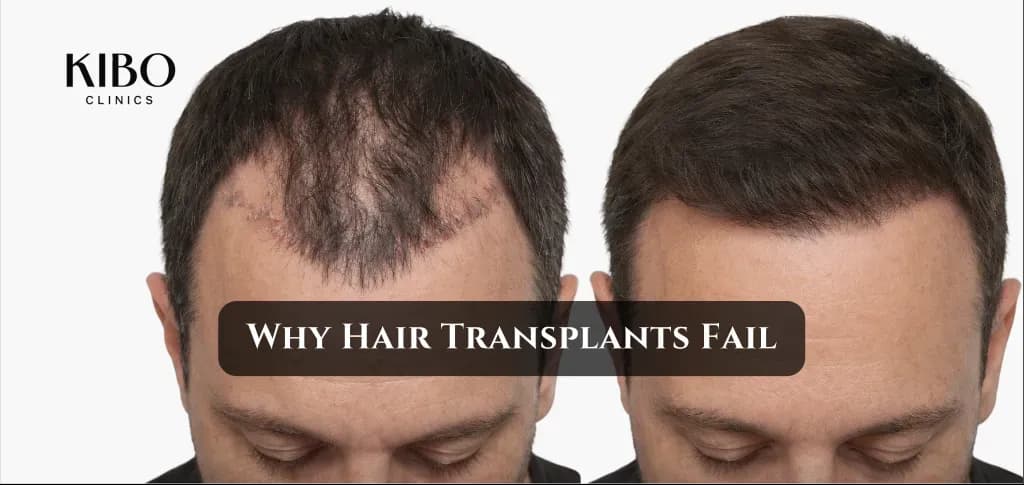
Who This Is For: Anyone unhappy with a hair transplant result who wants to know whether it's actually failed, still maturing, or something in between, and what genuine repair options exist.
An unfavorable hair-transplant result may reflect poor hairline design, pluggy or oversized grafts, wrong angles, inadequate growth, scarring, donor overharvesting, continued native-hair loss, or a result that is still maturing. Some cases can be improved with staged revision, graft removal or redistribution, additional grafting, scar treatment, or camouflage. Repair is not guaranteed: donor supply, scalp condition, diagnosis, timing, and realistic goals determine whether further surgery is advisable.
Does the Transplant Really "Fail"?
"Failed" gets used as a catch-all word for results that are actually quite different from each other, and lumping them together doesn't help anyone. Worth separating: normal maturation still in progress, incomplete growth, poor planning, a genuine technical complication, an aesthetic mismatch between what was done and what actually suited you, progressive native-hair loss changing the picture over time, and a genuinely poor or failed outcome. These need different responses, and calling all of them "failed" pushes people toward panic or premature revision when patience, or a completely different conversation, might be the right call instead.
Eight Common Causes
Fisher's peer-reviewed analysis divides unfavorable outcomes into judgment errors and technical errors. Judgment errors include ignoring progressive hair loss, operating too young, and poor hairline design. A low, straight juvenile hairline can consume a disproportionate share of donor supply and later become an isolated "island" as the native hair around it keeps receding. Planning genuinely needs to account for age, family history, donor density, hair calibre, future pattern, and the real possibility of additional loss down the line, not just what looks good today.
Technical errors include improper angulation, poor graft preparation, poor donor-site closure, and poor overall hairline design. A natural hairline genuinely isn't ruler-straight or perfectly symmetrical; the frontal transition is typically irregular and feathered, with small grafts at the leading edge positioned appropriately for the person's age. Historical rules about exact centimetres or angles shouldn't be treated as universal prescriptions for every face and every hairline.
Older large-punch grafts created the conspicuous "plug" or corn-row look that gave the field its bad reputation, but contemporary results can still look pluggy when multi-hair grafts get placed at the leading edge, spacing is uneven, or grafts end up stacked too close together. Wrong angle and direction is its own category too: hair genuinely needs to emerge according to regional anatomy, existing flow, curl, and calibre, and a graft placed at an unsuitable angle can look unnatural even when it grows perfectly well.
Garg and Garg identify trauma during extraction, poor handling, graft desiccation, and prolonged ischemia as real factors behind poor growth, but it's genuinely wrong to assume every low-density result means the grafts died. Native hair loss, donor quality, medical disease, or simply early timing can all contribute to a result that looks thin right now. And ISHRS is direct about donor limits: donor hair is genuinely finite, FUE overharvesting can create thin, "moth-eaten" areas, and FUT can leave a widened or poorly placed scar if closure tension wasn't managed well.
How Clinicians Assess a Bad Result
A proper assessment covers your history, the original operative records if you can get them, preoperative photographs, graft numbers, the technique originally used, donor assessment, a recipient-area examination, trichoscopy, scalp scarring, native-hair miniaturization, and any relevant medical causes. This is a lot more than a five-minute look at your scalp under bright light, and if a clinic skips most of this before recommending revision, that's worth noticing.
When Should Revision Be Considered?
Severe pain, spreading redness, fever, pus, darkening or dusky skin, persistent crusting, necrosis, heavy bleeding, wound separation, or rapidly worsening swelling are not routine "wait and see" problems. Get these assessed promptly by the operating clinic or an appropriate medical service, not on an elective revision timeline.
For everything else, the result should generally be evaluated after sufficient growth and maturation, commonly around the operating surgeon's planned review point, often somewhere in the 9 to 12 month range, though some cases genuinely continue maturing longer than that. The correct timing varies with technique, graft count, hair characteristics, and the specific question being asked, so there's no single universal deadline that applies to everyone. You shouldn't pursue elective revision just because early shedding or incomplete growth feels disappointing in month 3 or 4.
If there's active scarring alopecia, uncontrolled scalp inflammation, progressive diffuse shedding, unstable androgenetic alopecia, or untreated medical disease, that needs to be addressed first. Revision on an inflamed or unstable scalp genuinely can make the result worse, not better.
What Can Corrective Surgery Do?
Options include selective graft removal, redistribution, additional grafting, scar revision, scar camouflage, hairline softening, and staged density restoration. Most cases can be significantly improved, but that needs a real qualification: correction may be partial, staged across multiple sessions, or in some cases genuinely not possible given what's left to work with. Corrective surgery can improve appearance, but it can't guarantee normal density, fully erase scars, restore donor supply that's already been used up, or recover every damaged follicle. Anyone promising otherwise is overselling what surgery can actually do.
When Should Surgery Not Be Performed?
Insufficient donor hair, active disease, unstable ongoing loss, unrealistic goals, inadequate records from the first procedure, a poor healing risk, or simply not enough time having passed for maturation are all genuine reasons to hold off. In some of these situations, observation, a hairstyle change, or medical treatment for ongoing hair loss is the more appropriate next step than another operation.
Cause-to-Repair Matrix
| Unfavorable Finding | Possible Cause | Assessment | Potential Options | Limitation |
|---|---|---|---|---|
| Too-low or straight hairline | Poor design, aggressive patient goal, progressive loss | Compare facial proportions, age, native loss, graft size and transition zone | Selective graft removal, hairline softening, camouflage, staged redistribution | Cannot recreate unlimited donor supply |
| Pluggy or doll-hair appearance | Large grafts, poor spacing, multi-hair grafts at front | Examine graft size, spacing, skin texture, density | Graft excision, redistribution, additional singles, SMP | Removal can injure surrounding follicles and leave scars |
| Wrong angle/direction | Recipient-site creation or placement error | Examine emergence angle and regional flow | Selective extraction and reimplantation; camouflage | Requires high technical skill; grafts may not all be salvageable |
| Poor or patchy growth | Graft trauma, desiccation, ischemia, disease, poor planning, or normal timing | Wait/assess at appropriate interval; inspect scalp and records | Medical treatment, additional grafting after diagnosis | Cause may remain uncertain; no guarantee of improved growth |
| Continued thinning behind grafts | Progressive androgenetic alopecia | Compare baseline and current photographs; assess miniaturization | Medical treatment, staged grafting, long-term plan | Transplant does not stop native loss |
| FUE "moth-eaten" donor | Overharvesting or uneven extraction | Shaved and longer-hair examination, donor density mapping | Conservative camouflage, selective grafting, SMP | Donor reserve may be permanently reduced |
| Wide or painful FUT scar | Closure tension, healing, individual scar response | Scar examination and medical history | Scar revision, grafting into scar, SMP | Scar cannot always be erased; revision may widen it |
| Necrosis, infection, active inflammation | Surgical complication or scalp disease | Prompt examination; do not proceed with elective revision | Treat active condition first | Further surgery may be contraindicated |
Repair Options in Detail
Unnatural grafts can sometimes be removed, fully or partially, especially when they're too low, too large, or misdirected. But extraction itself can injure surrounding follicles and leave hypopigmentation, pitting, or new scars, so it should be presented as a specialised option, not an easy reset button. ISHRS describes modern FUE as allowing selective removal and, in some cases, moving grafts to a more appropriate area, though feasibility depends on graft quality, tissue condition, time since the original surgery, location, scarring, and how much donor reserve is left. A graft can't be guaranteed to survive after being manipulated a second time.
New grafts may soften a transition zone, improve density, camouflage scarring, or fill in an area left untreated, but only if there's genuinely enough safe donor supply remaining and future loss has actually been planned for. A wide FUT scar may sometimes be revised or camouflaged with grafts; FUE donor dots may be less visible with longer hair but are genuinely not scarless. Scalp micropigmentation can camouflage selected scars or low-density areas, but it doesn't create real hair and doesn't stop disease progression. Treatment for ongoing androgenetic alopecia may preserve native hair and improve the long-term appearance, and it should be individualised with a qualified clinician rather than started on your own. Sometimes observation or a hairstyle change is genuinely the safer option when donor supply is limited, not a consolation prize.
Choosing a Revision Surgeon
Ask specifically about extensive revision experience, not just routine first-time cases, since surgeon experience genuinely matters more here than in a standard first procedure. Request an explanation of the diagnosis, available donor supply, safe donor boundaries, graft-removal risks, the likely number of sessions, alternative non-surgical options, and what the plan is if growth turns out poor again. Ask who actually performs consultation, extraction, recipient-site creation, and placement, and what direct surgeon supervision genuinely means under local regulations, rather than assuming every step is done by the person you consulted with.
Get the operative report, graft count, technique, photographs, medication list, and complication history from your first procedure if you can. It's also worth knowing the general red flags in clinic selection and understanding how to actually read before-and-after photos rather than what a clinic's gallery wants you to see. Avoid any provider who guarantees complete correction, promises a fixed density, refuses to discuss donor limitations, pressures you to operate before maturation is complete, or shows only best-case results without comparable lighting, hair length, and follow-up.
Unhappy with a previous result? An honest assessment tells you what's actually possible before you commit to anything.
Kibo Clinics' Perspective on Corrective Hair Transplants
Not every disappointing result is a failure, and not every failure can be fully fixed. We think both of those things are worth saying plainly, even when the second one isn't what someone wants to hear in the moment.
At Kibo Clinics, we believe a revision conversation has to start with an honest look at what's actually left to work with, not a promise made before anyone has examined your scalp.
If you're unhappy with a previous transplant, a Kibo Clinics hair specialist can properly assess what happened, what your donor supply actually looks like now, and what genuinely realistic options exist for your specific situation.
Frequently Asked Questions
Is a low hairline always a failed transplant?
No. Its appropriateness depends on facial proportions, age, hair calibre, design, density, transition zone, and future loss. A low straight line with a harsh edge is more concerning than a naturally irregular hairline that sits lower on one individual.
Why is my transplant still thin after one year?
Possible explanations include normal maturation, inadequate graft number, poor graft growth, continuing native-hair loss, hair calibre, curl, scarring, or a diagnosis that was not stabilized. A review with records and photographs is needed.
Can scalp micropigmentation fix a bad transplant?
SMP can camouflage selected scars or low-density areas, but it does not create hair, correct wrong growth direction, or stop hair loss. It should be performed by an experienced provider familiar with hair-restoration patients.
Can body hair be used in revision?
ISHRS describes body-hair use as an option in selected cases, but body hair differs in calibre, growth cycle, texture, and predictability. It is not a universal substitute for scalp donor hair.
Is revision harder than a first transplant?
Often it is more complex because the scalp may contain scar tissue, donor reserves may be depleted, existing grafts must be protected or removed, and the design must correct a prior problem while planning for future loss.
Related Articles & Services
Hair Transplant
Corrective Hair Transplant | FUE Hair Transplant | Sapphire FUE Hair Transplant | Real-Time FUE Hair Transplant | Bio FUE Hair Transplant | Unshaven Hair Transplant | Direct Hair Transplant (DHT) | Body Hair Transplant | Hairline Correction
Hair Regrowth
PRP Therapy | GFC Therapy | Exosomes Therapy | IV Hair Boosters | Low-Level Laser Therapy | Mesotherapy for Hair Regrowth | Microneedling for Hair Regrowth | PDO Threads for Hair Regrowth
Must Read
Hair Transplant Procedure Steps | Hair Transplant Side Effects Guide | The Role of the Donor Area | Hair Breakage Causes and Treatments
Relevant Blogs
Hair Growth Cycle and Mechanical Shedding | Hairline Design Over Graft Count | Crown Restoration Challenges | What a Good Hair Transplant Gallery Looks Like | How Long Hair Transplant Results Last
Medical Disclaimer : Information from Kibo Hair Clinics is for educational purposes only. It does not replace diagnosis, trichoscopy, blood test interpretation, prescription treatment, procedure advice, or side-effect counselling from a qualified dermatologist or hair restoration doctor.