Discover expert insights on hair transplant procedures, FUE techniques, recovery tips, and hair restoration guides from Kibo's experienced team.

DHT blockers are most useful when hair loss is driven by androgenetic alopecia, because they reduce or interrupt the androgen pathway that miniaturises genetically sensitive follicles. Finasteride has the longest-established evidence for male pattern hair loss, while dutasteride suppresses DHT more strongly and often performs better in comparative studies but has a different approval and safety profile. Topical finasteride can reduce systemic exposure without eliminating it, while natural products and shampoos have much weaker evidence. This refresh also explains when a DHT blood test is unnecessary, current 2025-2026 safety updates, timelines, women’s considerations, what happens after stopping treatment, and when a transplant or non-DHT treatment may be more relevant.
Published: August 21, 2026 – 5 min read

Touching, twirling, or pulling your hair dozens of times a day creates cumulative mechanical stress that causes concentrated breakage and thinning exactly where you fidget most.
Published: August 21, 2026 – 5 min read

Gentle, occasional beard stroking is unlikely to cause patchy beard hair loss by itself. The risk changes when touching becomes repeated twisting, tight tugging or actual plucking: those behaviours can break the hair shaft, create traction on follicles or, when recurrent and difficult to control, fit trichotillomania. Touching can also transfer dirt and germs to the skin beneath the beard, which is a skin-care issue rather than proof of follicle damage. This guide separates breakage from follicular hair loss, explains how traction and beard trichotillomania differ from alopecia barbae, folliculitis and fungal infection, and shows what to do before assuming a beard habit is the cause of a bald patch.
Published: August 21, 2026 – 5 min read

Chlorinated pool water mainly damages the hair shaft rather than the follicle. Repeated exposure can make hair rougher, drier, more porous, tangled and easier to break, especially when it is bleached, coloured, curly, coily or already heat-damaged. A classic study of elite swimmers found major cuticle and colour changes without evidence of reduced hair-bulb activity, supporting the distinction between swimmer's hair and true follicular hair loss. Blonde or bleached hair that turns green is usually showing copper deposition, not chlorine pigment. The practical prevention sequence is fresh-water pre-wetting, a well-fitting swim cap, prompt post-swim rinsing, appropriate cleansing and conditioning. Chelating products are more useful for mineral or copper buildup, while strong clarifying shampoo is not automatically needed after every swim. Persistent widening of the part, recession, smooth patches, heavy shedding, pain, pustules or scarring needs a separate diagnosis rather than being blamed on the pool.
Published: August 21, 2026 – 5 min read

For someone living or working in Worli, the best hair-transplant decision is not automatically the nearest clinic or the cheapest per-graft quote. Worli and nearby Lower Parel, Prabhadevi, Mahalaxmi and South Mumbai have multiple hair-restoration options, but outcomes depend more on diagnosis, donor supply, hairline planning, who performs the surgical steps, graft handling and long-term planning than on the locality printed on the clinic page. Kibo Clinics is physically located in Khar West, not Worli, so this guide is written transparently for Worli patients comparing local clinics with Mumbai-wide options. It explains current Mumbai pricing logic, FUE and direct-implantation terminology, surgeon-vs-technician questions, graft-count planning, recovery, women’s candidacy, warning signs and the exact questions to ask before paying a booking amount.
Published: August 21, 2026 – 5 min read

Low-Level Laser/Light Therapy (LLLT), also called photobiomodulation or red-light therapy, has genuine clinical evidence for increasing hair density in some men and women with androgenetic alopecia, especially where miniaturised follicles are still present. Randomised sham-controlled trials of comb, cap and helmet devices and later meta-analyses support a modest hair-growth effect, but results are device- and protocol-specific and the evidence base has important limitations: many trials are small, follow-up is usually measured in months rather than years, and device designs, wavelengths, irradiance, fluence and treatment schedules vary. Hair-growth devices in the United States are generally FDA-cleared through the 510(k) pathway, not FDA-approved like a new drug. LLLT does not create new follicles in smooth long-standing bald areas, does not replace diagnosis or DHT-directed treatment when indicated, and has limited direct evidence for improving hair-transplant graft survival. The most useful way to choose LLLT is to confirm the type of hair loss first, then evaluate the specific device, clinical evidence, scalp coverage, treatment schedule, safety precautions, total cost and whether you can use it consistently for several months.
Published: August 21, 2026 – 5 min read
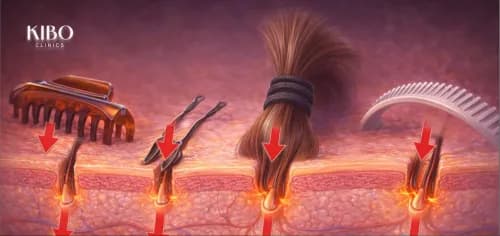
Yes, but usually because of repeated tension rather than because a claw clip, headband or pin is inherently harmful. The hairstyles which keep pulling on the hair can damage follicles and lead to traction alopecia.
Published: August 21, 2026 – 5 min read

A biotin IV infusion for hair growth pushes concentrated Vitamin B7 directly into your bloodstream. By bypassing the digestive tract, a biotin IV drip for hair ensures 100% bioavailability, accelerating keratin synthesis and strengthening the hair shaft from within. While traditional oral supplements are effective for general maintenance, intravenous therapy is a clinically superior option for individuals with malabsorption issues, chronic stress-induced shedding, or documented deficiencies. Most patients observe a visible improvement in hair density and texture within 8 to 12 weeks of consistent clinical sessions.
Published: August 21, 2026 – 5 min read

Washing your hair after a long day in Ahmedabad's 42-degree heat, hoping to feel refreshed, but instead noticing your hair feels rougher and more tangled than before shampooing, with visible strands collecting in the drain every single wash, creates the frustrating cycle thousands of Ahmedabad residents experience as they watch their hair become progressively drier, more brittle, and thinner despite trying every conditioner and hair mask available at local stores, not realizing the mineral-heavy water flowing from their taps is coating every strand with calcium and magnesium deposits that damage hair structure with each wash
Published: August 21, 2026 – 5 min read
YOUR HAIR JOURNEY STARTS HERE
