

Who This Is For: Frequent or competitive swimmers, parents of children who swim regularly, people with bleached or coloured hair, curly or coily hair, people noticing roughness or breakage after pool sessions, anyone worried that chlorine is causing hair loss, and people trying to decide between a swim cap, pre-swim conditioner, swimmer's shampoo, clarifying shampoo or chelating treatment.
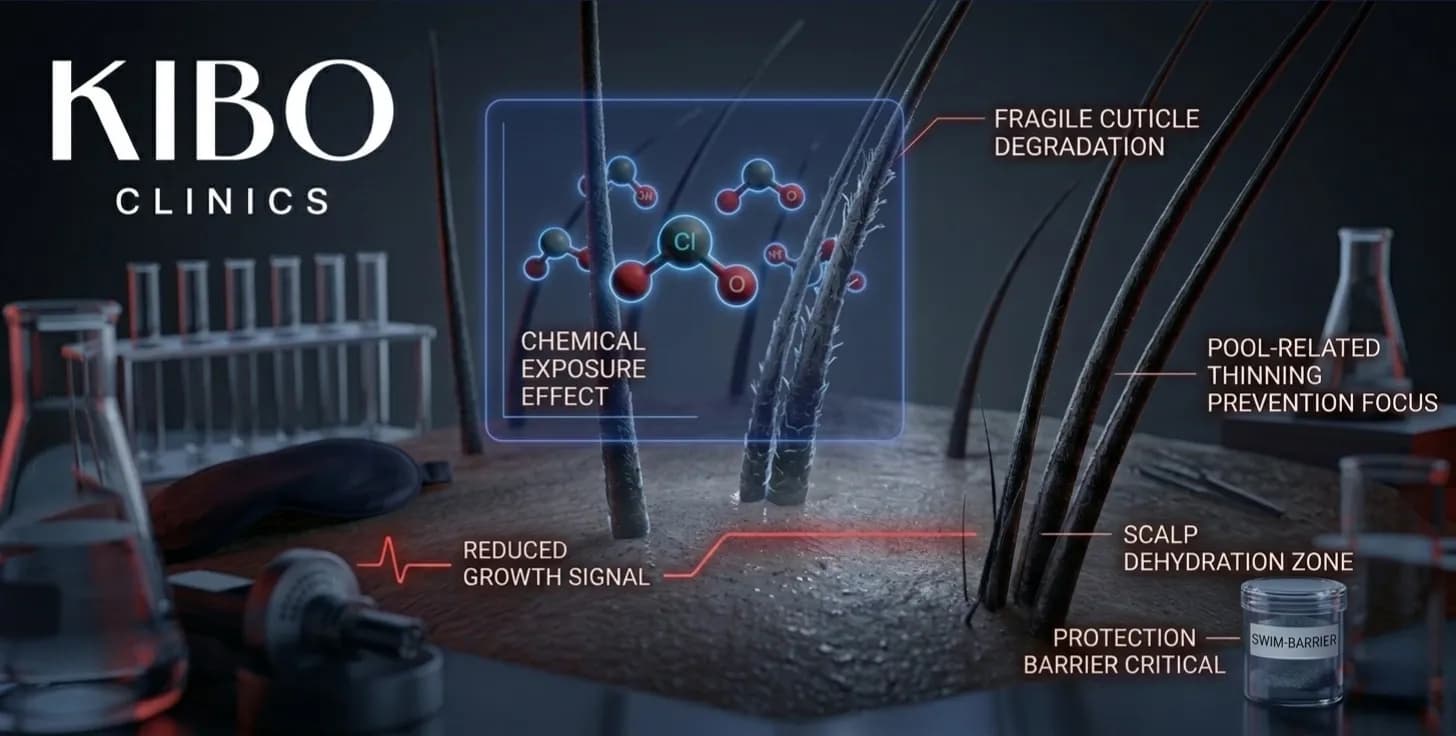
Yes, repeated chlorinated-pool exposure can damage the hair shaft, but routine swimming does not usually cause permanent follicular hair loss. Swimmer's hair is mainly a fibre problem: the hair can become rough, dull, tangled, brittle and easier to break. The risk rises when chlorine exposure is combined with friction, repeated wetting and drying, ultraviolet exposure, bleaching, colouring, heat styling or aggressive post-swim detangling.
Two myths need correcting immediately. Light or bleached hair that turns green in a pool is usually accumulating copper or other metals; chlorine can contribute to oxidation and cuticle damage but is not itself the green pigment. And hair that looks thinner after months of swimming may simply be breaking along the shaft. A widening part, receding hairline, smooth bald patch or heavy root shedding needs a separate diagnosis.
| What You Notice | Most Likely Level | First Step |
|---|---|---|
| Roughness, tangling, split ends, short snapped hairs | Hair shaft / cuticle | Reduce exposure and friction; rinse, cleanse appropriately and condition. |
| Green tint in blonde, grey or bleached hair | Metal deposition, especially copper | Use mineral-removal/chelating care. |
| Dry, itchy or stinging scalp | Irritant skin-barrier problem | Rinse promptly; assess persistent dermatitis. |
| Widening part, recession, patches or prolonged shedding | Possible follicular hair loss | Investigate the cause instead of blaming the pool. |
What Does Chlorine Actually Do to Hair?
Hair is a keratin fibre protected by overlapping cuticle cells. Pool water repeatedly wets the fibre, while friction from water movement, caps, towels, brushing and styling can wear the surface. Chlorine-related oxidants add chemical stress. As the cuticle becomes rougher or more porous, the strand tangles more easily and requires more force to comb, creating a second round of mechanical damage.
The strongest classic human evidence comes from a 2000 study of 67 elite swimmers and 54 controls. Hair discoloration affected 61% of swimmers and none of the controls. Microscopy of selected swimmer hairs showed severe cuticle loss and altered pigment structures, while hair-bulb tyrosine uptake was not significantly different. That supports the key distinction: repeated swimming can damage the fibre without proving impaired follicle growth.
Does Chlorine Cause Hair Loss or Just Breakage?
Routine pool exposure is much better supported as a cause of shaft damage than as a cause of androgenetic alopecia, alopecia areata or telogen effluvium. Broken hairs can make a ponytail feel thinner and increase visible hair in the shower, but a snapped strand is not the same as a hair lost because the follicle entered a shedding phase or miniaturised.
If scalp density is changing, review broader hair loss types and causes rather than repeatedly changing swimmer shampoo.
Chlorine, Copper and Chloramines: Three Different Pool Problems
| Pool Factor | Main Issue | Common Myth |
|---|---|---|
| Free chlorine / hypochlorous chemistry | Disinfection plus oxidative stress on exposed fibres | It causes every type of hair loss and every colour change. |
| Copper and other metals | Green or dull discoloration, especially in light porous hair | Chlorine itself is the green pigment. |
| Chloramines | Eye, skin and respiratory irritation | A strong pool smell means there is more effective free chlorine. |
CDC guidance explains that chloramines form when free chlorine reacts with nitrogen-containing contaminants. They matter for irritation, but they should not be described as a direct cause of pattern baldness.
Why Does Blonde or Bleached Hair Turn Green in a Pool?
Green swimmer's hair is primarily linked to copper deposition. Dermatology reports have found increased copper in green hair, especially in blonde or previously damaged hair exposed frequently to pool or domestic water. Bleaching, colouring, mechanical damage and sun exposure make the fibre more receptive to deposits.
That changes the solution. A conditioner improves feel but does not efficiently remove metal. Chelating care is designed for minerals. Repeated harsh clarifying or uncontrolled DIY acid/alkaline treatments can make porous hair even more fragile.
Chelating Shampoo vs Clarifying Shampoo: Which Does a Swimmer Need?
A clarifying shampoo is mainly a stronger cleanser for oil, styling film and general buildup. A chelating formula is designed to bind metal or mineral deposits, often using ingredients such as EDTA. Some swimmer products combine both functions.
| Hair Situation | Better Starting Point | Caution |
|---|---|---|
| Occasional swim, no persistent residue | Gentle regular shampoo as needed | Do not over-clean simply because a pool was involved. |
| Persistent coated feel / styling buildup | Intermittent clarifying | Overuse can worsen dryness. |
| Green tint / suspected metal buildup | Chelating / mineral-removal product | Condition afterward. |
| Bleached, curly or fragile hair | Mildest cleanser that removes residue + conditioner | A deep clean is not automatically healthier. |
How to Protect Hair Before Swimming
- Pre-wet with fresh water. This is a low-risk step recommended by medical/university sources and reduces immediate pool-water uptake.
- Add slip to dry or porous lengths. A light leave-in can reduce friction, but it is not a chemical-proof shield.
- Wear a well-fitting cap. Silicone or latex caps reduce exposure but are not fully waterproof.
- Use a loose, low-tension style under the cap. Do not create traction while trying to avoid chlorine.
- Reduce extra stress. Recently bleached, gummy or already snapping hair has less structural margin for repeated pool exposure.
- Protect outdoor swimmers from UV. Sun and pool exposure often act together.
Should You Wet Your Hair Before Swimming?
Yes, as part of a broader routine. Cleveland Clinic and UAB experts recommend getting hair wet before entering chlorinated water. The common sponge analogy is useful, but there is no need to invent an exact percentage of chlorine reduction. Pre-wetting lowers exposure; it does not make hair chlorine-proof.
Does a Swim Cap Keep Chlorine Out of Hair?
A cap reduces contact but usually does not keep every strand completely dry. Water enters around edges and fit varies with hair volume/material. Cap friction can also contribute to breakage if fragile hair is shoved under it roughly. Pre-wet, secure hair without high tension and remove the cap gently.
What Should You Do Immediately After Swimming?
- Rinse with fresh water promptly.
- Cleanse according to residue, scalp oil and hair type.
- Condition the lengths to reduce friction.
- Detangle with slip, working from the ends upward.
- Blot instead of rubbing with a towel.
- Avoid tight post-swim buns and rough brushing. Read wet hair styling damage.
- Use lower heat while the fibre is rough or fragile.
Should You Shampoo After Every Swim?
Rinse after every swim; shampoo frequency should be individualized. A competitive swimmer training daily may need frequent cleansing, while an occasional swimmer with dry curls may not need strong shampoo after each session. If a swimmer's shampoo leaves hair squeaky, rough or brittle, the routine is too stripping.
Chlorine and Curly or Coily Hair
Curly and coily fibres contain bends where mechanical stress concentrates, and the lengths can be less lubricated. Pool exposure can increase roughness, knotting and detangling force. Use high-slip conditioner, sectioned detangling and low-tension styles. Read Kibo's guide to curly hair breakage.
Chlorine and Bleached or Colour-Treated Hair
Chemical processing increases porosity and reduces the margin for additional oxidative and mechanical stress. Pool exposure can therefore produce more obvious roughness, fading, tangling and metal deposition. If bleached hair becomes gummy when wet or snaps under gentle handling, reduce additional chemical/heat stress rather than repeatedly clarifying it.
Is Chlorinated Tap Water the Same as Pool Exposure?
No. Exposure pattern matters. Both drinking water and pools can contain disinfectant residuals, but swimmers may keep hair immersed for a long session while also dealing with pool pH, metals, repeated wetting, cap friction and UV. A short shower should not automatically be treated as equivalent to repeated training in a pool.
Chlorine vs Salt Water: Which Is Worse?
There is no universal winner. Pools add disinfectant chemistry and sometimes metals; seawater leaves salt/mineral residue and is often paired with strong sun and wind. Both mainly increase shaft roughness and breakage rather than causing permanent baldness. For sea swimming, read salt water hair damage.
Can Chlorine Irritate the Scalp?
Yes. Pool chemicals can aggravate a sensitive skin barrier, while chloramines are associated with skin, eye and respiratory irritation. People with eczema, psoriasis or seborrhoeic dermatitis may notice more tightness or itch. Persistent thick scale, pustules, oozing or pain needs diagnosis. Hot-tub folliculitis, for example, is usually a bacterial problem associated with inadequately maintained water, not chlorine chemically destroying follicles.
Does Coconut Oil Before Swimming Protect Hair?
Coconut oil has laboratory evidence for reducing protein loss from damaged and undamaged hair. That supports it as a shaft-conditioning strategy, not as proven chlorine neutralisation, because the classic study was not a swimming-pool trial. Use a small amount on suitable lengths if it improves manageability and cap fit.
Do Vinegar, Baking Soda or Tomato Juice Remove Chlorine or Green Hair?
DIY remedies are popular because acids can affect mineral deposits and colour, but kitchen mixtures have uncontrolled pH and concentration. Baking soda is alkaline and can make rough hair feel worse; strong acids can irritate the scalp or alter colour-treated hair. For persistent metal-associated green hair, purpose-made chelation is more predictable.
Can Chlorine-Damaged Hair Be Repaired?
Surface condition can improve; a fractured strand cannot biologically heal. Conditioner, silicones, cationic agents and oils can reduce friction and temporarily smooth the surface. Mild roughness may feel better quickly, while severe breakage improves only as protected new length grows and damaged sections are trimmed.
When Swimming Is Not the Real Cause of Thinning
| Pattern | Why Pool Damage Does Not Explain It | Next Step |
|---|---|---|
| Widening central part | Suggests follicular miniaturisation | Assess pattern hair loss. |
| Receding temples / crown | Typical androgenetic pattern | Diagnosis-led medical plan. |
| Round smooth patches | Not swimmer's-hair pattern | Rule out alopecia areata or infection. |
| Heavy full-length shedding | Suggests hair-cycle shedding | Review illness, stress, thyroid, iron, weight loss and medicines. |
| Pain, pus or shiny scarring | Possible inflammatory/infectious/scarring disease | Prompt dermatology review. |
Do PRP or GFC Repair Chlorine-Damaged Hair?
No. These procedures do not rebuild a weathered or fractured shaft. If the problem is swimmer's hair, the first-line response is exposure reduction, suitable cleansing, conditioning and gentler handling.
If examination shows a separate non-scarring follicular hair-loss condition, a clinician may discuss condition-specific adjuncts such as PRP therapy for hair loss or GFC therapy for hair regrowth. Those decisions should be based on diagnosis, not simply on swimming.
Not sure whether you are seeing swimmer's breakage or true thinning? Assess the scalp pattern before spending on regrowth treatment.
Frequently Asked Questions
Does chlorine cause permanent hair loss?
Routine pool exposure mainly damages the hair shaft and is more likely to cause dryness and breakage than permanent follicular hair loss. Progressive thinning, recession or bald patches need another explanation.
Why does blonde hair turn green in a swimming pool?
Green swimmer's hair is mainly linked to copper or other metal deposition. Chlorine can contribute to cuticle damage and oxidation, but chlorine itself is not the green pigment.
Should I wet my hair before swimming?
Yes. Fresh-water pre-wetting is a practical exposure-reduction step. It does not make the hair chlorine-proof, so a cap and post-swim rinse still matter.
Does a swim cap completely protect hair from chlorine?
No. A well-fitting cap reduces water contact and keeps hair controlled, but most caps are not fully watertight.
Should I shampoo after every swim?
Rinse after every swim. Shampoo frequency depends on residue, scalp oil, product use and hair dryness. Strong clarifying shampoo is not necessary after every session for every swimmer.
What is the difference between clarifying and chelating shampoo?
Clarifying shampoo mainly removes oil, styling film and general buildup. Chelating formulas are designed to bind mineral or metal deposits such as copper.
Does chlorine damage curly or coily hair more?
Curly and coily hair may show more dryness, tangling and breakage because bends concentrate mechanical stress and the lengths can be less lubricated.
Can chlorine damage bleached or coloured hair?
Yes. Chemically processed hair is more porous and has less structural margin for additional oxidative and mechanical stress.
Can chlorine irritate the scalp?
Yes. Pool chemicals can contribute to dryness and irritant dermatitis. Persistent pain, pustules, thick scale or oozing needs assessment.
Does coconut oil protect hair from chlorine?
Coconut oil has evidence for reducing hair protein loss, but the classic studies were not pool-chlorine trials. It should not be described as a proven chlorine neutraliser.
How long does chlorine-damaged hair take to recover?
Mild roughness can improve quickly with conditioning and reduced exposure, but a fractured hair shaft cannot biologically heal. Severely split or broken sections need to grow out or be trimmed.
When should I see a dermatologist?
Seek assessment for persistent density loss, a widening part, receding hairline, bald patches, prolonged full-length shedding, scalp pain, pustules or shiny scarring.
Bottom Line
Chlorine can damage hair, but swimmer's hair is primarily a shaft problem rather than a direct cause of permanent baldness. Repeated pool exposure can roughen the cuticle, alter colour and increase breakage, especially when hair is bleached, coloured, curly, coily or already weathered. Green discoloration is more strongly linked to copper deposition than to chlorine pigment.
Pre-wet with fresh water, use a cap, rinse promptly, cleanse only as strongly as needed, condition the lengths and handle wet hair gently. When scalp density is actually reducing rather than the ends simply looking damaged, investigate the follicle instead of blaming the pool.
Related Articles & Services
Hair Transplant
FUE Hair Transplant | Sapphire FUE Hair Transplant | Direct Hair Transplant (DHT) | Corrective Hair Transplant | Hairline Correction
Hair Regrowth
Microneedling for Hair Regrowth | Low-Level Laser Therapy | Mesotherapy for Hair Regrowth
Must Read
Dermatologist-Recommended Shampoo | Hair Ties vs Scrunchies vs Clips | Hair Dryer Heat Safety | Daily Hair Protection | Hair Breakage Causes and Treatments
Relevant Blogs
Male Pattern Baldness | Hair Loss in Women | Scalp Psoriasis vs Dandruff | Seborrhoeic Dermatitis | Non-Surgical Hair Loss Treatments in India
Medical Disclaimer : Information from Kibo Hair Clinics is for educational purposes only. It does not replace diagnosis, trichoscopy, blood test interpretation, prescription treatment, procedure advice, or side-effect counselling from a qualified dermatologist or hair restoration doctor.