
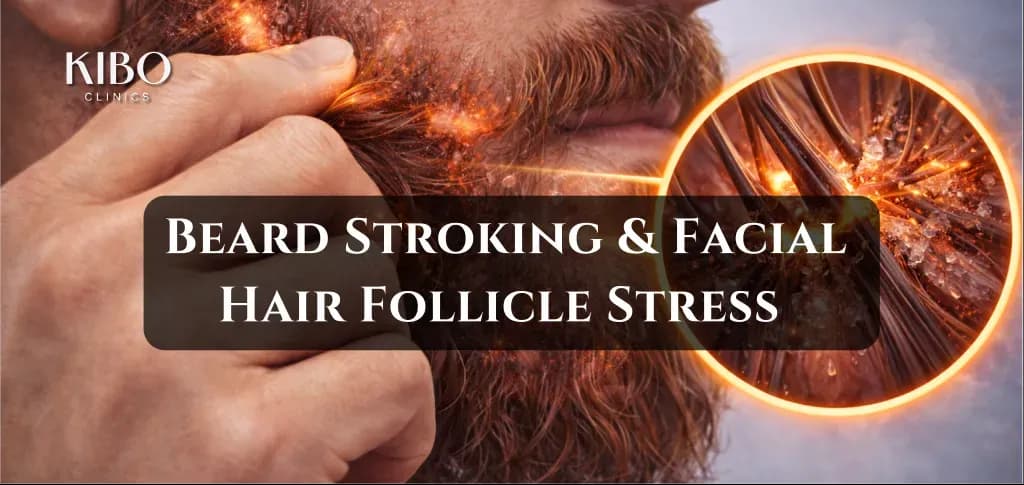
Can Beard Stroking Cause Patchy Growth? What Your Habit Is Doing to Your Follicles
Published on Thu Apr 23 2026
Article Information
Reviewed By: Kibo Clinics Content and Fact-Checking Team
Sources Referenced: American Academy of Dermatology (AAD) guidelines on traction alopecia, peer-reviewed research on facial hair anatomy on PubMed and PMC, NIH resources on trichotillomania and body-focused repetitive behaviours
Last Updated: April 2026
Reading Time: 13 minutes
Who This Is For: Anyone with a beard who notices patchy growth, thinning, or bald spots in areas they frequently touch, stroke, or pull
This article is for education only. For persistent beard patchiness, consult a qualified dermatologist to rule out autoimmune or medical causes.
Patchy beard not improving? Board Certified Dermatologists can check whether it is habit-related, autoimmune, or something else.
Vikram had been growing his beard for about two years. He was proud of it. But over the past six months, the left side of his chin was noticeably thinner than the right. The jawline on one side was filling in normally; the other had stubborn patches that would not grow past a certain length. He assumed it was genetics. Then his wife pointed something out during dinner: "You have been twisting that exact spot on your chin for the last twenty minutes." He had not noticed. He recorded himself during a few work calls the next day. In one hour, his hand went to his beard forty-three times. Mostly stroking. Some twisting. A few tugs on the chin. All concentrated on the left side - the exact side that was thinner.
If your beard has patchy spots that match where you tend to touch, stroke, or fidget, you are not imagining the connection. This guide explains what is actually happening to your facial follicles, why we do it in the first place, why beard hair is more vulnerable than scalp hair, how to tell if your habit is the cause, and what to do about it - including when it crosses into something that needs professional help.
Why Do Men Stroke Their Beards?
Before we talk about damage, it helps to understand why this habit exists. Beard stroking is one of the most common self-soothing behaviours in men. You are not doing anything unusual or wrong by touching your beard. It serves real psychological purposes.
Concentration and thinking. When you are working through a problem, reading something complex, or considering a decision, your hand often goes to your beard without you deciding to do it. The tactile feedback from touching your face helps anchor your attention. In body language, beard stroking during conversation is generally associated with thoughtful consideration - the person is processing what they have heard before responding.
Stress relief. Like nail biting, pen clicking, or finger tapping, beard stroking is a fidgeting behaviour that helps release nervous energy. Men under work pressure, students during exams, and anyone dealing with chronic stress tend to do it more frequently. It is the same mechanism that drives people to twirl their hair when anxious.
Self-grooming and comfort. Touching your beard simply feels familiar and calming. You do not decide to do it. Your hand just goes there. It is an automatic behaviour, the same category as adjusting your watch strap or touching your earring.
None of this is a problem in itself. The issue starts when the frequency crosses from occasional to constant - when gentle stroking becomes 40, 60, 100 repetitions a day, every day, concentrated on the same zones. That is when a harmless comfort behaviour starts creating measurable follicle stress.
Does Stroking Your Beard Help It Grow? (No, It Does Not)
This is one of the most common beliefs about beards, and it is not supported by any evidence. The idea is that stroking stimulates blood flow to the follicles, which promotes growth. While increased blood flow to the scalp or face can theoretically support follicle health, the amount of blood flow increase from casual touching is negligible. Your follicles are already receiving blood supply from the dermal capillaries around them - stroking your beard does not meaningfully add to that.
Beard growth rate is determined by genetics, hormones (primarily testosterone and DHT), your age, and your overall health. No amount of touching, rubbing, or stroking will make your beard grow faster or thicker. What chronic touching actually does is the opposite - it creates mechanical stress that can slow growth and create patchy areas over time.
If you want to support healthy beard growth, good nutrition, adequate sleep, stress management, and leaving the hair alone will do far more than any amount of touching. For broader context on what actually influences hair growth, our guide on hair loss types and causes covers the fundamentals.
Why Beard Follicles Are More Vulnerable Than Scalp Follicles
Beard hair and scalp hair are not the same. They look different, feel different, and grow differently. The anatomy matters here because it explains why the same amount of touching does more damage to your beard than it would to your head.
Shallower growth angle. Beard follicles emerge from the skin at roughly 30 to 45 degrees, compared to the near-vertical 90 degrees of scalp follicles. When you pull or stroke, the traction force hits at an angle that creates more leverage on the follicle anchor. Think of it like pulling a fence post from the side versus pushing straight down - the angled force is much more efficient at loosening the structure.
Shorter growth cycle. Beard hair stays in the active growth phase (anagen) for about 1 to 2 years, compared to 4 to 7 years for scalp hair. This faster cycling means more opportunities for chronic stress to push follicles into premature resting or make them skip growth cycles entirely.
Concentrated surface area. Your beard covers a much smaller area than your scalp, but the follicles are densely packed. Every stroking pass hits multiple stressed follicles simultaneously. On the scalp, the same hand movement would spread across a much larger area. This mirrors the stress mechanisms described in research on tension-based hair damage.
What Each Type of Beard Touch Actually Does
| Habit | What It Does to Your Hair | What It Does to Your Follicle | Damage Level |
|---|---|---|---|
| Stroking root to tip | Roughens cuticle, transfers oils and debris | Sustained traction weakens anchor grip | Low-Medium |
| Twisting sections between fingers | Breaks internal keratin bonds, permanently deforms shaft | Lateral torque on shallow-angle anchor | High |
| Tugging on chin or moustache | Stretches shaft, creates micro-fractures | Triggers inflammatory response around follicle | High |
| Running hand through full beard | Widespread cuticle disruption, deposits hand products | Diffuse low-grade traction across all touched follicles | Medium |
| Picking at beard skin or ingrown hairs | Damages shaft exit point, introduces bacteria | Localised inflammation, risk of folliculitis | Medium-High |
| Compulsive pulling (trichotillomania) | Forces hair out from root, traumatises shaft | Can cause permanent scarring in pull zones | Highest |
| Touching with sanitiser or lotion on hands | Alcohol dries cuticle, lotion attracts debris | Chemical irritation compounds mechanical stress | Low-Medium |
Twisting is the most damaging common habit. It combines torsion (rotational stress) with traction (pulling stress) in one motion. If you twist specific sections of your beard while thinking or reading, those exact sections are getting hit with two types of damage simultaneously. Picking at your beard skin or ingrown hairs is a closely related habit that adds localised infection risk on top of the mechanical damage.
Early Signs Most People Miss
The earliest sign is not patchy growth. It is realising you have the habit in the first place. Most men with beard-touching habits have no idea how often they do it. Try recording yourself during a work session or ask someone who sits near you. Count how many times your hand goes to your beard in an hour. If the number is above 10, the cumulative stress is adding up whether you feel it or not.
Other signals worth watching for:
- Texture difference in specific sections. If one part of your beard feels rougher, coarser, or more wiry than the rest, and it matches where you tend to stroke or twist, that is cuticle damage from repetitive friction.
- Asymmetric patchiness. One side thinner than the other, depending on which hand you use and which zones you favour. Habit-related patchiness is highly specific and asymmetric. Genetic gaps tend to be more symmetrical.
- Beard hairs with root bulbs on your hands or desk. A few shed hairs are normal. But hairs with the white bulb still attached confirm the follicle released the hair prematurely under mechanical traction, not normal cycling.
- Zones that will not fill in despite months of growth. If specific areas stay stubbornly thin while the rest grows normally, and those zones match your touching pattern, chronic stress is preventing those follicles from completing their growth cycle.
- Soreness or tenderness in the beard skin. Chronic mechanical stimulation triggers low-grade inflammation that shows up as sensitivity in the areas you touch most.
The pattern matters more than the severity. If the thin spots map directly to your touching zones, the habit is the primary driver. This is similar to how hair touching and twirling on the scalp creates damage through repetition rather than force.
Is It Your Habit or Something Medical?
Not all beard patchiness is from touching. Alopecia barbae (an autoimmune condition where your immune system attacks beard follicles) also causes patchy beard growth. According to a comprehensive review on PMC (PubMed Central), alopecia barbae accounts for roughly 28 percent of all alopecia areata cases and produces smooth, round bald patches, often along the jawline.
Here is how to tell the difference:
Habit-related patchiness: Matches your specific touching zones. Often asymmetric (worse on the side you fidget with more). You see short broken hairs rather than completely smooth skin. Texture in the patchy area is rougher than surrounding beard. Improves when you reduce the touching habit.
Alopecia barbae (autoimmune): Appears as smooth, round bald patches, often suddenly. May show "exclamation mark" hairs (short hairs narrower at the base). Can appear anywhere in the beard, not necessarily matching a touching pattern. Does not improve with habit changes alone. May be associated with other autoimmune conditions.
If your patches are smooth and round, appeared suddenly, or do not match your touching zones, see a qualified dermatologist. The treatments for autoimmune beard loss and mechanical beard damage are completely different, and getting the right diagnosis matters.
Habits That Make It Worse
High-stress environments. Beard stroking is a stress response. Men in high-pressure jobs, developers, students, and anyone under chronic work stress stroke their beards far more frequently, accumulating damage faster.
Longer beards. More length means more surface area to fidget with. Men with full beards can run their hands through the entire length, twist larger sections, and pull with more leverage. The longer the beard, the more visible the damage when chronic stroking creates patchy zones.
Touching with product-coated hands. Hand sanitiser dries out the cuticle. Lotions coat the hair and attract dirt. Every time you touch your beard after applying hand products, you are adding chemical stress on top of mechanical stress.
Combining stroking with aggressive grooming. If you stroke your beard all day and then brush it vigorously at night, you are layering different mechanical stresses on already-compromised follicles. Understanding how brushes and combs create stress helps you avoid this compounding effect.
Picking at beard skin or ingrown hairs. This is a closely related habit that many men do not distinguish from regular touching. Picking at the skin around beard follicles introduces bacteria, increases inflammation, and can cause folliculitis (infected follicles) which damages follicle health even further.
When Beard Stroking Becomes Trichotillomania
For most men, beard stroking is mild unconscious fidgeting that can be reduced with awareness and redirection. But for some, the habit crosses into compulsive territory. If you find yourself unable to stop pulling or plucking beard hairs despite visible damage and genuine desire to stop, this may be trichotillomania - a body-focused repetitive behaviour that the NIH classifies alongside conditions like compulsive skin picking.
According to the NIH, trichotillomania affects approximately 1 to 2 percent of the population. While it most commonly involves scalp hair, facial hair - including beard, moustache, and eyebrow pulling - is a well-documented pattern. The key distinction is control: if you can reduce the touching with awareness and habit substitution, it is a fidgeting habit. If you cannot stop despite trying, feel a rising tension before pulling and relief after, and notice you are creating visible bald patches, professional support is the right next step.
Cognitive behavioural therapy (CBT) and a specific approach called habit reversal training (HRT) have strong evidence for treating trichotillomania. There is no shame in needing help - it is a well-understood condition with effective treatments. Managing stress-related hair loss alongside the behavioural component often gives the best results.
Struggling with compulsive beard pulling or persistent patchiness? Get it assessed properly.
How to Stop Touching Your Beard
1. Track it first. Set a timer to go off every hour and count how many times you touched your beard. Most men are genuinely shocked to discover the number is 40, 60, even 100 times a day. You cannot fix a habit you do not consciously see.
2. Identify your triggers. Do you stroke more when stressed, concentrating, on phone calls, reading, or watching something? Knowing when you are most likely to reach for your beard lets you prepare an alternative response before the moment arrives.
3. Keep your hands busy with something else. Fidget tools, stress balls, textured desk objects - anything that gives your hands the tactile stimulation they are looking for without involving your beard. The goal is to redirect the fidgeting urge, not to eliminate fidgeting entirely.
4. Trim shorter temporarily. A shorter beard gives you less to grab, twist, or stroke. Cutting back for a few months while you work on the behaviour reduces mechanical stress and gives follicles time to recover.
5. Use beard oil to reduce friction damage per stroke. This does not fix the root cause, but a well-conditioned beard with a protective oil layer experiences less cuticle damage per stroking event compared to dry facial hair. It is a harm-reduction step while you work on the habit itself.
6. Ask someone to flag it for you. A partner, colleague, or friend who sees you regularly can tap the desk or give a subtle signal when they see your hand go to your beard. External feedback accelerates awareness far faster than self-monitoring alone.
7. Get professional help if it feels compulsive. If you are creating visible bald patches and cannot stop despite genuine effort, cognitive behavioural therapy or habit reversal training is the right step. This is a treatable condition, not a character flaw.
For a broader approach to reducing mechanical stress on hair across your whole routine, our guide on daily hair protection covers practical strategies for busy, active people.
When Habit Changes Are Not Enough
For most men with mild to moderate beard-touching habits, becoming aware of the behaviour and redirecting it reduces the frequency significantly within a few weeks. The damaged hair sheds and regrows over its natural cycle, and patchy zones gradually fill in over 3 to 4 months.
However, if the habit has been severe and long-standing, the follicle damage may be more significant. Chronic pulling in the same zones over years can create permanent scarring or follicle miniaturisation that does not reverse even after the behaviour stops.
If you have successfully reduced or stopped the habit but still see patchy growth in the affected zones after 6 months, a professional assessment can tell you whether the follicles are recovering normally or whether there is permanent damage that needs treatment. Options like PRP therapy, GFC therapy, or mesotherapy can support chronically stressed follicles and help them resume normal beard hair production. For severe permanent damage, a beard transplant may be worth discussing with your doctor.
Frequently Asked Questions
Does stroking your beard make it grow faster?
No. There is no evidence that stroking stimulates beard growth. Beard growth rate is determined by genetics, hormones (primarily testosterone and DHT), and your overall health. What chronic touching actually does is the opposite - it creates cumulative mechanical stress on follicles that can slow growth and create patchy areas over time. Good nutrition, adequate sleep, and leaving the hair alone will support growth far more than any amount of touching.
Does touching your beard damage it?
An occasional touch does not cause damage. The problem is frequency and repetition. If you are touching, stroking, twisting, or tugging your beard dozens of times a day, every day, over weeks and months, the cumulative mechanical stress weakens both the hair shafts (causing breakage) and the follicle anchors (causing premature shedding and growth disruption). The damage is proportional to how often you do it and how much force you use.
Why is my beard patchy in some areas but not others?
If the patchy areas map directly to where you habitually touch, stroke, or twist, the cause is very likely mechanical stress from the repetitive manipulation. Habit-related patchiness is highly specific and often asymmetric (worse on the side you fidget with more). Genetic patchiness tends to be more symmetrical. Smooth round patches that appeared suddenly may indicate alopecia barbae, an autoimmune condition that needs a dermatologist's assessment.
Is the damage from beard stroking permanent?
In most cases, no. If you stop the habit and the follicles have not been permanently scarred, beard hair typically grows back over 3 to 6 months. The follicles need time to recover from chronic stress and resume normal cycling. However, if you have been pulling hair from the same spots for years and there is visible scarring on the skin, those specific follicles may be permanently damaged. A dermatologist can check using trichoscopy and tell you whether the follicles are still viable.
Does pulled-out beard hair grow back?
Usually yes, if the follicle is still intact. When you pull a beard hair out with the root bulb attached, the follicle is temporarily empty but not destroyed. It typically produces a new hair within 2 to 4 months. The concern is when you pull from the same spot repeatedly over months or years - this can eventually damage the follicle structure permanently, leading to thinner regrowth or no regrowth in that specific spot.
How do I stop touching my beard?
Start by tracking how often you do it for one full day to build awareness. Then identify your triggers - stress, concentration, phone calls. Redirect the hand movement to a fidget tool or stress ball. Trimming shorter temporarily reduces the surface area available for manipulation. Ask someone near you to signal when they see your hand go to your beard. For compulsive pulling you cannot control despite trying, cognitive behavioural therapy or habit reversal training is effective.
Can stroking your beard cause it to stop growing?
A single stroke will not stop growth. But chronic repetitive stroking done dozens of times a day over months creates cumulative stress that can push follicles into premature resting or make them skip growth cycles entirely. The result is patchy zones where growth appears to have stopped. Once you break the habit, most follicles resume normal cycling within a few months.
What is beard trichotillomania?
Trichotillomania is a body-focused repetitive behaviour where a person compulsively pulls out their own hair. When it is focused on facial hair - beard, moustache, or eyebrows - it creates visible bald patches in the pull zones. The NIH reports it affects about 1 to 2 percent of the population. The key difference from casual fidgeting is that the person feels unable to stop despite wanting to, often feels rising tension before pulling and relief after. It responds well to cognitive behavioural therapy and habit reversal training.
Does beard oil help protect against stroking damage?
Beard oil reduces the friction and cuticle roughening per stroke. A well-conditioned beard experiences less shaft damage per touching event compared to dry, unprotected facial hair. However, beard oil does not prevent the follicle traction damage - it only reduces one aspect of the damage. It is a useful harm-reduction step while you work on the habit itself, not a substitute for changing the behaviour.
How long does it take for beard patches to fill in?
New damage stops immediately once you break the habit. Follicles that were stressed but not permanently damaged typically recover within a few weeks to a few months. Visible improvement in patchy zones is usually apparent within 3 to 4 months as new growth comes through from recovered follicles. If patches show no improvement after 6 months despite consistently stopping the habit, the follicles may need professional treatment to support recovery.
Medical Disclaimer
This article is published by Kibo Clinics for education only. It is not medical advice. Beard patchiness can have multiple causes including genetics, autoimmune conditions (alopecia barbae), hormonal factors, skin infections, and mechanical stress from habits. The information here describes general principles of mechanical hair damage and should not be used for self-diagnosis. Always consult a qualified dermatologist if your beard patchiness is sudden, produces smooth round bald spots, or does not improve after changing your habits.
Sources Referenced: American Academy of Dermatology (AAD) guidelines on traction alopecia; peer-reviewed comprehensive review on beard alopecia etiologies published on PubMed Central (PMC10381635); NIH resources on trichotillomania and body-focused repetitive behaviours; peer-reviewed research on facial hair follicle anatomy and mechanical damage on PubMed.
For a personal assessment, consult a Board Certified Doctor at Kibo Clinics. The doctor you meet in your consultation is the same doctor who handles your treatment through every stage.
Explore Kibo Clinic Services
Hair Transplant Services:
FUE Hair Transplant | Sapphire FUE | Direct Hair Transplant | Hairline Correction | Corrective Hair Transplant | Body Hair Transplant
Non-Surgical Regrowth:
Microneedling | Low Level Laser Therapy | IV Hair Boosters | PDO Threads | Unshaven Hair Transplant
Related Articles
Mechanical Hair Damage:
Hair Breakage Causes | Man Bun Traction Alopecia | Glasses and Temple Hair Damage | Headgear and Follicle Health
Hair Loss Basics:
Hair Loss in Women | Norwood Scale | Hair Myths Busted
Daily Care:
Best Hairstyles for Follicle Health | Low-Stress Hair Care | Silk Pillowcases | Hair Ties vs Scrunchies vs Clips