
Does Touching Your Hair Cause Breakage? Habits That Damage Hair
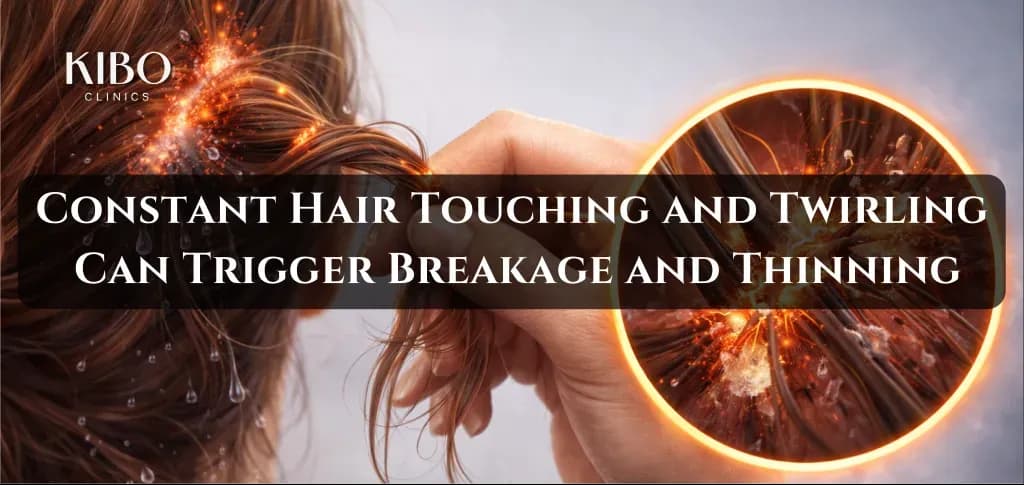
Published on Tue Mar 31 2026
Quick Summary
Touching, twirling, or pulling your hair dozens of times a day is one of the most common and least recognised habits that cause hair loss. Each individual touch is harmless. The damage comes from cumulative repetition — hundreds of mechanical stress events on the same follicles every single day. This shows up as concentrated breakage exactly where you touch most often, rough uneven texture in those zones, and sometimes visible thinning or bald patches if the habit crosses into compulsive territory. The damage is entirely preventable once you recognise the habit exists and understand what it is doing at a mechanical level.
You Do Not Even Realise Your Hand Is in Your Hair
Think about your typical workday or study session. You are sitting at your desk, focused on a screen or a book, and at some point your hand moves up to your hair. Maybe you twirl a strand around your finger while reading. Maybe you run your fingers through your hair while thinking. Maybe you pull gently on a section near your temple or behind your ear when you are concentrating.
You are not doing it deliberately. It is an unconscious fidgeting habit, the same way some people tap their feet or click their pen.
The difference is that clicking a pen does not damage your body. Touching your hair does. Every single time you manipulate a hair strand, you are creating mechanical stress on that shaft and the follicle it is attached to.
If you do this five times in an hour, the damage is negligible. If you do this fifty times in an hour, every working day for months, the cumulative mechanical stress adds up to measurable breakage and follicle damage.
Most people who have hair touching habits do not connect the behavior to their hair problems. They see thinning or breakage and assume it is stress, diet, or early pattern hair loss. But if the damage is concentrated in specific zones that perfectly match the areas you touch most often, the habit is the primary cause.
The Real Problem: Repetition Creates Cumulative Damage
A single instance of touching or twirling your hair is not harmful. The issue is the cumulative effect of doing it hundreds or thousands of times over weeks and months.
Every time you wrap a strand around your finger and pull it slightly, you are stretching the hair shaft. Hair has natural elasticity, but elasticity has limits. Repeatedly stretching the same section creates micro-damage in the cortex where the hydrogen bonds that hold the hair structure together start to weaken and break — one of the core causes of weak hair roots that most people overlook.
The cuticle damage from repetitive touching is even more significant:
- Your fingers carry natural oils, dead skin cells, and environmental debris
- Every pass transfers this material onto the hair shaft, creating a sticky residue that catches and lifts cuticle scales
- Once the cuticle is lifted, the next finger pass catches those scales even more easily
- Over time, the hair in zones you touch most frequently develops visibly rougher texture compared to hair you leave alone
Twirling is particularly damaging because it combines tension with torsion. When you wrap a strand around your finger and twist, you simultaneously pull on the follicle and twist the shaft along its length — creating a spiral stress pattern that weakens it at multiple points rather than just one contact zone.
Scalp touching adds a third layer. Repeatedly scratching or rubbing the same spot triggers low-grade inflammation that stresses the follicles and can push more hairs into the resting phase prematurely, while also disrupting natural sebum distribution across the scalp.
Hair Touching Habit vs Damage Profile
| Habit Type | What It Does to the Hair | What It Does to the Follicle | Visible Result | Damage Level |
|---|---|---|---|---|
| Running fingers through hair | Lifts cuticle scales; transfers oils and debris onto shaft | Disrupts sebum distribution; irritates follicle openings | Rough texture; dullness; faster dirt accumulation | Low to Medium |
| Twirling strands around finger | Combines tension and torsion; breaks cortex cross-links; permanently deforms shaft | Weakens follicle anchor through repeated lateral pulling | Kinked texture; mid-shaft breakage; concentrated thinning | High |
| Pulling on a section gently | Stretches shaft repeatedly; creates micro-damage in cortex | Stresses anchor structure; triggers inflammatory response | Weaker shaft; premature shedding in affected zone | Medium to High |
| Scratching / rubbing scalp repeatedly | Abrades hair at the root; disrupts natural oil layer | Chronic low-grade inflammation; follicles enter resting phase early | Scalp tenderness; itchiness; diffuse thinning at scratch zones | Medium |
| Compulsive pulling (trichotillomania) | Forces hair out from root; traumatises shaft at exit point | Permanent follicle damage or scarring in repeated pull zones | Visible bald patches; asymmetric gaps at temple or crown | Highest |
| Touching with product-coated hands | Deposits sanitizer alcohols or lotion emollients onto shaft; attracts dirt | Chemical irritation compounds mechanical stress at follicle openings | Dryness; brittleness; faster buildup requiring more washing | Low to Medium |
What Is Actually Happening to the Hair When You Touch It
When you run your fingers through your hair, friction between your fingertips and the hair shaft lifts the outermost cuticle scales. These scales are designed to lie flat and overlap like roof shingles, pointing from root to tip. Your fingers typically move root to tip, which is less damaging than the reverse direction, but it still creates friction that roughens the cuticle over time.
The natural oils and debris on your fingers coat the hair shaft with each pass. This coating attracts dust and environmental particles, making the hair dirtier faster and requiring more frequent washing. More frequent washing strips natural oils, creating a cycle where hair becomes progressively drier and more brittle — especially in the sections you touch most often.
When you twirl a strand around your finger, tension travels along the entire length of the hair from scalp to fingertip. The follicle anchor is designed to hold hair in place, but it is not designed to handle sustained lateral pulling forces repeatedly throughout the day. This is a mild version of the same mechanism that causes tension-based hair damage from styling — except instead of a hairstyle creating the tension, it is your own fingers.
The twisting motion specifically damages the internal cortex. Hair is made of keratin proteins with cross-links that give it shape and strength. Repeatedly twisting the shaft stresses these cross-links and can eventually break them, permanently altering the hair's texture and reducing its tensile strength. This is why chronically twirled hair often feels weaker and breaks more easily than neighboring untouched hair.
Early Signs People Miss
The earliest sign is not visible thinning. It is awareness that you have a habit in the first place. Most people with hair touching habits are completely unconscious of how often they do it.
Set up a video recording of yourself working for an hour. Count how many times your hand goes to your hair. If the number is higher than five to ten times per hour, you have a habit that is creating cumulative damage whether you feel it or not.
Other early signs to look for:
- Texture difference in specific sections — if the hair at your temple, behind your ear, or at the crown feels rougher, drier, or more tangled than other sections, and these sections match exactly where you touch or twirl, that is physical evidence of cuticle damage
- Short broken hairs with blunt ends concentrated in the zones you touch most — these are snapping mid-shaft, not shedding from the follicle
- Asymmetric bald patches or thinning spots at the temple, crown, or part line — the pattern is highly specific and asymmetric, which distinguishes it from genetic hair loss that tends to follow symmetrical patterns
- Scalp tenderness or itchiness in the spots you touch frequently — chronic mechanical stimulation of the follicle openings creates low-grade inflammation that shows up as sensitivity when you press on those areas
- Tighter grip needed over time — if you find yourself pulling more forcefully to get the same tactile feedback, follicle anchors in that zone have already weakened
Daily Habits Making It Worse
High-stress environments and mentally demanding work amplify hair touching because the behavior is often a stress response or concentration mechanism. The more stressed or focused you are, the more unconsciously you reach for your hair. People in demanding jobs, students during exam periods, and anyone dealing with chronic anxiety touch their hair far more frequently, meaning cumulative damage accumulates faster.
Having long hair gives you more surface area to fidget with, making the habit more severe. People with shoulder-length or longer hair can wrap strands multiple times, creating more tension and torsion per fidget event. The damage can be more dramatic and visible compared to someone with short hair who can only touch the roots and scalp.
Touching your hair with dirty hands or after applying hand lotion or sanitizer transfers chemicals and residue onto your hair shaft. Hand sanitizer contains alcohols that dry out and damage the hair cuticle. Hand lotion coats the hair and attracts dirt, compounding the mechanical damage with chemical exposure.
Combining hair touching with other mechanical stressors like tight hairstyles or frequent heat styling creates a multiplicative damage effect. If you wear a tight ponytail and also twirl the loose ends throughout the day, you are layering elastic tension at the tie point with torsion damage along the lengths. Understanding which hair accessories create the least additional stress helps minimise this compounding effect.
Not acknowledging that the habit is significant enough to cause damage allows it to continue unchecked for months or years. The damage is in the cumulative repetition, not in the force of a single touch. Acknowledging that the habit exists and has mechanical consequences is the necessary first step.
What Helps in Real Life
-
Track your habit for one full day to establish a baseline. Set a timer to go off every hour and note how many times you touched your hair in that hour. Most people are shocked to discover they are touching their hair 30, 50, 100 times per day without realising it. Awareness is the foundation of behavior change. You cannot fix a habit you do not consciously recognise.
-
Identify your triggers. Do you touch your hair more when you are stressed, concentrating, bored, or on phone calls? Understanding the emotional or situational triggers helps you anticipate when the behavior is most likely to occur and prepare alternative responses.
-
Keep your hands occupied with something else. Fidget spinners, stress balls, rings you can twist, textured objects you can rub between your fingers — all provide tactile stimulation that satisfies the fidgeting urge without involving your hair. The goal is not to eliminate fidgeting entirely but to redirect it toward objects that cannot be damaged by repetitive touching.
-
Tie your hair up or back in a style that makes it physically harder to access. If your hair is in a tight bun or braided, you cannot easily wrap strands around your fingers or run your hands through it. This creates a physical barrier that interrupts the unconscious hand-to-hair movement before it completes.
-
Apply a bitter-tasting nail polish or hand cream as a deterrent. Products designed to stop nail biting work on the same principle. When your hand goes to your hair and you taste or smell the bitter compound, it creates negative reinforcement that makes you more conscious of the behavior.
-
Work with a therapist or counselor if the habit feels compulsive or uncontrollable. Hair pulling and touching exist on a spectrum from mild unconscious fidgeting to full trichotillomania, a body-focused repetitive behavior disorder that requires professional intervention. If you have tried to stop and cannot, if you are creating visible bald patches, or if the behavior is causing significant distress, cognitive behavioral therapy or habit reversal training provides structured support.
-
Give yourself grace and expect gradual improvement rather than instant perfection. Breaking a deeply ingrained unconscious habit takes weeks to months. Each time you catch yourself and stop is progress, even if you touched your hair 50 times earlier that day. Building comprehensive low-stress hair care habits supports your recovery alongside the behavioral changes.
When Lifestyle Changes Are Not Enough
For most people with mild to moderate hair touching habits, becoming aware of the behavior and implementing redirection strategies reduces the frequency significantly within a few weeks. The hair that has already been damaged needs to grow out over three to six months, but once you stop the chronic manipulation, new growth comes through healthy and the breakage zones gradually fill in.
However, if the habit has been severe and long-standing, particularly if it crosses into compulsive pulling territory, the follicle damage may be more significant than just shaft breakage. Chronic pulling in the same zones can create permanent scarring or follicle miniaturisation that does not reverse even after the behavior stops.
If you have successfully reduced or stopped the hair touching behavior but you are still seeing progressive thinning in the affected zones after six months of recovery time, a professional trichoscopy assessment will tell you whether the follicles are recovering normally or whether there is permanent damage that needs treatment.
Why Kibo Clinics
When you come to us with thinning or bald patches that match a pattern of hair pulling or touching, we do not judge the behavior. We examine the actual state of the follicles in the affected zones to determine whether the damage is reversible with behavior modification alone or whether the follicles need support to recover their normal function. Because the treatment approach is completely different depending on what we find.
For patients where the follicles are still viable but have been producing progressively weaker hair due to chronic mechanical stress, we use treatments like PRP therapy or GFC therapy to strengthen those follicles and help them resume normal hair production. For patients where chronic pulling has created inflammation or follicular scarring, mesotherapy for hair regrowth addresses the inflammatory component while supporting regrowth in the recoverable zones.
We also connect you with resources and support for the behavioral side of the issue if needed. Hair health is not just about what treatments you apply. It is also about addressing the underlying behaviors that created the damage in the first place. Our 12-month care approach means we track both your scalp recovery and your success with habit modification over time, adjusting the plan as your hair responds and as you gain better control over the touching behavior. You deserve a plan that treats the whole problem, not just the visible symptom.
Get a call back to understand your hair loss stage and the best next step by certified doctor.
Frequently Asked Questions
Q: Can touching your hair cause it to fall out? Gentle touching does not cause hair to fall out from the follicle immediately, but chronic repetitive touching creates cumulative mechanical stress that weakens both the hair shaft and the follicle anchor over time. Every time you touch, twirl, or pull your hair, you create micro-damage that accumulates with each repetition. Over weeks and months, this can lead to breakage where the weakened shaft snaps, and in severe cases can cause the follicle to shed the hair prematurely or even enter a stressed state where it stops producing healthy terminal hair. The damage is from the repetition, not from a single touch.
Q: Is hair twirling bad for your hair? Yes. Hair twirling combines tension with torsion, simultaneously pulling on the follicle and twisting the shaft along its length. This creates spiral stress patterns that weaken the hair at multiple points and can permanently deform the shaft structure. Hair that has been repeatedly twirled often develops a kinked or wavy texture even in people with naturally straight hair, and breaks more easily than neighboring hair that has not been manipulated. The damage is both to the external cuticle from friction and to the internal cortex from the twisting motion breaking hydrogen bonds in the keratin structure.
Q: How do I stop touching my hair unconsciously? Breaking an unconscious habit requires first making it conscious. Track how often you touch your hair for one full day to establish awareness. Identify your triggers such as stress, concentration, boredom, or phone calls. Then redirect the behavior by keeping your hands occupied with fidget toys, stress balls, or textured objects that satisfy the tactile urge without damaging your hair. Tying your hair in styles that make it physically harder to access creates a barrier that interrupts the automatic hand movement. For compulsive behaviors that resist these strategies, cognitive behavioral therapy or habit reversal training provides structured professional support.
Q: Can hair touching cause bald spots? Yes, if the touching escalates to compulsive pulling. Chronic pulling in the same zones, even if the force feels gentle, can create permanent follicle damage or scarring that results in small bald patches, typically at the temple, crown, or along the part line wherever fingers naturally go during stress or concentration. This is a feature of trichotillomania, a body-focused repetitive behavior disorder. Even sub-clinical pulling that does not meet the full diagnostic criteria can create noticeable thinning or gaps in hair coverage if done consistently over months or years.
Q: Why does one side of my head have more breakage than the other? Asymmetric breakage almost always points to a mechanical cause rather than a systemic one. If you habitually touch, twirl, or pull hair on one side of your head more than the other — perhaps because you are right-handed and naturally reach for the right temple — that side will accumulate more cumulative damage and show more breakage. Hormonal or nutritional hair loss affects both sides relatively evenly. Mechanical damage follows the exact pattern of the behavior, making the asymmetry a diagnostic clue that a touching or manipulation habit is the primary cause.
Q: How long does it take for hair to recover after I stop touching it? New damage stops immediately once you break the touching habit. The hair shafts that have already been weakened or broken need to grow out, which takes three to six months depending on your hair growth rate and the length of the damaged zone. The follicles that have been stressed but not permanently damaged typically recover their normal function within a few weeks to a few months once the chronic mechanical irritation stops. Visible improvement in the affected zones is usually apparent within four to five months as the damaged hair grows out and healthier new growth replaces it.
Key Takeaways
- Hair breakage causes like twirling and repetitive touching are among the most overlooked — the damage is in the cumulative repetition, not in the force of any single touch
- Habits that cause hair loss are often unconscious — most people do not realise how frequently their hand goes to their hair until they track it
- Twirling is the most damaging type of touch because it combines tension and torsion simultaneously, weakening the shaft at multiple points
- Asymmetric breakage — one side worse than the other — is a reliable diagnostic sign that a mechanical touching habit is the primary cause
- Awareness and behavioral redirection stop new damage within weeks; full visible recovery takes three to six months
- Persistent thinning in affected zones after stopping the habit needs professional trichoscopy to rule out permanent follicle damage
Hair Transplant
FUE Hair Transplant | Sapphire FUE Hair Transplant | Direct Hair Transplant (DHT) | Corrective Hair Transplant | Hairline Correction
Hair Regrowth
PRP Therapy | GFC Therapy | Mesotherapy for Hair Regrowth | Microneedling for Hair Regrowth | Low Level Laser Therapy (LLLT)
Must Read
Hair Breakage Causes and Treatments | Hair Loss Types, Symptoms and Causes | Tension-Based Hair Damage During Styling | Scalp Oil and Reducing Hair Friction | Hair Ties vs Scrunchies vs Clips
Relevant Blogs
Best Hairstyles to Minimise Stress on Hair Follicles | Daily Hair Protection for Active Lifestyles | Low-Stress Hair Care for Busy Professionals | Repeated Hair Parting Damage | Office Chair Headrest Hair Breakage