
Does Salt Water Damage Hair? Coastal Air and Hair Fragility Explained
Published on Thu Apr 02 2026
Quick Summary
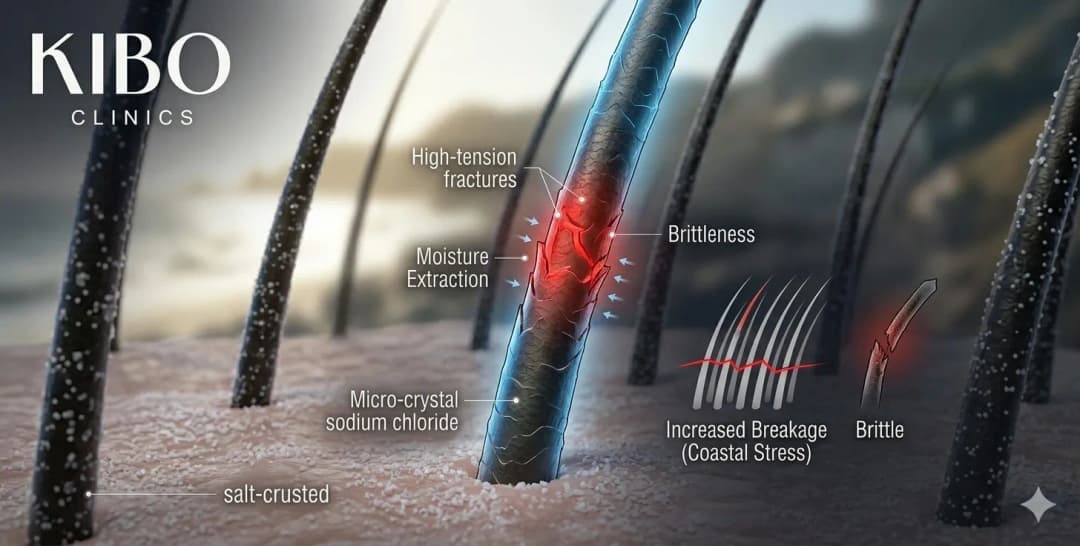
Salt water damages hair by acting as a hygroscopic agent it pulls moisture out of the inner cortex of the hair shaft, leaving strands progressively dehydrated, brittle, and prone to snapping under the kind of everyday handling that healthy hair tolerates without issue. For people living near the coast or visiting regularly, the damage does not come from swimming alone.
Airborne salt particles settle on the scalp and hair throughout the day, and combined with coastal humidity and UV radiation, they create a three-way stress environment that weakens the cuticle layer, disrupts scalp pH, and reduces the elasticity that keeps hair intact. Most coastal hair damage is fully reversible in the early stages but most people only act after months of breakage have already accumulated.
A Story Many Coastal Residents Relate To
Rhea, a 32-year-old marketing professional from Mumbai, moved to a sea-facing apartment two years ago. Within months, she noticed her hair felt coarser and more tangled, even though she had not changed her shampoo or oil routine.
She first blamed stress. Then she tried different conditioners and home remedies. Despite regular trims, her split ends returned quickly. The real change happened when she consulted a specialist who explained how constant salt exposure and humidity were weakening her hair cuticle.
With proper scalp care, protective routines, and targeted treatments, her breakage reduced within three months. The difference was not dramatic overnight, but gradual and noticeable.
Why Does Coastal Air Affect Hair Structure?
Salt-heavy coastal air affects hair in a stepwise manner.
Scalp health disruption — Salt particles settle on the scalp and mix with sweat and oil. This disturbs the natural pH balance, leading to dryness, mild irritation, and in some cases persistent itching that does not resolve with standard shampoo changes.
Follicle environment compromise — When the scalp barrier is weakened, follicles do not get an ideal environment for consistent growth. In some individuals, this triggers increased shedding that is incorrectly attributed to stress or nutrition.
Cuticle swelling cycle — High humidity causes the hair shaft to swell. Repeated swelling and drying weakens the outer cuticle layer — each cycle lifting the scales slightly more, making the hair increasingly porous and rough. The relationship between humidity and hair shaft mechanical vulnerability is the same process described in detail in humidity-related hair shaft damage, intensified here by the additional salt component.
UV protein breakdown — Coastal regions often have stronger and more prolonged sun exposure. UV rays break down hair proteins, especially keratin, making strands brittle and more prone to snapping at the weakest points along the shaft.
How Salt Pulls Moisture From Hair
Salt is hygroscopic — it attracts water. When salt settles on your hair, it pulls moisture away from the inner cortex of the hair shaft. Over time, this repeated dehydration reduces elasticity. Hair that lacks elasticity breaks easily during combing or styling.
This is why many people near coastal areas complain of increased hair fall during brushing rather than actual root-level hair loss. The strands are breaking at weak points along the shaft, not shedding from the follicle — a distinction that matters enormously for choosing the right treatment response.
Salt Water vs Hair — What Happens at Each Stage
| Exposure Type | What Happens to Hair | Visible Signs | Reversibility |
|---|---|---|---|
| Occasional sea swim — rinsed after | Temporary cuticle swelling; minor salt deposition; moisture loss minimal | Slight roughness; improves after rinsing and conditioning | Fully reversible — no lasting damage |
| Daily coastal air exposure — no protection | Gradual cuticle lifting; repeated dehydration cycle; porosity increases | Chronic frizz, rough texture, stickiness, tangling | Reversible with consistent care in 4–8 weeks |
| Direct sea water contact — not rinsed | Salt crystals form on shaft as water evaporates; intense moisture extraction; cortex exposed | Stiffness, excessive breakage, split ends multiplying rapidly | Reversible but requires 6–8 weeks of intensive care |
| Salt + UV + humidity — combined daily | Maximum cuticle damage; keratin degradation; scalp inflammation risk | Severe dryness, colour fading, visible thinning appearance | Professional assessment recommended; trimming may be necessary |
| Chemically treated hair + coastal exposure | Existing cuticle weakness amplified; salt penetrates cortex more readily | Accelerated colour fade, gummy texture when wet, rapid breakage | Higher protection requirements; recovery slower |
| Recovery with protective care | Cuticle sealing; moisture restored; salt residue cleared | Reduced roughness in 2–3 weeks; breakage reduces in 6–8 weeks | Fully reversible if started before cortex damage is severe |
How Does Coastal Hair Damage Show in Men and Women?
In men, coastal exposure often worsens existing pattern hair thinning. The combination of sun exposure, sweat, and salt can inflame the scalp, making early-stage male pattern baldness appear more prominent than it would without the environmental stress component. Men who keep short hair may notice rough texture, excessive dryness, and visible scalp due to brittle strands breaking faster.
In women, the changes are often seen as frizz, split ends, dullness, and increased breakage lengthwise. Women with long hair experience more tangling because rough cuticles catch on each other with every movement. Women with chemically treated or coloured hair are particularly vulnerable — the hair shaft is already sensitised, so salt exposure accelerates damage significantly faster than in untreated hair.
What Daily Habits Make It Better or Worse?
Habits that worsen the problem:
- Washing hair with very hot water — strips natural oils further, leaving strands unprotected against subsequent salt deposition
- Skipping conditioner — allows the cuticle to remain open and rough between washes
- Frequent heat styling on already dehydrated hair — accelerates breakage at the weakest cuticle points
- Ignoring scalp cleansing — leads to salt buildup mixed with sweat and sebum that irritates follicle openings
- Letting sea water or spray dry in the hair without rinsing — as water evaporates, salt crystals concentrate on the shaft and draw out moisture progressively
Habits that help:
- Rinsing hair with clean fresh water after beach exposure — the most impactful single habit change
- Using a mild pH-balanced shampoo 2 to 3 times weekly to remove salt residue
- Applying a leave-in conditioner or serum to form a protective layer on the shaft before outdoor exposure
- Covering hair with a scarf or hat to reduce direct UV impact combined with salt air
- Understanding how scalp oil balance reduces hair friction and maintaining it rather than stripping it with harsh cleansers
What Helps First — Practical Relief Steps
Start with scalp cleansing. Use a gentle shampoo 2 to 3 times per week to remove salt residue before it can dry into crystals on the shaft.
Introduce deep conditioning once weekly to restore moisture balance lost through repeated salt dehydration cycles. Focus conditioning on mid-lengths and ends where damage accumulates most.
Use a wide-tooth comb to reduce mechanical breakage from detangling rough cuticles. Wet hair plus salt damage plus aggressive brushing is one of the highest-risk combinations for accelerating breakage. The structural reasons are the same as those covered in wet hair breakage and root vulnerability.
Limit heat styling for at least four weeks to allow cuticle recovery. Salt-damaged hair under heat styling compounds damage faster than either stressor alone.
Most people notice reduced roughness within two to three weeks. Visible improvement in breakage typically takes six to eight weeks, depending on hair length and damage level. If fragility is severe, clinical treatments such as PRP therapy or scalp-supporting therapies may be advised after evaluation.
When to See a Hair Specialist
Do not wait if you notice:
- Sudden excessive shedding beyond 100 to 150 strands per day
- Persistent scalp itching, redness, or flaking that does not improve with basic care
- Visible thinning at temples or crown, especially in men with family history
- Women experiencing diffuse thinning along with breakage — may need hormonal evaluation
- Hair that feels gummy or stretchy when wet after coastal exposure — indicates severely elevated porosity that needs clinical assessment
Early assessment prevents confusion between simple hair shaft breakage and progressive hair loss conditions that require different treatment approaches. Hair breakage causes and treatments provides the full diagnostic framework for this distinction.
Common Myths About Coastal Hair Damage
Myth 1: Salt water makes hair thicker. Salt temporarily adds texture by roughening the cuticle surface. Repeated exposure dehydrates strands and increases brittleness — the apparent texture is structural damage, not thickness.
Myth 2: Only swimmers are affected. Even living near the sea exposes hair to airborne salt particles throughout the day. You do not need to swim to accumulate significant salt deposition on the scalp and shaft.
Myth 3: Oiling alone can fully protect hair. Oil may reduce surface dryness and friction. It does not prevent UV protein breakdown and does not block airborne salt deposition. It works best as part of a broader routine that includes consistent cleansing and conditioning.
Myth 4: Humidity hydrates hair naturally. Humidity causes the hair shaft to swell with water absorption, not true hydration of the cortex. This repeated swelling weakens the cuticle over time rather than nourishing the hair.
Myth 5: Cutting hair short solves the issue. Short hair reduces tangling and removes damaged ends, but it does not change scalp health or follicle function. The same environmental stressors continue affecting shorter hair.
Why Kibo Clinics
Many patients choose Kibo Clinics for hair fragility concerns because our approach addresses both environmental damage and long-term hair planning. We begin with comprehensive scalp assessment, hair and follicle analysis, and thorough lifestyle and environmental review — because coastal breakage and genetic thinning can coexist and require separate treatment strategies.
Our No Ghost Surgery pledge ensures the consulting surgeon personally performs your entire procedure, maintaining consistent quality throughout the session. We do not delegate critical steps to technicians.
The Kibo Hair Analysis (scalp and follicle assessment) is the first step in understanding your specific condition. We provide education, guidance, and support without guarantees, exaggerated claims, or miracle cure promises.
Patients undergoing medical or procedural treatments receive structured 12-month monitoring and follow-up guidance. This ensures seasonal and environmental triggers like coastal exposure are managed effectively over time.
Protect your hair from coastal stress before fragility turns into thinning.
Frequently Asked Questions
Q: Does salt water damage hair? Yes — salt water damages hair by extracting moisture from the inner cortex through its hygroscopic properties. As salt-laden water evaporates from the shaft, it leaves behind crystals that pull moisture out progressively. This reduces elasticity, roughens the cuticle, and makes hair brittle enough to break under everyday handling. The damage is cumulative — occasional exposure causes minimal lasting harm, but daily coastal air or frequent unprotected sea swimming creates measurable structural weakening over weeks.
Q: Does living near the sea cause permanent hair loss? Living near the sea mainly causes hair shaft damage, not permanent follicle loss. However, if someone already has genetic thinning, environmental stress from salt, humidity, and UV radiation can worsen the appearance. Proper scalp care reduces risk. Permanent hair loss usually involves hormonal or genetic causes that coastal exposure accelerates rather than creates independently.
Q: How to protect hair from salt water damage? Rinse with fresh water immediately after sea exposure before salt can dry onto the shaft. Apply a leave-in conditioner before beach visits to create a partial protective coating. Wear a scarf or hat to reduce direct salt air and UV contact. Use a mild pH-balanced shampoo 2 to 3 times weekly to prevent salt accumulation. Avoid heat styling on days of high salt exposure — the combination is particularly damaging.
Q: Is salt water good for hair? Salt water is not good for hair health despite its texture-adding effect. The temporary roughening of the cuticle that creates beachy waves comes from structural damage — not from any nourishing property. Prolonged or frequent salt water contact progressively weakens elasticity, increases porosity, and accelerates breakage. Occasional exposure with proper rinsing afterwards is manageable for most hair types, but regular unprotected exposure creates cumulative damage.
Q: How often should I wash my hair in coastal areas? Most people benefit from washing 2 to 3 times weekly. If exposed to beach water or heavy sea spray daily, gentle rinsing with fresh water in between washes reduces salt accumulation without the full stripping of a shampoo wash. Overwashing with harsh shampoos can worsen dryness. Balance based on exposure level and scalp sensitivity is more important than a fixed frequency.
Q: Why does my hair feel sticky near the beach? Salt particles mix with sweat and humidity, forming a residue on the hair shaft as the moisture evaporates. This makes hair feel stiff or sticky — what you are feeling is salt crystal deposits and raised cuticle scales. Regular rinsing after beach exposure prevents this buildup from setting and extracting further moisture.
Q: How do I know if it is breakage or hair fall? Breakage appears as shorter broken strands without a white bulb at the root. True hair fall includes a visible white bulb where the root was attached. Breakage is a shaft problem — treatable with moisture and cuticle repair. True root-level hair fall requires follicle assessment to identify the cause.
Q: Can PRP therapy help with coastal hair damage? PRP therapy supports follicle health and may improve hair density in suitable candidates experiencing thinning aggravated by environmental stress. It does not directly repair damaged hair shafts — those need to grow out and be replaced. Its benefit depends on whether follicle-level stress is present alongside the surface shaft damage.
Key Takeaways
- Salt water damages hair by acting as a hygroscopic agent that extracts moisture from the cortex — weakening elasticity until strands snap instead of flex under normal handling
- Is salt water good for hair? No — the beachy wave effect is cuticle damage, not a nourishing property; occasional protected exposure is manageable, daily unprotected contact is not
- How to protect hair from salt water damage — rinse with fresh water immediately after exposure, apply leave-in conditioner before beach visits, wash 2 to 3 times weekly to clear salt residue, avoid heat styling on high-exposure days
- Coastal damage is a three-factor stress environment: salt dehydration plus humidity swelling plus UV protein breakdown — any one alone is manageable, all three together accelerates damage significantly
- Most coastal breakage is fully reversible within 6 to 8 weeks of corrective care; the key signal that something more serious is happening is hair falling with a visible white root bulb rather than snapping mid-shaft
- Chemically treated or coloured hair in coastal climates needs significantly more active protection — the cuticle barrier is already compromised and salt exposure removes whatever resilience remains
Disclaimer
This content is for informational purposes only and does not substitute personalized medical advice. Hair response to coastal exposure varies based on genetics, health status, and care routine. Treatments support hair health but do not guarantee specific results. Professional evaluation is recommended for persistent or severe concerns.
Hair Transplant
FUE Hair Transplant | Sapphire FUE Hair Transplant | Bio FUE Hair Transplant | Realtime FUE Hair Transplant | Direct Hair Transplant (DHT)
Hair Regrowth
PRP Therapy | GFC Therapy | IV Hair Boosters | Mesotherapy for Hair Regrowth | Microneedling for Hair Regrowth
Must Read
Hair Loss Types Symptoms Causes | Hair Breakage Causes Treatments | DHT Blockers Hair Loss Guide | Hair Transplant Good Or Bad | Understanding The Language Of Natural Hairline
Relevant Blogs
Hair Brushes Combs Scalp Stress | Hair Dryer Heat Follicle Safety | Straighteners and Curling Irons Hair Stress | Pollution Build Up Weakening Hair Roots | Scalp Oil Reducing Hair Friction