
Reviewed By:
Shritej Mali
Independent Research Reviewer
Reviewing peer-reviewed studies and medical literature for evidence-based accuracy.
Written By: Kibo Clinics Content Team
Sources Referenced: American Academy of Dermatology, NIAMS, DermNet NZ, NCBI Bookshelf StatPearls, Cleveland Clinic, peer-reviewed dermatology literature
Last Updated: July 14, 2026
Reading Time: 10 minutes
֎ Show Quick Answer AI Quick answer summary
- Alopecia areata is an autoimmune type of hair loss: the immune system targets hair follicles, often creating sudden round or oval bald patches.
- It is usually non-scarring: the follicle is not usually destroyed, so regrowth is possible, but the course can be unpredictable.
- Patchy loss is different from diffuse shedding: telogen effluvium causes overall shedding, while alopecia areata often creates smooth, well-defined patches.
- Treatment depends on severity: small patches may regrow, while active, extensive or recurring disease needs a dermatologist-led plan.
- Do not self-diagnose a bald patch: fungal infection, traction, scarring alopecia, androgenetic alopecia and trichotillomania can look similar early on.
What Is Alopecia Areata?
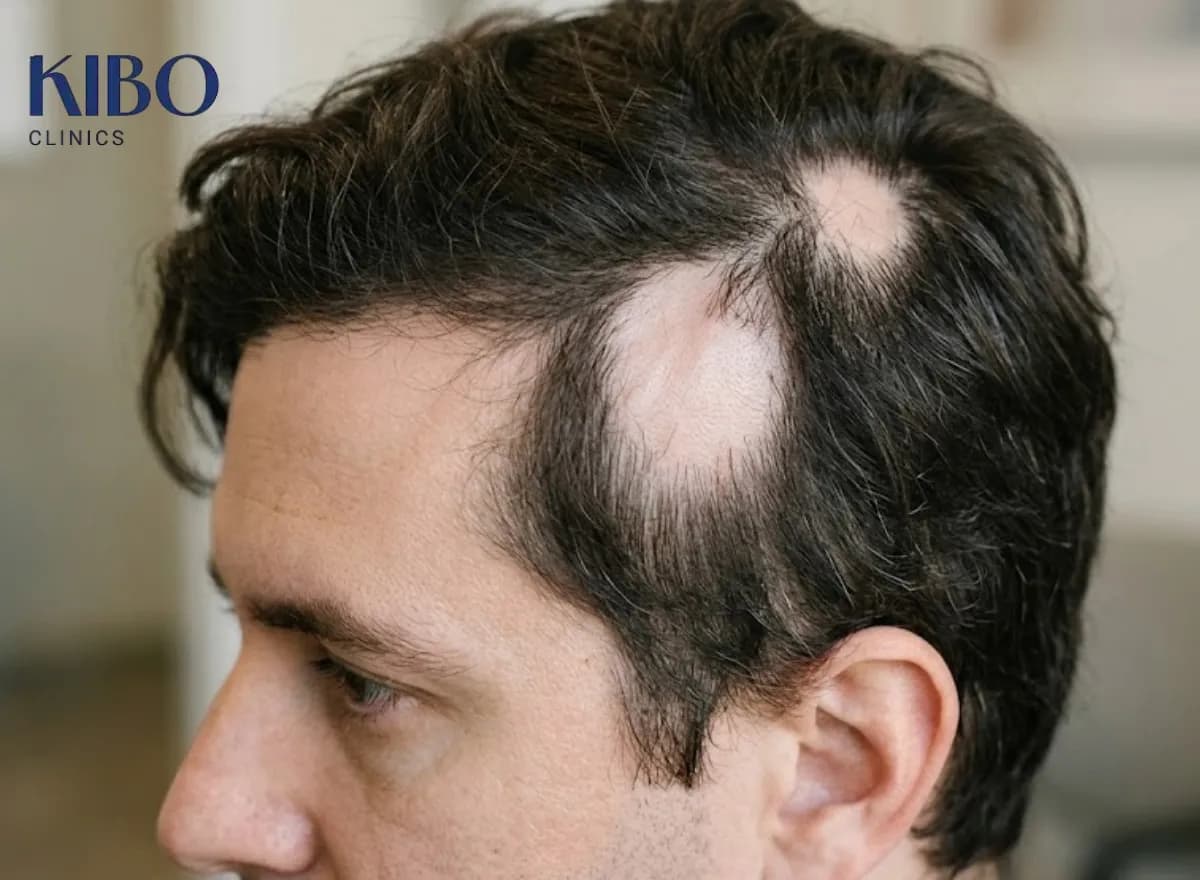
Alopecia areata is an autoimmune, usually non-scarring form of hair loss. In simple terms, the immune system reacts against hair follicles and interrupts active hair production. The result is often a sudden smooth patch on the scalp, beard, eyebrow or another hair-bearing area. Because “alopecia” means hair loss and “areata” means patchy, the name itself describes the most common pattern.
The important point is that alopecia areata is not the same as ordinary daily shedding. It is also not the same as genetic pattern thinning. If you are comparing different forms of hair fall, start with hair loss types, symptoms and causes and then use a dermatologist-led exam to confirm what is happening. A sudden bald patch deserves assessment because the correct next step depends on the diagnosis, not just on how much hair came out.
Why Does Hair Fall in Patches?
In alopecia areata, the immune attack mainly affects active anagen follicles. These are the follicles that are supposed to be producing visible hair. When that immune activity interrupts the follicle, hair can stop forming normally and shed from a sharply defined area. This is why the patch often looks round, smooth and sudden rather than gradually thin.
The follicle is usually not permanently destroyed, which is why regrowth can happen. However, the condition can relapse. One person may have one small patch that fills in, while another may have repeated patches, beard involvement, eyebrow loss or more extensive scalp disease. This unpredictability is why alopecia areata should be understood as an immune-mediated condition, not just a cosmetic hair fall problem.
The biology also connects with the normal hair growth stages. When the active phase is disrupted, density can change quickly in one area. For the growth stage itself, see anagen phase explained.
Common Signs of Alopecia Areata
The classic sign is a smooth round or oval patch of hair loss. The skin usually looks normal, without heavy scaling, pus or scarring. The patch may appear on the scalp, beard, eyebrows, eyelashes or body hair. Some people notice mild tingling or itching before a patch appears, but many notice no warning at all.
| What You Notice | Why It Matters |
|---|---|
| Round or oval bald patch | A common alopecia areata pattern, especially when the skin is smooth. |
| Beard patch | Alopecia barbae can affect beard areas and may be mistaken for shaving irritation. |
| Eyebrow or eyelash loss | This can increase cosmetic and emotional burden and needs careful assessment. |
| Nail pits or rough nails | Nail changes can occur in alopecia areata and may suggest a more active disease pattern. |
| Rapid widespread shedding | This may be diffuse alopecia areata, but it can also resemble telogen effluvium. |
Alopecia Areata vs Telogen Effluvium vs Pattern Hair Loss
A major reason people delay care is that different hair loss conditions are described with the same words: hair fall, bald spot, thinning or shedding. Alopecia areata usually creates a localised patch. Telogen effluvium usually causes diffuse shedding after stress, fever, illness, childbirth, dieting or medication changes. Androgenetic alopecia causes gradual patterned thinning related to genetic and androgen sensitivity.
| Condition | Typical Pattern | Common Clue |
|---|---|---|
| Alopecia areata | Smooth round patches, beard patches, eyebrow loss or sometimes diffuse AA. | May show exclamation-point hairs or black dots on trichoscopy. |
| Telogen effluvium | Diffuse shedding across the scalp. | Often appears weeks to months after a body stressor. |
| Androgenetic alopecia | Crown thinning, receding hairline or widening part. | Miniaturised hairs and gradual density change over time. |
| Scalp inflammation or infection | Patchy or diffuse loss with flakes, redness, pain, scaling or broken hairs. | Scalp symptoms are often more obvious than in classic alopecia areata. |
If your hair fall is sudden but spread across the scalp, compare it with sudden hair thinning from telogen effluvium and hair recovery after telogen effluvium. If the issue is a widening part, crown loss or hairline recession, review DHT-related hair loss, androgenetic alopecia and hair density and whether hair can recover from androgenetic alopecia.
What Triggers Alopecia Areata?
There is usually no single obvious trigger. Research points to immune dysregulation, genetic susceptibility and loss of immune privilege around the hair follicle. Some people report onset after emotional stress, illness or another immune event, but that does not mean stress alone “caused” the disease. It is more accurate to say that stress or illness may act as a trigger in someone who is already susceptible.
Alopecia areata is also associated with other immune or atopic conditions in some people, such as thyroid disease, vitiligo, psoriasis, eczema or allergic tendencies. This does not mean every person needs every blood test. It means the doctor should decide testing from your history, symptoms and scalp findings. For a practical testing overview, see blood tests for hair fall, vitamin D and hair follicles and iron deficiency and ferritin.
How Alopecia Areata Is Diagnosed
A dermatologist can often diagnose alopecia areata by examining the patch, scalp pattern, hair shafts and nails. Trichoscopy can show signs such as exclamation-point hairs, yellow dots, black dots or broken hairs. A hair pull test may help when the disease is active. A biopsy is not routine for every patient, but it may be needed if the diagnosis is uncertain or if scarring alopecia, fungal infection or another scalp disorder is suspected.
This is where seeing the right professional matters. A patch that looks simple can be autoimmune, fungal, traction-related, inflammatory or scarring. Kibo’s guide on dermatologist versus trichologist explains why medical diagnosis matters when symptoms are sudden, patchy or associated with scalp changes.
Can Hair Grow Back After Alopecia Areata?
Yes, hair can grow back after alopecia areata because the follicle is usually not destroyed. Regrowth may begin as fine, pale or white hair before thickening and darkening. Some patches fill in without aggressive treatment. Others recur or spread. The outcome depends on disease extent, duration, pattern, nail involvement, age at onset, family history, associated conditions and how active the patch is during examination.
It is also possible for regrowth and new shedding to happen at the same time. That is why monthly photos in consistent lighting are more useful than checking the patch every day. If your concern is fullness rather than a clear patch, compare hair density and the hair growth cycle and hair density versus strength.
Treatment Options: What Helps and What Does Not
Treatment is not one-size-fits-all. A small stable patch, a child with limited disease, eyebrow involvement and extensive rapidly progressing scalp loss are different situations. Common medical options discussed by dermatologists include topical corticosteroids, steroid injections for suitable localised patches, minoxidil as a supportive regrowth aid in selected cases, topical immunotherapy in specialist settings and systemic options such as JAK inhibitors for severe disease where appropriate and available.
The most important expectation is that alopecia areata has no guaranteed permanent cure. Treatments may help regrowth, but relapse can happen. Home remedies, oils, supplements and shampoos should not be treated as autoimmune treatment. They may support scalp comfort or general hair care, but they cannot reliably stop an immune attack on the follicle.
At Kibo Clinics, supportive non-surgical options such as PRP therapy, GFC therapy or low-level laser therapy may be discussed only if the doctor finds them suitable for the overall diagnosis. They should not be viewed as standalone cures for alopecia areata, and they do not replace dermatologist-led treatment for active autoimmune hair loss.
When Patchy Hair Loss Is Not Alopecia Areata
A bald patch with scaling, pus, pain, broken hairs or redness may point toward infection or inflammation rather than classic alopecia areata. A shiny scarred patch can suggest scarring alopecia. A patch around the hairline after tight hairstyles can suggest traction. Diffuse shedding after childbirth, fever or stress may be telogen effluvium rather than alopecia areata. Hormonal patterns can also overlap in women, especially when PCOS, postpartum changes or menopause are part of the history.
Useful follow-up reading includes scalp psoriasis versus dandruff, seborrhoeic dermatitis and scalp flaking, whether dandruff causes hair loss, hair loss in women, PCOS hair thinning in women, postpartum hair loss recovery and menopause and hair density.
Patchy loss, diffuse shedding and pattern thinning need different plans.
Frequently Asked Questions
What is alopecia areata?
Alopecia areata is an autoimmune type of hair loss in which the immune system targets hair follicles. It often causes sudden round or oval patches on the scalp, beard, eyebrows or other hair-bearing areas.
Why does alopecia areata cause patchy hair loss?
The immune activity interrupts active hair follicles in a local area. Because those follicles stop producing hair together, the loss often appears as a smooth patch instead of all-over shedding.
Is alopecia areata contagious?
No. Alopecia areata is not contagious. You cannot catch it from touching someone, sharing towels or being near someone with patchy hair loss.
Can hair regrow after alopecia areata?
Yes, regrowth is possible because the follicles are usually not permanently destroyed. However, the timing is unpredictable, and some people experience repeated episodes or new patches.
What is the difference between alopecia areata and telogen effluvium?
Alopecia areata usually causes patchy, smooth bald areas. Telogen effluvium usually causes diffuse shedding across the scalp after a trigger such as illness, stress, childbirth, surgery or dieting.
Can stress trigger alopecia areata?
Stress may act as a trigger in some susceptible people, but alopecia areata is not simply stress hair fall. It is an immune-mediated condition, so treatment should not rely only on stress control.
Does alopecia areata affect the beard?
Yes. Alopecia areata can affect the beard, where it is often called alopecia barbae. It can create one or more smooth beard patches and should be checked if it is new, spreading or recurrent.
When should I see a doctor for a bald patch?
See a doctor if the patch is sudden, spreading, painful, scaly, red, recurrent, involves eyebrows or beard, or appears with nail changes. Early diagnosis helps separate alopecia areata from infection, scarring alopecia, telogen effluvium and pattern hair loss.
Want a doctor-led diagnosis before trying more products?
Why Kibo Clinics
Kibo Clinics assesses patchy hair loss by separating alopecia areata from diffuse shedding, breakage, scalp disease and progressive pattern loss. The consultation looks at the patch pattern, timeline, scalp symptoms, nail changes, family history, medical history and whether trichoscopy or testing is needed.
Sources referenced: American Academy of Dermatology Association, “Alopecia areata: Overview, signs and symptoms, causes, diagnosis and treatment”; National Institute of Arthritis and Musculoskeletal and Skin Diseases, “Alopecia Areata”; DermNet NZ, “Alopecia Areata”; Lepe K et al., “Alopecia Areata,” StatPearls, NCBI Bookshelf, updated 2024; Gilhar A, Etzioni A, Paus R., “Alopecia Areata,” New England Journal of Medicine, 2012; Harries MJ et al., British Association of Dermatologists living guideline for alopecia areata, British Journal of Dermatology, 2025.
For a personal assessment, consult a Board Certified Doctor at Kibo Clinics. The doctor you meet in your consultation is the same doctor who handles your treatment through every stage.
Talk to a Board Certified DoctorExplore Kibo Clinic Services
Surgical Hair Transplant: FUE Hair Transplant | Sapphire FUE Hair Transplant | Direct Hair Transplant | Bio FUE Hair Transplant | Real Time FUE Hair Transplant | Corrective Hair Transplant | Hairline Correction | Unshaven Hair Transplant | Body Hair Transplant
Non-Surgical Hair Treatments: Mesotherapy for Hair Regrowth | Microneedling for Hair Regrowth | IV Hair Boosters |
Medical Disclaimer : Information from Kibo Hair Clinics is for educational purposes only. It does not replace diagnosis, trichoscopy, blood test interpretation, prescription treatment, procedure advice, or side-effect counselling from a qualified dermatologist or hair restoration doctor.