
Backpack Straps & Hair Pulling: How Commuting Impacts Long Hair Health
Published on Fri Mar 27 2026
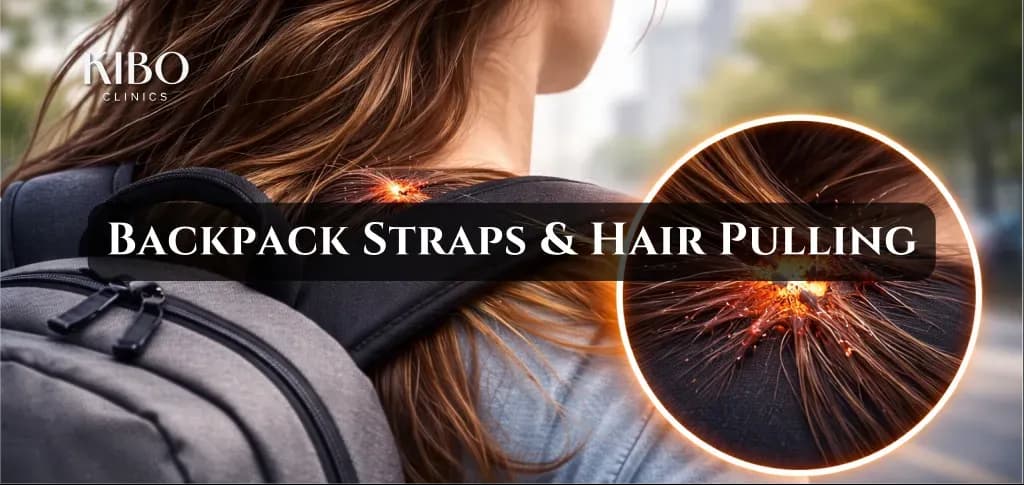
Quick Answer: Backpack straps are one of the most overlooked long hair breakage causes for daily commuters. Repeated friction and traction on the same hair zone weakens the shaft every single day — causing breakage that looks like thinning, while the follicles stay completely healthy. Small habit changes fix this fast.
What You Need to Know at a Glance
- Backpack straps pull, snag, and snap hair at the shoulder contact point — daily and silently
- This is mechanical hair breakage, not hair loss — the follicles are completely fine
- Two forces cause it: traction (pulling) and friction (rubbing) — happening together in the same spot
- Fine hair, chemically treated hair, and wet hair face the highest risk
- You will notice broken shorter hairs at a specific length — not random diffuse shedding
- Most people blame stress, shampoo, or diet and never find the real cause
- Habit changes alone stop new damage within 1–2 weeks
Why You Keep Blaming the Wrong Things
Most people never connect their hair breakage to their bag. Here is the typical morning routine that causes it:
- Hair left down loose or loosely tied
- Loaded bag slung over one or both shoulders
- 20–45 minute commute — walking, train, or metro — bag shifting with every move
- Hair gets caught under the strap, pressed against it, and pulled every time you turn or adjust
- Repeat 5–6 days a week for months
The damage stacks up quietly while you keep searching your diet, water quality, or shampoo for answers. This is one of the most overlooked causes of daily hair breakage in people with long hair.
The Real Problem: Traction + Friction in the Same Spot Every Day
Two forces work together at the strap contact point:
| Force | What It Does to Your Hair | End Result |
|---|---|---|
| Traction | Pulls hair away from scalp, stretches the shaft | Weakens the shaft at the contact point over time |
| Friction | Strap rubs against the cuticle surface | Lifts and breaks down the protective cuticle layer |
Understanding traction alopecia causes begins here — it is not always tight hairstyles. Research on traction alopecia from repeated pulling confirms that daily low-level traction in the same spot can progress from shaft-only damage to follicle stress over years.
The critical point: the follicle is healthy. No scalp oil, serum, or massage will fix shaft-level damage. The only solution is stopping the mechanical stress and letting the damaged zone grow out. Understanding which hairstyles minimise shaft stress is the most practical first step.
What Is Actually Happening to the Hair Shaft
Your hair shaft has three layers. Here is how strap damage progresses through them step by step:
- Cuticle lifted: Strap rubs against the outer layer daily → cuticle scales lift → surface becomes rougher → hair snags even more easily next time
- Cortex exposed: Once the cuticle breaks down completely, the inner cortex is exposed → tensile strength drops significantly → hair snaps under loads it previously handled
- Breakage clusters: Tension is greatest at the weakest point — exactly where the strap sits. All breakage appears at one specific length, not randomly distributed
Fine hair carries significantly higher traction stress risk — its smaller diameter provides less resistance to cuticle lifting. Chemically treated hair shows strap damage in weeks. Even healthy coarse hair will eventually succumb with enough daily repetition.
Early Warning Signs Most People Miss
| Sign You Notice | What It Actually Means |
|---|---|
| Rough or dry zone along sides and back when running fingers through | Cuticle breakdown at the strap contact point |
| Short hair fragments (not full shed hairs) when removing your bag | Shaft breakage — not follicle shedding |
| One side of head looks and feels thinner than the other | Bag carried predominantly on one shoulder |
| Hair tangles more at the back during commute than any other time | Hair snagging on the strap — every tangle is a pulling event |
| Visible band of shorter broken hairs at exactly shoulder height | Classic long-term strap damage pattern |
The asymmetric thinning (one side only) is the key diagnostic clue. It separates mechanical damage from the causes of hair thinning in women that are hormonal or nutritional — those affect both sides evenly. Hair thinning in women from mechanical causes follows the exact pattern of contact, not a bilateral diffuse pattern.
Daily Habits That Make It Significantly Worse
- Wearing hair completely loose — maximises surface area caught under the strap; hip or waist-length hair shows a breakage band at exactly shoulder height
- Narrow, hard, or textured straps — concentrate contact force on a tiny section of hair; chain and cord straps are the worst offenders
- Tight hairstyles combined with strap friction — hair loss from tight hairstyles and strap friction together create double-direction tension on the shaft. The cumulative effect of tension-based styling damage significantly amplifies strap harm
- Adjusting a loaded bag with hair underneath — creates a sudden sharp traction force; far more damaging than steady walking friction
- Commuting with wet or damp hair — wet hair is up to 40% weaker than dry; strap contact on wet hair causes dramatically more breakage. See why wet hair is more vulnerable to mechanical damage
- Heavy bags — increase downward strap pressure, grinding harder into trapped hair with every step
6 Things That Actually Fix This
-
Tie hair up before putting the bag on — not after A high bun, braid, or top knot completely removes hair from the strap contact zone. This single change eliminates almost all commute-related shaft damage immediately. See which low-stress protective hairstyles work without creating their own tension.
-
Switch to a wider padded strap or a two-strap backpack Two straps distribute load evenly and reduce pressure on each side. Wide, smooth, padded straps glide over hair rather than grip it.
-
Use a scrunchie or spiral tie instead of a tight elastic A tight elastic adds its own traction stress at the fastening point. A scrunchie or soft spiral tie reduces that additional tension load significantly.
-
Never leave home with wet hair on a commute day Wash the night before, or give full drying time before heading out. Even partially dried hair is meaningfully stronger under strap pressure.
-
Apply leave-in conditioner or serum to your lengths before leaving This coats the cuticle and reduces friction between the strap surface and hair. It does not stop traction but meaningfully reduces cuticle roughening on long commutes.
-
Use Friday and Saturday nights for targeted overnight recovery Two days without strap contact, combined with a focused overnight hair care routine, concentrates repair exactly where the damage is worst.
Recovery Timeline: What to Expect After Changing Habits
| Timeframe | What to Expect |
|---|---|
| Week 1–2 | New breakage stops once strap contact is eliminated |
| Month 1–2 | Significantly less hair coming off with the bag; texture begins improving |
| Month 3–6 | Damaged zone grows out; visible improvement in evenness and volume |
| 6+ months | Full recovery for most shaft-only breakage cases |
If asymmetry between sides is not improving after 3–4 months of consistent habit changes, a professional trichoscopy assessment is the next step. Building a low-stress hair care routine alongside professional input gives the fastest recovery. For active lifestyles, the guide on daily hair protection for active lifestyles is a practical companion read.
Why Kibo Clinics
When you come to us with breakage or unexplained thinning, we start by actually looking at your hair and scalp — not handing you a product recommendation.
- Trichoscopy first: We examine shaft condition, follicle health, and damage distribution before recommending anything
- Shaft-only damage: PRP therapy and GFC therapy improve follicle output so new growth is stronger and more resistant to daily mechanical demands
- Follicle-level traction stress: Mesotherapy addresses inflammatory components directly while supporting recovery
- Lifestyle review: We work through your commute habits, bag type, and styling routine — because great treatment paired with the same damaging habits always underperforms
- 12-month care plan: Our No Ghost Surgery pledge means you get a plan that fits your actual life, not just a one-time procedure
Frequently Asked Questions
Can a backpack strap actually cause hair loss?
Backpack straps primarily cause shaft breakage — not true hair loss from the follicle. The follicles stay intact. In rare cases of very long-term consistent traction, some follicle-level stress can develop, but this is uncommon from strap friction alone.
Why does my hair break more on one side than the other?
Almost always a mechanical cause. If you carry your bag on one shoulder, that side gets daily friction while the other does not. Hormonal and nutritional conditions affect both sides evenly. Mechanical damage follows the exact contact pattern.
Is the damage from backpack straps permanent?
Broken shafts cannot be repaired — they need to grow out over 3–6 months. Follicles remain healthy and produce normal undamaged new growth once the mechanical stress is removed.
What is the best hairstyle to wear during a commute with a backpack?
Any style that keeps hair off the shoulders and upper back — high bun, braided updo, French twist, or high ponytail. Avoid low ponytails at shoulder height, which sit directly in the highest-contact zone.
Does bag type make a difference to hair damage?
Yes, significantly. Two-strap backpacks distribute load evenly and cause far less friction. If a crossbody bag is essential, choosing the widest, smoothest, most padded strap available makes a real difference over thin chains or cords.
How long does it take to see improvement after changing habits?
New breakage stops within 1–2 weeks of removing strap contact. Visible recovery of the damaged zone takes 3–6 months as broken hairs grow out. Pairing habit changes with a targeted overnight conditioning routine accelerates the timeline.
Disclaimer: This content is for educational purposes only and does not constitute medical advice. If you are experiencing significant hair loss or thinning, please consult a qualified trichologist or dermatologist for a personalised assessment.
Hair Transplant
FUE Hair Transplant | Sapphire FUE Hair Transplant | Direct Hair Transplant (DHT) | Corrective Hair Transplant | Hairline Correction
Hair Regrowth
PRP Therapy | GFC Therapy | Mesotherapy for Hair Regrowth | Microneedling for Hair Regrowth | Low Level Laser Therapy (LLLT)
Must Read
Hair Breakage Causes and Treatments | Hair Loss Types, Symptoms and Causes | Tension-Based Hair Damage During Styling | Hair Extensions and Traction Alopecia Risk | How Tight Headgear Affects Hair Follicle Health
Relevant Blogs
Best Hairstyles to Minimise Stress on Hair Follicles | Hair Ties vs Scrunchies vs Clips | Wet Hair Styling and Root Vulnerability | Daily Hair Protection for Active Lifestyles | Low-Stress Hair Care for Busy Professionals