
Fine Hair and Traction Stress: Why Fine Hair Loses to Tight Styles Faster
Published on Fri Apr 03 2026
Quick Summary
Fine hair is more vulnerable to traction stress than thick hair because each strand contains less structural keratin protein — meaning the same ponytail tension that thick hair distributes safely across a wide shaft gets concentrated into a narrower structure, sending more of that pulling force directly to the follicle anchor. Traction alopecia in fine hair develops faster, at lower tension levels, and in styling situations that most people would never consider problematic. The temples thin first because hairline follicles are always under the highest tension in any pulled-back style, and fine hair in those zones has the least structural resistance. Most cases caught in the early stage — when scalp soreness appears before any visible thinning — are fully reversible with habit correction.
A Story Many People Do Not Notice Until It Is Late
Riya, 29, from Bengaluru, always had soft, silky hair. It looked healthy but was naturally fine. She loved sleek ponytails for work and tight braids for workouts. At first, she only noticed mild scalp tenderness.
Within a year, she began seeing more hair around her hairline falling out. She tried oiling, changing shampoos, and trimming regularly. But the thinning near her temples continued, especially after long days with tight hairstyles.
After evaluation, she was told she had early traction-related thinning. The issue was not hair care products — it was repeated mechanical stress on naturally fine strands and follicles. Once she reduced tension and followed a guided treatment plan, shedding reduced and early regrowth became visible.
Why Is Fine Hair Structurally More Vulnerable to Traction?
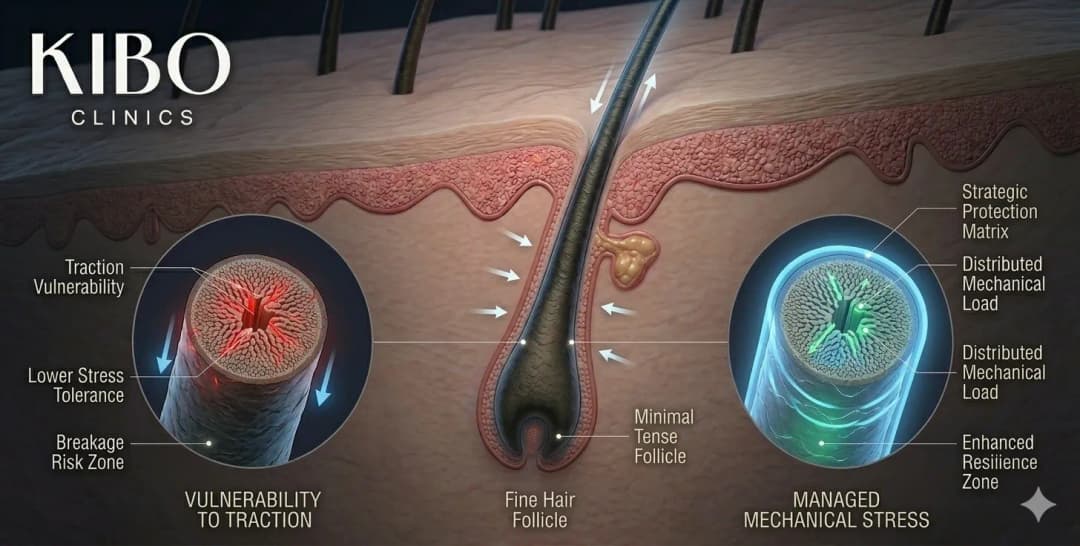
Fine hair has a smaller diameter compared to thick hair. This means each strand contains less structural protein (keratin), making it more flexible but also more prone to stretching and breakage under repeated stress.
Scalp health forms the base — If the scalp is tight, inflamed, or poorly nourished, follicles become more sensitive to pulling. Fine hair follicles sitting in an already-compromised scalp environment reach their traction tolerance faster than thick hair follicles in the same conditions.
Shaft diameter determines stress absorption — Fine hair follicles may not be inherently weaker as structures, but the thinner shaft offers less mechanical resistance. The same pulling force that a thick strand distributes along its length gets concentrated in a fine strand — transmitting more of it directly to the follicle anchor.
Hormones and stress compound the vulnerability — High stress, thyroid imbalance, or post-pregnancy changes can push fine hair into a shedding phase faster because the reduced shaft diameter leaves less margin before anchoring fails.
Lifestyle habits amplify the strain — Tight hairstyles, heat styling, chemical treatments, and extensions interact with fine hair's reduced structural tolerance in ways they would not with thick hair.
How Mechanical Tension Damages the Follicle
When hair is pulled tightly, tension travels from the strand to the follicle. Over time this creates:
- Reduced blood flow to the follicle
- Micro-inflammation around the root
- Weakening of the anchoring structures
- Shortened anagen (growth) phase
If this continues for months or years, the follicle may shrink. In advanced cases, scarring can occur — leading to permanent hair loss that does not respond to conservative treatment. Understanding traction alopecia from tight hairstyles explains the full biomechanical pathway from styling habit to follicle damage.
Fine Hair vs Thick Hair — Traction Stress Comparison
| Factor | Fine Hair | Thick Hair | Practical Implication |
|---|---|---|---|
| Shaft diameter | Smaller — less keratin per strand | Larger — more keratin per strand | Fine hair transfers more traction force to the follicle per strand |
| Mechanical resistance | Lower — stretches and snaps at lower force | Higher — tolerates more pulling before breaking | Same tension level causes visible damage sooner in fine hair |
| Traction tolerance | Low — reaches damage threshold faster | High — withstands more repeated tension before follicle stress | Fine hair needs lower-tension styles to achieve the same safety margin as thick hair |
| Timeline to visible damage | Faster — months of daily tight styling can create hairline changes | Slower — years typically required for similar damage at same tension | Fine hair users notice traction alopecia earlier, giving a shorter window for reversal |
| Breakage pattern | Snaps at lower tension; shorter broken strands accumulate faster | Requires more force to break; breakage less frequent at same tension | Fine hair appears to "break more" at the same styling intensity |
| Recovery potential | Good if caught early; scarring risk higher if ignored due to faster damage progression | Good; slower progression gives more intervention time | Fine hair requires earlier action at lower tension signals |
What Hairstyles Commonly Trigger Traction Stress in Fine Hair?
Traction stress is not limited to extreme styles. It builds slowly with daily habits that seem completely normal:
- Tight ponytails and buns — create constant upward pull, especially around the hairline where fine hair is most structurally fragile
- Braids and cornrows — apply uniform tension along the scalp for extended periods
- Hair extensions — add weight, increasing downward force on fine strands already under styling tension
- Clips and tight rubber bands — cause localised stress at the contact point
- Slick-back gel styles — hold fine hair rigidly in stretched positions for hours without any tension variation
Fine hair shows damage earlier at each of these styling types because the strand snaps or sheds sooner than thick hair under the same styling forces.
How Does Traction Stress Show in Men and Women?
In women, thinning most commonly appears along the temples, edges, and part line. This is the classic traction alopecia pattern seen in women who frequently wear tight braids, ponytails, or extensions. Women with already fine hair who experience postpartum shedding face a compound risk — the hormonal shedding removes density while ongoing tight styling creates follicle stress simultaneously.
In men, traction may appear at the frontal hairline or areas where helmets, caps, or tight styling products create pressure. Men with early male pattern hair loss who also style tightly see recession accelerate faster than the genetic component alone would produce.
Fine hair in both genders tends to show breakage before actual follicle damage becomes obvious — making scalp soreness the most valuable early warning signal to act on.
What Daily Habits Make It Better or Worse?
Habits that silently increase traction stress in fine hair:
- Wearing tight hairstyles daily without any rest days — follicles in fine hair need tension-free recovery time
- Sleeping with tight braids or buns — prolongs tension for 6 to 8 hours without interruption
- Using elastic bands without fabric covering — increases friction breakage at the contact point on already-fine strands
- Frequent chemical treatments — reduce strand strength, lowering the tension threshold before damage occurs
- Heat styling — weakens protein bonds in fine hair, reducing its already-lower mechanical tolerance further
Habits that protect fine hair from traction damage:
- Rotating hairstyle position and type daily — distributes stress across different follicle zones
- Keeping ponytails loose and positioned differently each day — prevents the same follicles from bearing chronic concentrated load
- Using soft scrunchies instead of tight rubber bands — distributes tension across more surface area
- Letting hair rest untied at home — provides the tension-free recovery time fine hair needs
The most important mistake to avoid is ignoring scalp soreness. In fine hair, pain after a styled look is a reliable early warning that traction has exceeded safe levels for that hair type.
Choosing low-tension hairstyle alternatives specifically for fine hair provides practical daily styling options that maintain security without exceeding follicle tolerance.
What Helps First — Practical Relief Steps
Immediately loosen hairstyles if you notice tenderness, soreness, or early hairline changes. For fine hair, scalp soreness is the signal to act — waiting for visible thinning means the intervention window has already narrowed.
Avoid extensions and heavy braids during the recovery period. The combined weight and attachment tension of extensions on fine hair creates stress at a level most fine hair cannot sustain daily without progressive follicle damage.
Switch to low-tension styles and give hair complete rest days at home — untied and unclipped. This is particularly important for fine hair because the follicle anchoring system recovers between tension events, and without adequate rest time, each subsequent session adds to cumulative damage.
Massage the scalp gently with fingertip pads — not nails — to improve circulation to stressed follicle zones. The hair ties, scrunchies, and clips comparison guide covers which specific accessories reduce traction stress for fine hair.
Most people with fine hair notice reduced soreness within 1 to 2 weeks after reducing tension. Early regrowth may be visible in 3 to 4 months if follicles are not permanently damaged.
When to See a Hair Specialist
Professional evaluation is needed if:
- Hairline recession continues despite reducing tight styles for 3 months
- You see shiny or smooth patches on the scalp — may indicate follicle scarring
- Persistent redness, itching, or burning at styling tension zones
- Hair does not regrow after 6 months of consistent lifestyle correction
- Family history of pattern baldness combined with traction — the two accelerate each other
Early intervention can prevent permanent follicle damage. Fine hair has less time between early warning signs and irreversible scarring than thick hair, making prompt assessment more important.
Common Myths About Fine Hair and Traction Stress
Myth 1: Only very tight braids cause damage. Even moderate daily tension over months can lead to thinning in fine hair — the lower structural resistance means the threshold for damage is reached at tension levels that thick hair handles safely.
Myth 2: Fine hair is naturally weak and nothing can help. Fine hair is not inherently weak — it simply requires lower-tension handling. With appropriate styling habits, fine hair can maintain healthy density and resist traction damage effectively.
Myth 3: Oiling alone can fix traction hair loss. Oil may improve scalp condition and shaft lubrication but cannot reverse long-term follicle damage from chronic traction. Structural damage to the anchoring system requires tension elimination and, in some cases, clinical treatment.
Myth 4: If hair grows back once, it will always grow back. Repeated traction can eventually cause follicle scarring that makes regrowth impossible. Early action is the only reliable prevention.
Myth 5: Extensions are safe if they look natural. Weight and attachment method determine damage risk, not appearance. Fine hair under extension weight is under significantly higher follicle stress than it appears from the outside.
Why Kibo Clinics
Many patients choose Kibo Clinics for traction-related hair concerns because our approach addresses both scalp health and long-term hair planning. We begin with comprehensive scalp assessment, hair and follicle analysis, and thorough lifestyle and environmental review — identifying whether fine hair thinning is from traction alone or has an underlying hormonal or genetic component that is also contributing.
Our No Ghost Surgery pledge ensures the consulting surgeon personally performs your entire procedure, maintaining consistent quality throughout the session. We do not delegate critical steps to technicians.
The Kibo Hair Analysis (scalp and follicle assessment) is the first step in understanding your specific condition. We provide education, guidance, and support without guarantees, exaggerated claims, or miracle cure promises.
Patients are guided through a structured 12-month monitoring plan to track regrowth, adjust treatments when needed, and maintain scalp health through every phase of recovery. Options may include PRP therapy, GFC therapy, or microneedling for hair regrowth depending on damage extent and follicle status.
If you notice early thinning or hairline changes after tight styling, timely evaluation can prevent long-term damage.
Frequently Asked Questions
Q: Does fine hair mean I will definitely get traction hair loss? No. Fine hair is more sensitive to pulling, but traction hair loss depends on styling habits and duration of tension. With low-tension styles and proper care, many people with fine hair maintain healthy density. The risk increases only when mechanical stress is repeated consistently over time without adequate rest days.
Q: How long does it take for traction damage to become permanent? It varies significantly. Early-stage traction in fine hair may reverse within months after reducing tension. Long-term pulling for several years — particularly in fine hair which has a lower damage threshold — can lead to scarring and permanent follicle damage. Early action improves recovery chances more reliably than any treatment applied after scarring has begun.
Q: Can thick hair also suffer from traction stress? Yes. Thick hair tolerates more force but is not immune. Repeated tight braids, extensions, or heavy styling can damage any hair type — the timeline to damage is longer for thick hair, not the risk itself.
Q: Is hairline thinning from ponytails reversible in fine hair? If follicles are still active and not scarred, reducing tension can allow regrowth within 3 to 6 months. In fine hair, this window is narrower than in thick hair because scarring can occur at an earlier stage of traction damage. If shiny smooth patches without hair follicle openings have appeared, scarring has likely begun and medical evaluation is required.
Q: Can PRP therapy help traction-related thinning in fine hair? PRP may support follicle health in early stages by improving blood flow and delivering growth factors to stressed follicles. It does not reverse scarred follicles and works best alongside complete elimination of tight styling habits. Suitability depends on scalp assessment and follicle status.
Q: Is scalp pain after styling normal? Mild occasional discomfort can occur. But repeated soreness after styling — particularly in fine hair where the damage threshold is lower — is a warning sign of excessive tension. Ignoring persistent scalp soreness after tight hairstyles increases long-term permanent damage risk.
Key Takeaways
- Fine hair traction stress develops faster and at lower tension levels than in thick hair because each strand contains less keratin and transfers more pulling force directly to the follicle anchor
- Traction alopecia in fine hair most often begins at the temples and hairline — the zones bearing highest tension in any pulled-back style, and where fine hair has the least structural resistance
- Scalp soreness after styling is the most reliable early warning in fine hair — it appears before any visible thinning and indicates the tension level has already exceeded safe limits for that hair type
- How to prevent hair breakage in fine hair — rotate style position daily, use soft scrunchies not rubber bands, avoid extensions during any period of increasing shedding, and implement complete tension-free rest days at home
- Most early traction thinning in fine hair reverses within 3 to 4 months of habit correction; the intervention window is shorter than thick hair, making prompt action more important
- Shiny smooth scalp patches without visible follicle openings indicate scarring has begun — at this stage, clinical evaluation cannot be delayed
Disclaimer
This content is for informational purposes only and does not substitute personalized medical advice. Traction-related hair thinning varies depending on duration, genetics, scalp health, and treatment response. Not all cases are reversible. Professional evaluation is necessary to determine appropriate management.
Hair Transplant
FUE Hair Transplant | Sapphire FUE Hair Transplant | Bio FUE Hair Transplant | Realtime FUE Hair Transplant | Direct Hair Transplant (DHT)
Hair Regrowth
PRP Therapy | GFC Therapy | IV Hair Boosters | Mesotherapy for Hair Regrowth | Microneedling for Hair Regrowth
Must Read
Hair Loss Types Symptoms Causes | Hair Breakage Causes Treatments | DHT Blockers Hair Loss Guide | Hair Transplant Good Or Bad | Understanding The Language Of Natural Hairline
Relevant Blogs
Hair Brushes Combs Scalp Stress | Hair Dryer Heat Follicle Safety | Straighteners and Curling Irons Hair Stress | Pollution Build Up Weakening Hair Roots | Scalp Oil Reducing Hair Friction