
Does Dust Cause Hair Fall? How City Pollution Clogs Follicles and Triggers Shedding
Published on Thu Apr 02 2026
Quick Summary
Dust and micro-particles cause hair loss by settling into scalp pores, mixing with sweat and sebum to form a sticky layer that clogs follicle openings, triggers chronic inflammation, and generates oxidative stress that disrupts the normal hair growth cycle.
In Indian metro cities where daily two-wheeler commutes expose the scalp directly to PM2.5, PM10, vehicle emissions, and construction dust for hours, this buildup accumulates faster than occasional shampooing can clear it and most people do not notice the connection until shedding has been increasing for months.
The damage is not cosmetic buildup. It is follicle-level inflammation that, in people already genetically sensitive to hair loss, silently accelerates thinning by months to years.
A Story from the City: When Daily Commute Became a Hair Problem
Ritika, 29, works in Bengaluru and travels nearly two hours daily on her scooter. Over the past year, she noticed increased hair fall, scalp itching, and stubborn dandruff that kept coming back despite changing shampoos.
At first, she blamed stress and hard water. She tried anti-dandruff products and home remedies, but the itching returned within days. Gradually, her hair felt thinner near the front, and she started seeing more strands on her pillow.
A scalp assessment later showed clogged follicles, excess oil buildup mixed with dust particles, and mild inflammation. Once she improved scalp cleansing habits and started targeted treatments, shedding reduced and her scalp felt calmer within weeks.
How Do Dust and Micro-Particles Affect Scalp Health?
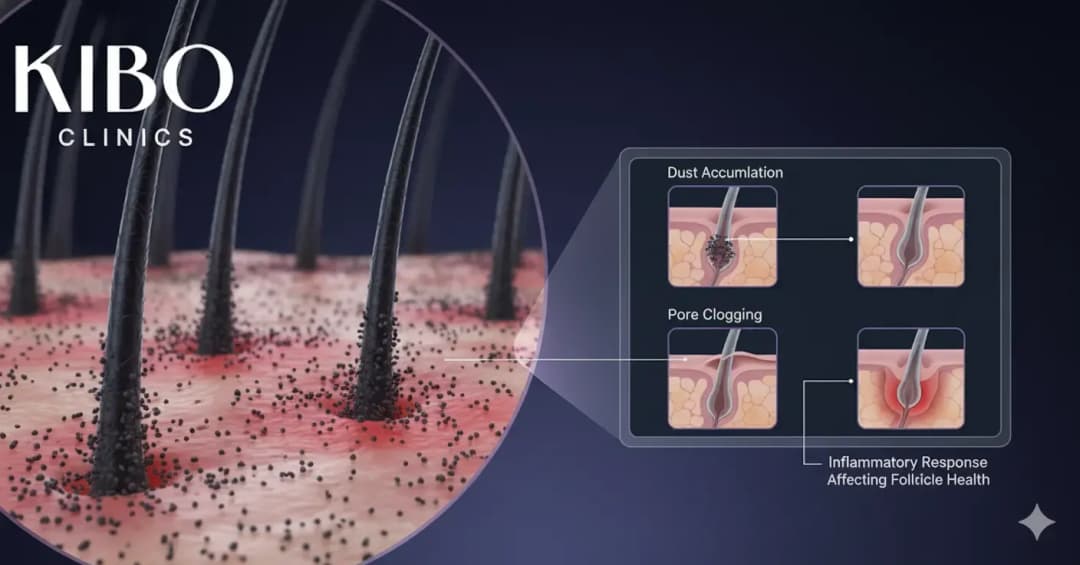
In Indian metro cities, air contains particulate matter (PM10 and PM2.5), vehicle emissions, construction dust, and industrial pollutants. These micro-particles are small enough to settle deep into scalp pores. The process usually follows this pattern:
Stage 1 — Surface accumulation: Particles settle on the scalp and mix with sweat and sebum. This creates a sticky layer that traps more dirt with each passing hour.
Stage 2 — Follicle blockage: Clogged pores disturb normal oil flow. When oil cannot exit properly, it irritates surrounding skin and encourages fungal overgrowth, producing the persistent dandruff and itching that does not respond to standard anti-dandruff shampoos.
Stage 3 — Chronic inflammation: Inflammation develops around the follicle. Chronic low-grade inflammation weakens the hair root and shortens the hair growth cycle — pushing follicles into the shedding phase earlier than their natural rhythm.
Stage 4 — Follicle-level oxidative stress: Micro-particles increase oxidative stress, generating unstable free radical molecules that damage cells, disrupt protein structure in hair shafts, and reduce nutrient delivery to follicles.
In people already prone to genetic hair loss, pollution acts as an accelerant that compresses the timeline of visible thinning. This is closely related to the broader pollution buildup and hair root weakening mechanism that affects urban residents across India.
Why Is This Problem Worse in Indian Cities?
Several factors combine to make Indian urban environments particularly high-risk for scalp buildup damage:
- High traffic density and constant construction activities increase airborne dust throughout the day
- Hot and humid weather causes more sweating, making dust particles stick to the scalp more readily
- Two-wheeler commutes directly expose the scalp and hair to road-level particulate matter for extended periods
- Hard water in many cities adds mineral buildup on top of pollution deposits, worsening scalp congestion
- Tight helmets worn over already-dusty scalps trap the buildup against follicle openings for the entire commute
Scalp Buildup Hair Loss — Stage by Stage
| Stage | What Is Happening | What You Notice | Action Required |
|---|---|---|---|
| Early — 1–4 weeks | Particles begin accumulating in pores; oil flow slightly disrupted | Scalp feels heavy or itchy by evening; mild dandruff | Increase wash frequency; add clarifying shampoo once weekly |
| Moderate — 1–3 months | Follicle openings clogged; fungal growth present; mild inflammation | Persistent dandruff, increased daily shedding, scalp redness | Medicated scalp care; antioxidant serums; reduce tight hairstyles |
| Advanced — 3–6 months | Chronic inflammation shortening hair growth cycles; oxidative follicle stress | Wider parting, visible frontal thinning, hair feeling flat and lifeless | Professional scalp assessment; clinical treatment evaluation |
| With genetic predisposition | Pollution accelerates existing androgenetic timeline; follicles miniaturise faster | Crown or temple thinning appearing earlier than expected genetically | Urgent assessment; medical treatment + pollution protection combined |
| Recovery (with corrective care) | Follicles unclogged; inflammation reduces; growth cycle resets | Reduced itching in 3–4 weeks; shedding stabilises in 6–8 weeks | Maintain consistent hygiene; monitor for 3–6 months |
How Does Dust-Related Scalp Damage Show in Men and Women?
In men, pollution-related irritation often worsens existing male pattern baldness. Faster thinning at the temples and crown can appear when inflammation is layered on top of existing DHT sensitivity — making what would have been slow genetic progression look sudden.
In women, diffuse hair thinning is more common. The parting may look wider, and hair may feel flat and lifeless due to buildup. Women with long hair may not notice scalp buildup immediately, but increased shedding during washing becomes a consistent complaint that eventually becomes undeniable.
Men may experience more visible flaking because of higher sebum production — the oil traps more particles per square centimeter than on lower-sebum scalps.
What Daily Habits Make It Better or Worse?
Habits that worsen the problem:
- Wearing no head cover during long two-wheeler commutes — direct particle contact for the entire journey
- Delaying hair wash for many days — allows accumulated dust and sebum to harden around follicle openings
- Using heavy styling products — traps more pollutants against the scalp surface
- Scratching the scalp aggressively — worsens inflammation and creates micro-wounds that increase infection risk
- Oiling daily without cleansing — oil attracts and traps more particles against an already-clogged scalp
Habits that help:
- Covering hair with a breathable scarf or clean helmet liner during commutes
- Washing the scalp based on sweat and exposure level rather than a fixed weekly schedule
- Using mild, pH-balanced shampoos that support the natural barrier without over-stripping
- Drying the scalp properly after washing — prevents fungal overgrowth in warm conditions
- Choosing low-tension hairstyles that do not additionally trap sweat and dust against the scalp
What Helps First — Practical Relief Steps
Start with improving scalp hygiene immediately. If you travel daily in polluted areas, washing 3 to 4 times a week may be necessary — not because washing is inherently good for hair, but because the particle accumulation rate in urban India exceeds what less frequent washing can clear.
Use a gentle clarifying shampoo once weekly to remove buildup that regular shampoo cannot break down. This is the single most impactful product change for urban commuters experiencing scalp heaviness and persistent itching.
Avoid very hot water — it increases dryness and strips the protective oil layer that provides some barrier against subsequent particle adhesion.
Consider antioxidant-rich scalp serums to reduce oxidative stress from daily pollutant exposure. These support follicle health at the cellular level rather than just cleaning the surface.
For understanding the full mechanism behind scalp buildup and hair fall, the same follicle-clogging principle applies whether the source is styling products or urban dust.
Within 3 to 4 weeks of consistent care, itching and excessive shedding often reduce. Visible regrowth takes longer because hair cycles need time to reset — typically 3 to 6 months.
When to See a Hair Specialist
Do not wait if you notice:
- Hair fall lasting more than three months despite good scalp care
- Visible thinning at crown or widening parting
- Persistent itching, redness, or painful scalp patches
- Sudden heavy shedding after a period of increased pollution exposure combined with illness or high stress
- Family history of baldness with thinning appearing earlier than expected
Early intervention prevents long-term follicle damage. Scalp inflammation that has been present for months requires more than hygiene changes to resolve — it needs clinical support to restore normal follicle function.
Common Myths About Dust and Scalp Health
Myth 1: Only dandruff causes scalp itching. Pollution-related inflammation can cause persistent itching even without classic dandruff, often presenting as a generalised sensitivity that comes back within days of washing.
Myth 2: Oiling daily protects from dust. Excess oil on a scalp already burdened with dust attracts and traps more particles. Light oiling before washing can help loosen dirt, but daily oiling without cleansing worsens follicle blockage.
Myth 3: Hair fall from dust is always temporary. Long-term inflammation from chronic dust exposure can accelerate genetic hair thinning permanently in susceptible individuals. The window for reversible intervention closes over time.
Myth 4: Covering your head fully prevents all damage. Protection significantly reduces particle contact, but it does not eliminate it. Proper post-commute cleansing is still necessary regardless of head cover used.
Why Kibo Clinics
Many patients choose Kibo Clinics for pollution-related scalp and hair issues because our approach addresses both current inflammation and long-term hair planning. We begin with comprehensive scalp assessment, hair and follicle analysis, and thorough lifestyle and environmental review — identifying whether the shedding is from correctable buildup inflammation or has already progressed to follicle miniaturisation requiring active medical management.
Our No Ghost Surgery pledge ensures the consulting surgeon personally performs your entire procedure, maintaining consistent quality throughout the session. We do not delegate critical steps to technicians.
The Kibo Hair Analysis (scalp and follicle assessment) is the first step in understanding your specific condition. We provide education, guidance, and support without guarantees, exaggerated claims, or miracle cure promises.
For patients with active thinning, supportive options like PRP therapy, IV hair boosters, or advanced transplant planning may be discussed when appropriate. We also provide structured 12-month monitoring to track scalp recovery, shedding patterns, and response to treatment.
Concerned about city pollution affecting your hair? Book a professional scalp analysis today.
Frequently Asked Questions
Q: Can pollution alone cause permanent hair loss? Pollution mainly causes inflammation and temporary shedding. However, in people with genetic hair loss, it can accelerate thinning into something that looks and behaves like permanent loss. Early scalp care reduces the risk of this progression. Professional evaluation identifies whether underlying genetic factors are also at play.
Q: How often should I wash my hair in polluted cities? Frequency depends on exposure and sweat levels. Many urban commuters benefit from washing 3 to 4 times weekly. Overwashing with harsh shampoos can dry the scalp. Use mild cleansers and adjust based on itching or buildup rather than following a fixed schedule.
Q: Does wearing a helmet increase scalp problems? Helmets can trap sweat and heat, which may increase fungal growth if hygiene is poor. Using a clean inner liner and drying the scalp after travel helps significantly. Helmets also protect from direct dust exposure — the net effect depends on how well the liner is maintained.
Q: Are anti-pollution shampoos effective? They help remove buildup but cannot block pollution completely. Consistency of cleansing matters more than brand claims. Look for gentle cleansing and antioxidant support rather than harsh detergents that strip the scalp barrier.
Q: Is hair oiling good in dusty environments? Light oiling before wash can help loosen and lift trapped particles during cleansing. Daily heavy oiling without cleansing worsens buildup by giving particles more surface to adhere to. Balance based on your cleansing frequency is important.
Q: Does pollution affect transplanted hair? Transplanted hair is exposed to the same pollution as natural hair. During early healing, protection and hygiene are especially important as new follicles are vulnerable to infection and inflammation. Long-term protective habits remain necessary.
Q: How long does it take to recover from pollution-related hair fall? Mild cases improve within 4 to 8 weeks with better scalp care. Visible regrowth takes 3 to 6 months because hair cycles are slow. Severe cases or those with underlying genetic sensitivity may require medical treatment for complete recovery.
Key Takeaways
- Does dust cause hair fall? Yes — by clogging follicle openings, triggering chronic inflammation, and generating oxidative stress that shortens the hair growth cycle
- Scalp buildup hair loss is not about visible flakes alone — it is the invisible follicle-level inflammation from accumulated PM2.5 and PM10 particles that does the real damage
- How to protect hair from dust — cover with a breathable scarf during commutes, wash 3 to 4 times weekly if travelling in high-pollution conditions, use a weekly clarifying shampoo, and avoid heavy oiling between washes
- Persistent dandruff that returns within days of washing is a strong signal that pollution buildup rather than simple dandruff fungus is the cause
- Urban two-wheeler commuters in India face the highest daily scalp dust exposure of any lifestyle category — standard once-weekly washing is insufficient for this level of particle accumulation
- Shedding persisting beyond 3 months despite improved hygiene needs professional assessment to rule out follicle miniaturisation or accelerated genetic thinning
Disclaimer
This content is for informational purposes only and does not substitute personalized medical advice. Pollution-related hair fall varies based on genetics, hormones, health conditions, and lifestyle. Treatment responses differ among individuals. Professional consultation is necessary for accurate diagnosis and appropriate management.
Hair Transplant
FUE Hair Transplant | Sapphire FUE Hair Transplant | Bio FUE Hair Transplant | Realtime FUE Hair Transplant | Direct Hair Transplant (DHT)
Hair Regrowth
PRP Therapy | GFC Therapy | IV Hair Boosters | Mesotherapy for Hair Regrowth | Microneedling for Hair Regrowth
Must Read
Hair Loss Types Symptoms Causes | Hair Breakage Causes Treatments | DHT Blockers Hair Loss Guide | Hair Transplant Good Or Bad | Understanding The Language Of Natural Hairline
Relevant Blogs
Hair Brushes Combs Scalp Stress | Hair Dryer Heat Follicle Safety | Straighteners and Curling Irons Hair Stress | Pollution Build Up Weakening Hair Roots | Scalp Oil Reducing Hair Friction