
What Really Happens During Each Stage of the Hair Growth Cycle
Published on Tue Jun 30 2026
Reviewed By:
Shritej Mali
Independent Research Reviewer
Reviewing peer-reviewed studies and medical literature for evidence-based accuracy.
Written By: Kibo Clinics Content Team
Sources Referenced: American Academy of Dermatology, International Society of Hair Restoration Surgery, NIH/NCBI Bookshelf StatPearls, peer-reviewed dermatology literature
Last Updated: June 29, 2026
Reading Time: 6 minutes
֎ Show Quick Answer AI Quick answer summary
- The four practical hair growth stages are anagen, catagen, telogen and exogen: growth, transition, rest and shedding.
- A shed hair does not automatically mean a damaged follicle: scalp follicles cycle independently, so normal daily shedding is expected.
- Telogen shedding is delayed: fever, illness, surgery, childbirth, rapid weight loss, stress or some medicines can lead to extra shedding weeks or months later.
- Pattern thinning is different from temporary shedding: a receding hairline, a wider part or finer hairs usually needs assessment rather than reassurance alone.
- The useful next step is diagnosis, not a quick product fix: identify the trigger, check the scalp and assess whether the change is shedding, breakage or progressive hair loss.
Not sure whether your hair fall is normal shedding or a change in density?
What Is the Hair Growth Cycle?
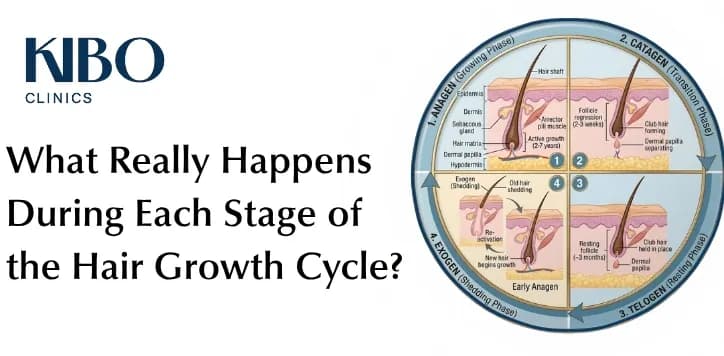
The hair growth cycle is the repeating process through which a follicle makes a hair shaft, slows down, rests, releases the old shaft and begins again. The strand above the scalp is not the whole story. The follicle below the skin is the living structure that determines whether a new hair is being produced, held in place or released.
Scalp follicles do not all follow the same timetable. While one follicle is actively growing a strand, another may be resting and another may be shedding. That staggered pattern protects visible density and explains why seeing some hair in the shower or on a brush is usually normal. The question is not whether any hair falls. It is whether the amount, pattern, duration or scalp symptoms have changed from your usual baseline.
Evidence basis: International Society of Hair Restoration Surgery, “Hair Loss and the Hair Growth Cycle”; Natarelli et al., International Journal of Molecular Sciences, 2023.
The Four Hair Growth Stages
| Stage | What Happens | Typical Scalp Timing |
|---|---|---|
| Anagen | The follicle actively produces and lengthens the hair shaft. | About 2 to 8 years |
| Catagen | Growth stops and the lower part of the follicle regresses. | About 2 to 4 weeks |
| Telogen | The follicle rests while the old club hair remains in place. | About 2 to 4 months |
| Exogen | The old strand is released as a new anagen shaft begins to emerge. | A shedding period within renewal |
Some clinical texts describe three main phases and include exogen within telogen. The four-stage model is clearer for patients because it separates the resting part of the cycle from the moment a hair actually sheds.
Anagen: The Active Growth Stage
Anagen is when cells at the base of the follicle form the hair fibre. It is the stage that builds length and much of your visible density. Scalp anagen can last for years, which is why scalp hair can grow long. Eyebrows stay shorter because their active-growth phase is much shorter.
Anagen length varies between people. Genetics, age and health all influence the cycle. In progressive pattern hair loss, repeated cycles can become shorter and the strands can become finer, shorter and less pigmented. That is different from a one-off wave of shedding.
Catagen: The Short Transition Stage
Catagen is the brief handover between growth and rest. Active hair-shaft production stops, the lower follicle regresses and the strand separates from the structures that supported it during anagen. It does not usually fall out at this point.
This stage matters because it explains why hair fall is often delayed. A strand can stop growing first, rest later and shed later still. Seeing it on your pillow today does not necessarily identify what changed today.
Telogen: The Resting Stage
In telogen, the follicle is resting. The old strand may remain anchored for months, even though it is no longer lengthening. Under normal conditions, only a minority of scalp follicles are in telogen at one time, so shedding stays spread out.
After a major physical or hormonal stressor, more follicles can shift into telogen together. NIH/NCBI StatPearls lists high fever, severe infection, surgery, postpartum change, restrictive dieting, low protein intake, iron deficiency, thyroid disease and some medicines among recognised triggers of telogen effluvium. The extra shedding often becomes noticeable about three months after the trigger, although the interval can range from one to six months. See stress-related telogen effluvium for the separate guide.
Exogen: The Shedding Stage
Exogen is the release of the old hair shaft. According to ISHRS, this typically happens after the next anagen cycle has started and a new shaft begins to emerge. That is why a hair released during washing or brushing does not automatically mean the follicle is permanently inactive.
A small pale club at the end of a shed strand is keratinised material, not the living follicle itself. Wash days can look more dramatic because loose hairs collect and come out together. For a focused look at timing, see hair shedding after one month.
What the Four Stages Do Not Explain on Their Own
The cycle explains ordinary renewal. It does not prove that every change in density is normal. The American Academy of Dermatology notes that shedding 50 to 100 hairs daily can be normal, but a receding hairline, a widening part, a bald patch or overall thinning points toward hair loss rather than routine shedding.
Pattern hair loss changes the follicle over repeated cycles. Men often notice recession or crown thinning, while women may notice a wider part or reduced ponytail volume. Read male pattern baldness explained and hair loss in women for the pattern-specific signs. Breakage can also make hair look less full even when the follicle is still cycling, which is covered in hair breakage causes and treatments.
Scalp symptoms matter too. Itching, pain, thick scale, redness, pustules or shiny bare areas are not explained by routine exogen. Relevant scalp conditions include seborrhoeic dermatitis and scalp flaking and scalp psoriasis versus dandruff.
When to Get an Individual Assessment
Arrange an assessment when shedding is suddenly heavy, continues for months, follows no clear trigger, or comes with visible thinning, a bald patch or scalp symptoms. A clinician considers the timeline, hair pattern, medical history, medicines, diet and scalp examination. When history suggests it, tests can help check for a disease, deficiency, hormonal issue or infection.
Useful background reading includes blood tests for hair fall, iron deficiency and hair thinning and vitamin D and hair follicles. For choosing the right professional, see dermatologist versus trichologist.
Heavy shedding, a widening part, or a bald patch deserves a proper scalp assessment.
Frequently Asked Questions
What are the four stages of the hair growth cycle?
They are anagen, catagen, telogen and exogen. In simple terms, they describe active growth, transition, rest and shedding. Some scientific descriptions group exogen with telogen, but separating it helps explain visible hair fall.
Which stage makes hair grow?
Anagen is the active growth stage. Cells in the lower follicle form the hair shaft during this phase. On the scalp, anagen usually lasts years, which allows hair to gain length before the follicle enters transition and rest.
Which hair-growth stage causes visible shedding?
Visible release occurs in exogen. However, a hair may have stopped actively growing earlier and rested in telogen before it shed. This is why the event linked with increased shedding may have happened weeks or months before you noticed the fall.
Is shedding hair with a white bulb normal?
Often, yes. The pale club at the end of a telogen strand is not the living follicle. A club hair can be released as the follicle begins a new cycle. A major change in the amount of shedding or in visible density still deserves assessment.
Why does hair shed after fever or stress?
A significant stressor can move an unusually large number of follicles into telogen. When those hairs return to anagen, the resting club hairs are pushed out, so the shedding is often delayed rather than immediate.
Does frequent washing cause hair loss?
Washing usually releases hairs that were already loose and ready to shed. It does not create a new hair-growth cycle. Hair breaking from harsh handling is different from a complete shed hair coming from the follicle.
When is hair fall no longer normal?
Seek assessment for sudden heavy shedding, ongoing shedding lasting months, a receding hairline, a widening part, a bald patch, thinning at the crown, or scalp pain, redness, itch and scale. These changes are not fully explained by normal cycling.
Can you restart the hair growth cycle overnight?
No. The cycle has biological timing. The useful approach is to identify the reason for the change, correct a proven trigger where possible and follow a diagnosis-based plan if progressive hair loss is present.
Want a doctor-led answer before trying more products?
Why Kibo Clinics
Kibo Clinics approaches hair fall by first separating normal shedding, breakage, scalp disease and progressive pattern loss. A consultation considers the pattern you are seeing, the timeline of change, your health history and the scalp itself. That keeps the discussion centred on the cause of your concern rather than on a generic product or procedure.
For a personal assessment, Kibo Clinics is located in Khar West, Mumbai. The doctor who conducts your consultation is the same doctor who handles your treatment through every stage.
Medical Disclaimer
This article is for educational purposes only. It does not replace diagnosis, a scalp examination, blood-test interpretation or a treatment plan from a qualified clinician. Hair shedding, breakage and progressive hair loss can look similar at first, but they do not always have the same cause or next step.
Sources referenced: International Society of Hair Restoration Surgery, “Hair Loss and the Hair Growth Cycle,” updated 2024; American Academy of Dermatology, “Do you have hair loss or hair shedding?” and “Hair loss: Diagnosis and treatment”; Hughes EC, Syed HA, Saleh D, “Telogen Effluvium,” StatPearls, updated 2024; Hoover E, Alhajj M, Flores JL, “Physiology, Hair,” StatPearls, updated 2025; Natarelli N et al., “Integrative and Mechanistic Approach to the Hair Growth Cycle and Hair Loss,” International Journal of Molecular Sciences, 2023.
For a personal assessment, consult a Board Certified Doctor at Kibo Clinics. The doctor you meet in your consultation is the same doctor who handles your treatment through every stage.
Talk to a Board Certified DoctorExplore Kibo Clinic Services
Surgical Hair Transplant: FUE Hair Transplant | Sapphire FUE Hair Transplant | Direct Hair Transplant | Bio FUE Hair Transplant | Real Time FUE Hair Transplant | Corrective Hair Transplant | Hairline Correction | Unshaven Hair Transplant | Body Hair Transplant
Non-Surgical Hair Treatments: PRP Therapy | GFC Therapy | Mesotherapy for Hair Regrowth | Microneedling for Hair Regrowth | Low-Level Laser Therapy | IV Hair Boosters | PDO Threads Hair Regrowth | Exosome Therapy
Explore More
Must Read: Hair Growth Cycle and Mechanical Shedding | Hair Loss Types, Symptoms and Causes | How Seasonal Weather Affects Hair Shedding | Hair Myths Busted | Why Scalp Hygiene Matters
Related Reads: Hair Density vs Strength | Hair Thickness and Stress Distribution | New Hair Growth and Styling Damage | Wet Hair Styling and Root Vulnerability | Frequent Washing and Hair Loss
People Also Read: Postpartum Hair Loss Recovery | PCOS Hair Thinning in Women | Menopause and Hair Density | Receding Hairline Causes | DHT Blockers for Hair Loss