
Minimalist Hair Care: Why Less Is the Best Hair Care Routine for Hair Fall
Published on Fri Apr 03 2026
Quick Summary
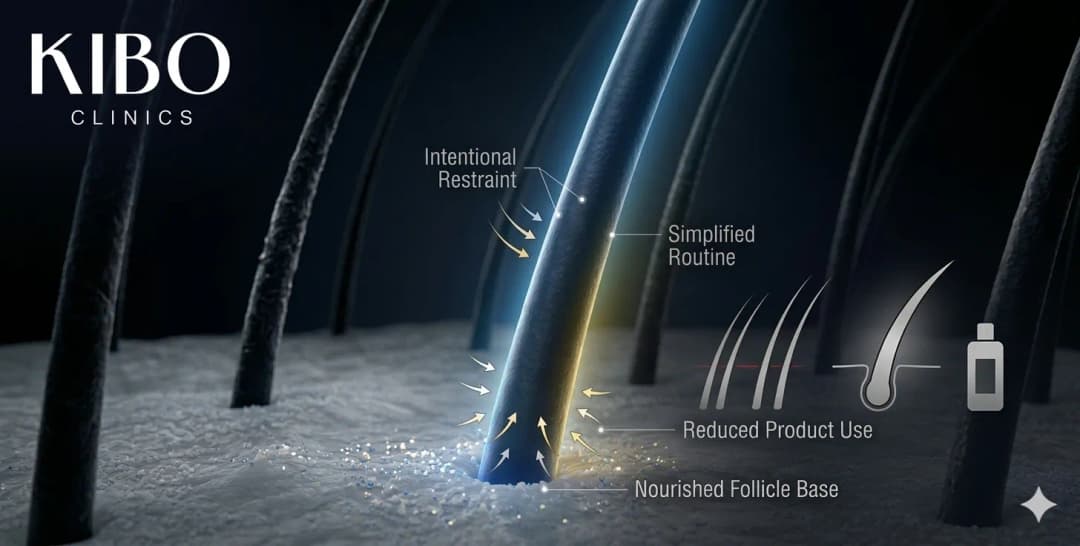
Minimalist hair care and the best hair care routine for hair fall share the same foundation fewer well-chosen products applied consistently, rather than many products applied experimentally. Most people experiencing product-overload hair loss are not suffering from follicle weakness.
They are suffering from a repeatedly disrupted scalp barrier that cannot stabilise because the treatment regimen itself is the source of inflammation. Over-washing strips protective sebum, layering active serums disrupts scalp pH, and changing shampoos every two weeks prevents the scalp from adapting to any single formulation. The result looks like hair fall but is actually a scalp barrier in permanent recovery mode and the fix is doing less, not more.
When Doing Too Much Started Making Hair Worse
Riya, 29, from Bengaluru, began noticing extra hair fall during the pandemic. She tried everything she saw online — onion juice, castor oil masks, rosemary serum, weekly exfoliation, protein packs, and two different anti-hair fall shampoos.
Within six months, her scalp became itchy and sensitive. Her hair felt dry at the ends but oily at the roots. Instead of improving, the shedding increased.
When she simplified her routine to a mild shampoo, limited oiling, reduced heat styling, and improved sleep, the irritation reduced within weeks. Hair fall slowed gradually over three months. Her case is common: follicles often respond better to consistency than overload.
What Is Minimalist Hair Care and Why Does It Work?
Minimalist hair care focuses on maintaining scalp health first. Healthy follicles grow from a balanced scalp environment — and that balance is disrupted far more easily by excess treatment than by too little.
Scalp barrier disruption — Excess products, harsh shampoos, and frequent chemical exposure strip natural oils. This triggers either dryness or compensatory excess oil production. Both conditions affect follicle stability in ways that mimic — and compound — actual hair loss conditions.
Follicle inflammation — Hair follicles need oxygen, blood flow, and a stable chemical environment. Inflammation from product buildup or ingredient irritation weakens the follicle anchor and can push healthy hair into the telogen phase prematurely. The hair growth cycle disruption that results looks identical to telogen effluvium from stress or nutritional deficiency.
Hormonal compounding — When the scalp is already inflamed from product overload, hormonal hair loss (like androgenetic alopecia) or stress-related shedding becomes visually amplified. The inflammation makes existing miniaturisation appear worse and makes stress shedding appear more severe.
Lifestyle and environment on top — Pollution, hard water, poor diet, and sleep deprivation already stress follicles. Adding multiple cosmetic treatments on top of this pushes the total burden above what the scalp can manage — and the visible result is increased hair fall that, confusingly, accelerates the more treatment is applied.
How Over-Treatment Damages the Scalp Barrier
- Frequent exfoliation causes micro-irritation that prevents the barrier from completing its repair cycle
- Using multiple active serums together disrupts scalp pH balance — different actives often work at incompatible pH ranges
- Daily heat styling increases dryness and breakage on a scalp barrier already compromised by product overload
- Changing shampoos every few weeks prevents the scalp from stabilising around any single formulation
The scalp barrier, once irritated, takes weeks to recover. During that window, shedding appears worse — which typically triggers more product experimentation, and the cycle continues.
Minimalist Hair Routine vs Product Overload — What Each Does
| Approach | Scalp Effect | Follicle Effect | Timeline to Change |
|---|---|---|---|
| Daily harsh shampoo | Strips protective sebum; triggers compensatory oil overproduction | Follicle environment destabilised; dryness or oil-clogged pores | Damage visible in 2–4 weeks; scalp adapts negatively |
| Mild shampoo 3–4 times weekly | Cleanses without stripping; allows sebum to function as designed | Stable environment for follicle cycling; reduced inflammation | Scalp comfort improvement in 2–3 weeks |
| Multiple active serums layered daily | pH disruption; incompatible actives competing or irritating simultaneously | Micro-inflammation around follicle openings; itching and sensitivity | Sensitivity builds over weeks; scalp never stabilises |
| One targeted serum based on assessed need | Single active at appropriate pH; scalp can respond without interference | Targeted benefit without competing inflammation | Results assessable after 12 weeks of consistent use |
| Heavy overnight oiling daily | Clogs follicle openings; attracts dust; worsens dandruff in prone scalps | Follicle occlusion; fungal growth acceleration in dandruff-prone scalps | Dandruff and itching worsen progressively |
| Light pre-wash oiling once weekly | Reduces protein loss during washing; smooths cuticle temporarily | Supports scalp barrier without clogging; suitable even for oily scalps | Texture improvement visible in 3–4 weeks |
How Can You Build a Minimalist Hair Routine?
The framework is three essentials, applied consistently for a minimum of 12 weeks before evaluating results:
Step 1 — One mild sulphate-balanced shampoo suited to your scalp type. Use it 3 to 4 times weekly. Do not switch shampoos for at least 3 months — the scalp needs time to stabilise around a formulation before any improvement becomes measurable.
Step 2 — Conditioner to mid-lengths and ends only. Never apply conditioner to the scalp — it adds unnecessary coating to an area that produces its own natural conditioning through sebum.
Step 3 — One targeted solution if assessed need exists. If dandruff is present, an antifungal shampoo. If follicle stimulation is needed, a single clinically-supported serum. Not both simultaneously. Not three different options to "try what works."
The scalp oil and friction management approach explains why pre-wash oiling once weekly is the appropriate supplementary step — delivering the evidence-supported benefit of oiling without the follicle-clogging risk of daily overnight application.
How Does Minimalist Hair Care Show in Men and Women?
In men, overuse of styling gels, wax, and daily harsh washing can worsen scalp dryness and make male pattern hair loss appear more aggressive. Men often ignore scalp irritation until itching or visible thinning occurs — by which point the product overload has been compounding the underlying condition for months.
In women, layering oils, masks, leave-in creams, and heat styling tools commonly leads to buildup and breakage. Women with long hair frequently mistake breakage from product overload for root-level hair fall — which leads to more treatment, more irritation, and a cycle that continues until the scalp is finally given a recovery period.
Hormonal conditions like PCOS in women or androgen sensitivity in men still require medical evaluation. Minimalist hair care supports scalp health but does not replace clinical treatment for genetic or hormonal hair loss.
What Daily Habits Make It Better or Worse?
Habits that worsen follicle health:
- Over-washing — strips protective oils and prevents the scalp from maintaining its natural moisture balance
- Sleeping with wet hair — increases fungal risk on a scalp that may already be compromised from product buildup
- Switching products frequently — confuses the scalp's adaptation process and prevents any baseline from establishing
- Scratching the scalp aggressively — worsens inflammation at follicle openings on a scalp already sensitised from product overload
Habits that support minimalist hair health:
- Regular gentle washing on a consistent schedule — cleanliness without stripping
- Wide-tooth comb on damp conditioned hair — reduces mechanical breakage from detangling
- Managing stress through sleep and exercise — stabilises the hormonal cycle that product overload has been compounding
- Protein-rich diet — supports follicle strength from within, addressing one input that no external product can substitute
What Helps First — Practical Relief Steps
Reduce to three essentials immediately. Mild shampoo, conditioner for lengths, and one targeted product only. Remove everything else — the scalp barrier cannot heal while it is continuously being challenged by new formulations.
Stop chemical treatments for at least 8 to 12 weeks. This is the minimum barrier recovery window. Adding colour, bleach, or smoothing treatments during this period prevents the scalp from achieving the stability that will make any subsequent evaluation meaningful.
Limit heat tools to once a week or less. Heat removes moisture from strands that are already struggling with the dryness side effect of scalp barrier disruption.
For understanding what constitutes genuine hair fall versus breakage from product overload, hair breakage causes and treatments provides the diagnostic framework — distinguishing shaft damage from root-level shedding determines whether minimalism alone is sufficient or clinical assessment is also needed.
Within 2 to 4 weeks, scalp irritation typically reduces. Within 8 to 12 weeks, shedding may stabilise if product overload was the primary cause. Hair regrowth, if possible, takes 3 to 6 months depending on follicle health.
When to See a Hair Specialist
Do not wait if you notice:
- Hair fall lasting more than 3 months despite routine simplification
- Visible thinning at the crown or temples — may indicate pattern hair loss that minimalism cannot address
- Sudden heavy shedding after illness, surgery, or stress — may be telogen effluvium requiring separate management
- Persistent itching, redness, scaling, or pain — needs scalp examination to rule out infection or inflammatory conditions
- Family history of baldness with progressive thinning beginning before 35
Minimalism helps maintain follicles and remove avoidable stressors — but it cannot reverse advanced genetic loss. Early clinical evaluation determines whether habit correction is sufficient or medical treatment is needed alongside.
Common Myths About Minimalist Hair Care
Myth 1: More products mean faster results. Using too many actives simultaneously can irritate the scalp and slow improvement by preventing the barrier from stabilising. Consistency with one well-chosen product outperforms constant experimentation with many.
Myth 2: Natural remedies are always safe. Even natural oils or herbs can cause allergic reactions or clog follicle openings if overused or applied to incompatible scalp types. "Natural" is not a proxy for scalp-safe.
Myth 3: Oiling daily prevents hair fall. Daily oiling without adequate cleansing clogs follicle openings and worsens dandruff-prone scalp conditions. Pre-wash oiling once weekly is the evidence-supported approach.
Myth 4: If shedding reduces in one week, the routine is working. Hair cycles take months to stabilise. A week of reduced shedding may simply reflect fewer telogen hairs ready to shed at that moment rather than any genuine improvement in the growth cycle.
Why Kibo Clinics
Many patients choose Kibo Clinics for hair thinning and scalp concerns because our approach addresses both current hair health and long-term planning. We begin with comprehensive scalp assessment, hair and follicle analysis, and thorough lifestyle and environmental review — specifically identifying whether product overload is the primary driver or whether underlying genetic or hormonal causes require concurrent clinical management.
Our No Ghost Surgery pledge ensures the consulting surgeon personally performs your entire procedure, maintaining consistent quality throughout the session. We do not delegate critical steps to technicians.
The Kibo Hair Analysis (scalp and follicle assessment) is the first step in understanding your specific condition. We provide education, guidance, and support without guarantees, exaggerated claims, or miracle cure promises.
We also monitor progress for up to 12 months with PRP therapy, GFC therapy, or structured scalp care guidance adjusting based on scalp response, shedding pattern, and treatment tolerance over time.
If you feel overwhelmed by too many products and still see hair fall, it may be time to simplify your approach with expert guidance from Kibo Clinics.
Frequently Asked Questions
Q: What is minimalist hair care? Minimalist hair care means using fewer, well-chosen products applied consistently — a mild shampoo suited to your scalp type, conditioner on lengths only, and one targeted active if a specific assessed need exists. The goal is maintaining the scalp barrier rather than repeatedly disrupting it with experimental product combinations.
Q: Does washing hair less reduce hair fall? Washing less can help if over-washing is causing dryness or irritation. However, not washing enough leads to buildup and dandruff that independently worsens follicle health. The goal is the right frequency for your scalp type — most people do well with 3 to 4 washes per week.
Q: Can minimalist hair care regrow lost hair? Minimalism improves scalp health and may reduce stress-related or product overload-driven shedding. It cannot regrow hair lost due to advanced genetic baldness. Where genetic loss is present, medical or surgical options may be needed alongside the simplified routine.
Q: Is oiling necessary in a minimalist hair routine? Oiling is optional. Light pre-wash oiling once weekly has evidence behind it for reducing protein loss during washing. Heavy daily overnight oiling without cleansing clogs follicle openings and worsens dandruff-prone scalps. If your scalp is oily or dandruff-prone, skip oiling and focus on cleansing frequency.
Q: How long should I follow a minimalist routine before judging results? Evaluate results after at least 12 weeks. Minor improvements in scalp comfort may appear in 2 to 4 weeks. Visible density changes take several months because hair growth cycles are slow — a 12-week baseline is the minimum period that produces meaningful information.
Q: Can minimalist care help with dandruff and hair fall together? Reducing product buildup may improve mild dandruff by allowing the scalp barrier to recover. Fungal dandruff typically needs an antifungal shampoo as the one targeted product in the minimalist routine — not in addition to multiple other products. If flakes persist beyond 4 to 6 weeks of single-product medicated care, seek professional evaluation.
Key Takeaways
- Minimalist hair care works because follicles stabilise better with a consistent simple routine than with constant experimental product changes that keep the scalp barrier in perpetual recovery
- Hair care routine for hair fall and dandruff — reduce to mild shampoo, lengths-only conditioner, and one antifungal shampoo for dandruff; eliminate everything else for at least 12 weeks before evaluating results
- Product overload hair fall looks identical to genuine hair loss — the key signal is scalp itching, sensitivity, and a history of frequent product switching; removing the trigger produces visible improvement within 8 to 12 weeks
- Best hair care routine for hair fall and growth — 3 to 4 times weekly mild wash, weekly pre-wash oiling, one targeted serum if clinically indicated, no heat or chemical treatments for 8 to 12 weeks minimum
- Consistency with one product for 12 weeks produces better diagnostic information and better results than trying multiple products simultaneously for 2 weeks each
- Minimalist hair care addresses the correctable — scalp barrier restoration, product overload inflammation, and mechanical stress reduction; it does not replace clinical assessment for genetic or hormonal hair loss
Disclaimer
This content is for informational purposes only and does not substitute personalized medical advice. Hair fall causes vary between individuals. Treatment response depends on genetics, hormones, scalp condition, and overall health. No routine guarantees regrowth. Consult a qualified professional for proper diagnosis and tailored management.
Hair Transplant
FUE Hair Transplant | Sapphire FUE Hair Transplant | Bio FUE Hair Transplant | Realtime FUE Hair Transplant | Direct Hair Transplant (DHT)
Hair Regrowth
PRP Therapy | GFC Therapy | IV Hair Boosters | Mesotherapy for Hair Regrowth | Microneedling for Hair Regrowth
Must Read
Hair Loss Types Symptoms Causes | Hair Breakage Causes Treatments | DHT Blockers Hair Loss Guide | Hair Transplant Good Or Bad | Understanding The Language Of Natural Hairline
Relevant Blogs
Hair Brushes Combs Scalp Stress | Hair Dryer Heat Follicle Safety | Straighteners and Curling Irons Hair Stress | Pollution Build Up Weakening Hair Roots | Scalp Oil Reducing Hair Friction